Observing Nature: The Guide
Guide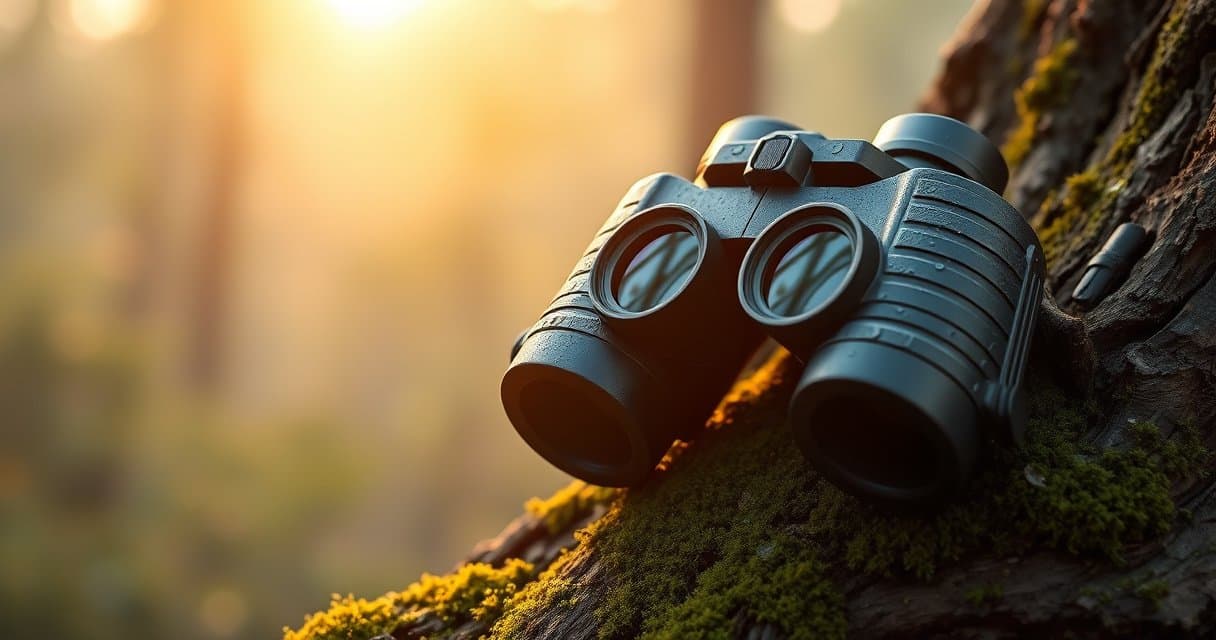
It is often at the most magical moment that everything goes wrong: a tawny raptor lands at the top of a tree, but your binoculars fail to capture the details of its plumage. Observing nature is an art, and the right equipment is not a luxury; it is your passport to enter a world invisible to the naked eye. Let me guide you to make the right choices, without breaking the bank or burdening yourself.
Key Points to Remember
- Choose your gear based on your primary use to find the best compromise between power, weight, and versatility.
- Prioritize an exit pupil of at least 4mm and "fully multi-coated" optical treatments for a bright and sharp image.
- Your clothing should be silent and in neutral colors to avoid frightening wildlife and maximize your observations.
- Gentle maintenance and proper storage are essential to preserve the quality and lifespan of your optical equipment.
- Personal comfort (adjusting the interpupillary distance, eyecups) is a crucial detail for turning observation into lasting pleasure.
Getting Started: Choosing Your Equipment Based on Your Activity
We all make the same mistake at the beginning: we start with the gear. "I need binoculars!" But the only real question to ask is much simpler: where and what will you be observing most often? The answer will dictate everything, from weight to power, and will keep you from buying a Ferrari for city cycling.
For the mobile birder: lightness above all
Do you hike forest trails or wetlands for hours? Then every gram counts. Forget bulky models with excessive zoom. Prioritize compact binoculars, around 8x32 or 10x42. The 8x offers a wider field of view, which is precious for locating a bird in foliage. The 10x provides a bit more detail, but at the cost of slightly reduced stability – it's up to you to see what suits you. The goal is to not feel them in your backpack. Honestly, at less than 600g, you'll never leave them behind.
For the best nature observation spotting scope: stability and detail
Here, we shift gears. The spotting scope is your fixed observation post. Imagine yourself stalking a roe deer or scrutinizing a seabird colony from a cliff. For this, the winning trio is: a sturdy tripod, a magnification between 20x and 60x (via a zoom), and a large aperture (65mm to 85mm objective lens) to capture light. The trap? Believing you'll use 60x all the time. Often it's the opposite: atmospheric turbulence and vibrations make the image blurry. A good 30-40x is often much more useful and brighter. Aim for models with ED (Extra-low Dispersion) glass; they eliminate those unpleasant purple fringes on contrasts, and the difference in sharpness is striking.
For the generalist hiker: versatility
Do you want a pair of binoculars for the mountains, a bit of birding, admiring a landscape, or a distant chamois? Don't over-specialize. An all-terrain model like a 10x50 is an excellent compromise. The 50mm diameter captures a lot of light for observations at dawn and dusk, and the 10x magnification is sufficient for most cases. Just make sure they are waterproof (nitrogen purged) and have an anti-reflective coating. It's the Swiss army knife of observation.
For safari or marine observation: light-gathering power
Here, conditions are often harsh (salt, dust, heat) and animals are sometimes far away. The absolute priority is brightness. You need binoculars with large front lenses: a 10x56 or even a 12x50. They will be a bit heavier, but the image will remain clear and contrasted at dawn or dusk, key moments for animal activity. For observing from a boat, a model with image stabilization is a serious investment, but it literally changes your life by neutralizing the roll.
The final tip? Consider your own comfort. Interpupillary distance is crucial: adjust the width of the binoculars well so you see only one perfect circle. And if you wear glasses, check that the eyecups fold down enough to allow your eye to be close enough to the eyepiece. It's a detail, but it's what makes the difference between tiring observation and hours of pleasure.
The Language of Optics: Deciphering Technical Specifications
Checking out without understanding these concepts is a bit like playing the lottery. Specification sheets are full of intimidating numbers and acronyms. Let's take them one by one, and you'll see it's mostly common sense.
Magnification & Diameter: The Two Key Numbers
You always see this notation: 8x42, 10x50, 20-60x80. The first number is the magnification. The second, the diameter of the front lenses in millimeters.
- Magnification (8x, 10x...) : A 10x brings the image 10 times closer. Simple. But beware, the more powerful it is, the more the image shakes with the slightest hand movement. Beyond 10x for binoculars, a tripod becomes almost essential. For a better nature observation spotting scope, a 20-60x zoom is typical, but as I said, the 60x is often unusable without perfect conditions.
- Diameter (42mm, 50mm...) : This is the light collector. The larger it is, the brighter the image, especially in low light. But it adds weight and bulk. An 8x42 is an excellent all-round balance for daytime. For dusk, you go up to 8x56 or 10x56.
Exit Pupil: Your Brightness Gauge
This is the most useful concept for judging performance in low light. To calculate it, divide the diameter by the magnification. An 8x42 gives an exit pupil of 5.25 mm (42/8). Why is it important? Your eye's pupil dilates to about 7mm in the dark. If the exit pupil of your binoculars is smaller (e.g., 3mm on a 10x30), you "lose" light. For observation at dawn or dusk, aim for an exit pupil of at least 4mm, ideally 5mm or more. This is a much more telling piece of data than vague marketing promises.
Optical Coatings: The Key to Clarity
Always look at the lenses. If they have violet, green, or magenta reflections, that's a good sign. It indicates a multi-layer coating that reduces stray reflections and increases light transmission. "Fully multi-coated" is what you need: all lens surfaces are coated. Avoid overly simple mentions like "coated" or "multi-coated," as these are often the bare minimum. The difference is noticeable under a cloudy sky or in dense forest: images retain contrast and natural colors.
Prisms & Glass: The Inner Battle
- Prisms (Porro vs Roof) : Porro prisms (Z-shaped) traditionally offer better depth perception and are often cheaper for equal performance, but they are bulkier. Roof prisms (straight lines) are more compact and modern. For a Roof prism to offer an image as good, it requires complex phase correction ("phase correction"). Without it, the image can be slightly less sharp.
- Glass (BK-7 vs BaK-4) : BaK-4 prisms are made of higher quality glass. When looking through the eyepieces, the field of view circle should be perfectly sharp, without grayish or clipped edges. That's the signature of BaK-4.
- ED/HD Glass : These low-dispersion glass elements are a real game-changer, especially at high magnifications or for dark objects against a bright sky. They radically reduce chromatic aberration (those unsightly colored fringes on edges). For a spotting scope, it's a non-negotiable criterion for me if your budget allows. The image is simply sharper and truer.
Don't forget the field of view, often noted in meters at 1000m (e.g., 120m/1000m). A wide field (above 130m) is great for following a bird in flight or scanning a landscape. A narrower field is often the price to pay for high magnification. It's a constant trade-off, and now, you have the keys to make an informed choice.
Our Selection
For this selection, we are looking at three optical observation instruments, but they meet very different needs. On one hand, two spotting scopes for nature and shooting, and on the other, an original accessory for everyday viewing comfort. We have analyzed their technical specifications and community feedback to help you see more clearly.
| Product | Magnification | Objective Diameter | Waterproofing | Key Strengths |
|---|---|---|---|---|
| SVBONY SV28 | 25x - 75x | 70 mm | IP65 | Versatility (complete kit), smartphone adapter included, tripod provided. |
| Bushnell Trophy Xtreme | 20x - 60x | 65 mm | Waterproof (O-ring seals) | Legendary ruggedness, 20-year warranty, fully multi-coated optics. |
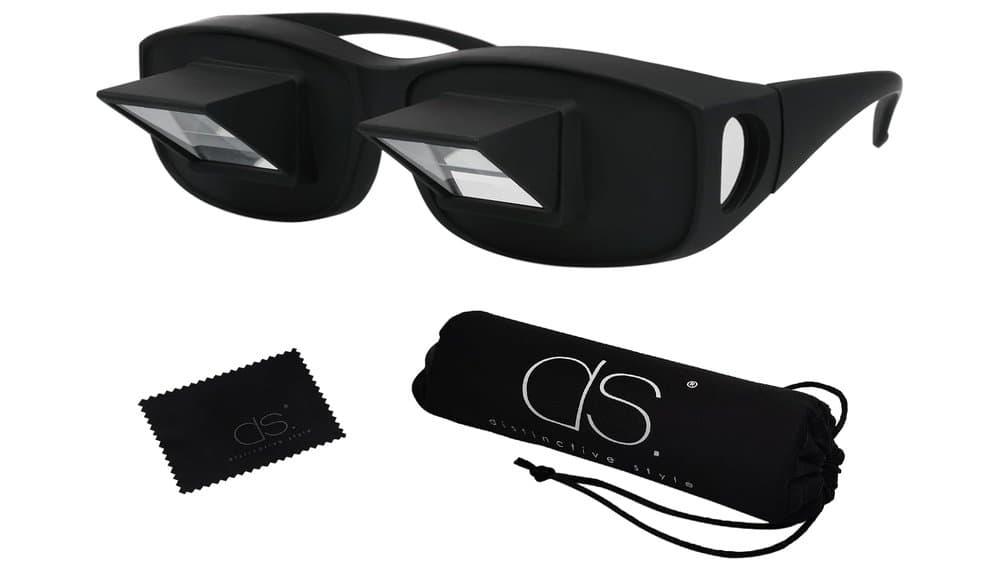
| DSstyles Periscope Prism | 1x (erect vision) | N/A (glasses) | No | Comfort for watching TV lying down, lightweight, horizontal design. |
SVBONY SV28
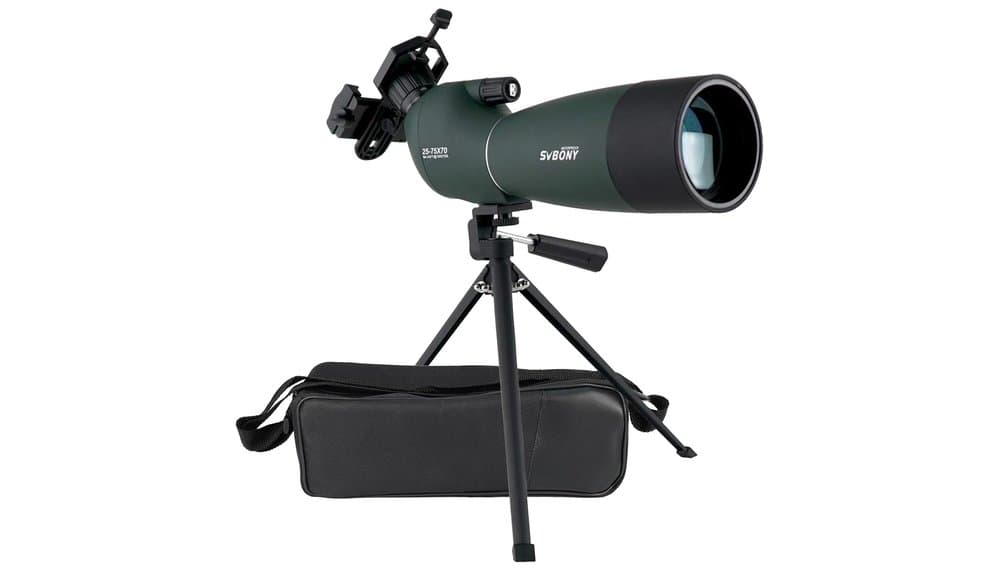
The SVBONY SV28 presents itself as a versatile spotting scope and a complete starter kit. On paper, its specifications are ambitious: a 25x to 75x magnification coupled with a 70 mm objective lens for good light gathering, all in an IP65 waterproof housing. The kit includes a tabletop tripod, a universal smartphone adapter, and a rubberized coating.
According to user feedback, it is precisely this versatility that is appealing. Beginners in birdwatching or occasional shooters appreciate having everything needed to get started. The ability to take photos with your phone is a major selling point, allowing for easy sharing of observations. The community also notes that the optical quality is decent for its segment, with a relatively clear and contrasted image thanks to the BAK-4 prism and lens coatings.
However, reviews highlight some concrete limitations. The provided tripod is considered too light for outdoor use whenever there is a bit of wind, especially at maximum zoom. At high magnification (beyond 60x), several users report a significant loss of sharpness and brightness, making the image difficult to stabilize and use. Finally, the zoom and focus mechanisms can feel less precise and less smooth than on higher-end models. It is therefore a product that excels in its role as a complete "starter kit," but whose optical and mechanical limits must be acknowledged.
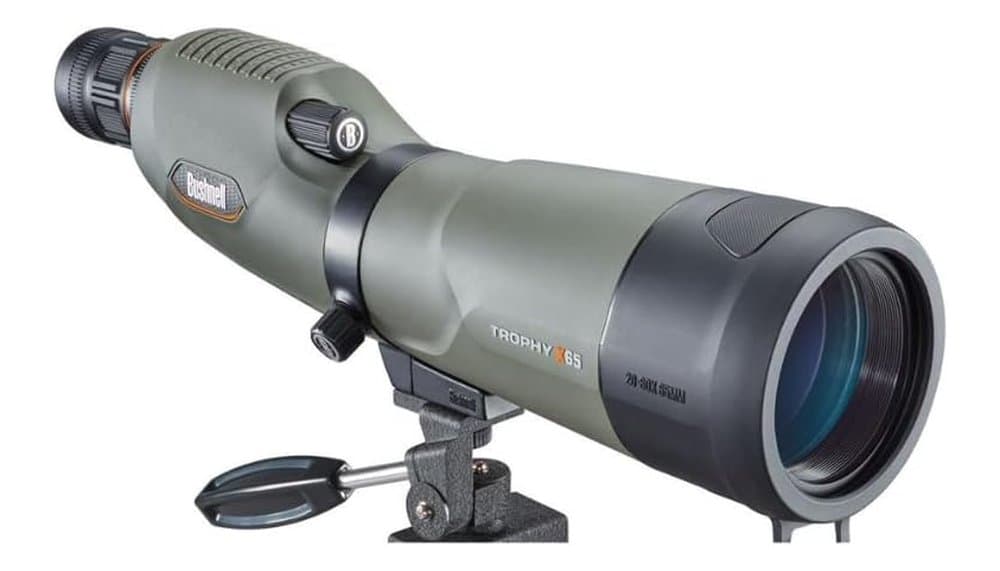
Bushnell Trophy Xtreme
The Bushnell Trophy Xtreme embodies a different philosophy: reliability and durability above all. With a 20-year warranty and a reputation for robust construction, it clearly targets demanding users and harsh conditions, like hunting or long outdoor sessions. Its specs advertise fully multi-coated optics for optimal light transmission and waterproofing ensured by O-ring seals.
The community of experienced users praises several points. Its ruggedness is no empty claim: the rubberized housing resists shocks well and offers a good grip, even with gloves on. The image is considered bright and contrasted, particularly in the low to medium magnification ranges (20x-40x), which is crucial for spotting details in the dim light of dawn or dusk. The longevity of the device is also a strong argument put forward.
Feedback, however, points out a few less positive aspects. Some find the weight (around 1 kg) and bulk significant for truly mobile use without a tripod. As with many extended-zoom spotting scopes, the image quality noticeably declines at maximum magnification (60x), becoming softer and less bright. Finally, the entry price is higher than that of a beginner's kit, which is justified by the brand and warranty, but positions this model in a more demanding niche. It is the tool for the regular observer who prioritizes long-term reliability.
DSstyles Periscope Prism
The DSstyles Periscope Prism is a unique product in this selection. It is not a long-range observation instrument, but a visual comfort accessory using a prism to erect the image. Its goal is to allow watching television or reading while lying on your back, without having to lift your head, by projecting the image horizontally.
Reviews from users who have adopted this product are very clear about its targeted utility. For people with reduced mobility, convalescing, or simply for those who like watching a screen on the ceiling, this accessory works as advertised. It provides undeniable comfort by avoiding neck strain. Its lightweight design makes it easy to wear for long periods.
Nevertheless, it is crucial to understand its intrinsic limitations. The optical quality is not comparable to that of standard glasses or a screen viewed directly. According to feedback, the image can appear shrunken, slightly distorted at the edges, and colors may be altered. It also requires an adaptation period for the brain, as lateral vision can be disorienting at first. This is absolutely not a product to replace a spotting scope or binoculars, but a very specific solution to a particular comfort problem.
Optimize Your Field Attire for Successful Observation
The best optical equipment in the world is useless if you are spotted from 200 meters away or if your hands are shaking from the cold after 15 minutes. Stalking is a discipline. And your attire is its first step, too often overlooked.
The Law of Camouflage: Blend In, Don't Dress Up
No need to go out in full military sniper gear. The goal is to break up your silhouette and avoid bright colors that signal danger in nature.
- Colors: Prioritize neutral, matte shades: khaki, brown, slate gray, dark green. Avoid at all costs pure white (very visible) and royal blue (rare in nature, perceived well by many birds). In winter, gray-beige tones are more discreet on a snowy landscape than bright white.
- Materials: Forget jackets that rustle loudly (like nylon windbreakers). The "swishing" noise alerts all game in the vicinity. Opt for soft fabrics like wool, matte polyester, or cotton. Corduroy is a classic among naturalists for a reason: it's silent and warm.
- Flashy Accessories: Put away the bright red backpack. Hide the metal watch strap that can catch a ray of sunlight. A scarf or hat in a neutral color can mask the paleness of your face.
Immobile Comfort: Your Ally for Long Waits
You may spend long minutes in the same position. You must anticipate.
- The Technical Layer: Adopt the three-layer system. A first breathable base layer (merino wool), a warm intermediate layer (thin, silent fleece), and an outer layer that is windproof and waterproof. This way you can adapt to the rising sun or a sudden downpour.
- Extremities: Gloves are a headache. Fingers must be free to manipulate focus wheels. The solution? Fingerless gloves coupled with mitten-style finger covers that you can flip back in seconds. For feet, warm socks and waterproof shoes with good ankle support are essential, even for a simple watch.
The Logistics of Silence and Speed
It's the small details that make the difference between a stealthy observation and a general flight.
- Your Equipment Within Reach: Have you ever tried to noisily open a backpack to take out your best close-range nature observation spotting scope while a deer is within range? You've missed it. Use a binocular harness or a side pouch that opens quickly, where everything is accessible without sudden movement. The tripod must unfold and lock silently – test it at home before you leave.
- The Mental Checklist: Before you settle in, take stock: phone on silent mode (not vibrate, the buzzing on a stump travels), water bottle accessible without rummaging, snack in a pocket without crinkly plastic wrapper. A whistle in your pocket can be useful in case of trouble, but it's the only noise allowed!
Frankly, we spend months choosing a pair of binoculars, but then go out in blue jeans and a red puffer jacket. That's a guarantee of seeing less. Your attire is your first observation tool. It makes you invisible, comfortable, and patient. And it's often patience that rewards.
Making Your Gear Last: Maintenance, Storage, and Best Practices
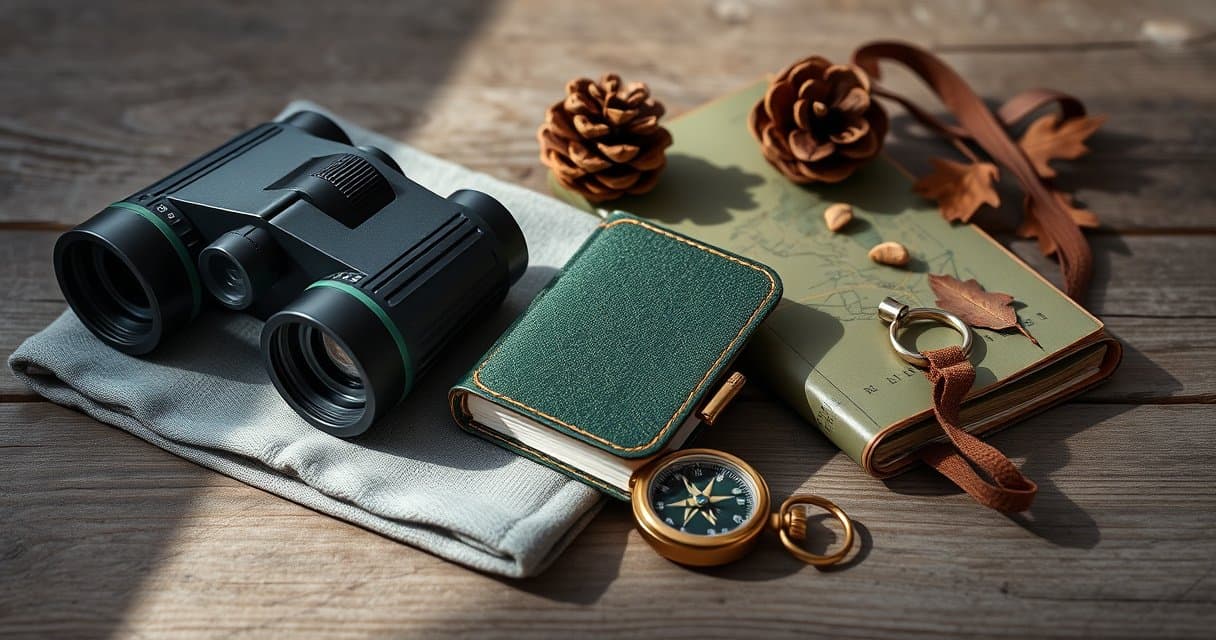
You have invested in good gear. It's a field partner, not a gadget. Treating it as such ensures it will accompany you for decades, not just a few seasons. The number one enemy? Haste and bad habits, far more than intensive use.
Cleaning: A Surgical Operation, Not a Quick Wipe
The front lens of your scope is its heart. Scratch it with the corner of your t-shirt and you will introduce microscopic scratches that will forever degrade contrast and sharpness. The golden rule: only clean when absolutely necessary. Dry dust is removed with a blast from a blower blower or a very soft brush reserved for this purpose. For fingerprints or sea spray, use a perfectly clean microfiber cloth, slightly dampened with a specific lens cleaning fluid. Always from the center outward, without pressure. A piece of advice worth its weight in gold: attach a sunshade and keep the lens caps on when you are not observing. It is the best protection there is.
Storage: Creating a Sanctuary Against Aggression
Your garage or your car trunk in the middle of summer are hostile environments. Extreme heat can damage internal glues and seals, while sudden temperature changes cause condensation inside the tube, even on a waterproof model.
- At home: Always store your gear in its original case, protected from dust, in a temperate and dry place. Avoid damp cabinets or cupboards near a radiator.
- In the field: Never leave a pair of binoculars or a spotting scope in full sun on a picnic table. The heat accumulated inside the tube creates air turbulence that blurs the image. Place them in the shade, or better yet, keep them in hand.
Actions That Preserve Waterproofing
Your gear is "waterproof"? That's a guarantee, not an invitation to neglect it. Waterproofing is ensured by O-ring rubber seals. Over time, they dry out. After an outing in the rain or by the sea, wipe the body with a soft, damp cloth (with fresh water) to remove salt and deposits. Dry it thoroughly before storing. Above all, avoid unscrewing the diopter or focus adjustments excessively and roughly; it is often at these points that dust and moisture try to infiltrate. A best spotting scope for nature deserves this little five-minute care after each outing.
Transport: The Riskiest Moment
The shock that damages prisms rarely happens during observation. It occurs when equipment falls from the car seat or when a bag is poorly placed. Always use a padded case. In the car, secure the bag with a seatbelt or place it on the floor behind the passenger seat. Does it seem excessive? Wait until you see the price of a repair for optical misalignment... Frankly, it is the simplest and most effective precaution.
Conclusion
Taking the time to observe nature is much more than just looking. It's learning to see. And with the right equipment, this connection becomes deep, sharp, and luminous.
Don't let yourself be overwhelmed by specifications. Start simply. Go into the field. Your eye and your curiosity are the most important instruments. The rest is there to serve them.
So, choose, adjust, and set off. An adventure awaits, at the end of your binoculars.
Frequently Asked Questions
Which binoculars should I choose for birdwatching while hiking?
For birdwatching while hiking, prioritize compact and lightweight binoculars (less than 600g) like an 8x32 or 10x42 model, which offer a good balance between magnification, field of view, and portability.
What is the best spotting scope for observing animals?
A good spotting scope requires a sturdy tripod, a 20-60x zoom, and a large aperture (65mm to 85mm), with ED (Extra-low Dispersion) glass for a sharp, color-fringe-free image.
How do I properly clean binocular lenses?
Clean lenses only when necessary, first removing dust with a blower, then using a clean microfiber cloth and a specific lens-cleaning solution, always wiping from the center outwards without applying pressure.
What is the exit pupil on binoculars?
The exit pupil, calculated by dividing the objective lens diameter by the magnification (e.g., 42/8 = 5.25mm), is a key indicator of brightness; aim for at least 4mm for observation in low light.
Do I need different binoculars for a safari?
For a safari or marine observation, prioritize brightness with models like 10x56 or 12x50, and consider image stabilization from a boat to compensate for movement.
How can I be discreet when observing animals?
Wear clothing in neutral, matte colors (khaki, brown) made from quiet fabrics, avoid shiny accessories, and keep your equipment in an accessible harness or pouch to avoid noisy movements.
100% free and independent — All our articles are written independently, without any sponsorship. We may earn a commission on purchases made through our links, at no extra cost to you.
Guides you might like
Astrophotography Telescope Buying Guide
Choose the right telescope for astrophotography to avoid frustration. Key factors depend on your target nebula or object.
Best Binoculars Value Guide
Find value binoculars that match your real needs. Understand specs like 8x42 and key features for the best observation without overspending.
Best Nature Binoculars Kids
Discover how to choose the perfect first binoculars for a child, focusing on lightweight design, ergonomics, and sparking a love for nature observation.
Articles you might like
Vanguard Endeavor HD65A Spotting Scope Review
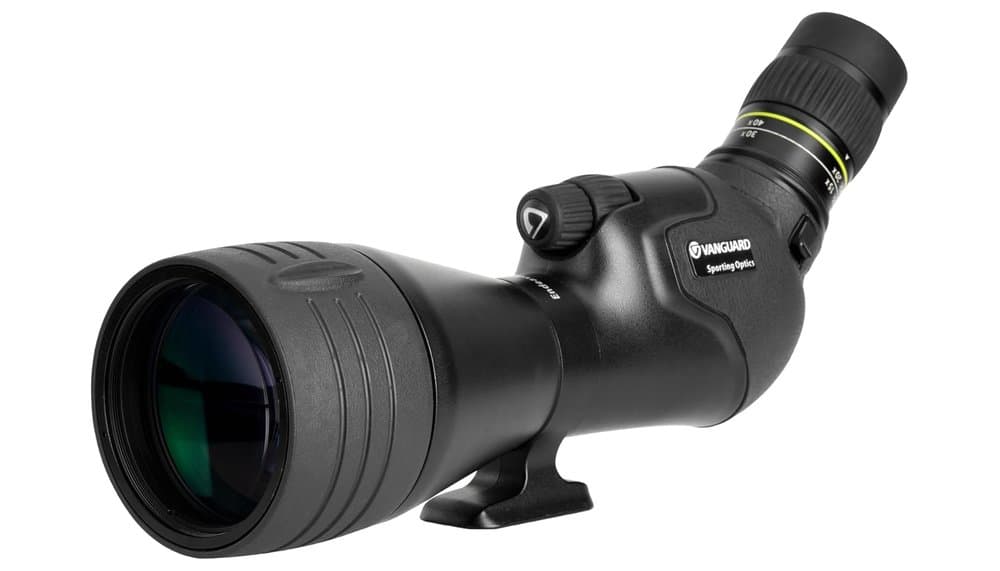
Spotting scope with 65mm ED glass & 15-45x zoom for birding & hiking. Balanced performance & portability for serious nature observers.
Carson AdventurePak Kids' Exploration Tool Kit Review
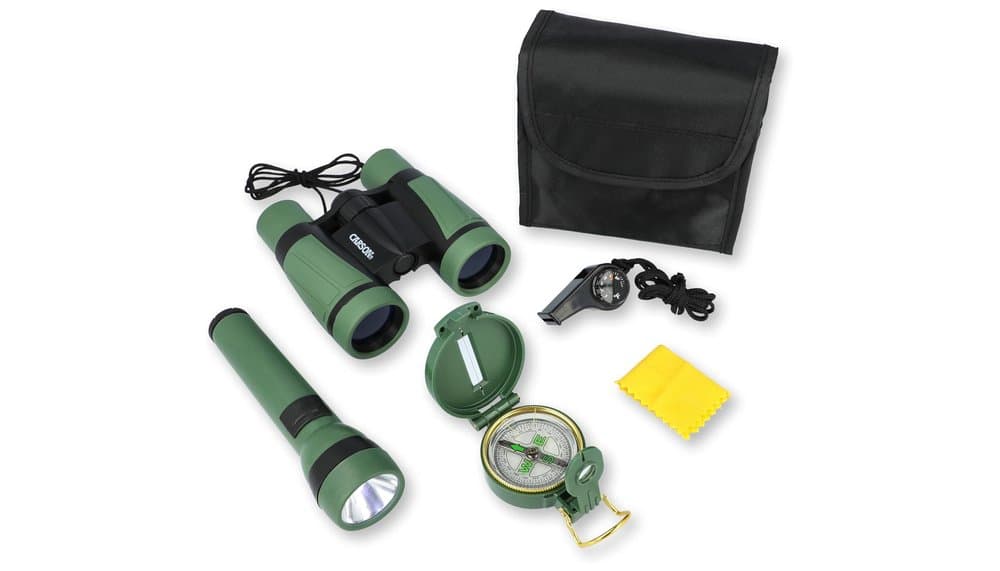
Explore nature with this kid's 5-piece tool kit for outdoor adventure and educational discovery. Perfect for young explorers.
BOSTRON CY 10x50 Monocular Review & Test
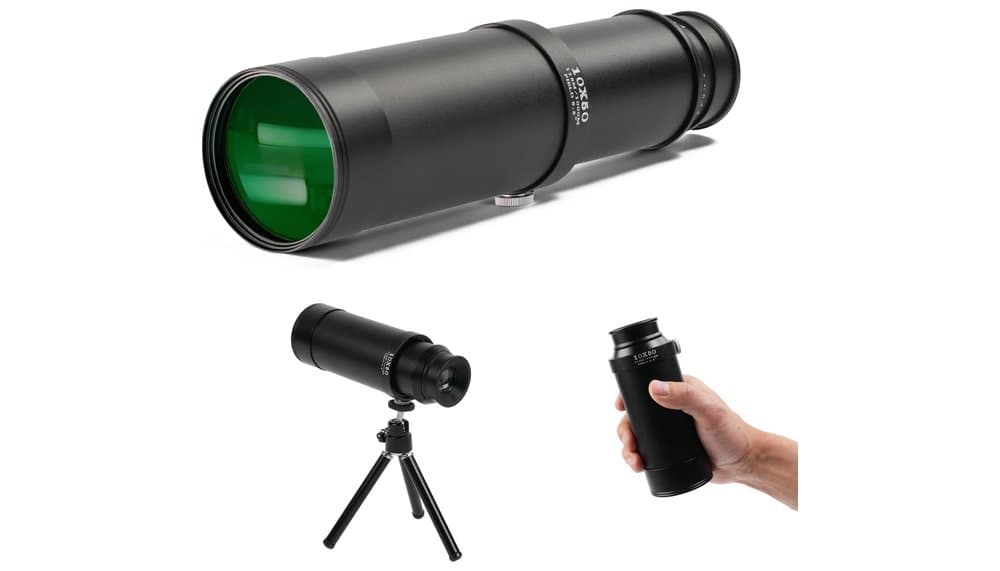
Compact 10x50 monocular review: Analyzes optical clarity, field of view & build quality for hiking, nature & astronomy. See its true value.