Ultimate Travel Telescope Guide
Guide
Has this ever happened to you? Seeing an observing window open up on the weather during your vacation, but finding yourself without an instrument to take advantage of it. The real dilemma is this: a travel telescope should not be a mere compromise. It must be a faithful companion, capable of revealing the universe from any backpack, without sacrificing essential performance. Frankly, with the right keys in hand, it is entirely possible.
Key Points to Remember
- Portability is paramount: a travel telescope must be compact (tube ~40 cm) and light (<3 kg).
- For an ideal balance, aim for an aperture between 100 and 130 mm, offering a good performance/logistics ratio.
- Prioritize a robust altazimuth mount with slow-motion controls for quick setup and stable observation.
- Invest in a dedicated carrying case and take only two or three quality eyepieces to travel light.
- Choose the type of optics (refractor, Maksutov) based on your primary practice (deep sky, planets, terrestrial observation).
Fundamental Criteria for a Portable Telescope
Before even discussing magnification, you must discuss portability. This is the first filter, the most brutal one. Are you going on a multi-day hike? A tube longer than 60 cm and weighing more than 5 kg will quickly become your worst enemy. For true portable use, aim for compact models, with a tube around 40 cm long and a weight under 3 kg, including the tube and mount.
Next, let's talk money. The diameter of the primary mirror or lens (the aperture) is the engine of your telescope. It's what gathers light. The larger it is, the more faint stars and details you will see. But it's also the main contributor to weight and volume. For travel, an aperture between 70 mm and 130 mm is often the sweet spot. Below 70 mm, you sacrifice too much capability; above 130 mm, logistics often become complex.
The Winning Trio: Aperture, Size, Budget
You cannot maximize everything at once. That's the law. Here is how this triangle plays out in practice:
| User Priority | Ideal Aperture | Compromise to Accept | Point of Caution |
|---|---|---|---|
| Ultra-Portability (hiking, biking) | 70 to 90 mm | Limited deep-sky performance | Prioritize Maksutov or short-focal-length refractor models. |
| Perfect Versatility (weekend, car) | 100 to 130 mm | Moderate weight and volume | Check the folded dimensions of the tripod. |
| Maximum Performance (fixed location) | 150 mm and above | Heavy logistics (large tube, robust tripod) | The mount must be very stable, which adds weight. |
Frankly, unless you are a deep-sky purist, a well-designed 100 mm is often the best travel telescope. It offers a perfect balance: enough light for galaxies and nebulae under decent skies, while remaining portable.
The last fundamental criterion is robustness. Your instrument will endure temperature variations, be jostled in a trunk, and maybe get a few drops of rain. Solid construction with finishes that can withstand handling is essential. Look at models with carbon fiber tubes: they are lighter and less sensitive to thermal shock than aluminum. And a friendly piece of advice: a dedicated carrying case is almost never a superfluous accessory; it's travel insurance.
Choosing Your Optics: Diameter, Focal Length, and Coatings
The aperture is the diameter of the lens or mirror that captures light. We touched on it briefly, but let's dig deeper. A 100 mm diameter collects roughly twice as much light as a 70 mm. What does that mean in practice? Under a night sky, this translates to brighter images with more detail in nebulae. But during the day, for terrestrial observation, the difference is less striking. There, it's more the quality of the glass and coatings that makes the difference.
This is where things get interesting. The focal length, often expressed in mm, determines the character of your instrument. A telescope with a short focal length (for example, 400 mm) is naturally "fast" (we talk about a low focal ratio like f/4 or f/5). It offers a wide field, perfect for sweeping across the Milky Way or observing large terrestrial landscapes. Conversely, a long focal length (1000 mm or more) provides a narrower field but a higher base magnification, ideal for the Moon, planets, or observing distant birds.
Lenses and Coatings: The Key to Sharpness
You will often see the terms ED (Extra-low Dispersion), HD, or apochromatic. In short, these special glasses correct an optical defect that creates colored fringes, especially visible on the edges of the Moon or on a heron against a bright sky. For travel, an apo or ED objective is a real plus, especially if you also plan to use the instrument during the day. The image is "cleaner," more contrasted.
Anti-reflective coatings (the multi-coatings on lenses) are just as crucial. They maximize light transmission and boost contrast. A well-coated lens will give you a brighter, more vibrant image, with fewer stray reflections when observing near a light source.
As for the Newton vs Maksutov-Cassegrain vs Refractor debate for travel:
- The refractor (a spotting scope) with a short focal length is often king for portability and day/night versatility, with no thermal stabilization delay.
- The Maksutov-Cassegrain (a short, stout tube) offers a long focal length in an ultra-compact format, perfect for the Moon and planets, but its field is narrow.
- The classic Newton quickly becomes bulky for travel, except for a few truly miniature "tabletop" models.
Frankly, for most people looking for the best travel terrestrial telescope, a good 80 to 100 mm refractor with ED glass is an unbeatable choice. It starts instantly, requires no maintenance, and its upright image (with a star diagonal) is perfect for landscapes and wildlife.
Our Selection
Exploring the stars and nature does not necessarily require expensive professional equipment. To guide your choice, we have analyzed a selection of three optical instruments suited to different needs and levels, based on their technical specifications and community feedback. From the traditional telescope to the ultra-portable monocular, here is our comparative analysis.
| Product | Aperture / Diameter | Focal Length / Magnification | Primary Uses | Key Strengths (based on reviews) |
|---|---|---|---|---|
| SOLOMARK 80900 | 80 mm | 900 mm (45x - 90x) | Beginner/Intermediate Astronomy, Lunar Observation | Large aperture, stable tripod, complete and portable kit |
| BDSHUNBF 16x52 | 52 mm | Fixed 16x Magnification | Terrestrial Observation (Birdwatching, Hiking), Concerts | Compact and light, waterproof, BAK4 and FMC optics |
| Xyvolve 70/300mm | 70 mm | 300 mm (15x - 150x) | Beginner Astronomy, Simple Astrophotography (Moon) | Versatility of magnifications, astrophotography kit included, smooth mount |
SOLOMARK 80900 Telescope
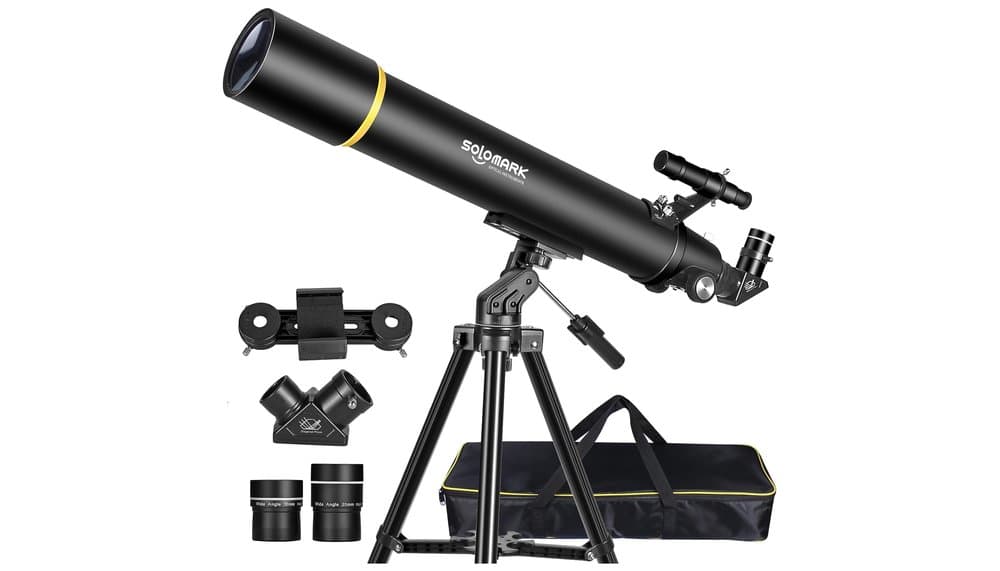
On paper, the SOLOMARK 80900 is a classic refractor telescope with solid characteristics for introducing astronomy. Its 80 mm aperture is its main asset: it promises to capture enough light to deliver clear and bright images of the Moon, bright planets like Jupiter or Saturn, and some star clusters. Based on user feedback, this advantage is tangible, with many highlighting the sharpness of lunar observations.
The community also appreciates its complete and portable kit aspect. The aluminum tripod, described as stable, and the included carrying bag make it a relatively easy instrument to store and move. The supplied eyepieces (10mm and 20mm) provide magnifications of 90x and 45x, considered suitable for a beginner. The smartphone adapter allows for attempting first photos of the Moon, a frequently mentioned plus.
However, reviews highlight some inherent limitations of this type of equipment. First, its 900 mm focal length makes it relatively bulky and less suited for occasional terrestrial observation. Second, although the alt-azimuth mount is simple, some note a learning curve for precisely pointing and tracking celestial objects, especially at higher magnifications. Finally, despite the large aperture, one should not expect, with this entry-level model, to observe galaxies or nebulae with as much detail as with more sophisticated instruments. It is a telescope that rewards patience and suits those who want to explore the sky more seriously than with a simple pair of binoculars.
BDSHUNBF Monocular Telescope 16X52
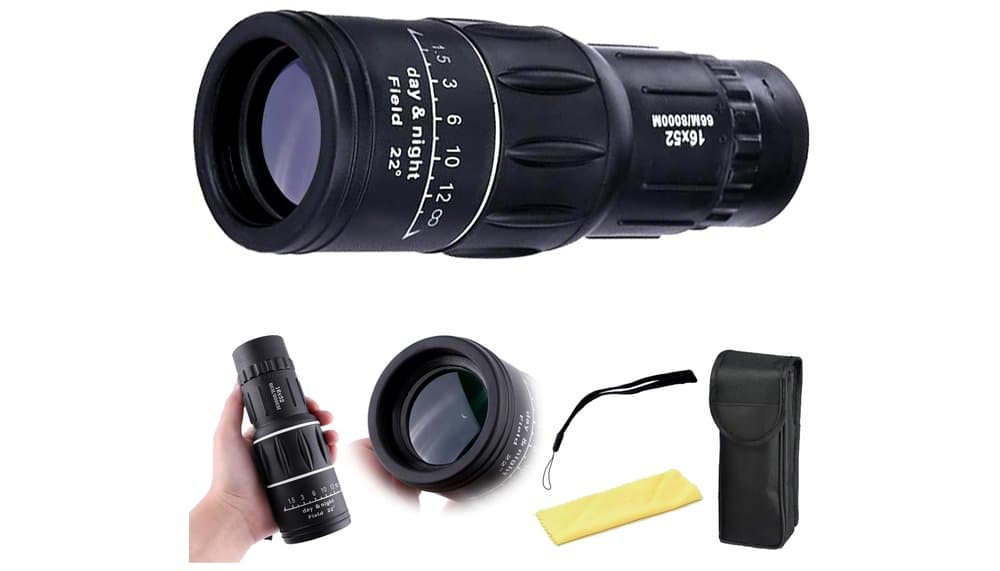
The BDSHUNBF positions itself at the opposite end: it is a monocular designed for terrestrial observation and extreme portability. At 270 grams and with compact dimensions, it slips into a jacket pocket, a point unanimously praised by users for hiking, birdwatching, or sporting events.
Its technical specifications promise quality optics with a BAK4 prism and FMC (Full Multi-Coated) lenses, terms indicating better light transmission and reduced aberrations. Reviews largely confirm this promise for daytime use, with an image judged sharp and bright in good weather. Its waterproof and dustproof rating is also a strong practical argument for adventurers.
Nevertheless, community reviews outline a profile with clear limits. The fixed 16x magnification is a double-edged sword: while sufficient for most uses, it makes the image very sensitive to shaking. Without support (a small tripod is rarely included), it can be difficult to stabilize the view for long periods. Furthermore, several reviews note that performance in low light (dusk) or for very basic astronomy (observing the Moon) is limited, and that the focus ring can have play or be too sensitive. In summary, it is an excellent companion for active daytime observation, but not the ideal tool for astronomy or situations where stability is paramount.
Astronomical Telescope Refractor 70-300mm (Xyvolve)
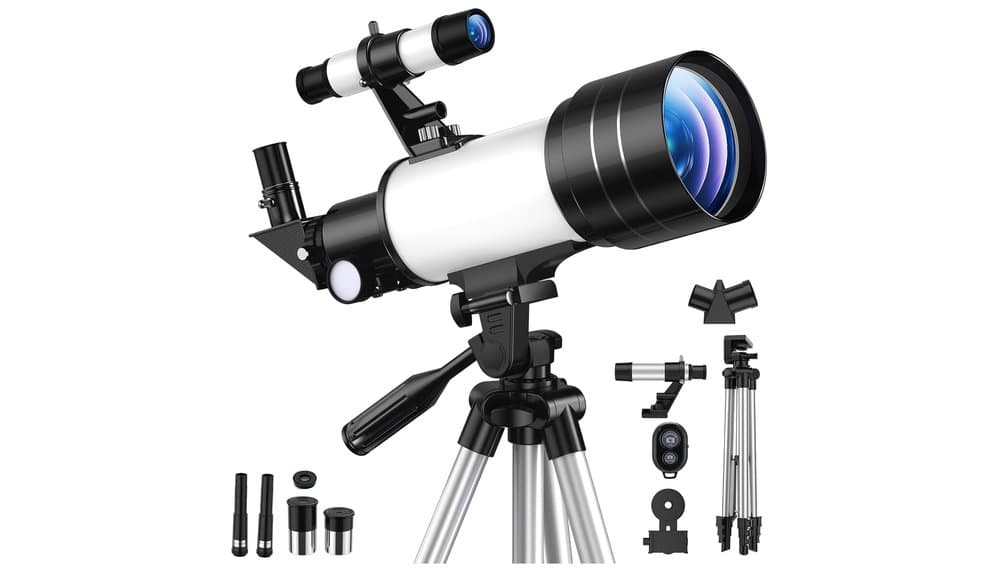
The Xyvolve 70/300mm seeks to combine worlds: it is a small astronomical telescope banking on versatility and accessibility, particularly for beginner astrophotography. Its short 300 mm focal length (F/4.3 ratio) makes it a more compact and brighter instrument for its aperture (70mm) than a traditional refractor, theoretically suited to wider fields of view.
The point that stands out most from the feedback is the richness of its equipment. It comes with two eyepieces, two Barlow lenses (1.5x and 3x) allowing the magnification range to be extended from 15x to 150x, a Bluetooth smartphone adapter, and a dedicated remote control. This array is very appealing to beginners who want to experiment with different zoom levels and photograph the Moon without touching the device, avoiding vibrations.
However, this versatility comes at a cost in terms of optical performance. The very short focal length, while practical, can exacerbate chromatic aberration (color fringing on the edges of bright objects), a point sometimes noted. Furthermore, the very high magnifications advertised (150x) push the limits of the optics and the stability of the supplied small tripod; the community notes that image quality degrades noticeably beyond a certain zoom level, and that stability could be improved. It is therefore an ideal kit for a fun and interactive introduction to observation and lunar photography, provided expectations are realistic regarding performance at the highest magnifications and absolute image fineness.
The Mount, the Pivot of Your Observing Experience
The best optics in the world become frustrating if placed on a shaky mount. Imagine trying to admire the details of Saturn's rings with constant trembling in the eyepiece, or tracking a raptor in flight when the movements are jerky and imprecise. The mount is the silent but indispensable foundation of your enjoyment.
There are two main families, and your choice will largely dictate your way of observing. On one hand, the altazimuth mount: simple, intuitive, lightweight. You move the tube up and down (altitude) and left to right (azimuth). Perfect for terrestrial observation and travel, as it sets up in seconds. On the other, the equatorial mount, designed to compensate for the Earth's rotation by following a single axis. It is essential for long-exposure astrophotography, but it is heavier, more complex to polar align, and often less suited for a quick outing while hiking.
Stability vs. Speed: The Permanent Compromise
For a travel telescope, the weight of the mount is a decisive factor. A mount made of lightweight aluminum alloy is tempting, but test it with your tube before buying. A rule of thumb: the mount's rated load capacity should be at least 1.5 times the actual weight of your equipped telescope. A tripod that buckles under the weight guarantees shaky images at the slightest breeze. For serene observation, a stable mount is non-negotiable, even if it weighs a few hundred grams more.
Fine adjustment systems make all the difference, especially in astronomy. A simple plastic fork makes precision aiming nearly impossible. Look for mounts with micrometric movements, small knobs that allow hyper-precise adjustments once the object is in the field of view. This is what transforms a celestial treasure hunt from frustration into a pleasure of smooth and controlled piloting.
My opinion? For someone seeking the best terrestrial travel telescope, a robust altazimuth mount with fine movements is largely sufficient and much more pragmatic. You will save a huge amount of time on setup, and your back will thank you. Reserve the equatorial mount for serious astrophotography projects, where it then becomes a necessary investment, but for lightweight travel, simplicity wins.
Accessories and Storage for Light and Efficient Travel
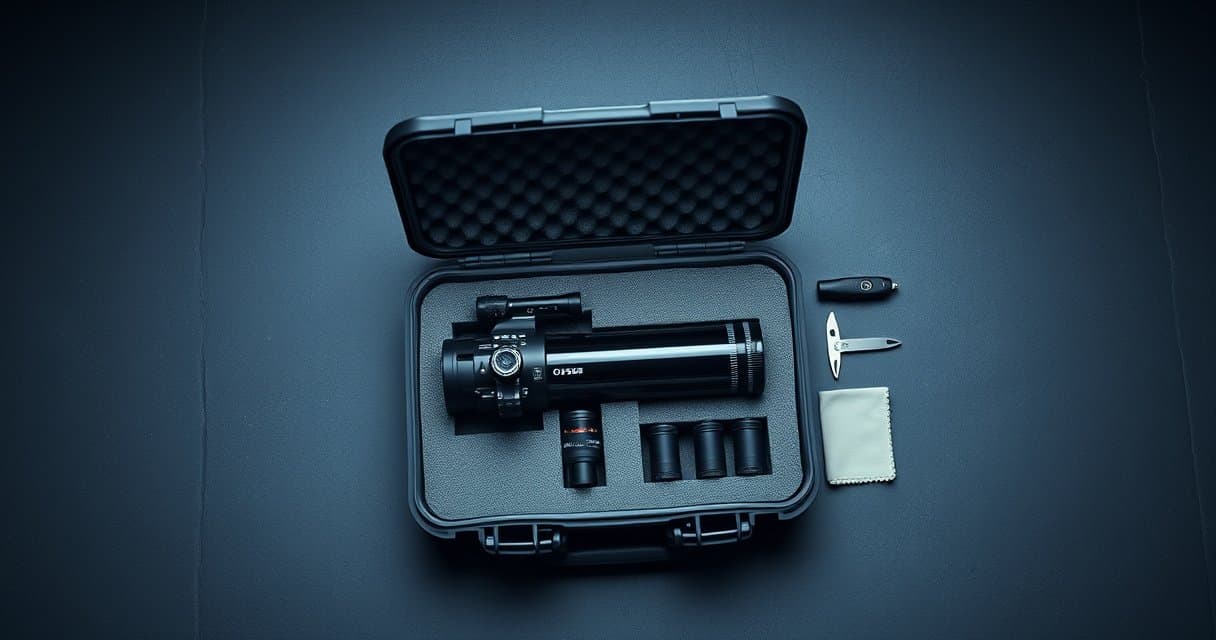
You have chosen your perfect combo: optics and mount. Now you need to transport and use it in the field without hassle. This is where the right accessories make the difference between a successful outing and an ordeal. Don't neglect them; they are as important as the instrument itself.
Protection First: A Custom-Fitted Case
A standard backpack is rarely suitable. Knocks against other equipment or simply poorly distributed weight can damage the delicate adjustments of the mount or, worse, misalign the mirrors or prisms. Invest in a dedicated rigid case or bag, with molded compartments or adjustable dividers.
Make sure to check two things: padding and handles. Foam 4 to 5 cm thick is a good standard. And a sturdy carrying handle, as well as straps to carry everything like a backpack, are essential for approaches on foot. For a best travel terrestrial telescope, the carrying case is an integral part of the kit, not an option.
Eyepieces: Quality and Versatility
There's no need to bring your entire collection. In the field, simplicity and versatility rule. Bring two, three maximum.
- A wide-field eyepiece (e.g., 20mm or 25mm) for panoramic observations, finding objects, and moments of low light.
- A medium-power eyepiece (e.g., 10mm) for details on the Moon, planets, or wildlife at a distance.
- Possibly a zoom eyepiece (e.g., 8-24mm) that combines both functions in one element. It's an excellent compromise for travel.
Prioritize quality over quantity. One good wide-field eyepiece with good eye-relief (ideally >15mm for eyeglass wearers) will give you more satisfaction than three entry-level ones that strain the eye.
The Small Essentials That Save the Session
Here is what you absolutely must have in a separate small pouch:
- A red-light headlamp. It preserves your night vision when you change an eyepiece or consult a map. White light is forbidden at a shared observation site!
- A microfiber cloth and a lens blower. Dust and condensation are your enemies. Always clean by blowing first, then wiping with gentle circular motions.
- Spare batteries for the motorized mount or finderscope, if you have one. Nothing worse than an instrument dying at the crucial moment.
- A celestial mapping app on your smartphone (in airplane mode to save battery) can heavily replace a paper atlas.
Optimizing Weight: The Art of Letting Go
Do the following exercise: take out all your gear, then put back in the bag only the essentials for a 2-3 hour outing. You'll be surprised by what you leave out. A tripod that's too heavy? Perhaps a shorter but lighter carbon model will do for a seated session. An accessory you haven't used in three outings? Leave it at home. The true luxury in travel is lightness.
Adapting Your Configuration to Your Field Practice
A generic instrument is rarely optimal. What works for a mountain hike will be a burden on safari, and vice-versa. Your terrain dictates your priorities. Here is how to refine your choice.
For Backpacking and Hiking: Weight as Religion
Here, every gram counts. Your kit must fit in an already loaded backpack. Prioritize a simple altazimuth mount, in lightweight aluminum or even carbon if the budget allows. On the optical side, a Maksutov-Cassegrain telescope of 90 to 102mm aperture is often the best terrestrial and celestial travel telescope for this scenario: ultra-compact, it offers a long focal length in a tiny tube. For nature, a wide-field finder (like a red dot) is faster and lighter than an optical finder. The goal is to be able to set up and pack away in less than 5 minutes, even with gloves on.
For Road Trips and Camper Vans: Versatility as the Watchword
Here, you have space, but no desire to handle a giant. A 127 to 150mm Schmidt-Cassegrain becomes feasible, with its lightweight yet stable equatorial mount. Take advantage of this to choose a slightly sturdier tripod and a greater variety of eyepieces. A heated lens dew shield can be wise for humid nights by a lake or in the forest. This is the ideal setting to add a lightweight planetary video system if astrophotography tempts you.
For Observation from a Fixed Location (Lodging, Balcony): Prioritize Aperture
If you transport your equipment by car over short distances to set it up for several days in the same spot, the situation changes. The absolute priority becomes the amount of light collected. Aiming for a Newtonian or an apochromatic refractor of 130 to 150mm aperture becomes very interesting. You will be able to appreciate fine details on planets and delve deeper into deep-sky objects. The mount must above all be stable for this aperture, regardless of whether it's a bit heavy.
For Daytime Observation and Wildlife: Speed of Execution
If your heart leans towards ornithology or panoramic terrestrial observation, your needs diverge. Long focal length is less crucial than a wide field of view and fast focusing. A short apochromatic refractor (70-80mm, F/6) is a champion here. Pair it with a 45° diagonal for comfort and a quality zoom eyepiece. Imperatively check the minimum focusing distance (4-5 meters max is a good standard) to avoid frustration with a nearby bird. Here, the mount must allow for fluid and rapid movements to track a moving subject.
The Special Case of Air Travel
This is the expert level. You must think "cabin" versus "hold". The optical tube, precious and fragile, must absolutely be designed for a roll-on cabin bag (standard dimensions approximately 55x40x20 cm). This is often the maximum limit for a 102mm Maksutov with its case. The mount and tripod, less sensitive, can go in the hold in your luggage, surrounded by clothes. Check your instrument's warranty conditions for air travel, and don't forget local power plug adapters for your accessories.
Conclusion
Take your time. Do not choose a travel telescope on a whim.
First, identify your usual playground. Weigh your priorities: a quick glance or extended sessions? Starry light or twilight?
The perfect equipment does not exist. But with these keys in hand, you will find the one that will become your companion on all your explorations. The sky and distant horizons await you, wherever you are.
Safe travels, and clear skies.
Frequently Asked Questions
What is the best telescope for stargazing while traveling?
An ideal travel telescope combines portability and performance, with an aperture between 70 mm and 130 mm to capture sufficient light. A refractor or Maksutov-Cassegrain model with a tube around 40 cm long and weighing less than 3 kg is optimal for transport.
Which mount to choose for a portable telescope?
For portable use, a robust altazimuth mount is recommended for its lightness and ease of setup. It should have a load capacity of at least 1.5 times the weight of the telescope and be equipped with micrometric movements for precise pointing.
What telescope diameter for hiking?
For hiking, aim for a diameter (aperture) between 70 mm and 90 mm for a good performance-portability compromise. Maksutov-Cassegrain telescopes or short focal length refractors in this range offer an ultra-compact format.
Which accessories are essential for a travel telescope?
Essential accessories are a dedicated padded carrying case, two eyepieces (one wide-field and one medium power), as well as a red-light headlamp. A zoom eyepiece (e.g., 8-24mm) is also an excellent compromise for saving space.
100% free and independent — All our articles are written independently, without any sponsorship. We may earn a commission on purchases made through our links, at no extra cost to you.
Guides you might like
Astrophotography Telescope Buying Guide
Choose the right telescope for astrophotography to avoid frustration. Key factors depend on your target nebula or object.
Best Binoculars Value Guide
Find value binoculars that match your real needs. Understand specs like 8x42 and key features for the best observation without overspending.
Best Nature Binoculars Kids
Discover how to choose the perfect first binoculars for a child, focusing on lightweight design, ergonomics, and sparking a love for nature observation.
Articles you might like
Caytail 4K 48MP Hunting Camera Review & Test
In-depth review of the Caytail 4K 48MP trail camera with included SD card. We analyze specs and real user feedback on its true field performance.
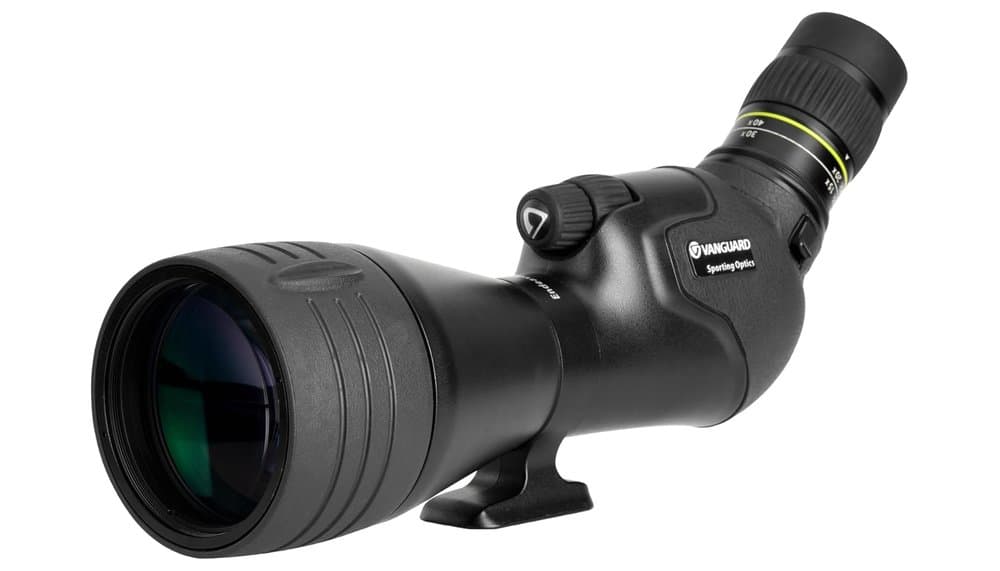
Vanguard Endeavor HD65A Spotting Scope Review
Spotting scope with 65mm ED glass & 15-45x zoom for birding & hiking. Balanced performance & portability for serious nature observers.
Carson AdventurePak Kids' Exploration Tool Kit Review
Explore nature with this kid's 5-piece tool kit for outdoor adventure and educational discovery. Perfect for young explorers.