WiFi Trail Camera Guide
Guide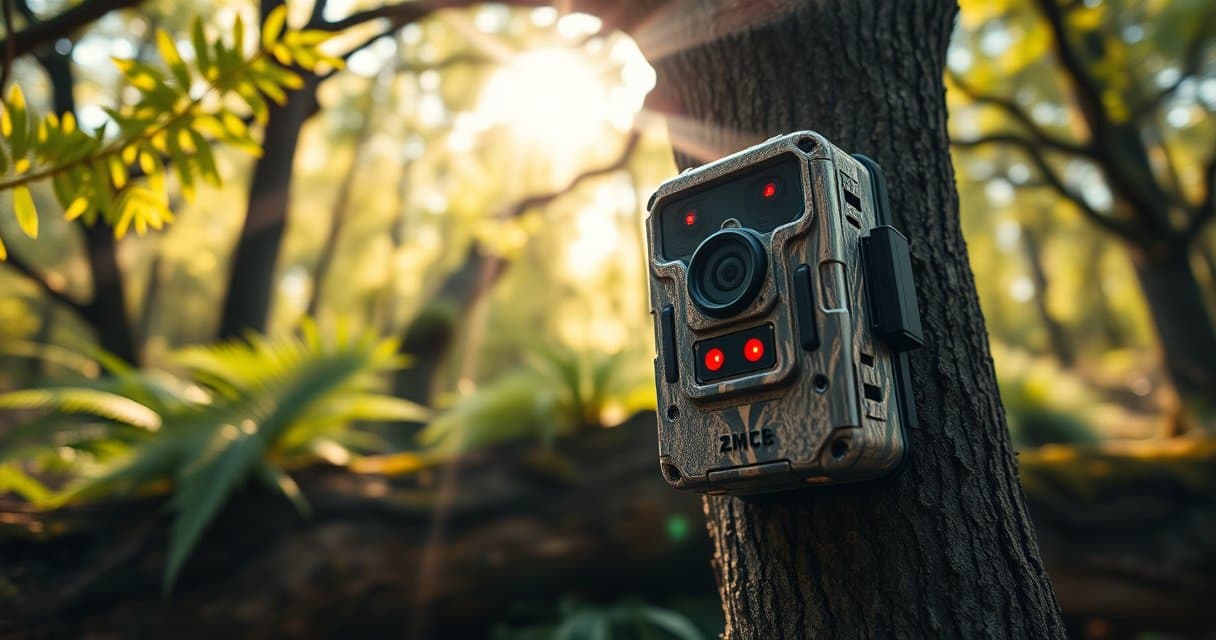
Imagine this: you return from a week in the forest without knowing if the deer finally showed its nose in front of your stand. With a wifi trail camera, there's no more need for the round trip. You check the images from your couch, in complete discretion. Let's see together how this connectivity truly changes the game for observing wildlife without disturbing it, and how to properly choose your device to avoid any unpleasant surprises.
Key Points to Remember
- WiFi allows you to view and retrieve images remotely, avoiding disturbing the animals and making unnecessary trips.
- Image quality depends less on megapixels and more on the quality of the lens, sensor, and processor, especially for nighttime shots.
- For reliable battery life, prioritize lithium batteries and verify the actual waterproofing of the device.
- The choice of camera should be based on your project, from simple naturalist gardening to demanding scientific surveillance.
- The effective WiFi range is limited (15-50 m); for very long-distance transmission, a cellular (4G) model is necessary.
What is the Practical Benefit of WiFi Connectivity for Observation?
Frankly, WiFi is not a gimmick. It's what transforms a simple photo box into a true remote observation station. Before, you had to disturb the area, risk leaving your scent, and hope the SD card hadn't crashed. Now, you can check your images in a few seconds, without moving from your blind or even from home. It's a complete change in philosophy.
Saving Time and Preserving the Site
The biggest advantage is the saving of time and disturbance. Let's take a concrete example: you are monitoring a wild boar feeding spot. Without WiFi, you have to go there every week to retrieve the card. With each visit, you risk disturbing the animals with your scent and noise, and you lose hours of travel. With WiFi, you connect from the edge of the forest, 50 meters away, to download the latest videos. You know instantly if the site is active. If the card is empty, you avoid an unnecessary visit. That's efficiency.
Adjusting Your Strategy in Real Time
This is where it gets exciting. The direct connection via the app allows you to modify settings remotely. You noticed the animals always pass 5 meters to the right? You adjust the framing and the sensitivity of the PIR sensor from your phone. The weather changes and the light drops? You increase the video clip duration. You no longer wait for the next check to optimize your setup. This reactivity is a major asset for anyone who really wants to understand animal behavior, not just collect blurry images of disappearing tails.
The Crucial Limit: Range
We must be very clear on this: the WiFi built into these cameras is not home WiFi. It creates a direct network between the device and your smartphone, with an effective range often between 15 and 30 meters in dense forest. In open terrain, you might sometimes reach 50 meters. This means you must physically approach within this distance to retrieve the files. It is not 4G that sends images from 10 km away. For me, this is the criterion that separates two uses: if you can regularly get close to the site (for a reserve, a garden, a personal blind), WiFi is perfect. For a completely inaccessible area over long periods, you should look at models with a cellular network.
The App, the Crucial Factor
Everything goes through the mobile app. And frankly, they are not all equal. A good application must be stable, intuitive, and fast. Check that it allows you to:
- Preview a live video stream for perfect framing.
- Download files in batches, not one by one.
- Finely configure all parameters (resolution, PIR sensitivity, night mode). A best WiFi trail camera is also judged by the quality of its software. A buggy app can make the experience frustrating, regardless of the quality of the photo sensor.
What Optical and Electronic Elements Does Image Quality Really Depend On?
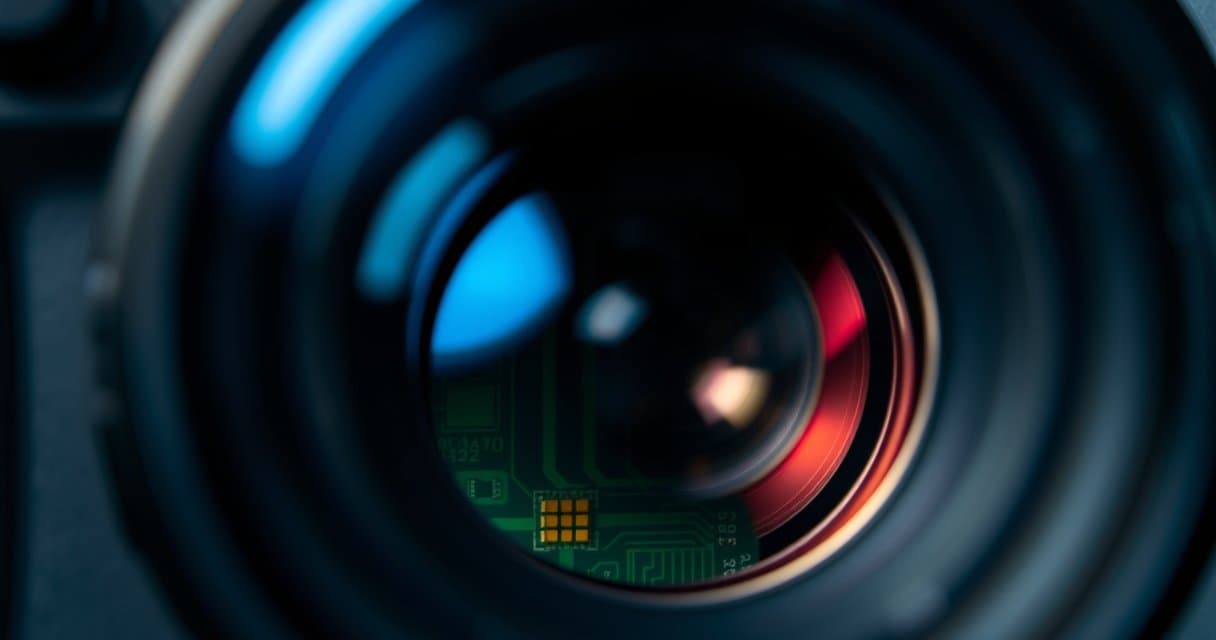
We see too many people relying solely on the megapixels displayed on the box. That's a mistake. A poor-quality 30-megapixel sensor will produce a worse image than a good 20 MP one. True image quality, especially in the extreme conditions of the field, depends on three fronts: the lens, the sensor, and the electronic processing that connects them.
The Lens: The First Window to the World
This is the most underestimated element. A mediocre lens, with plastic or poorly treated optics, will produce blurry images at the edges, chromatic aberrations (those purple or green fringes on contrasting edges), and a significant loss of light. For a camera that must operate at dawn and dusk, this is crucial. Prioritize models that highlight glass lenses. They offer much better light transmission and superior sharpness across the entire field. And be wary of an overly wide field of view (beyond 120°) if the resolution is not very high: the animal in the center of the image will be very small and lack detail.
The Sensor and Night Vision: The Truth Comes Out in the Dark
At night, everything changes. Quality then depends on two things: the sensitivity of the CMOS sensor and the power/placement of the Infrared (IR) LEDs. A sensor that performs well in low light requires less IR illumination to obtain a clear image, which preserves discretion and battery life.
- 940nm vs 850nm LEDs : 940nm are "no-glow," completely invisible. 850nm emit a faint reddish glow, sometimes perceptible to wary animals. If you are observing very skittish species like deer, opt for 940nm. But be careful: with equal technology, the range of 940nm is often slightly lower.
- Real Range : Let's take an example. A manufacturer claims 30 meters of IR range. In reality, with a dark-colored animal like a wild boar, the useful range for an identifiable image will be closer to 15-20 meters. For a better wifi trail camera, look for tests that show night images at different distances, not just marketing numbers.
The Image Processor: The Invisible Artisan
This is what transforms the raw light captured by the sensor into a photo or video. Its quality determines the trigger speed after detection, the management of digital noise in low light, and the smoothness of videos. A slow trigger speed (above 0.5 seconds) will cause you to miss half your sequences, as the animal will already be out of the frame. The real progress on recent models is the ability to record in 1080p at 60 frames per second, or in 1520p, which gives incredibly smooth videos for analyzing behavior. This often justifies the price. For me, a good processor is better than over-hyped resolution.
Our Selection
Looking for a reliable, connected, and high-performance hunting camera? The choice can be difficult given the plethora of options. To help you see more clearly, we have scrutinized three popular models by analyzing their technical specifications and, above all, feedback from the user community. Our selection leans towards devices equipped with Wi-Fi, allowing you to retrieve your images and configure the trap remotely. Here is a comparative overview of their respective strengths and limitations.
| Product | Maximum Resolution | Battery Life & Power | Night Vision | Key Strengths (based on specs and reviews) |
|---|---|---|---|---|
| VOOPEAK Hunting Camera | 60MP / 4K 30fps | Solar panel + Integrated 4400mAh battery + 8x AA | "Starlight" night vision (color) | Dual-lens, Wi-Fi/Bluetooth, H.265 video format (saves SD card space) |
| iZEEKER iG420 | 64MP / 4K 30fps | Solar panel + 5200mAh Li-ion battery + 4x AA | Infrared, range 20m (65ft) | Integrated LCD screen, Wi-Fi 6, complete kit (SD + battery included) |
| GardePro E6 | 48MP / 1296p | 8x AA only | "No Glow" 940nm Infrared, range 25m | Reinforced Wi-Fi antenna, mature dedicated app, ultra-wide field (110°) |
VOOPEAK Hunting Camera
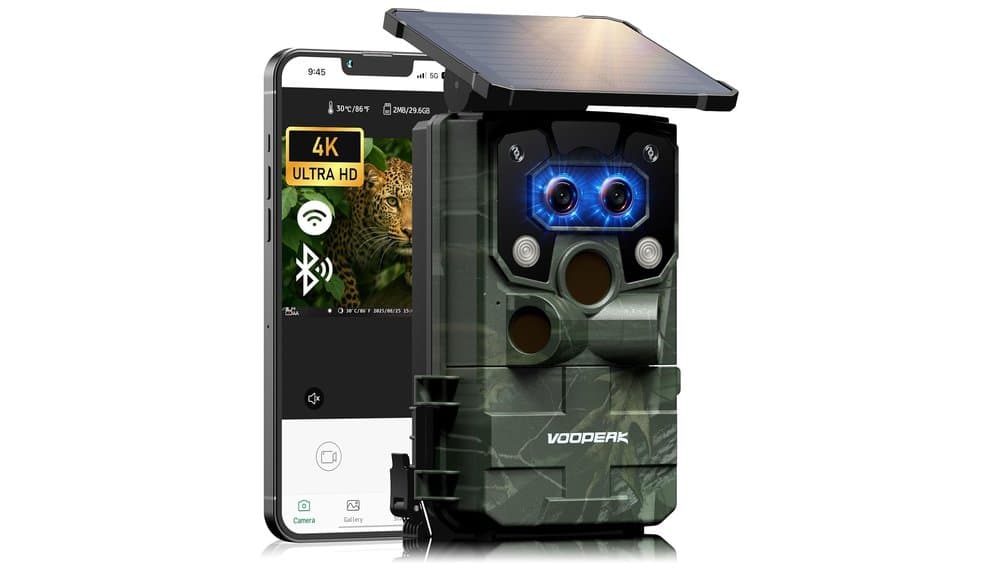
On paper, the VOOPEAK stands out for its technical approach with a dual-lens configuration. According to its specifications, this optical architecture, coupled with the Starlight function, would allow capturing color images even in very low-light conditions, instead of traditional black-and-white infrared shots. This is a compelling argument for those who want more realism in their nighttime captures. User feedback generally confirms the daytime image quality, which is considered good, with details rendered by the 60MP sensors and 4K video.
Regarding battery life, the combination of a solar panel and a large integrated 4400mAh battery promises interesting field longevity. The community also appreciates the H.265 video format, which efficiently compresses files and allows storing more videos on the same memory card. However, some reviews highlight limitations. The Wi-Fi connection, although practical, is said to have a very limited range (about 10 meters), requiring you to get very close to the camera to retrieve media. Furthermore, the user interface via the mobile app is sometimes described as unintuitive or unstable. Finally, despite the presence of the solar panel, actual battery performance seems to depend heavily on the sunlight at the installation site, and it is unclear whether the integrated battery is removable or easily replaceable.
iZEEKER iG420
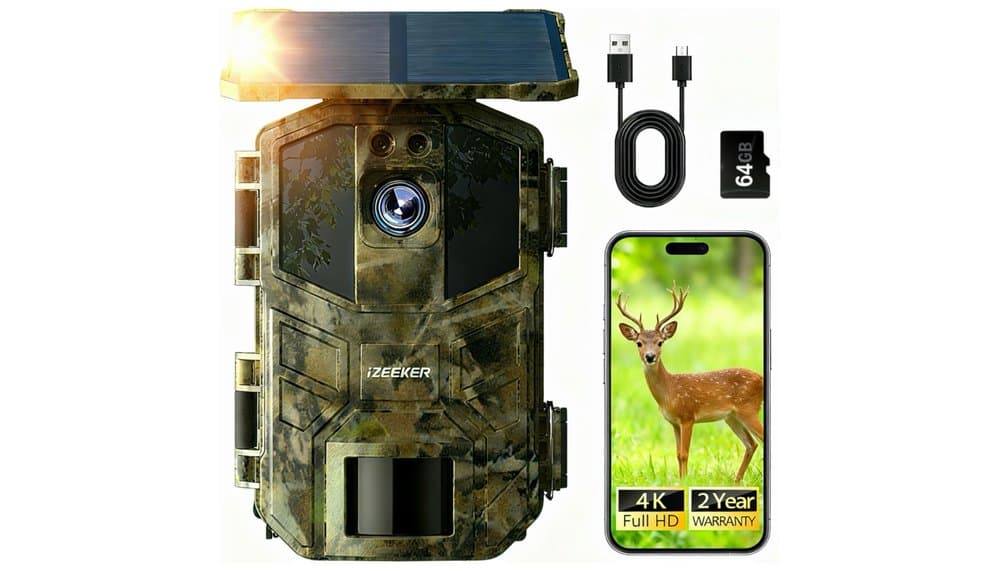
The iZEEKER iG420 seems to be the champion of "ready-to-use." According to the specifications, and confirmed by many buyers, it arrives complete in the box: a micro SD card (64GB), a pre-installed 5200mAh rechargeable lithium battery, and even a set of backup AA batteries. This makes it a very practical choice to start immediately. Its major asset is undoubtedly the integrated LCD screen on the housing. According to feedback, this screen is a real plus in the field for configuring the camera, checking its framing, and quickly viewing captures without having to take out your smartphone, especially in areas with no network.
On paper, its specifications are solid: 64MP, 4K video, fast 0.1s trigger, and the promise of a Wi-Fi 6 connection for more stable transfers. Users generally validate the ease of installation and the versatility of the triple power system (solar, integrated battery, AA batteries), which seems to offer highly appreciated battery life. However, the community also notes a few points of caution. As with the VOOPEAK, the effective Wi-Fi range is considered limited (less than 10m) and does not allow connection to a home router for remote viewing. Despite the presence of the screen, some find the configuration menu on the device itself a bit complex. Finally, although Wi-Fi 6 is advertised, its real advantage over classic Wi-Fi in this very localized usage context is not always obvious to the end user.
GardePro E6
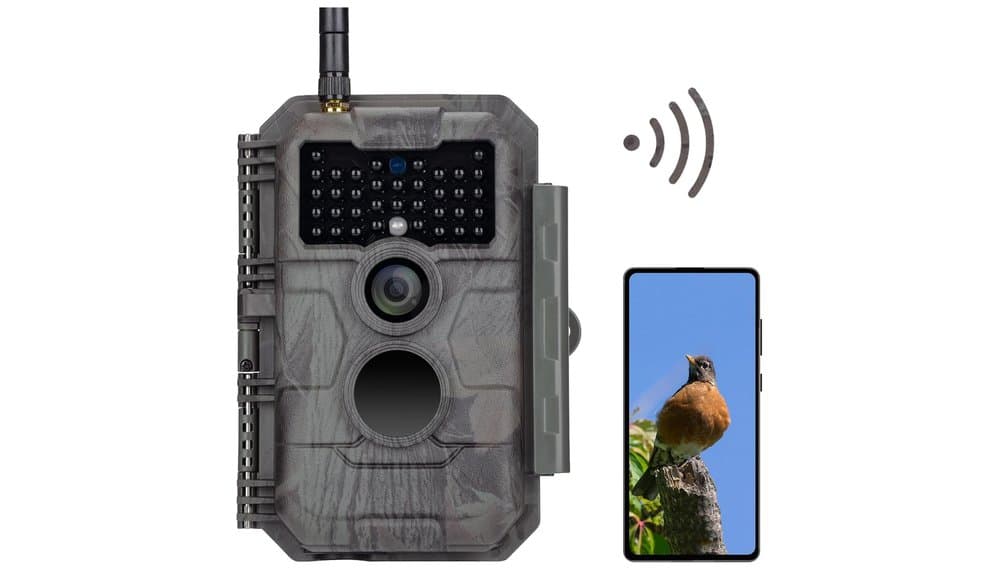
The GardePro E6 is clearly a proven model, as evidenced by the large volume of customer reviews. Its approach is different: it does not aim for maximum resolutions (48MP and 1296p) nor integrated solar power, but focuses on Wi-Fi signal reliability and nocturnal discretion. Its key technical strength is the reinforced Wi-Fi antenna, designed to offer a more stable connection and a slightly better range than average, according to feedback. Its other major asset is the "No Glow" 940nm infrared technology, completely invisible to the eyes of animals and humans. Reviews agree that this allows for perfectly discreet captures without scaring wildlife.
The community also highlights the general robustness of the device and the quality of the dedicated mobile app, considered mature and reliable. The ultra-wide 110° field of view is also a real plus for covering a larger area. The limitations noted are more pragmatic. Battery life relies solely on 8 AA batteries, which implies a logistics of spares or purchasing an optional external power pack for long-term installations. Its maximum video resolution (1296p) is lower than the 4K offered by the other two models. Finally, some users report that the trigger speed (0.2s), although decent, may be slightly slower than that of the newest models advertising 0.1s, which could make a difference on very fast animals.
How to ensure autonomy and reliability in the field?
This is THE topic that will make the difference between a smooth experience and constant trouble. You can have the best trail camera wifi on the market, but if it fails after three days or if you have to go back to it every week, it will be useless to you. Reliability is a trio: power supply, resistance to the elements, and connection stability.
Battery choice: don't fight the wrong battle
Most models run on 8 to 12 AA batteries. But not all batteries are created equal, especially in winter.
- Alkaline batteries: Forget them for serious use. Their voltage drops drastically in cold weather. You risk losing 80% of their capacity in a single freezing night.
- Lithium batteries (non-rechargeable): These are the best for cold resistance. They last for months, even at -20°C, and their discharge is linear. It's an extra cost, but it's the price of peace of mind.
- Rechargeable Ni-MH batteries: Economical and ecological on paper, but often disappointing in practice. They hate the cold and their lower voltage can sometimes cause problems for some power-hungry devices. Reserved for use in mild seasons, provided you recharge them very regularly. A friendly piece of advice: invest from the start in a pack of good brand lithium batteries. You'll thank me in January.
Waterproofing and robustness: reading between the lines of the IP rating
An IP66 or IP67 rating is today a minimum standard. It means total protection against dust and powerful water jets. That's good, but it doesn't tell the whole story about resistance to shocks or extreme temperature variations. Look at the operating temperature range. A model that specifies -20°C to +60°C will be much more reliable than another indicating only 0°C to 40°C. The key is often the sealing gasket of the battery compartment and the SD card door. A thin, poorly positioned gasket will be the first cause of water infiltration. Before installing it for good, do a test at home: close the camera with a piece of toilet paper inside and briefly run it under a trickle of water. If the paper is dry, it's a good sign.
The trap of permanent connectivity
Activating WiFi permanently to receive real-time alerts is convenient, but it's an energy drain. It's the mode that drains batteries the fastest. A smarter configuration for real autonomy of several weeks is to:
- Deactivate instant notifications or schedule them for specific time slots.
- Only connect to the device via the app when you are nearby, to retrieve media in batches.
- Choose, if your model allows it, an external power supply with a small solar panel facing south. It's an investment, but it's the only solution for 100% continuous monitoring over several months without intervention. Frankly, if your project is to monitor a remote site year-round, it's essential.
Choosing Your Camera Based on Your Project: From Beginner to Advanced Surveillance
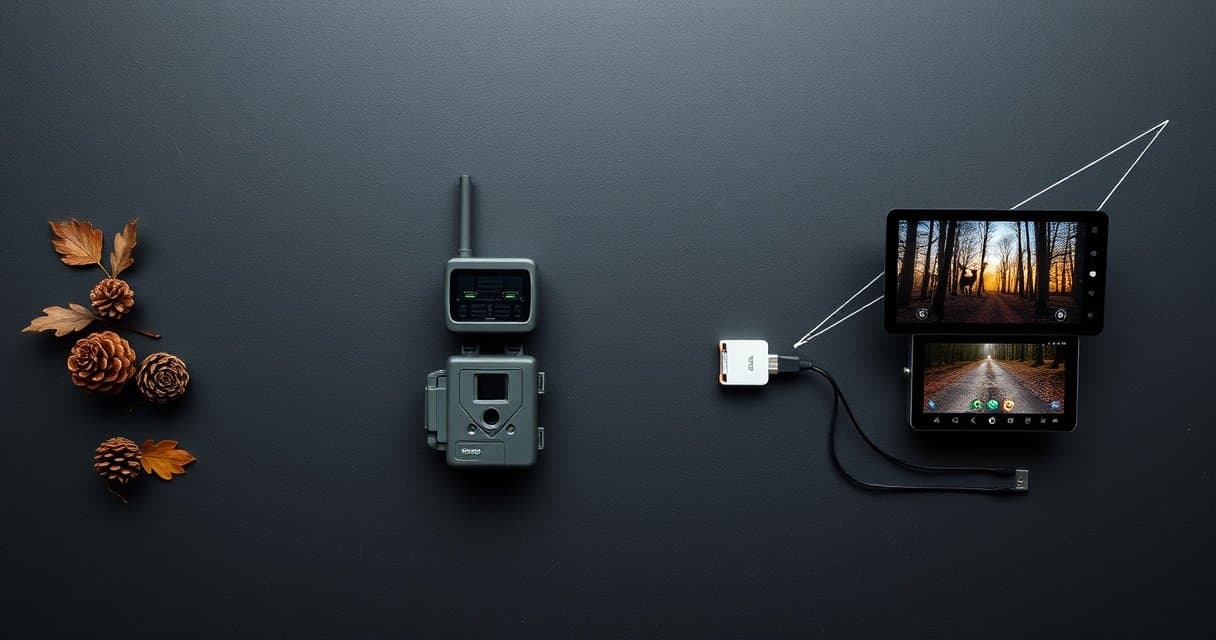
The right choice doesn't depend on a list of features, but on what you actually want to do with it. You don't equip yourself the same way for having fun in your garden and for documenting the passage of a rare species at a remote site. Here's how to align your project and your budget.
For the Garden, Beginners, and Children
The goal here is simplicity and immediate enjoyment, without technical headaches. You want to see hedgehogs at night or birds on the feeder.
- Priorities: An intuitive app interface, installation in 5 minutes, and a contained price. A resolution of 12 to 16 megapixels and 720p video are more than sufficient.
- Acceptable compromises: Limited battery life of a few weeks (you are nearby to change the batteries), a slightly slow trigger speed (0.8 to 1.5 seconds), and night vision with a modest range (15 meters). IP66 waterproofing is necessary, but resistance to extreme temperatures is less critical.
- My opinion: This is the segment where you shouldn't spend too much. A maximum of one hundred euros. The most important thing is that it works right away and is fun. If it breaks or you move on to something else, the loss is minimal.
For the Passionate Naturalist and the Seasoned Hunter
Here, we get into the heart of the matter. You have one or several feeding stations, a wallow, a game trail you want to monitor seriously, sometimes several kilometers from home.
- Priorities: Reliability above all. Fast detection (0.3 to 0.6 seconds) to avoid missing the animal, excellent battery life (several months on lithium batteries), and day and night image quality that allows for unambiguous identification. Prioritize a photo resolution of at least 20MP and smooth Full HD 1080p video.
- Key features: A video mode with sound (very useful for behavior), good false alert management (PIR sensitivity adjustment), and a stable app for remote configuration. Durability must be impeccable, with a wide temperature range (-20°C to +60°C).
- My opinion: This is where you find the best value for money. Expect to spend between €150 and €250. It's an investment, but for regular use over several years, this is where you will find the best wifi trail camera for your practice. Don't skimp.
For Scientific Surveillance or Very Remote Sites
The project is demanding: monitoring a large territory, a discreet species, or a site inaccessible for months. The slightest failure can cause you to miss precious data.
- Priorities: Total autonomy and remote data transmission. We often move beyond simple WiFi to hybrid models with cellular connectivity (4G), which send images directly to your phone, wherever you are. Image quality must be impeccable, with a wide lens and 4K or 1520p video for details.
- Imperatives: A high-capacity internal battery coupled with a solar panel, backup internal memory, and intelligent detection algorithms to minimize unnecessary triggers (moving leaves). Fine programming (time slots, batch sending) is crucial.
- Frankly: This is the high-end, starting at €300 and well beyond. It's not a purchase, it's professional equipment. If your project warrants it, it's essential. Otherwise, it's an expensive over-equipment.
Conclusion
So, there you have it. Choosing a wifi trail camera isn't just about comparing specs. It's about putting technology at the service of your passion for observation.
Think about what you really want to see. Weigh the importance of battery life against the quality of the live image. And above all, don't underestimate durability: your device will have to face the elements, alone.
By starting from your actual project, you will find the model that suits you. The one that will bring you back images, not problems.
Happy observing
Frequently Asked Questions
Frequently Asked Questions
What is the actual WiFi range of a trail camera?
The effective range of the built-in WiFi is 15 to 30 meters in dense forest and can reach up to 50 meters in open terrain, which requires you to physically approach within that distance to retrieve files.
Why choose lithium batteries for a trail camera?
Lithium batteries are essential for use in winter conditions because they maintain their voltage and capacity even at -20°C, unlike alkaline batteries whose performance drops drastically in the cold.
What is the difference between 850nm and 940nm infrared LEDs?
850nm LEDs emit a faint reddish glow, while 940nm LEDs are completely invisible ("no-glow"), offering maximum discretion to avoid alerting skittish animals like deer.
How to ensure the waterproofing of a surveillance camera before installing it?
Test the waterproofing of the battery compartment and the SD card door by placing a piece of toilet paper inside and briefly passing the camera under a light stream of water; if the paper stays dry, the waterproof seal is effective.
What are the priorities when choosing a trail camera for a passionate naturalist?
Choose a model offering fast detection (0.3 to 0.6 seconds), excellent battery life of several months on lithium batteries, and high image quality (at least 20MP and Full HD 1080p video) for reliable identification day and night.
Can a WiFi camera send images over several kilometers?
No, the built-in WiFi does not allow long-distance transmission; it creates a direct network with your smartphone. For complete remote monitoring without having to travel to the location, you should prioritize models equipped with cellular connectivity (4G).
100% free and independent — All our articles are written independently, without any sponsorship. We may earn a commission on purchases made through our links, at no extra cost to you.
Guides you might like
Astrophotography Telescope Buying Guide
Choose the right telescope for astrophotography to avoid frustration. Key factors depend on your target nebula or object.
Best Binoculars Value Guide
Find value binoculars that match your real needs. Understand specs like 8x42 and key features for the best observation without overspending.
Best Nature Binoculars Kids
Discover how to choose the perfect first binoculars for a child, focusing on lightweight design, ergonomics, and sparking a love for nature observation.
Articles you might like
Caytail 4K 48MP Hunting Camera Review & Test
In-depth review of the Caytail 4K 48MP trail camera with included SD card. We analyze specs and real user feedback on its true field performance.
Vanguard Endeavor HD65A Spotting Scope Review
Spotting scope with 65mm ED glass & 15-45x zoom for birding & hiking. Balanced performance & portability for serious nature observers.
Carson AdventurePak Kids' Exploration Tool Kit Review
Explore nature with this kid's 5-piece tool kit for outdoor adventure and educational discovery. Perfect for young explorers.