Ultimate Guide to Night Vision Binoculars
Guide
Have you ever dreamed of unraveling the mysteries of the night and observing the secret life of animals after sunset? Choosing your night vision binoculars is precisely about opening that door. But beware, the market is full of technical options, from Generation image intensifiers to digital sensors, and it's easy to get lost. Follow me, we'll sort it all out together so your next adventure in the dark is a true success.
Key Takeaways
- You must first choose between Gen 1, Gen 2+, and digital technologies, each with its own strengths and limitations in terms of performance, residual light required, and budget.
- Calculating the exit pupil (objective lens diameter / magnification) is crucial to ensure a bright and comfortable image, ideally aiming for at least 7 mm.
- For handheld use, moderate magnification (between 4x and 6x) is recommended for stability, unlike high magnifications which amplify handshake.
- Sturdiness, waterproofing, and weight are key factors for reliable and comfortable equipment in the field, sometimes requiring accessories like a harness.
- The total investment should include the cost of essential accessories (batteries, tripod, case) and anticipate maintenance and warranty to protect the purchase in the long term.
Generation 1, 2, or Digital: Which One for Your Night Outings?
This is the core of the matter. Choosing your technology means choosing what you will actually see in the dark. I'll be frank: we're far from the spy gadgets you see in movies. In reality, each type has its strengths and its significant drawbacks.
To tell them apart at a glance, here is what distinguishes them:
| Technology | How does it work? | In what kind of darkness? | For whom? |
|---|---|---|---|
| Generation 1 (Gen 1) | Amplifies low light (moon, stars). | Requires residual light. Full moon night = ok. Pitch black under trees = very limited. | The beginner on a tight budget, for occasional sessions under clear skies. |
| Generation 2+ (Gen 2+) | High-end image intensifier with microchannels. | See in deep darkness. Significantly superior performance. | The demanding observer or professional, for whom image quality outweighs budget. |
| Digital | A sensor (like a camera) and a screen replace the classic eyepiece. | From twilight to total darkness (often thanks to an integrated IR illuminator). | The versatile user who also wants to record, or the one who dislikes the green and grainy image of Gen 1. |
The True Face of Generation 1
You can find them from 150 euros. The image is typically greenish, a bit grainy, sometimes with a "fish-eye" effect on the edges. Their big weakness? They absolutely need a light source, however minimal. Under a cloudy sky or in thick woods, the image can become very dark and low-contrast. Frankly, at this price, don't expect a miracle. It's a tool for initiation, not a solution for the darkest nights.
Why Aim for Generation 2+?
Here, we're talking about clarity, resolution, and sensitivity in darkness that are in a different league. The image is sharper, brighter, and the field of view is often wider. The price, of course, soars: easily count 10 to 20 times the price of a basic Gen 1. It's a lifelong investment for an enthusiast. If you are looking for the best night vision binoculars in terms of pure optical performance, this is it. But for an occasional hiker, it's a budget hard to justify.
The Rise of Digital: My Clear Opinion
Digital models have changed everything. No more fragile intensifier tube, but a small screen. Their advantages are huge: they can often record photos and videos, they are immune to bright lights (no "blooming" that damages the device), and with their integrated infrared illuminator, they see in complete darkness. The downside? An image that can have slight latency, and battery life that needs close monitoring. For me, it's the most sensible and versatile choice today for a serious amateur, especially if you like archiving your observations.
Magnification and Brightness: Finding the Right Technical Balance
Once the technology is chosen, you need to understand the numbers. On the device, you will always see an indication like 5x50. The first number is the magnification. The second, the diameter of the objectives in millimeters. And this is where brightness comes into play.
The Trap of Maximum Magnification
We often think: "the bigger, the better." A serious mistake. High magnification, like 8x or 10x, also amplifies every tremor of your hands. Without a tripod, the image becomes unusable. For handheld use at night, I strongly advise staying between 4x and 6x. This is the sweet spot for a stable image and a wide enough field of view to follow a moving animal. Opting for 10x is often a guarantee of immense frustration.
The Key to Brightness: The Exit Pupil
Here is the most important concept. The lens diameter alone means nothing. What matters is the diameter of the light beam that reaches your eye, called the exit pupil. You calculate it simply: objective lens diameter divided by the magnification.
- A 4x40 model gives an exit pupil of 10mm (40/4).
- An 8x40 model gives only 5mm (40/8).
Why is this crucial? At night, the pupil of your eye dilates to its maximum, about 7mm in a young adult. If the exit pupil of your binoculars is smaller (like the 5mm in the example), you are not receiving all the light they could collect. It's like putting a cap on a funnel. For the best night vision binoculars in terms of brightness comfort, aim for an exit pupil of at least 7mm. A 5x50 (10mm) will be objectively brighter and more comfortable than an 8x56 (7mm), despite having a smaller objective lens.
The Twilight Factor: A Performance Indicator
This is another useful number for comparison. It is calculated by the square root of the product (Magnification x Objective Diameter). The higher it is, the better the theoretical ability to discern details in low light. An 8x42 has a factor of about 18.3. A 10x50 reaches 22.4. It is not an absolute truth, but a good way to compare two models side by side when you are hesitating.
Our Selection
Whether you're a night nature enthusiast, a hunter, or simply concerned about your property's security, choosing the right night vision binoculars can be complex. We have analyzed the technical specifications and user feedback for three popular models to help you see more clearly. Our selection highlights products with distinct profiles, each with its strengths and compromises.
| Product | Range / Zoom | Resolution & Storage | Battery Life & Durability | Key Strengths |
|---|---|---|---|---|
| HOTPEAK NV01 | 400m Range<br>12x digital Zoom | 112MP photos / 4K video<br>64GB card included | Up to 16h (day)<br>Plastic construction | Powerful zoom, very high photo resolution, long battery life |
| Haokoo | 600m Range<br>8x digital + 5x optical Zoom | 40MP photos / 4K video<br>64GB card included | 5000mAh battery<br>IP65 Waterproof / Metal body | Significant range, optical zoom, robust and waterproof construction |
| HOTPEAK NV02 Pro | 460m Range<br>10x digital Zoom | 48MP photos / 4K video<br>32GB card included | Up to 15h (day)<br>Compact design | Excellent compromise, solid battery life, intuitive handling |
HOTPEAK NV01
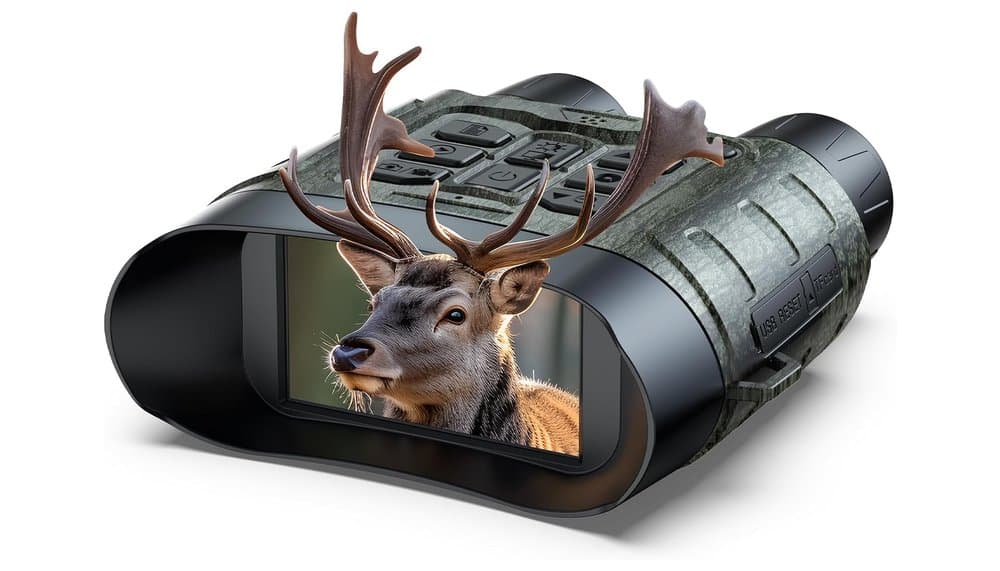
On paper, the HOTPEAK NV01 relies on impressive numbers to stand out. With an advertised photo resolution of 112 megapixels and a 12x digital zoom, it promises to capture very distant details, which is interesting for discreet wildlife observation. According to user feedback, the image quality in low-light conditions is often considered decent for its segment, and the 16-hour battery life in day mode (about 10h with infrared) is unanimously praised as a real strength for long expeditions.
However, analysis of reviews also reveals concrete limitations. The "112MP" label actually corresponds to software interpolation, and photos at native resolution are of a lower definition, which some buyers noted with disappointment. The purely digital zoom can cause significant loss of sharpness when pushed to the maximum. The plastic construction, while light (490g), is perceived by part of the community as less premium and potentially less shock-resistant than a metal housing. Finally, while the range is 400m, some reviews point out that clarity at this maximum distance greatly depends on conditions of total darkness.
For whom? This model seems suitable for the user primarily seeking a powerful zoom and marathon battery life for long sessions, and who is aware of the compromises of digital zoom and lightweight construction.
Haokoo Night Vision Binoculars
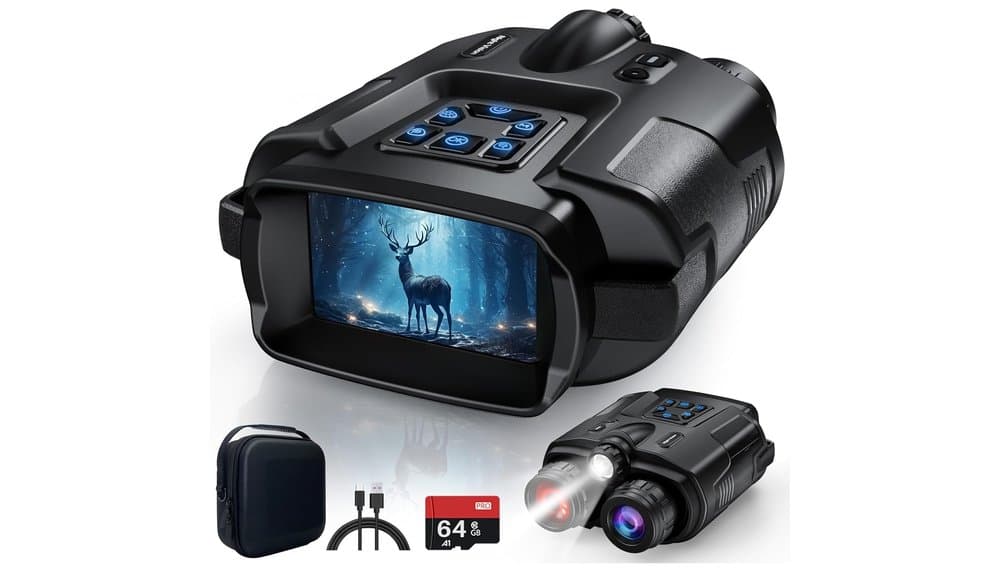
The Haokoo binoculars adopt a different approach, highlighted by their technical specifications. Its main asset lies in the combination of a 5x optical zoom and an 8x digital zoom. According to feedback, the optical zoom provides superior base stability and sharpness compared to purely digital zoom, which is appreciated for tracking moving objects. With a claimed range of 600 meters and a 3W IR lamp, it is the most performant model in the selection on paper for seeing far in the dark.
Reviews also converge on the robust construction. The metal housing and IP65 waterproof certification are strong arguments for outdoor activities in wet or dusty conditions. The inclusion of a multifunctional tactical lamp (flashlight, strobe, SOS) adds practical utility for hiking or camping.
The points of caution noted by the community mainly concern the weight (636g, the heaviest here) which can become tiring during prolonged handheld use. Some users also mention that the 3-inch screen, while adequate, could offer a higher definition to better take advantage of 4K videos. Finally, although the range is significant, as with all active infrared systems, it is reduced in the presence of fog or rain.
For whom? This is the preferred choice for those who value ruggedness and waterproofing for intensive outdoor use, and who seek the best possible range, even if it means accepting a heavier weight.
HOTPEAK NV02 Pro
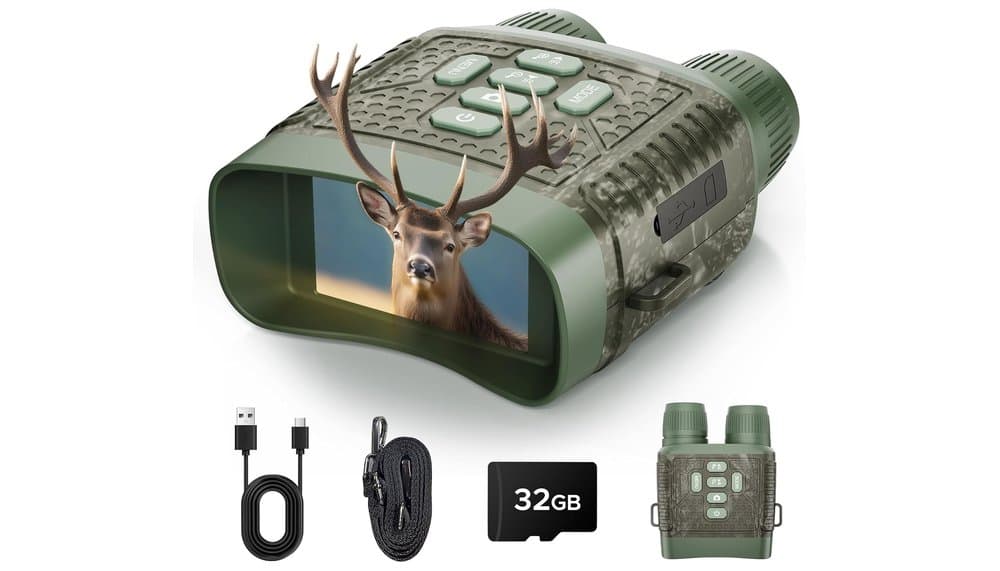
The HOTPEAK NV02 Pro positions itself as a balanced compromise. Its specifications, with a 10x zoom and 48MP/4K resolution, sit between the two other models. The community notes with satisfaction its compact design and contained weight (440g), which make it pleasant to handle for long periods. Its battery life, similar to the NV01 with up to 15 hours of daytime use, is also a major argument.
User feedback highlights the ease of use and general image quality for its price. The inclusion of a USB-C port for transfer and charging is an appreciated modern touch. However, the typical limitations of this segment also emerge: the effective range (460m) is lower than the Haokoo's, and the zoom, while extensive, remains digital, with the associated loss of quality at its full potential. The included 32GB memory card is also less generous than the 64GB cards of the other two models, which may require an additional purchase for very long outings.
For whom? The NV02 Pro targets the user looking for an overall good balance: respectable performance, solid battery life, a handy format, and who doesn't necessarily need the ultimate range or the waterproof ruggedness of the Haokoo model. It is a very good candidate for a versatile introduction to night vision.
Field Gear: Waterproofing, Weight, and Essential Accessories
All the technique in the world is useless if your binoculars fail at the first drizzle or are so heavy you leave them in the car. Let's get concrete about what makes them truly operational.
Construction That Withstands the Elements
In the field, the weather changes, condensation forms, and shocks happen. Three things are non-negotiable. First, waterproofing. Look for the indication "waterproof" or better, a standard like IPX7. This guarantees the housings are purged with nitrogen and sealed. No internal fogging, even when moving from a warm interior to a cold, damp exterior. Next, robustness. A rubber-armored coating isn't just a "tactical" look. It absorbs shocks, offers a better grip, and insulates from the cold. Finally, frankly, avoid models with buttons or dials that are too fragile or poorly protected. An adjustment knob that snags in your bag is a guarantee of a bad surprise at the critical moment.
The Real Weight of Comfort
Weight is a misleading figure. 800 grams seems acceptable on paper. But hold them in front of your eyes for twenty minutes, and you'll understand. The real problem is balance. A well-balanced pair is more comfortable to hold than a lighter one whose center of gravity is too far forward. For prolonged handheld use, aiming for a weight under 1 kg is a good target. Beyond that, you'll seriously consider a support. And speaking of that, the supplied strap: replace it immediately with a binocular harness. It's a game-changer. The weight is distributed across your shoulders and back, no more marks on your neck, and your binoculars are always ready, without bouncing around.
Accessories That Make the Difference
You're not just buying binoculars, you're equipping a practice. Here's what really matters:
- Batteries/Power cells: Digital or intensifier models are power-hungry. Always have a spare charged set in a waterproof case. Nothing worse than seeing an otter emerge from the water as your battery indicator flashes.
- The tripod and adapter: As soon as you use magnification above 6x or observe for long minutes, it's essential. A perfectly stable image reveals details invisible when handheld. Check that the chosen model has a standard mounting screw (1/4").
- The case: The supplied one is often just a simple foam pouch. Invest in a rigid or semi-rigid case for difficult transport. For home storage, a simple airtight box with a silica-gel packet will protect against mold.
Remember: the best night vision binoculars are the ones you want and are able to take with you, in all weather, to the very limit of your patience.
Observing Wildlife at Night: From the Hiker to the Demanding Naturalist
You will not use the same tool to identify an owl in a woods from a trail as you would to study beaver behavior on a pond for hours. Your practice dictates your needs.
The Night Hiker or Curious Observer
You go out for a walk under the stars, you want to scan a silhouette in a field or spot a shelter. Your priority is versatility and responsiveness. Here, a good pair of digital binoculars with a decent sensor can be a smart choice. Why? They often tolerate stray lights without damage (a distant car headlight is not fatal), and some even offer a day/night mode. Look for a lightweight model (under 900g), with modest magnification (4x or 5x) for a wide field of view and a stable image. A good starting point. But be careful, for truly identifying an animal in near-darkness, their limitations quickly appear if the sensor is too small.
The Photographer-Naturalist and Recording
Here, we enter another dimension. If you wish to capture images or videos for documentation, digital is almost essential. The ability to record directly, often onto an SD card, is a major asset. But don't be fooled by marketing: sensor resolution trumps everything. A 1/2" sensor will perform much better in the dark than a tiny 1/3". Also aim for good optical zoom, as digital zoom degrades the image. A tip: these models are often compact blocks. Ergonomics for a long session are crucial. Well-placed buttons, an intuitive interface. And plan for external batteries, as the screen and sensor are very power-hungry.
The Enthusiast of Nocturnal Mammals or Light Astronomy
This is the domain of Generation 2+ image intensifiers for serious budgets. You want to follow the discreet movements of a badger, distinguish the details of a fox's fur at 50 meters in a very dark forest, or observe lunar terrain with crystalline clarity? Image quality and sensitivity in deep shadow become paramount. Here, the decisive criterion is the figure of merit (tube resolution x gain). It is this number that separates the "usable" image from the "revealing" image. Ocular comfort is also crucial: a long "eye relief" (18mm or more) is essential if you wear glasses. These models are specialized instruments: heavy, delicate, and expensive. But for the demanding observer, the difference is abyssal.
Choosing Your Observation Post
The technique in your hands is not everything. Your strategy in the field is just as important. Avoid facing a direct light source, even a distant one. Use vegetation as a support to stabilize your elbows. And above all, give your eyes, and the device, time to acclimate to the darkness. The best night vision binoculars for you are those that match your level of demand for detail and limiting conditions. A happy amateur with simple equipment in a moonlit clearing is already a great victory.
Budget and Maintenance: Investing Durablely Without Mistakes
Let's be frank, good night vision binoculars represent an investment. And the purchase price is only one part of the equation. You have to think about hidden costs and how to protect this purchase long-term, otherwise it's money thrown out the window.
Understanding Investment Tiers
Don't just look at the number on the price tag. Think in terms of "total starting budget". Here is what you absolutely must include in your calculation, in addition to the price of the binoculars themselves:
| Investment Tier | Cost of Binoculars (indicative) | Additional Costs to Plan For |
|---|---|---|
| Beginner & Versatility | 200 € - 600 € | Quality rechargeable batteries + charger (30-50€), rigid protective case (40-80€), microfiber cloth and silica gel. |
| Serious Practice & Performance | 600 € - 1500 € | All of the above, plus a sturdy tripod and suitable head (150-300€), a dedicated backpack, and potentially filters (anti-glare, infrared). |
| Expertise & Extreme Conditions | 1500 € and up | A significant budget for professional maintenance (re-alignment, internal cleaning), proprietary replacement batteries (often very expensive), and a secure transport case. |
The rule? Budget approximately 15 to 20% of the purchase price for essential accessories. If that number seems unreasonable, perhaps you're aiming for a model too high-end for your actual use.
Daily Maintenance: A Religion
These instruments hate moisture, shocks, and… your fingers. The front lens of the best night vision binoculars is often coated with delicate treatments. Always blow dust away before wiping, with a soft small brush. Use only a perfectly clean microfiber cloth and a product designed for optics. Never use fabric, tissue paper, or household cleaner! It's the difference between a perfect image for ten years and a permanent halo in your field of vision after two seasons.
For models with intensifiers, an absolute rule: avoid intense light sources. Accidentally pointing towards a streetlight or a flashlight can burn the photocathode tube and cause permanent damage. It's like looking at the sun with a telescope, but worse. Always activate the objective lens cap before storing.
The Question of Warranty and Customer Service
This is a point too often overlooked. A brand with a good repair network in France or Europe is often worth more than an attractive offer without identifiable after-sales service. Check the warranty duration (2 years is a minimum) and especially what it covers. Is waterproofing guaranteed for life? Intensifier tubes have a limited lifespan (several thousand hours): is their replacement possible and at what cost? For digital models, firmware updates can fix bugs. Does the brand offer this service? Asking these questions before buying ensures your night companion doesn't become an expensive paperweight at the first hiccup.
Conclusion
You are now equipped to choose your night vision binoculars with full knowledge.
Think about your outings, about what you really want to see. Then, follow the thread: technology, brightness, ruggedness.
It's a piece of equipment that opens a new world. That of the night, alive and fascinating.
So, make your choice. And enjoy the show.
Frequently Asked Questions
What is the best night vision technology?
Digital models are the most versatile for an amateur because they see in total darkness thanks to their IR illuminator and can record videos. Generation 2+ intensifiers offer the best pure image performance for experts, while Generation 1 is limited to clear nights with residual light.
How to calculate the brightness of night vision binoculars?
The key is the exit pupil, calculated by dividing the objective lens diameter by the magnification (e.g., 40/4 = 10mm). For optimal comfort at night, aim for an exit pupil of at least 7mm to match the eye's dilated pupil.
What magnification to choose for night vision binoculars?
For handheld use, a magnification between 4x and 6x is ideal for a stable image and a wide field of view. A higher magnification (8x or 10x) amplifies shake too much and almost always requires a tripod.
Are digital night vision binoculars better than Generation 1?
Yes, digital models generally surpass Generation 1 because they function in total darkness with their IR illuminator and are immune to damage from bright lights. They also often offer recording functions, unlike basic Gen 1.
What budget to plan for serious night vision binoculars?
You should anticipate an additional budget of 15 to 20% of the purchase price for essential accessories like a tripod, a hard case, and spare batteries. Models for serious use start around €600, not including these accessories.
Which binoculars for observing animals at night?
For occasional observation, digital binoculars with at least a 1/2" sensor and optical zoom are a good choice. For detailed study of nocturnal mammals, Generation 2+ intensifiers are significantly superior in sensitivity and resolution.
100% free and independent — All our articles are written independently, without any sponsorship. We may earn a commission on purchases made through our links, at no extra cost to you.
Guides you might like
Astrophotography Telescope Buying Guide
Choose the right telescope for astrophotography to avoid frustration. Key factors depend on your target nebula or object.
Best Binoculars Value Guide
Find value binoculars that match your real needs. Understand specs like 8x42 and key features for the best observation without overspending.
Best Nature Binoculars Kids
Discover how to choose the perfect first binoculars for a child, focusing on lightweight design, ergonomics, and sparking a love for nature observation.
Articles you might like
Caytail 4K 48MP Hunting Camera Review & Test
In-depth review of the Caytail 4K 48MP trail camera with included SD card. We analyze specs and real user feedback on its true field performance.
Vanguard Endeavor HD65A Spotting Scope Review
Spotting scope with 65mm ED glass & 15-45x zoom for birding & hiking. Balanced performance & portability for serious nature observers.
Carson AdventurePak Kids' Exploration Tool Kit Review
Explore nature with this kid's 5-piece tool kit for outdoor adventure and educational discovery. Perfect for young explorers.