Bresser Junior 6x21 Binoculars Review
Published on 12 May 2026 · By OptiqueNature
Review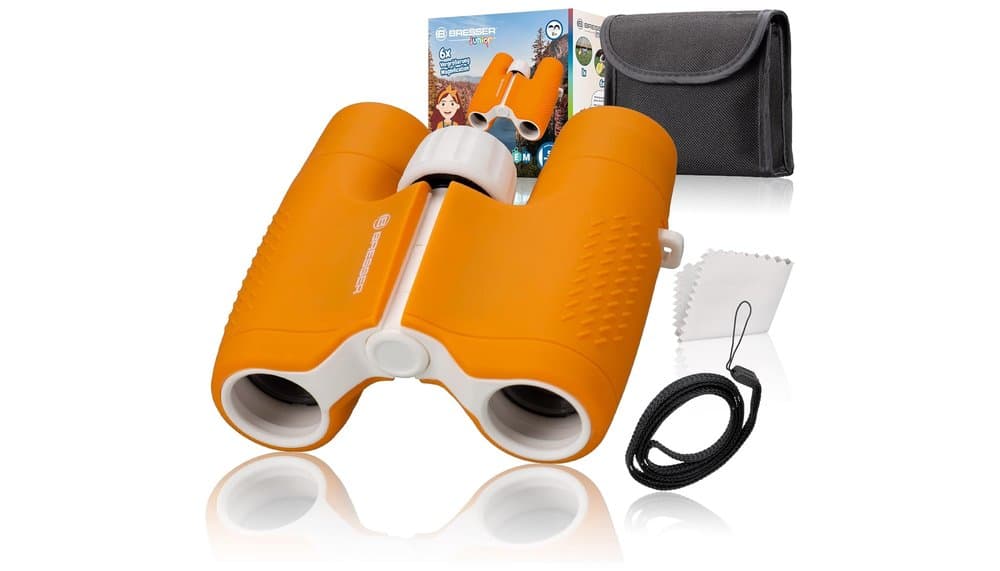
Introduction
The first steps into observing nature are decisive moments. Capturing a child's attention, sparking their desire to explore and understand their environment requires a suitable tool, simple and robust. The Bresser Junior 6x21 Binoculars for Kids presents itself as a gateway to this world. But in a market where offerings range from plastic toys to optics seriously designed for young people, where exactly does this model stand? We conduct here a complete analysis, not based on personal testing, but on a rigorous examination of the technical specifications provided by Bresser and on synthesizing the numerous feedback from the community of users and reviewers.
Our objective is to determine if these binoculars offer a valid optical experience that can awaken a passion, or if they remain confined to the status of a gadget. We will analyze their build, their visual performance in various contexts (birds, hiking) and their value for money against the competition.
Strengths and Weaknesses
Before going into detail, here is a summary of the strengths and limitations of the Bresser Junior 6x21, as they emerge from the available data.
Strengths
- Ergonomics and durability designed for children: The rubberized surface offers an excellent grip and good shock resistance. Its featherweight 168 grams is unanimously praised.
- Ease of use: The central focusing is intuitive and easy to operate for young fingers. The interpupillary distance adjustment is also present.
- Relevant included accessories: The transport pouch with Velcro closure and the wrist strap are practical additions greatly appreciated by parents for protection and against loss.
- Adequate eye relief for glasses wearers: Foldable eyecups and an eye relief of 15 mm allow for use with glasses, a rare point in this segment.
Weaknesses
- Basic optics: The specifications and feedback indicate this clearly: it is squarely an entry-level optic. The lenses do not have the advanced coatings (phase coatings, dielectric prisms) found on models for adults, even budget ones.
- Lack of waterproofing: The binoculars are not waterproof and not nitrogen-purged. They will not withstand rain or strong temperature variations that could cause internal fogging.
- Relatively narrow field of view: Although typical for a 6x21 format, the field of view is not a standout strength that particularly distinguishes it from low-priced competitors.
- Inconsistent build quality: A few user reports mention issues with centering or collimation (alignment of the two channels) on some units.
Detailed Performance Analysis
Optical Quality and View
On paper, the specs announce a 6x magnification and an objective lens diameter of 21 mm. This configuration is intelligent for a junior target. The low magnification ensures image stability, minimizing shake, and an exit pupil of 3.5 mm (21/6) is generous for daytime observation, facilitating eye placement.
However, this is where the product shows its limits. According to the specifications and confirmed by some more critical reviews, the binoculars do not incorporate Extra-low Dispersion (ED) glass and the coatings on the prisms and lenses are basic. The light transmission is not disclosed, which is revealing: it is sufficient for daytime but will drop quickly in low-light conditions (dense forest, late afternoon). The twilight factor, calculated at √(6x21) ≈ 11, is low, confirming that usage is strictly diurnal.
The minimum focusing distance is not specified in the general specs but is in the detailed technical specs at 52 mm interpupillary distance, suggesting an ability to observe close objects, useful for insects or details. The angular field of view is also not given, but the 6x21 format generally leads one to anticipate a correct but not exceptional field, around 6-7°.
Build and Ergonomics
This is an area where the Bresser Junior 6x21 receives praise. The rubber cladding is not just an aesthetic gimmick. The community notes that it offers a secure grip and good protection against minor shocks. The weight of 168 g is consistently cited as a major advantage, allowing for long observation sessions without fatigue for small arms.
The focus adjustment via a large central wheel is described as smooth and accessible to children. The foldable eyecups are a real plus, allowing for immediate use with or without glasses. The interpupillary distance (from 52 to 66 mm according to the detailed sheet) is suited to children's faces.
The black spot is weather resistance. It is clearly stated "Not Water Resistant". These binoculars fear water and internal fogging. This is a significant limitation for a product intended for outdoor nature use, where a rain shower or a simple temperature change between indoors and outdoors can be problematic.
Usage by Discipline
- Bird watching (beginner): Suitable for initiation in the garden or park. The 6x is enough to observe common birds at a reasonable distance. The lack of brightness and sharpness will make identifying fine details on distant subjects or in shadows difficult.
- Hiking and discovery: Ideal for this scenario. Light, sturdy, and simple, it allows the child to "do like the grown-ups" and observe the landscape, a distant animal, or an interesting detail.
- Sporting or cultural events: The compactness and ease of use make it a good companion for family outings to stadiums or open-air theaters.
- Astronomy: Very limited. The small objective diameter and lack of high-performance coatings only allow observing the Moon with some detail. Planets and deep-sky objects will remain mere points of light.
Technical Specifications Table
| Feature | Bresser Junior 6x21 Specification |
|---|---|
| Configuration | 6x21 |
| Prism | Roof |
| Optical Coatings | Not specified (basic) |
| ED Glass | No |
| Field of View (at 1000m) | Not disclosed |
| Close Focus | Not disclosed |
| Eye Relief | 15 mm |
| Eyecups | Foldable rubber |
| Focusing | Central |
| Waterproof / Nitrogen Purged | No / No |
| External Coating | Rubber |
| Weight | 168 g |
| Dimensions (L x H x W) | 90 x 100 x 35 mm |
| Included Accessories | Belt pouch, wrist strap, cleaning cloth (sometimes), manual |
What Users and Reviewers Say
An analysis of the 162 overall reviews, with an average rating of 4.6/5, reveals very clear trends.
Praise is predominant and convergent:
- Perceived value for money is excellent for a first pair of binoculars. The phrase "perfect for starting out" comes back as a leitmotif.
- The lightness and handling are the most cited advantages. Parents emphasize that their children can use them for a long time without complaint.
- The sturdiness of the rubber cladding is frequently mentioned, reassuring against inevitable drops.
- The image quality is deemed very decent for the price and use by the vast majority. Comments like "clear and sharp image", "sufficient magnification" are typical.
- The accessories (especially the pouch) are considered a real practical plus.
Criticisms, although in the minority, are instructive:
- A few users point out a limited optical quality, with images potentially lacking sharpness at the edges or contrast. One review sums it up: "the optical quality is very, very low".
- Collimation (alignment of the two images) can be faulty on some units, causing visual discomfort. This suggests variable quality control on the production line.
- The lack of a neck strap is noted, the wrist strap being the only carrying method.
- For some younger children (around 4 years old), the grip and adjustment can still be a bit tricky despite the dedicated design.
Conclusion: Who Are They Really For?
The Bresser Junior 6x21 Binoculars for Kids is not a performance optic. It will not rival mid-range models for adults in terms of clarity, brightness, or field of view. Its lack of waterproofing is a real handicap for serious naturalist use in all weather conditions.
However, our analysis shows that it fulfills its primary role perfectly: being an excellent tool for initiation that is robust, secure, and simple. For a child aged 5 to 10 discovering the world with their eyes, who needs an object sized for them, light, and that will survive adventures in the garden or on family outings, these binoculars represent a very judicious choice. The presence of foldable eyecups even makes them usable by a teenager or an occasional adult looking for an ultra-compact and economical pair for events.
The verdict is therefore nuanced but positive within its segment. If you are looking for a true observation instrument for a young enthusiast already at ease, you will probably need to look towards more accomplished models, often waterproof, with better quality optics. But if the goal is to offer a successful first experience, without breaking the bank and with the guarantee of a product suited to children's hands and clumsiness, the Bresser Junior 6x21 stands as a serious option, highly endorsed by the community of parent-users. It is a well-designed springboard into the world of observation.
100% free and independent — All our articles are written independently, without any sponsorship. We may earn a commission on purchases made through our links, at no extra cost to you.
Articles you might like
Carson AdventurePak Kids' Exploration Tool Kit Review
Explore nature with this kid's 5-piece tool kit for outdoor adventure and educational discovery. Perfect for young explorers.
BOSTRON CY 10x50 Monocular Review & Test
Compact 10x50 monocular review: Analyzes optical clarity, field of view & build quality for hiking, nature & astronomy. See its true value.
FunKind HC600Pro 4G Trail Camera Review
FunKind HC600Pro solar-powered 4G trail camera review. Analyzes real-time wildlife monitoring specs, solar/battery power, and performance data.
Guides you might like
WiFi Trail Camera Guide
See wildlife discreetly from your couch! Learn how WiFi trail cameras let you monitor animals without disturbance and how to choose the right one.
Ultimate Travel Telescope Guide
Choose a portable, high-performance travel telescope to explore the universe from your backpack without compromising on essential astronomical views.
Ultimate Guide to Night Vision Binoculars
Choose the perfect night vision binoculars: Gen vs. digital? Unravel the tech to make your nighttime wildlife adventures a total success. Guide inside.