Birdwatching Telescope Buying Guide
Guide
Choosing your first birdwatching spotting scope is a bit like finding yourself in the middle of a forest without a marked trail: the numbers, the technical terms, everything seems a bit obscure at first. However, the joy of observing a kinglet in minute detail, of discovering the color of a kestrel's iris without disturbing it, is priceless. Honestly, with a few key concepts, you can avoid the pitfalls and find the instrument that suits you. I'll guide you to see things more clearly.
Key Points to Remember
- Prioritize a balance between magnification, objective lens diameter, and field of view rather than chasing maximum magnification.
- Opt for ED (Extra-low Dispersion) glass and nitrogen waterproofing for a sharp image and durable equipment in the field.
- Adapt your choice to your practice: weight and compactness for hiking, large objective lens for fixed observation.
- A stable and robust tripod is essential to exploit the full potential of your spotting scope.
Deciphering Specifications: Magnification, Objective Lens, and Field of View
Spotting scopes are often designated by two numbers, like 20-60x80. Don't let this code intimidate you! The first number is the magnification, the second is the diameter of the objective lens in millimeters. This is the starting point for your entire choice.
Magnification: The Promise... and Its Limits
A 60x magnification is tempting, I know. You can already imagine counting the feathers on a falcon 300 meters away. But reality is more complex. With such magnification, the slightest tremor in your hands is amplified, making the image unusable without an extremely stable tripod. Worse, the atmosphere itself (the heat shimmering over a field in summer) creates visible turbulence, a "boiling" image. For hand-held observation, stay between 20x and 30x maximum. For tripod use, a versatile range like 20-60x is ideal: you zoom down to 20x to locate the bird easily (the field of view is wider), then you zoom in for details. Frankly, a fixed 30x magnification is often brighter and sharper than a zoom pushed to its maximum.
Objective Lens Diameter: The Key to Light
This is it, the second number (the 80 in 20-60x80), which makes all the difference in low light conditions — at dawn, dusk, or under overcast skies. A 65mm objective lens gathers light well, an 80mm gathers much more. Here is a concrete example: with a 20-60x80 spotting scope, you will still be able to distinguish the subtle plumage markings of a shorebird at dusk, whereas a 65mm will render the image dark and lack detail. But this gain comes at a cost: weight, bulk, and price. This is the first major compromise to make.
Field of View: Don't Lose Sight of the Bird
It's talked about less, but it's crucial. Expressed in meters at 1000m distance (e.g., 33m/1000m), it indicates the width of the scene you see. A wide field is essential for following a bird in flight or quickly locating a subject in vegetation. In general, the higher the magnification, the narrower the field becomes. This is why zooms at their lowest magnification often offer the best field. Compare this data between models; it will tell you a lot about their "fast" and pleasant character in the field.
To summarize these three elements:
| Specification | What it provides | The pitfall to avoid |
|---|---|---|
| High Magnification (e.g., 60x) | Details at very long distance. | Extreme instability, "boiling" image in high heat, very narrow field of view. |
| Large Objective Lens (e.g., 80mm) | Bright, detailed image in low light. | Heavy, bulky, and more expensive spotting scope. Often requires a sturdier tripod. |
| Wide Field of View (e.g., >40m/1000m) | Easy location, tracking of moving subjects, comfortable observation. | Often associated with low magnification or high-end models. |
My friendly advice? Don't chase maximum magnification. A better birdwatching spotting scope is often one that offers a good balance: an objective lens large enough for your practice (a 65mm may suffice in full daylight), a reasonable zoom range, and a generous field of view. It's this balance that makes the difference between frustrating observation and hours of pleasure.
Optical Quality: From Lens Treatments to Waterproofing
Once you understand the numbers, you get to the real subject: image quality. Because two spotting scopes displaying 20-60x80 can offer a radically different experience. Everything hinges on the materials, the treatments, and the construction.
Special Lenses: The Magic of Acronyms (ED, HD, Fluorite)
You will encounter them often. These so-called "low dispersion" lenses (Extra-low Dispersion, HD, etc.) have a simple but essential mission: to reduce chromatic aberrations. Concretely, without them, on strong contrasts (a white grey heron silhouetted against a grey sky), you will see unpleasant purple or green fringing on the edges. With them, the image is clean, the colors are faithful, and the contrast is better. It's one of the clearest markers between entry-level and higher-end models. Frankly, for serious birding where feather detail matters, it's an investment that is immediately noticeable.
Multicoated Treatments: Every Photon Counts
Light, upon entering the spotting scope, strikes many glass surfaces. Each time, a portion is reflected and lost. Anti-reflective coatings, especially if they are multicoated on all surfaces (often noted as "FMC"), maximize light transmission. The result? An image that is brighter and has more contrast, especially in the shadows. Look into the eyepiece, facing a light source: if the reflections you see are emerald green or dark violet rather than bright white, it's a good sign. It's that little extra that makes the difference at the end of the day.
Waterproofing and Nitrogen Purge: Built to Last
Birding means rain, morning humidity, sudden temperature changes. An optic that is not sealed will eventually see its internal lenses fog up irreparably. Ensure the model is waterproof (splash-resistant) and above all purged with nitrogen or argon. This inert gas, inserted into the body of the tube, drives out all residual moisture and prevents internal condensation. It's non-negotiable. A "waterproof" mention or a protection rating (IPX7) is your insurance for the years to come.
Mechanics: Smoothness and Precision
Good glass can be ruined by poor mechanics. Turn the focusing wheel. It should be smooth, precise, with no play or jerkiness. Focus that is too stiff or too loose will make finding sharpness exhausting, especially for tracking a bird in motion. The zoom ring should also turn evenly. Don't hesitate to test this in a store; it's the feel of your instrument.
Our Selection
Our Selection of Spotting Scopes for Nature Observation
Whether you are a passionate birdwatcher, hunter, or simply curious about wildlife and flora, a good spotting scope is an important investment. Our selection of the day compares three distinct models: a good value for money option, a choice for experts, and a very high brightness option. Here is our comparative analysis, based on technical specifications and feedback from the user community.
| Product | Magnification | Objective Lens Diameter (mm) | Weight (kg) | Key Strengths |
|---|---|---|---|---|
| SVBONY SV406P | 20-60x | 80 | 1.63 | ED glass, dual focus, compactness |
| Vanguard Endeavor HD82A | 20-60x | 82 | 1.89 | BaK-4 prism, advanced multi-coating, excellent finish |
| Bresser Pirsch 25-75x100 | 25-75x | 100 | 2.14 | Very high brightness, versatility, perfect for digiscoping |
SVBONY SV406P
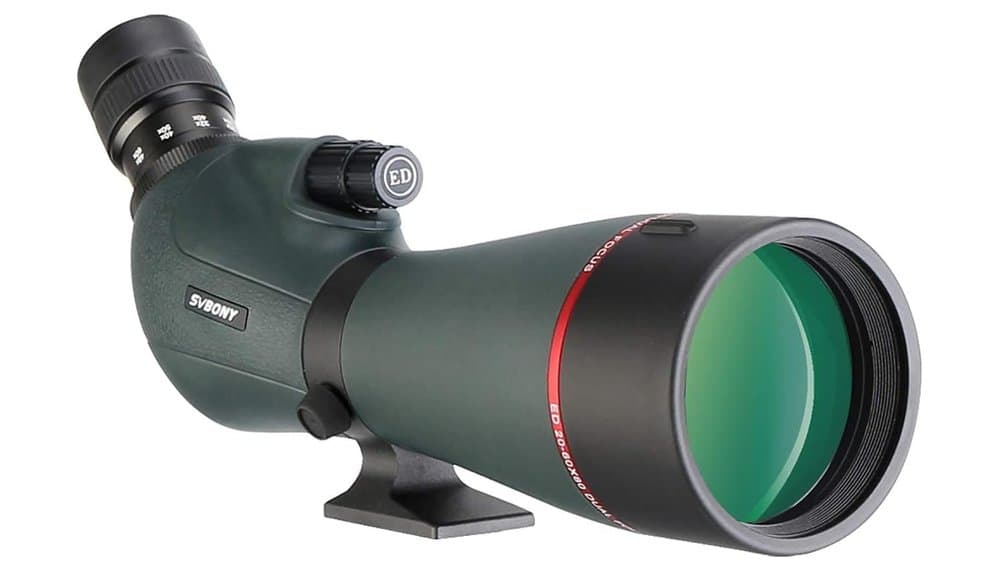
The SVBONY SV406P positions itself as an ambitious entry-level spotting scope. On paper, its technical specifications are enticing with an 80 mm objective lens made of Extra-low Dispersion (ED) glass promising sharp images and reduced chromatic aberration. Its 20-60x zoom offers great versatility for close observation as well as for significant distances. According to customer reviews, the dual focus system (coarse and fine) is appreciated for its precision, although some note a learning curve to master the two knobs.
User feedback highlights two major strengths. First, its compactness and contained weight (1.63 kg) make it an easy field companion to transport. Second, its performance-to-price ratio is very often praised. However, the community also points out some limitations. The IPX7 waterproof rating is an asset, but the eyepiece coating is sometimes judged less effective in extreme backlight conditions, with possible glare. Finally, the included zoom eyepiece offers good versatility, but image purists recommend, for prolonged sessions, investing in high-quality fixed eyepieces for increased visual comfort. It is an excellent choice to get started or for occasional use without breaking the bank.
Vanguard Endeavor HD82A
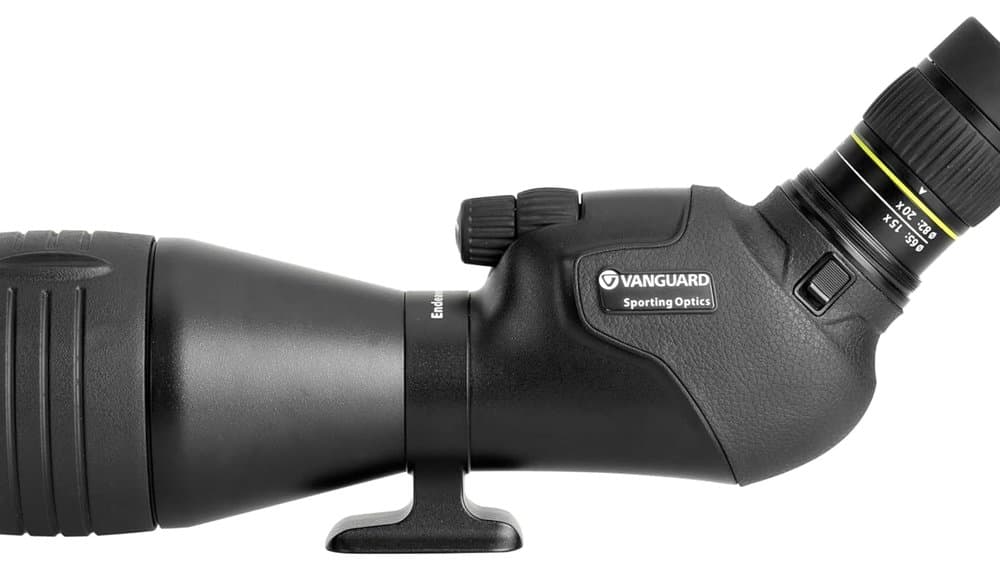
The Vanguard Endeavor HD82A embodies the high-end spotting scope for the demanding observer. Its specs announce an 82 mm objective lens combined with MultiGuard multi-coated optical treatments and a BaK-4 prism, promising optimal light transmission and faithful colors. Its magnesium body gives it notable robustness without excessively weighing down the unit (1.89 kg). According to feedback, the build quality is unanimously praised, with a finish that inspires confidence for use in difficult conditions.
Where this model stands out, according to experienced users, is in its performance during the "golden hours" (dawn and dusk). Clarity and contrast remain excellent even in low light, which is crucial for wildlife observation. The precise focus knob and the reduced minimum focusing distance (about 6 meters) are also major assets for tracking close or moving subjects. The main point of caution raised by the community concerns its slightly larger size compared to 80 mm models, requiring a stable tripod to fully exploit its potential. It is the tool of choice for the serious birdwatcher or naturalist who does not compromise on image quality.
Bresser Pirsch 25-75x100
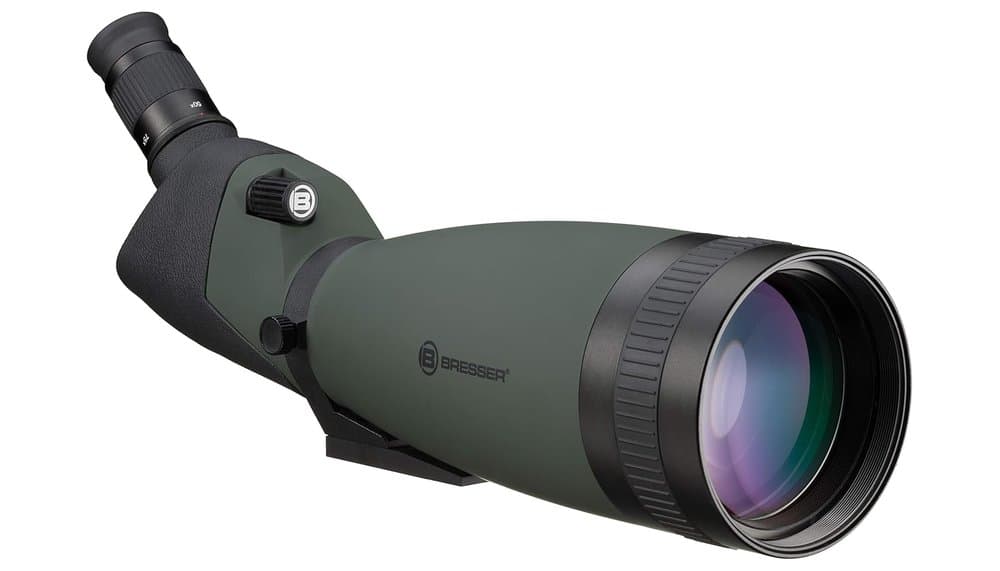
The Bresser Pirsch 25-75x100 bets everything on power and brightness with its imposing 100 mm diameter objective lens. This model is designed for those seeking strong magnifications (up to 75x) and maximum light capture, ideal for very long-distance observation or in low-light conditions. Its waterproof and robust body makes it an instrument suited for intensive outdoor use.
Feedback from hunters and shoreline observers highlights its exceptional resolving power at long distances. The versatility of the 25-75x zoom is appreciated, and its native compatibility with digiscoping (taking photos via smartphone or camera) makes it a product favored by those who wish to immortalize their observations. However, the community notes inherent compromises with this design. At 2.14 kg, it is the heaviest and bulkiest in our selection, requiring a solid tripod and often a dedicated carrying bag. Furthermore, at its maximum magnification (75x), atmospheric stability (haze, air turbulence) becomes a crucial limiting factor, and the image can lose sharpness if conditions are not perfect. It is a specialist spotting scope for situations where light is scarce and distance is significant.
Adapting to the Terrain: Weight, Size, and Robustness
The best optics in the world are useless if they stay in the car trunk because they are too heavy to carry. It's a delicate balance: you must reconcile performance and practicality. Your style of observation should dictate this choice.
The Weight Dilemma: The Truth About the Numbers
Always look at the bare weight of the spotting scope, but also consider the total weight you'll carry. A 65 mm scope often weighs between 1200 and 1500 grams. An 80-85 mm model can easily exceed 1800-2000 grams. Add to that a sturdy tripod (1.5 to 2.5 kg) and a head, and your backpack gets heavy fast. For mountain hiking or long foot-based prospecting, every gram counts. A tip: if you walk a lot, aim for an objective of 65 mm or less. You sacrifice a bit of brightness at the end of the day, but you gain in comfort all day long.
Size: Backpack Dimensions
A spotting scope doesn't travel alone. Measure its length when folded and its diameter. A large 95 mm objective is impressive on a tripod, but it requires a dedicated and bulky bag. Compare these dimensions to those of your usual backpack. Some compact models, called "retractable objective" scopes, gain 10 to 15 cm in length when stored. This is a real plus for transport.
Construction: Rubber, Metal, and Shock Resistance
The terrain is rough. A magnesium body is lighter and more rigid than plastic, and it dissipates shocks better. A dense rubber coating doesn't just provide a good grip: it protects the optics from minor bumps and scratches. Also check the resistance to dust and water splashes (IP rating). A scope that can fall from its tripod onto grass or dirt must be able to take the hit without the collimation being knocked out of alignment.
Daily Practicality
Observe the small details. Is the focusing ring wide enough to be operated with thin gloves in winter? Is the objective lens cap attached to the body or does it risk dangling and falling off? These elements seem secondary, but in the field, they make the difference between a pleasant tool and a frustrating object. A better birding spotting scope for the traveler is above all a reliable scope, one that deploys quickly and withstands real-life use.
Finally, mentally test your typical day. Carrying 4 kg of equipment over 10 km of dike is very different from observing from a fixed point accessible by car. Your back and your motivation will thank you for having made a conscious choice.
Pairing Your Spotting Scope with Its Essential Accessories
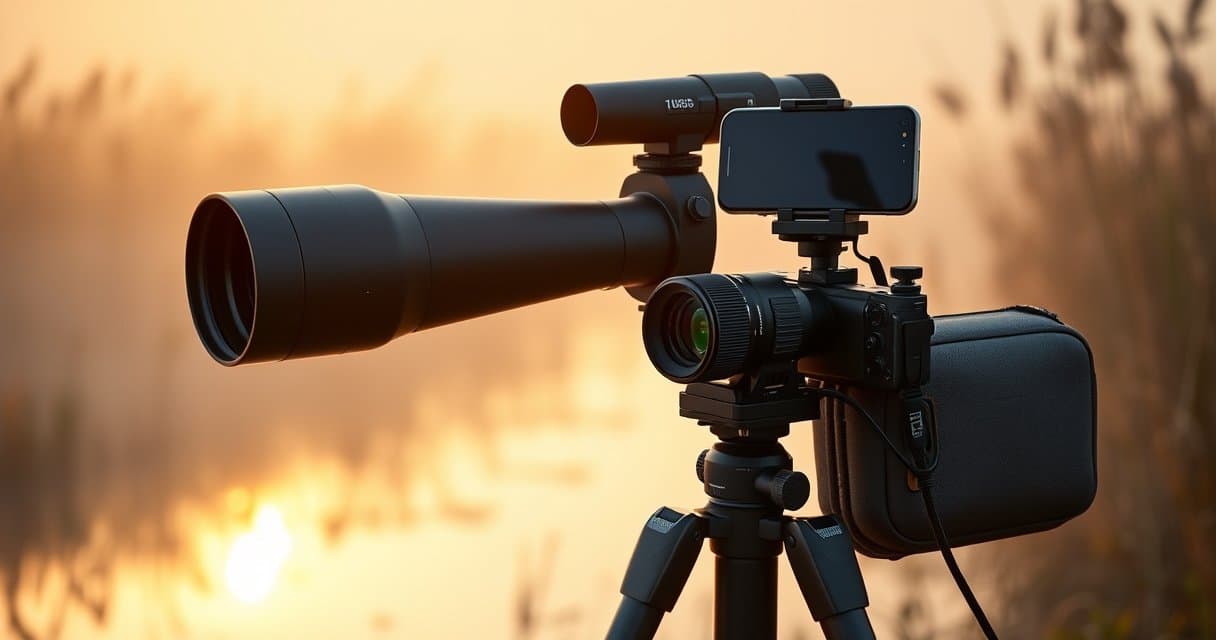
Buying a spotting scope without considering its accessories is like buying a sports car without wheels. You won't get far. The optics only reveal their full potential with a stable support and suitable complements. Let's review the essentials.
The Tripod: Your Pillar of Stability
Forget the small, lightweight tripods sold in kits. They are useless. At 60x magnification, even a light breeze will make the image vibrate. Aim for a tripod capable of carrying at least double the weight of your scope. For a 1.5 kg scope, a tripod with a maximum load of 3-4 kg is an absolute minimum. Height is crucial: set it up without extending the last leg section, otherwise it will become a wobbly mess. Carbon fiber is lighter and less cold to the touch, but more expensive. Aluminum is robust and economical, but heavier to carry. My opinion? If your budget is tight, invest more in the tripod than in a small additional lens.
The Tripod Head: Smoothness and Precision of Movement
A cheap tripod head is the number one enemy of precise observation. A smooth fluid friction head, often called a photo/video head, is much better suited than a ball head for birdwatching. It allows for smooth, controlled movements to follow a bird in flight or to recenter it gently. Check the quick-release system (the Arca-Swiss plate is a very practical standard). And frankly, a head that creaks, locks up in jerks, or has play ruins all the pleasure. This is a point where you shouldn't cut corners.
Digiscoping: Turning Your Smartphone into a Telephoto Lens
It's the revolution of the moment. A simple universal adapter allows you to attach your phone to the eyepiece. The result? Stunning photos and videos without investing in a camera costing several thousand euros. The key to success? Perfect alignment. Opt for adapters with micrometric adjustment that fit your specific smartphone model. Be careful, not all eyepieces are equally suited for this: an eyepiece with long eye relief and good contrast will yield better results. It's fun, and it completely changes how you share your observations.
Cases and Covers: A Question of Longevity
Your scope faces rain, dust, and shocks in the trunk. A padded transport case is non-negotiable for travel. In the field, a soft, lightweight case attached to the tripod allows you to store and retrieve the instrument quickly, while protecting it from branches and bumps. For long-term storage, consider a desiccant bag in the case to avoid any risk of internal fogging. These details preserve your investment over time.
Don't forget the little extras: a removable sunshade to avoid flares, a microfiber cloth always within reach, and why not a backpack with quick side access. A best spotting scope for birdwatching is always the heart of a well-thought-out system.
Choosing Based on Your Budget and Type of Observation
You don't choose the same spotting scope for watching an osprey 200 meters away by a lake as you do for tracking warblers in a dense forest. Your practice decides everything, and your budget gives you the means to your ambitions. Let's focus on what really matters for you.
The Beginner or Occasional Observer
You want to try it out without breaking the bank? The budget is typically around €150 to €400. At this price, aim for the essentials: an objective lens of 60 to 65 mm and a magnification of 20-60x. Don't expect miracles in low light, but for daytime outings, it's perfect. Weatherproofing (nitrogen) is now common even in this range, it's a must. Your main goal: learn to handle the instrument and see if the passion takes hold. One piece of advice: in this category, choose a brand known for its entry-level optics over an unknown brand with lofty promises. The optics will be decent, but it's the sturdy tripod that will really make the difference for your comfort. Don't invest everything in the tube.
The Passionate Hobbyist, Regularly in the Field
Here we get to the heart of the matter, with a budget of €400 to €1000. This is the best value-for-money zone. Is your practice intensifying? Are you starting to feel the limits of your first scope? Here, objectives of 70 to 82 mm become accessible, with ED (Extra-low Dispersion) glass that significantly reduces color fringing on high-contrast edges. The build quality is better, the focus is smoother. This is the ideal segment for someone monitoring migration from a fixed point, or observing in wetlands. The weight can increase, so if you're a hiker, look at "compact" models in 65 mm ED. They are expensive for their size, but their performance per gram is unbeatable. In my opinion, this is the best investment for serious progression.
The Professional or Demanding Purist
Above €1000, you pay for the last nuance of detail, brightness, and color fidelity. These are instruments for those with a trained eye who want the perfect tool. Objectives of 80 to 95 mm, high-end multi-coatings, ultra-precise focusing mechanisms. They excel in extreme conditions: at dawn, dusk, or for identifying juveniles backlit at very long distances. If your practice involves detailed study or professional digiscoping, this investment is justified. Otherwise, the difference from a good mid-range scope can be subtle for an untrained eye. Frankly, at this level, you must try before you buy.
Your Activity as Your Guide
- Hiking and Mobility: Weight and size are king. A 60-65 mm objective, even with lower magnification (15-45x), will be much more useful than a large model left at home. Durability is paramount.
- Observation from a Fixed Point (reserve, garden, seaside): Here, you can afford a large objective (80 mm or more) to capture maximum light and detail, without worrying about weight. This is the domain of very high-definition spotting scopes.
- Ambitious Digiscoping: Absolute priority on raw optical quality and image purity at the edges. A good eyepiece with long eye relief is essential. Here, the budget increases quickly, as your smartphone or camera sensor reveals all the weaknesses of the optics.
- Observation in Maritime or Humid Environments: Resistance to salt, certified waterproofing (IPX7), and hydrophobic coatings on the lenses are no longer options but necessities. Aim for ruggedness above all.
Your best birdwatching spotting scope will therefore be the one that disappears between your eye and the bird, offering you a crystal-clear window into its world. Don't choose it based on paper specs alone. If you can, test a model in real conditions, at dusk—that's when the differences become glaringly apparent.
Conclusion
Your choice lies before you.
A spotting scope is not just an assembly of glass and metal. It is your passport to the intimacy of the wild world, the ticket to moments of pure wonder.
Remember the essentials: your practice and your budget guide everything. Do not search for the perfect instrument, search for the one that will be perfect for you.
Go into the field. Test, compare. Let your eye decide.
Then set off on the adventure. The birds are waiting for you.
Frequently Asked Questions
Which spotting scope is best for hand-held bird observation?
For hand-held observation, choose a model with low magnification, between 20x and 30x maximum, as higher magnification would amplify hand trembles too much and make the image unstable.
What is the best magnification for an observation spotting scope?
A versatile magnification range like 20-60x is ideal, as it allows you to locate the bird at 20x with a wide field of view, and then zoom in up to 60x on a tripod to observe details.
Why choose an 80mm objective lens on a spotting scope?
An 80mm objective lens captures significantly more light than a 65mm model, which is essential for obtaining a bright and detailed image at dawn, dusk, or in overcast weather.
What are ED lenses on a spotting scope?
ED (Extra-low Dispersion) lenses reduce chromatic aberrations, such as colored fringes on the edges of birds, to provide a cleaner, more contrasted image with faithful colors.
Which tripod is needed for an ornithological spotting scope?
You need a robust tripod capable of supporting at least double the weight of your scope and whose usage height is achieved without extending the last leg section to ensure optimal stability.
100% free and independent — All our articles are written independently, without any sponsorship. We may earn a commission on purchases made through our links, at no extra cost to you.
Guides you might like
Astrophotography Telescope Buying Guide
Choose the right telescope for astrophotography to avoid frustration. Key factors depend on your target nebula or object.
Best Binoculars Value Guide
Find value binoculars that match your real needs. Understand specs like 8x42 and key features for the best observation without overspending.
Best Nature Binoculars Kids
Discover how to choose the perfect first binoculars for a child, focusing on lightweight design, ergonomics, and sparking a love for nature observation.
Articles you might like
Caytail 4K 48MP Hunting Camera Review & Test
In-depth review of the Caytail 4K 48MP trail camera with included SD card. We analyze specs and real user feedback on its true field performance.
Vanguard Endeavor HD65A Spotting Scope Review
Spotting scope with 65mm ED glass & 15-45x zoom for birding & hiking. Balanced performance & portability for serious nature observers.
Carson AdventurePak Kids' Exploration Tool Kit Review
Explore nature with this kid's 5-piece tool kit for outdoor adventure and educational discovery. Perfect for young explorers.