Best waterproof marine binoculars
Guide
Salt, sea spray, rolling decks: to face the marine environment, your binoculars need to be warriors, not pontoon upstarts. Choosing a truly waterproof model suited to navigation is simply a matter of safety equipment. Frankly, between unsuitable magnification that induces nausea and dull optics that miss a landmark in the mist, disappointments come quickly. Let's see how to find the pair that will hold the sea with you, in all weathers.
Key Points to Remember
- True waterproofing (IPX7 standard minimum and nitrogen purging) is essential, not an option, to withstand unforgiving marine conditions.
- The 7x50 format is the best compromise at sea, offering a stable image on a moving deck and excellent brightness at dusk or in fog.
- Prioritize BaK-4 glass prisms and a Fully Multi-Coated (FMC) treatment for a clear, bright image free from stray reflections.
- Rigorous maintenance, especially a systematic rinse with fresh water after every outing, is crucial to preserve the waterproofing and longevity of your binoculars.
- Tailor your choice to your program: priority on field of view for regattas, on versatility for coastal cruising, and on low-light comfort for bluewater sailing.
Waterproofing and Robustness, Much More Than Just a Label
Let's be clear: a binocular that simply claims to be "splash-resistant" has no place on a boat. The marine environment is merciless. It combines omnipresent humidity, corrosive salt, inevitable shocks, and sudden temperature changes. Your equipment must be designed for this, period.
The True Meaning of Waterproofing
When we talk about waterproofing, two specific things must be considered. First, the standard. You must aim for a minimum IPX7 certification. This means the housing can survive temporary immersion (usually 30 minutes) in one meter of fresh water. It's your safety net if they fall overboard. Some high-end models reach IPX8 (prolonged immersion at greater depth). Second, and this is just as crucial, comes nitrogen (or argon) purging. This process involves replacing the humid internal air with an inert gas. Why? To completely prevent fogging inside the lenses when the temperature changes abruptly – a classic phenomenon when you take binoculars from a warm cabin to use them on a cold deck. Without this, your optics are doomed to fog up at the worst possible moment.
A Construction Built to Last
Waterproofing is useless if the housing doesn't hold up. On the water, everything is amplified: UV rays degrading low-quality plastics, salt corroding untreated metals, shocks against a winch or the deck. The best waterproof marine binoculars have a magnesium alloy chassis covered with a thick rubber armor. This rubber is not just for looks; it provides an essential non-slip grip with wet or gloved hands, and it absorbs shocks like a hull. Frankly, an all-lightweight plastic housing might be fine for hiking, but at sea, it doesn't cut it. The weight, felt as a drawback on land, often becomes a guarantee of stability and construction quality once on board.
Seals and Weak Points
Waterproofing relies on seals, and these seals are the weak links. They are mainly located at the eyepieces, the central focusing wheel, and sometimes at specific buttons (for an integrated compass). These seals must be regularly inspected and, above all, protected. A valuable tip: after each use, especially in a saline environment, rinse your binoculars with lukewarm fresh water. Never use high-pressure jets, just a gentle stream. Then dry them with a soft microfiber cloth. This prevents salt residue from prematurely degrading the elastomer of the seals. A neglected pair will lose its waterproofing long before its optics wear out.
Understanding the Numbers: What Do 7x50 or 10x50 Really Mean?
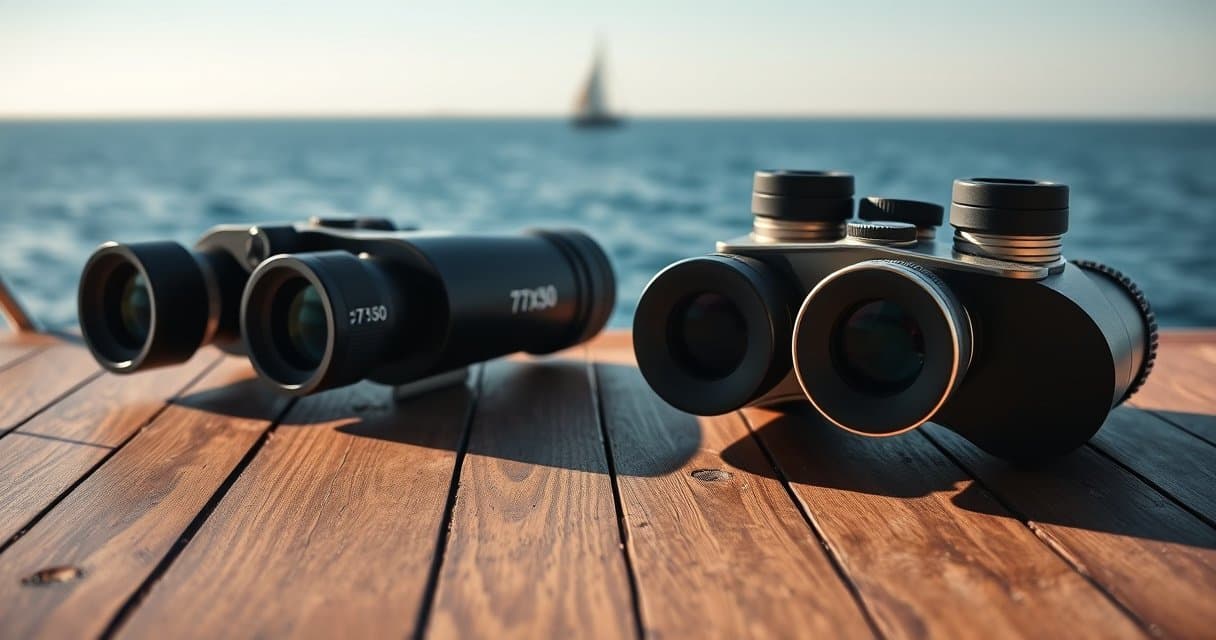
These two numbers, like "7x50," are the optical identity card of your binoculars. The first is the magnification, the second the diameter of the objective lenses (in millimeters). But on the water, these numbers take on a practical significance far beyond a simple marketing slogan.
Magnification (7x, 10x…): Stability versus Detail
The "x" tells you how many times closer the object appears. A 7x magnifies 7 times, a 10x magnifies 10 times. The temptation is to choose the strongest, but at sea, it's a trap. High magnification also amplifies all the movements of the boat. On a moving deck, a 10x demands a very steady hand and quickly becomes tiring to use for extended periods. The 7x, on the other hand, offers a much more stable and peaceful image to the eye. It is also generally associated with a wider field of view – essential for scanning the horizon quickly or following a drifting buoy. For me, the 7x50 remains the undisputed king for general navigation. Reserve the 10x50 for precise uses on a stable, stationary boat, or from dry land for observing details of a vessel offshore.
Objective Lens Diameter (50mm): The Key to Brightness
The second number, the 50 in 7x50, is the diameter of the large front lenses. The larger it is, the more light the binoculars gather. This is crucial for observations in low light: at dawn, dusk, in foggy weather, or for night watches. A 50mm is excellent, a 42mm is good, but a 30mm will often be insufficient as soon as the light fades. Beware, a large objective also increases weight and bulk. It's a compromise to consider.
The Winning Duo: Exit Pupil
This is the secret number that links the other two. To calculate it, divide the objective lens diameter by the magnification. A 7x50 gives an exit pupil of 7.1mm (50/7). A 10x50 gives 5mm. Why is this important? The larger this number is (ideally greater than 5mm), the brighter and more comfortable the image will be, because it corresponds to the size of your eye's pupil in darkness. A 7x50, with its large 7.1mm exit pupil, is perfect for night use. A 10x50, at 5mm, will already be excellent during the day but may seem a bit less bright when night falls. This is what makes formats like 7x50 or 8x56 reliable choices for the best waterproof marine binoculars: they ensure performance when conditions deteriorate.
Our Selection
Faced with the vastness of the horizon, whether at sea or on a coastal hike, a good pair of marine binoculars can make all the difference. The presence of an integrated compass makes it a full-fledged navigation tool. To help you see more clearly, we have analyzed three popular 7x50 and 10x50 binocular models with a compass, based on their technical specifications and feedback from the user community. Here is our comparative selection.
| Product | Magnification & Objective | Strengths (based on reviews) | Waterproofing & Durability | Community Notes |
|---|---|---|---|---|
| Bushnell Navy 7x50 | 7x | Exceptional brightness in low light, ease of use | Waterproof, fog-proof (nitrogen purged), rubber armored coating | Proven reliability, highly appreciated for classic navigation |
| NOCOEX Marine 10x50 | 10x | Power and wide field, illuminated compass, buoyancy | Waterproof, fog-proof, floats if dropped in water | Features/price ratio very well rated, versatile |
| Bresser Nautic 7x50 | 7x | Robust construction (metal chassis), multi-coated optics, illuminated compass | Waterproof, fog-proof (nitrogen purged), rubber armored | Perceived as a professional and durable tool |
Bushnell Navy 7x50
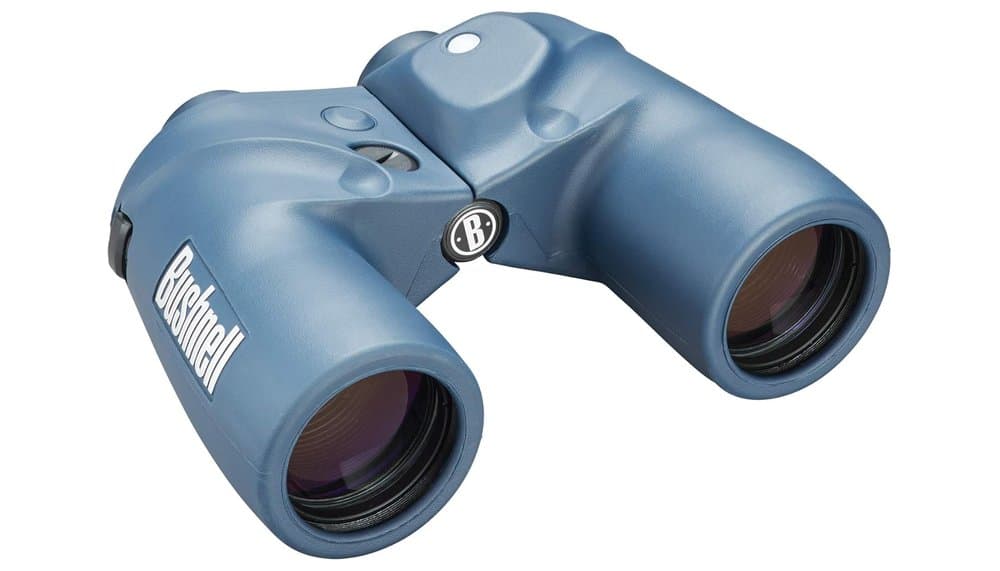
This model embodies the classic navigation binoculars. On paper, the specs announce a proven 7x50 configuration, ideal for stability and brightness. The 7x magnification offers a more stable image on a moving boat, and the large 50mm objectives capture maximum light, which is crucial at dawn, dusk, or in overcast weather. The community confirms this strength, often highlighting the perceived clarity and color fidelity.
User feedback also highlights its ergonomic grip thanks to its rubber armor, and the reliability of its waterproof sealing and fog-proof treatment. The integrated compass is described as readable and precise for basic orientation. However, some points of caution emerge. According to reviews, it is a relatively heavy and bulky model, which may be less suited for a long hike than for nautical use. Furthermore, some users would have preferred a central diopter adjustment rather than individual focus rings on each eyepiece, considered less intuitive for quick readjustment needs. Finally, while durability is generally praised, the compass is not illuminated, a drawback for night use.
NOCOEX Marine 10x50
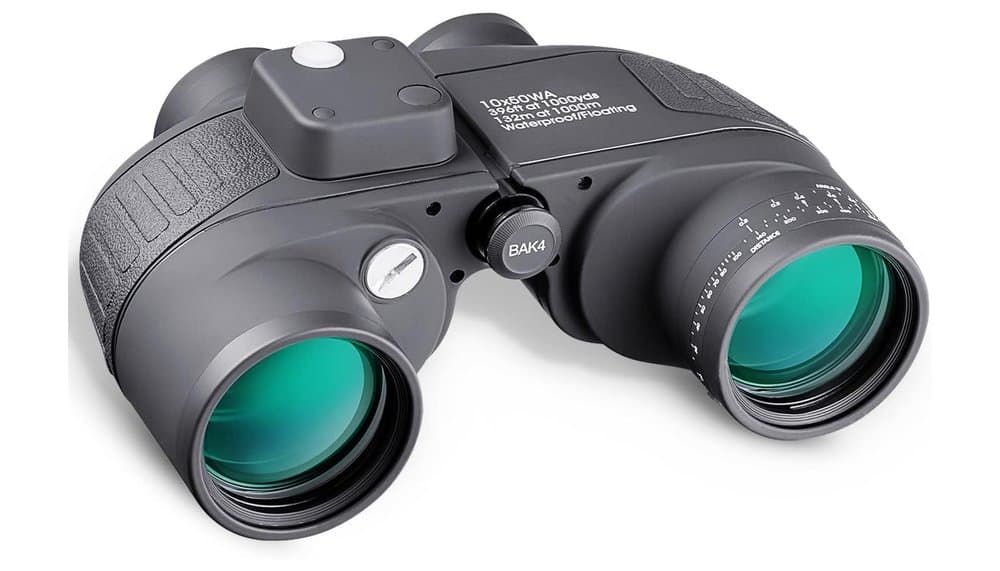
The NOCOEX Marine 10x50 positions itself as a versatile and feature-rich model. The first thing of interest here is its 10x magnification, which offers superior close-up compared to 7x. This can be a major asset for identifying distant details, such as beacons or coastal points. The technical specifications highlight BAK-4 prisms and FMC (Fully Multi-Coated) treatment, promising a bright and contrasted image. Community feedback agrees, praising the sharpness and wide field of view (396ft/1000m) despite the high magnification.
What reviews particularly emphasize is its complete equipment. The integrated compass is illuminated (powered by a battery), a big plus for night navigation. Another unique feature: the binoculars are reportedly designed to float if dropped in water, an appreciable safety feature in a marine environment. Users also note the delivery with many accessories (case, strap, etc.). However, this gain in power has a downside. 10x is more sensitive to shaking; a less steady hand or marked swell can affect image stability. Moreover, according to some feedback, with equal brightness, the image may appear slightly less bright than with a 7x50, especially in extreme low-light conditions, due to the higher magnification spreading the light over a larger image.
Bresser Nautic 7x50
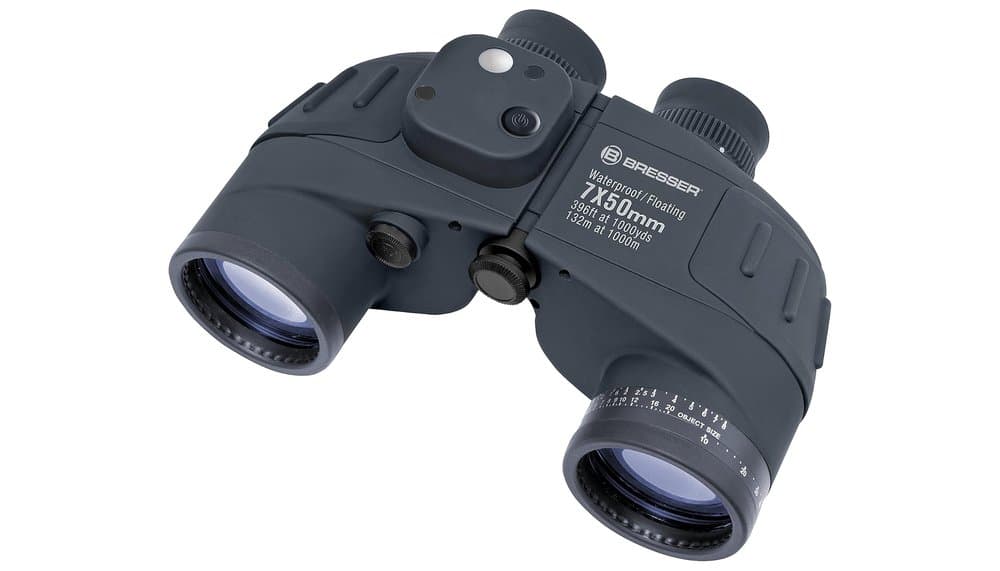
The Bresser Nautic 7x50 exudes an impression of professional robustness. Its technical sheet indicates a metal chassis covered with rubber armor, a construction that inspires confidence for intensive use in difficult conditions. Like its competitors, it benefits from nitrogen purging for waterproof sealing and fog-proofing. The multi-coated optics promise clear images and marine specifics are present with an integrated and illuminated compass, as well as a measuring reticle.
The user community validates this promise of solidity. Feedback often speaks of a product that "feels good in the hand", "substantial", and gives an impression of superior build quality. The individual focus on each eyepiece (diopter adjustable on each side) is perceived as a sign of a higher-end model and, once set, offers great depth of field. However, this characteristic is also its main point of debate. For some purists, it's ideal for navigation. For other users, especially those who share the binoculars or use them in varied contexts (wildlife observation), this system is considered less practical and slower than a central focus wheel coupled with a diopter adjustment on a single eyepiece. It is therefore a choice that leans towards primarily nautical use. Its weight is also the highest of the three, which can be a factor to consider.
The Optical Heart: From Prisms to Glass, What Makes the Difference at Sea
Once durability is assured and the numbers are deciphered, it is in the quality of the glass and prisms that image sharpness and purity are determined. This is where the budget truly matters. A dull, reflection-filled image will cause you to miss critical details.
BaK-4 vs. BK-7 Prisms: The Matter of the Gray Diamond
Inside your binoculars, prisms correct the image. Their quality is crucial. Prisms made of BaK-4 glass (barium crown) are superior to BK-7 (borosilicate). The difference? With average quality binoculars (BK-7), if you look at a clear sky while slightly moving your eyes away from the eyepieces, you will often see a vignetting in the shape of a grayish diamond at the edges. With BaK-4, the field of view remains perfectly circular and bright right to the edge. At sea, where you are constantly scanning the horizon, this uniform clarity is a real comfort. For better waterproof marine binoculars, BaK-4 is no longer a luxury option; it is a standard to demand.
Lens Coatings: The War Against Reflections
Sun on water creates extreme conditions for light. Uncoated lenses let an enormous amount of light escape and generate internal reflections ("ghosts") that crush contrast. Here is the hierarchy to know:
- Coated (C): A single coating on one or two surfaces. Insufficient.
- Fully Coated (FC): All optical surfaces (both sides of each lens) have an anti-reflection coating. This is the bare minimum.
- Multi-Coated (MC): Multiple layers on some lenses. Good.
- Fully Multi-Coated (FMC): This is what you need. Multiple layers of coating on all glass surfaces. This maximizes light transmission (often beyond 90%) and radically eliminates stray reflections. The image is brighter, colors are more vivid and natural, even in full backlight. Don't skimp on this.
ED/HD Glass: For a Razor-Sharp Image
Even with the best coatings, one defect can remain: chromatic aberration. This is the purple or green fringe you sometimes see on high-contrast edges, like a white rigging against a blue sky. Extra-low Dispersion (ED or HD) glass is designed to reduce this phenomenon to an absolute minimum. The image gains in sharpness and "bite." On a distant subject like a boat on the horizon, the difference is striking. It's a real plus, but it comes at a cost. My opinion? For intensive and demanding use, it's an investment that is fully justified. For occasional leisure navigation, well-coated optics (FMC) with BaK-4 prisms can be perfectly sufficient.
Choosing Based on Your Sailing: From Racing to Long Passages
The ideal choice for offshore sailing is not the same as for a racer. Your habits at sea should dictate the priority of criteria. Here is how to adapt your search.
For Racing and Performance Sailing: Field of View Above All
Here, speed is paramount. You need to quickly spot competitors, buoys, and wind shifts. An ultra-stable image or high magnification are secondary. What matters is a wide apparent field of view. Look for a high number in meters at 1000m (at least 110m) or a high viewing angle in degrees. Lightweight binoculars (around 800g) and a very compact size are also an advantage for quick maneuvers and to prevent them from swinging around. Waterproofing remains essential, of course, but weight and size become decisive factors. A configuration like 7x35 can even be considered for its extreme lightness and wide field, provided its brightness is sufficient for daytime conditions.
For Coastal Cruising and Day Sailing: Versatility is King
You sail for the day, you enter and leave ports, you observe the coast. Versatility is key. The 7x50 format often stands out as the best compromise. It offers a decent field for navigation, excellent brightness for morning fog or returns at dusk, and sufficient stability in a bit of a chop. Prioritize a model with a short close focus distance (around 3-4 meters): this will be very useful for checking an anchor, inspecting the hull, or observing wildlife near the boat. It is in this category that buoyancy becomes a real plus, for often hectic deck maneuvers.
For Offshore Sailing and Bluewater Cruising: Endurance and Comfort
On a cruising sailboat or a passagemaking vessel, observation sessions are long. Optical comfort over time and performance in low light are paramount for night watches or overcast weather. A 50mm objective lens is highly appreciated here for its large exit pupil (around 7mm). Weight is less critical than on a small performance sailboat, so you can opt for more robust and better-equipped models. An integrated compass with red illumination becomes a valuable navigation tool for taking bearings. Frankly, for these uses, this is where the best waterproof marine binoculars justify their price with ED glass and premium FMC coatings that reduce eye strain after hours of watchkeeping.
The Features That Change Everything: Compass, Buoyancy, and Comfort
Once optics and robustness are ensured, certain features transform your binoculars from a simple observation tool into a true piece of deck equipment. They make the difference between an okay model and the model that becomes yours for years.
The Integrated Compass: More Than a Gadget
On the water, knowing a heading or taking a bearing quickly can be crucial. An integrated compass with a luminous reticle (lit in red to preserve night vision) allows you to do it one-handed, with your eyes still at the eyepieces. The classic mistake? Wanting 0.1° accuracy like on a primary navigation compass. It's unnecessary. An accuracy of one degree (±1°) is largely sufficient for a visual bearing. Check the readability and stability of the needle, especially in a bit of a sea state. For a serious navigator, this feature can prove as useful as a traditional bearing compass, and much faster.
Buoyancy: The Feature That Saves Your Investment
Let's be honest, no one ever planned to drop their binoculars overboard. But it happens, in a sudden roll or during an energetic tack. A pair that floats is the guarantee of not seeing 500 euros disappear into the depths. This buoyancy is generally achieved through lightweight construction and internal air chambers. One piece of advice: if you opt for a non-buoyant model, absolutely invest in a floating strap sleeve. It's not as practical, but it's something. It's such an obvious feature for the best waterproof marine binoculars that its absence on an expensive model always leaves me perplexed.
Comfort of Use, A Detail That Isn't One
You might be holding them for entire watches. Ergonomics is therefore paramount. Two key points that are often underestimated: the diopter adjustment and the eyecups. A diopter ring that locks positively prevents it from moving and messing up the focus in its case. It's a small detail that changes everything in daily use. As for the eyecups, they should retract or twist down easily if you wear sunglasses, and offer good extension for those who don't. Eyecups that are too stiff or too short become real torture. Don't hesitate to manipulate them in-store; it's a decisive test. After all, they are the point of contact between you and the perfect image you're seeking.
Rigorous Maintenance for Maximum Longevity
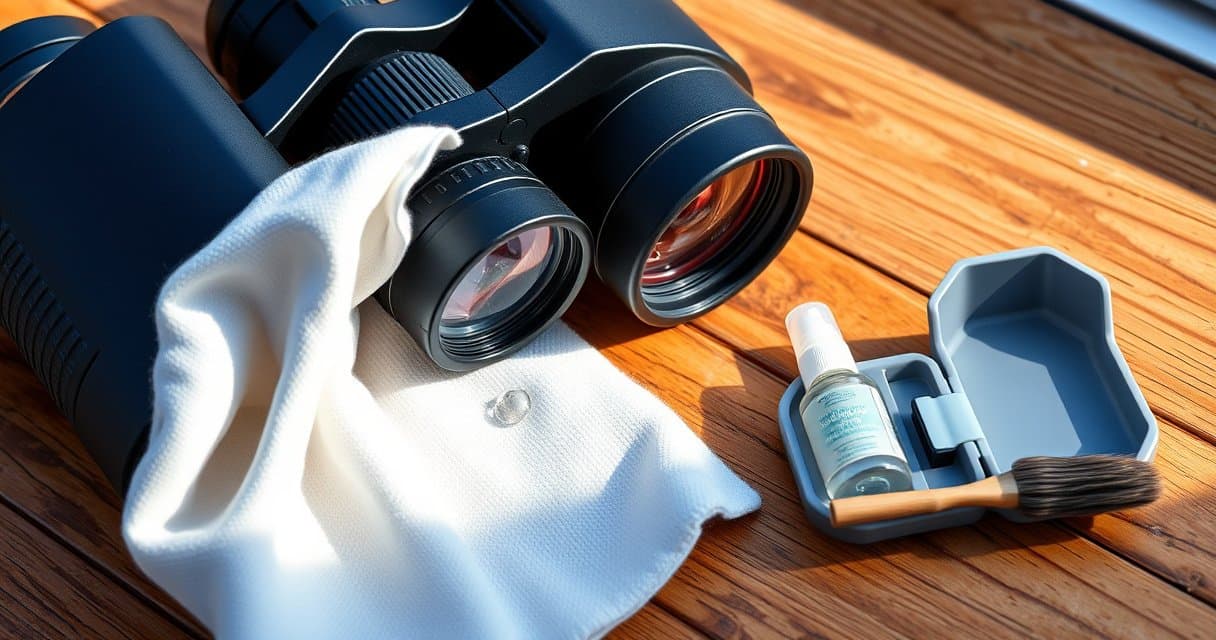
Purchasing marine binoculars is an investment. Treating them like a simple accessory guarantees their early decline. Salt water, sun, and neglect are a formidable trinity. Here is how to fight them.
The Essential Ritual: Rinsing with Fresh Water
The golden rule is simple: after every outing at sea, your binoculars need a shower. Even if they haven't been splashed, the micro-particles of salt suspended in the air settle everywhere. This salt is an insidious enemy that corrodes mechanisms, attacks rubber coatings, and can ultimately compromise the waterproof seal. Don't settle for a damp cloth. Rinse them under a gentle stream of lukewarm fresh water for a good minute, gently turning the focus wheels to let water penetrate everywhere. This is the most important action for the health of your equipment.
Drying and Storage: The Art of Prevention
Once rinsed, the temptation is to wipe them vigorously. Resist. Pat them dry with a very soft, absorbent microfiber cloth, perfect for optics. Absolutely avoid paper towels or abrasive fabrics that could scratch the lens coatings. Then, let them air dry in the shade, with the lenses pointed slightly downward so any residual moisture can escape. For storage, their original case is their home. Always store them inside it, away from a direct heat source (like a boat locker in full sun) which could degrade the waterproof seals and internal adhesives. A silica gel packet in the case is an excellent idea to absorb any residual humidity.
Periodic Checks and Mistakes to Avoid
Get into the habit, once or twice a season, of checking the condition of the waterproof seals, especially those around the eyepieces and on the central wheel. They should remain supple and without cracks. If you notice they are hardening or cracking, contact the manufacturer or an authorized repairer – this is a serious procedure. Another critical point: never attempt to unscrew anything yourself. The waterproof assembly is a precise balance and you could compromise everything. Finally, protect the lenses with objective lens caps when the binoculars are not in use. It's a simple barrier against dust and accidental scratches. These small attentions ensure your best waterproof marine binoculars will remain so for a decade or more.
Conclusion
There you have it, all the cards are in your hand.
Choosing your marine binoculars is not about buying a gadget. It's an investment in a tool for navigation, safety, and wonder.
Waterproofing is non-negotiable. The right optical compromise will save you a lot of frustration. And rigorous maintenance will ensure their companionship for miles and miles.
So, the ball is in your court. Consider your plans, hold them in your hands, and set off with peace of mind. The sea and its spectacles await you. Fair winds!
Frequently Asked Questions
What are the best waterproof marine binoculars for a sailboat?
Opt for a model certified IPX7 or IPX8, with nitrogen purging to prevent internal fogging, a robust construction in magnesium alloy, and Fully Multi-Coated (FMC) optical treatment. The 7x50 format is often recommended for its good compromise between stability, brightness, and field of view.
Why choose 7x50 binoculars over 10x50 for navigation?
The 7x magnification offers a more stable image on a moving deck and generally a wider field of view, essential for scanning the horizon. A 10x50 amplifies the roll more and can be more tiring to use over time.
How to properly maintain marine binoculars after a trip at sea?
Rinse them systematically with lukewarm fresh water to remove salt, then dry them with a soft microfiber cloth. Store them in their case, away from direct heat sources, and periodically check the condition of the waterproof seals.
What is the difference between BaK-4 and BK-7 prisms in binoculars?
Prisms made of BaK-4 glass offer better light transmission and a circular, sharp field of view to the edge, while BK-7 prisms can cause vignetting (grey diamond shape) at the periphery of the image, especially in low-light conditions.
Is a built-in compass in binoculars useful for navigation?
Yes, a built-in compass with an illuminated reticle (preferably red) allows for quickly taking a bearing without taking your eyes off the observation. An accuracy of around ±1° is sufficient for this use and represents a significant time saver.
Are floating binoculars a real advantage?
Absolutely, buoyancy is a crucial safety feature that protects your investment in case of falling overboard. This characteristic is often achieved through lightweight construction and internal air chambers.
100% free and independent — All our articles are written independently, without any sponsorship. We may earn a commission on purchases made through our links, at no extra cost to you.
Guides you might like
Astrophotography Telescope Buying Guide
Choose the right telescope for astrophotography to avoid frustration. Key factors depend on your target nebula or object.
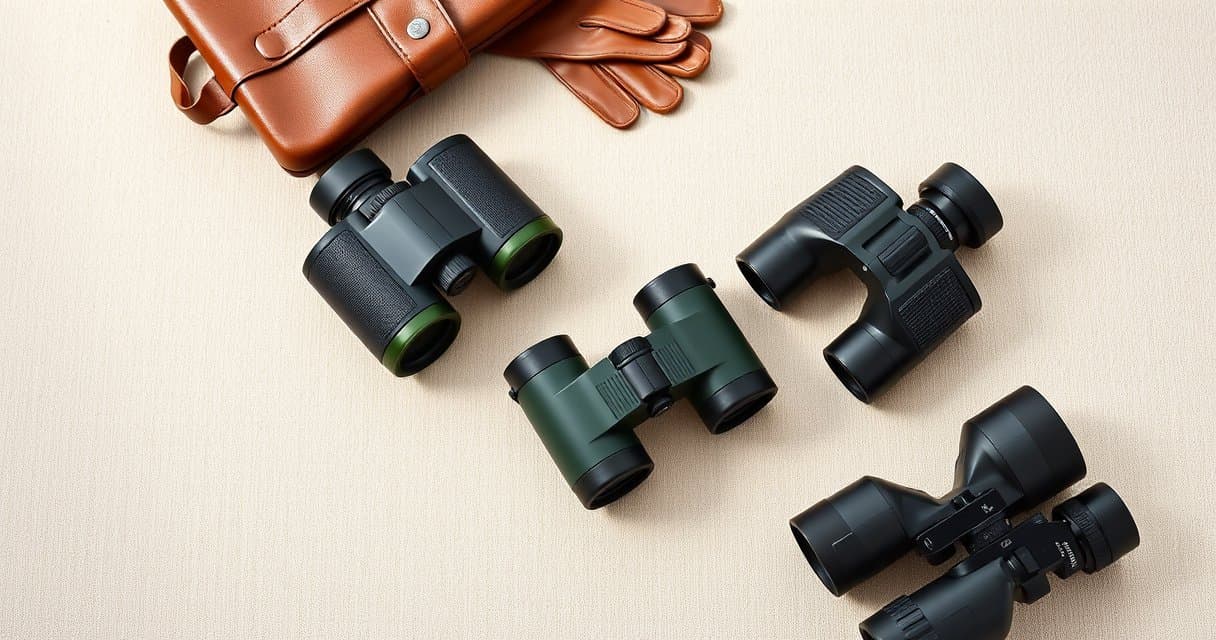
Best Binoculars Value Guide
Find value binoculars that match your real needs. Understand specs like 8x42 and key features for the best observation without overspending.

Best Nature Binoculars Kids
Discover how to choose the perfect first binoculars for a child, focusing on lightweight design, ergonomics, and sparking a love for nature observation.
Articles you might like
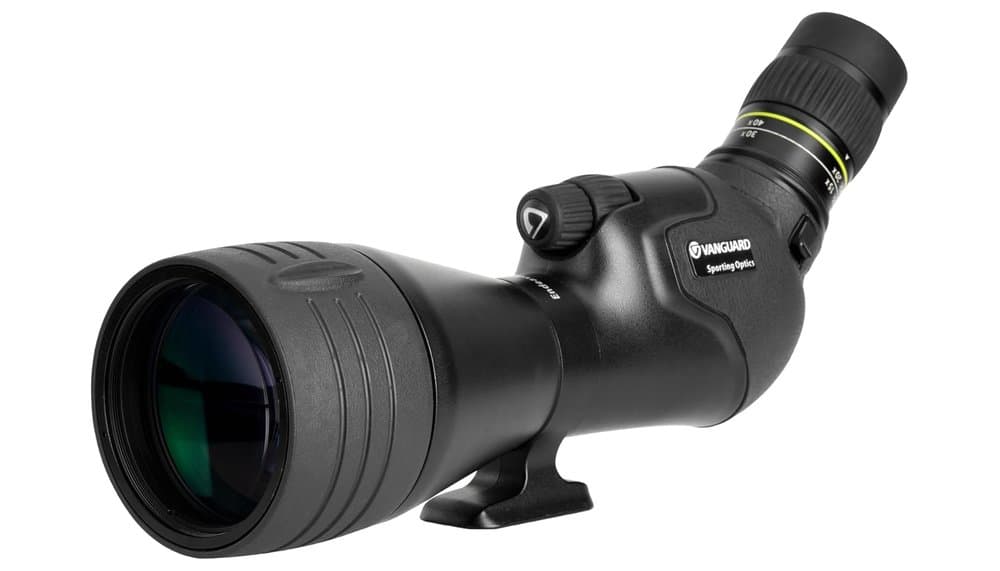
Vanguard Endeavor HD65A Spotting Scope Review
Spotting scope with 65mm ED glass & 15-45x zoom for birding & hiking. Balanced performance & portability for serious nature observers.
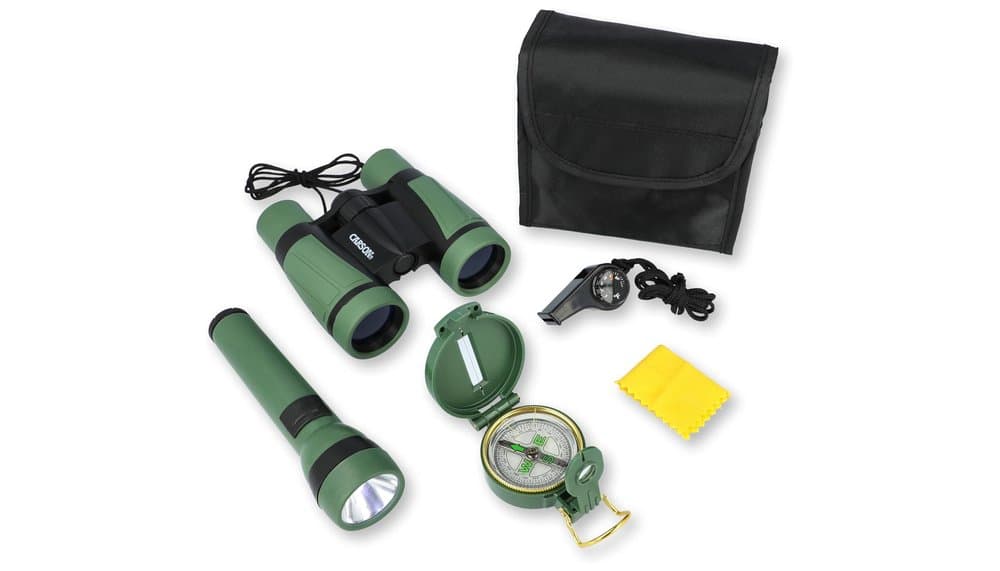
Carson AdventurePak Kids' Exploration Tool Kit Review
Explore nature with this kid's 5-piece tool kit for outdoor adventure and educational discovery. Perfect for young explorers.
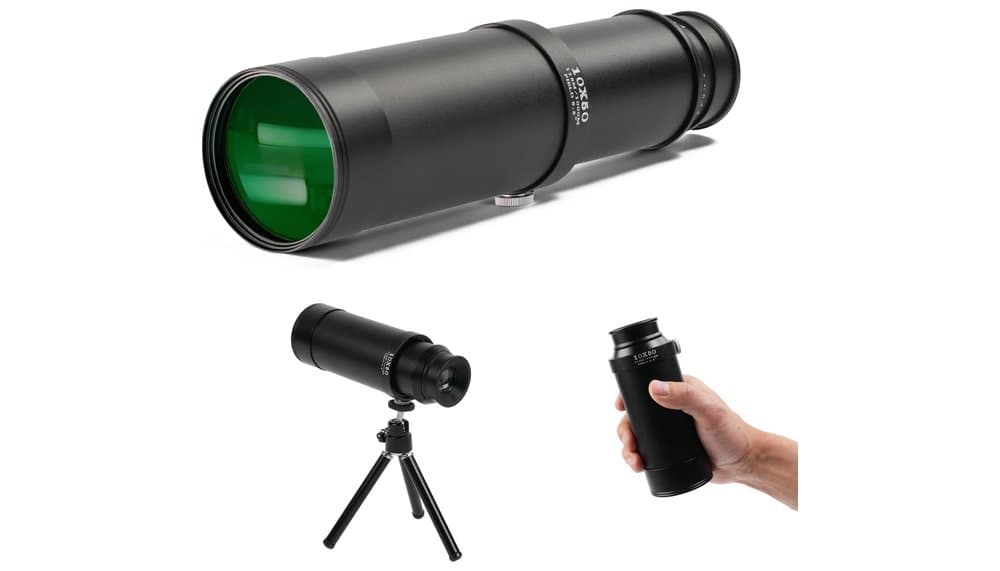
BOSTRON CY 10x50 Monocular Review & Test
Compact 10x50 monocular review: Analyzes optical clarity, field of view & build quality for hiking, nature & astronomy. See its true value.