Compact Hiking Monocular Buying Guide
Guide
So, you're going hiking and you dream of scrutinizing the details of a raptor in its nest or an ibex on the opposite ridge? A compact monocular is the tool you need, a concentrate of optical power that fits in the palm of your hand. Frankly, choosing the right model makes all the difference between a bright, sharp image and a blurry disappointment. Let's see together how to make the right choice, without breaking the bank or weighing you down.
Key Points to Remember
- An 8x or 10x is the best compromise for hiking, offering good detail and a stable handheld image.
- Prioritize BaK-4 prisms and fully multi-coated lenses for a bright and sharp image from edge to edge.
- An IPX7 waterproof rating and nitrogen purging are essential to protect the device from the elements and fogging.
- The objective lens diameter (the second number) determines brightness: 25-36mm is a good balance between performance and compactness.
- The best choice depends on your main activity: an 8x32 for birdwatching, a versatile 10x30, or an 8x25 format for extreme compactness.
Deciphering Key Numbers: Magnification and Objective Lens Diameter
You've certainly noticed these two numbers, written large on every monocular, like 8x25 or 10x42. These are not secret codes, but the two most important parameters for understanding what the instrument will offer you. And frankly, understanding them well helps you avoid making a bad purchase.
The first number is the magnification. An 8x makes an object appear as if it were eight times closer. For hiking, this is the ideal range. You benefit from a wide field of view to scan a landscape or follow a bird in flight, and the image remains fairly stable when hand-held. Do you want more detail on a distant cliff? Opt for a 10x. But be careful, from 12x upwards, without support or a tripod, the image will shake so much it becomes unusable. This is the classic mistake: we think "bigger is better" and end up with an unusable image in the field.
The second number is the diameter of the front objective lens, in millimeters. This dictates the brightness. The larger it is, the more light it captures. An 8x42 model will be much brighter than an 8x25, and this will be noticeable in dense forest or at dusk. For a compact monocular dedicated to hiking, a diameter between 25mm and 36mm constitutes an excellent compromise. Bright enough for most situations, without adding excessive weight or bulk.
The Fundamental Compromise: Power vs. Versatility
Here is a small table to visualize concretely what these numbers mean according to your needs:
| Typical Configuration | Key Strengths | Points to Watch | Ideal for... |
|---|---|---|---|
| 8x25 or 10x25 | Ultra-lightweight, fits in a pocket. Perfect for minimal weight. | Limited brightness as soon as light fades. | The lightweight hiker who wants an occasional glance at the panorama. |
| 8x30 or 10x30 | Excellent balance. Good brightness, compactness preserved. | Slightly reduced field of view on the 10x30. | The safe and versatile choice for most hikers. |
| 8x42 or 10x42 | Very bright and comfortable image. Striking details. | Heavier and bulkier. Often overflows from a pocket. | The serious observer (birdwatching, wildlife), willing to sacrifice a bit of portability. |
My advice? For general hiking use, aim for the middle box. A 10x30 is often the best compact hiking monocular: it offers appreciable detail sharpness without being unmanageable hand-held, and its brightness is sufficient for most days. An 8x30 will be even more stable and offer a wider field, perfect if you prioritize tracking movement and overall views. It's up to you to decide what matters most.
How Prisms and Lenses Shape the Image
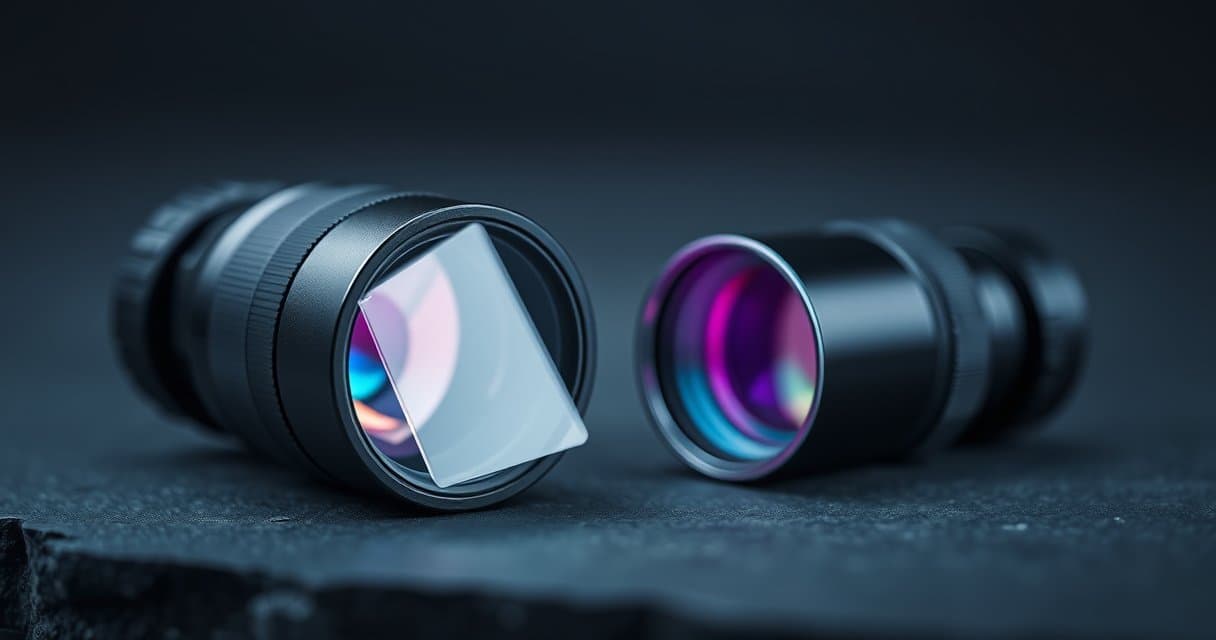
Now that we've talked numbers, let's get to the heart of optical quality. Because two monoculars proudly displaying 10x42 can offer you a radically different experience. One will have a dull image, with unpleasant colored fringes on contrasts, the other will have a clarity and sharpness that will make you smile. This difference comes down to the prisms and lenses. This is where the true value of an instrument is determined.
The Prism War: BaK-4 vs BK-7
Inside your monocular, small prisms correct the image. Their quality is crucial. You will encounter two main types:
- BK-7 prism: This is the entry-level standard, made of borosilicate glass. It gets the job done, but can lead to a slight loss of brightness and, more importantly, a "soft-focus" effect at the edges of the image.
- BaK-4 prism: Made from barium crown glass, it has a higher refractive index. Translation? It guides light more efficiently to your eyes. The result is an overall brighter image, with a sharp field of view from edge to edge, even in low light.
On a model claiming to be the best compact hiking monocular in its category, a BaK-4 prism is almost a given. If you see this mentioned in the specifications, it's a very good sign. Conversely, if it's not specified, assume it's BK-7. The difference is most noticeable in the last minutes of twilight.
Lens Coatings: The Magic of Layers
Look at the objective lens of your monocular. If it reflects a bright white glare back at you, it's a bad sign. An uncoated lens loses a huge amount of light to reflection. This is where anti-reflective coatings come in. They come in levels:
- Coated: A single layer on one or two surfaces. The bare minimum.
- Fully coated: A single layer, but on all optical surfaces. Already better.
- Multi-coated: Multiple layers on some surfaces. This is a decent standard.
- Fully multi-coated: Multiple layers on all surfaces. This is what you should aim for. It maximizes light transmission, improves contrast, and reduces ghosting (those parasitic reflections around light sources). The image is more vibrant, colors are more faithful.
And then there are special lenses, like Extra-low Dispersion glass (ED, HD, FL...). Their role? To minimize chromatic aberration – those purple or green fringes you might see on high-contrast edges, like a dark branch against a bright sky. They make a tangible difference to image sharpness, especially at high magnification (10x and above). They are often the hallmark of high-end models, but are starting to appear on some serious mid-range options.
Our Selection
Looking for a compact monocular for hiking, bird watching, or sports events without weighing yourself down? We reviewed three popular models, analyzing their technical specifications and user feedback to help you see more clearly. Here is our comparative selection.
| Product | Magnification | Objective Lens | Key Strengths | Weight & Size |
|---|---|---|---|---|
| Technaxx TX-176 | 10x | 25 mm | Extreme compactness, ease of use | 82 g / 11 cm |
| Monocular Generico | 16x | 52 mm | Performance optics, waterproofing | 300 g / ~15 cm |
| Télescope 500x25 | Advertised 500x | 25 mm | Ambitious claims, ergonomic design | 88 g / ~4.8 cm |
Technaxx TX-176 Monocular
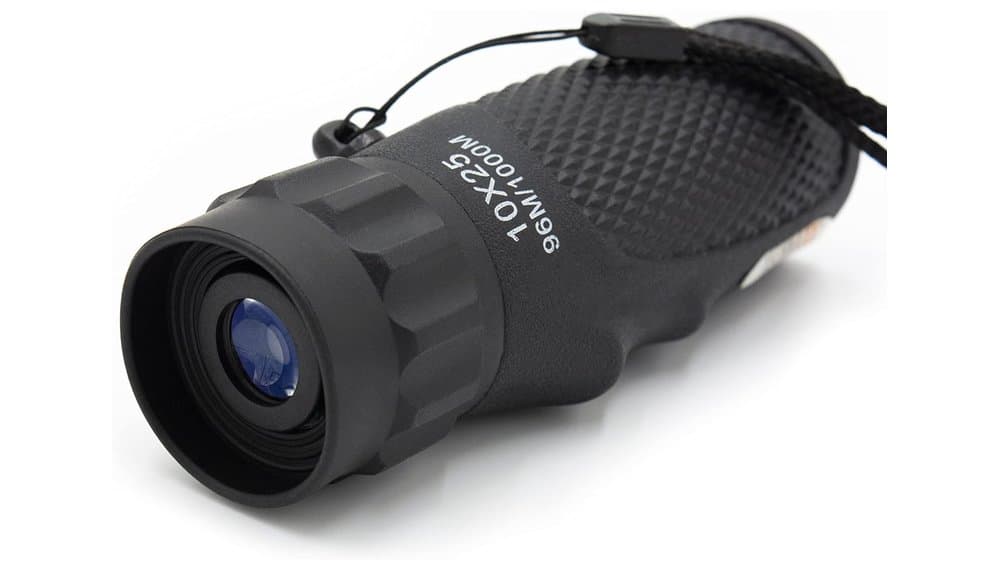
The Technaxx TX-176 positions itself as the champion of compactness and simplicity. On paper, its specifications promise an ultra-lightweight (only 82 grams) and discreet tool that easily fits in a pocket. Its 10x magnification and 25 mm objective lens suggest versatile use for common activities like hiking or casual observation.
According to community feedback, its main advantages indeed lie in its practical format and intuitive handling. Users appreciate being able to take it anywhere without it being a burden. The view is described as clear and bright for an entry-level model, perfectly suited for daytime use.
However, reviews also highlight its natural limitations. The 25 mm objective lens and 10x magnification offer an adequate field of view but are not designed for low light conditions (dusk, dense forest) or very detailed long-distance observation. It's an instrument for a quick, practical "look." Some feedback also mentions that the build, while sturdy for normal use, may feel lightweight compared to more robust models. In summary, it's an excellent daily and discreet companion, but not the tool for a demanding birdwatching enthusiast or a hunter needing performance in difficult lighting conditions.
Monocular Generico (16x52)
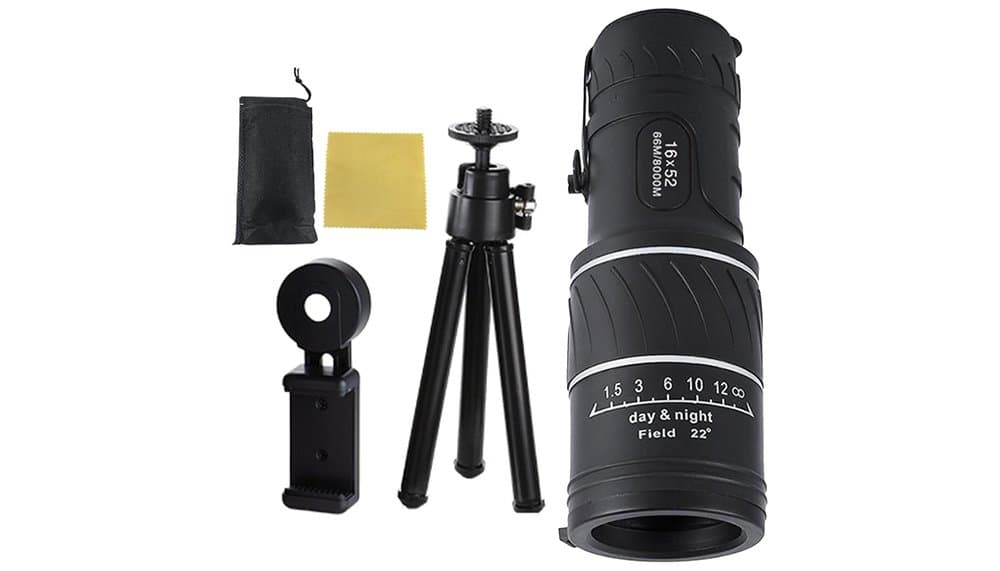
With the Monocular Generico (model 16x52), we move to a segment more demanding in terms of optical performance. The technical specifications are ambitious: a magnification of 16x coupled with a large 52 mm objective lens and a BAK-4 prism, which, on paper, promises brighter, more contrasted images and superior resolving power, especially in low light.
The user community largely confirms these strengths. Reviews often praise the clarity and brightness of the image, far superior to compact models, making it a preferred choice for bird watching or surveillance in natural settings. Its waterproofing and nitrogen purging (protecting it from fogging) are also features championed by outdoor enthusiasts in all weather conditions.
However, these performances come at a cost in terms of practicality. The main negative point raised in reviews concerns its weight (around 300g) and size. It is no longer a matter of slipping it into a trouser pocket. Furthermore, the high magnification (16x) makes the image more sensitive to shaking: stable handheld use becomes difficult without support (tripod, rest). The community notes that it is a high-performance tool, but one reserved for dedicated outings where you accept carrying a bit more equipment for a much better image quality.
Télescope monoculaire 500x25
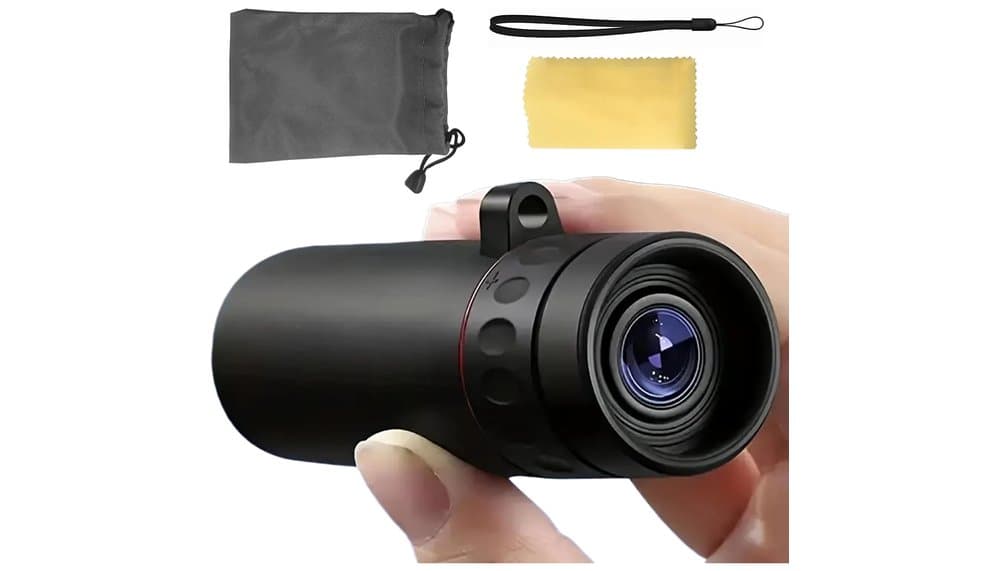
The Télescope monoculaire 500x25 clearly banks on the marketing argument of a spectacular number with its advertised 500x magnification. On paper, it also promises a construction with a BAK-4 prism, an ergonomic non-slip design, and interesting compactness (about 88g).
Analysis of user feedback reveals a significant gap between marketing promises and physical reality. The community is unanimous on one point: the claim of 500x magnification with an objective lens of only 25mm is optically impossible in such a small format and at this price point. In practice, users estimate the true useful magnification to be between 8x and 12x. Reviews point out that, despite this excessive claim, the device can deliver an acceptable image for basic use in full daylight, with a correct field of view.
The limitations, however, are numerous. The optical quality is often described as average, with visible distortions at the edges of the image and issues with chromatic aberration (color fringing). The mention of "low light vision" is very relative with such a small objective lens. This product illustrates a classic pitfall: one should be wary of exaggerated magnification numbers, often a sign of aggressive marketing rather than real performance. It is a very economical option for occasional use with low expectations, but not a reliable instrument for serious observation.
Assessing Robustness and Waterproofing for the Field
Great optics are good. But if they constantly fog up or break at the first impact, they're a money pit. For a tool meant to live in your backpack, facing rain, dust, and potential falls, construction is just as crucial as the lens. This is often what separates a toy from a true mountain companion.
The Jargon of Waterproofing: IPX and Nitrogen Purge
You will often see mentions of "waterproof" or "water-resistant." But what matters is the degree of protection. Look for the IPX rating. For hiking, aim for a minimum of IPX7. This means the device can be temporarily immersed in 1 meter of water for 30 minutes. In short, a downpour or a drop in a stream won't faze it. An IPX6 rating (protection against powerful water jets) might suffice for very occasional use, but frankly, IPX7 offers real peace of mind without a huge extra cost.
This waterproofing is only possible through a sealed construction combined with nitrogen purging. The principle? The humid air inside the device is replaced with dry nitrogen before final sealing. This prevents fogging inside the lenses when the temperature changes abruptly – imagine taking your monocular out of a warm bag to observe in the cold air of a summit. Without this purge, the image quickly becomes unusable. It's a non-negotiable feature for me.
Frame and Ergonomics: Surviving Shocks and Cold
Look at the body of the monocular. A frame made of lightweight alloy covered with thick rubber is ideal. This rubber provides a firm grip, even with light gloves, and absorbs shocks much better than bare plastic. Tap it lightly with your finger: it shouldn't sound hollow or cheap.
Also check the robustness of the focusing mechanism. The wheel should turn with smooth, consistent resistance, neither too stiff nor too loose. It should be protected against dust and water infiltration. A model that claims to be the best compact hiking monocular will necessarily have careful finishing at this level.
Testing Essential Accessories
The included case says a lot about the manufacturer's intentions. A simple neoprene pouch is for the living room. For the field, you need a rigid or semi-rigid case, with a sturdy attachment to fix it to your belt or pack. And above all, a proper carrying strap. A thin cord will break in two hikes. Opt for a wide, comfortable wrist strap, or better yet, a neck strap that keeps the instrument within reach while freeing your arms. These are details, but they reflect a design thought out for real use, not for display.
Don't forget the lens caps. Those for the eyepiece and objective must stay on firmly, ideally with a clip or a tight friction system. Losing them in the wilderness is truly heartbreaking and exposes your lenses to scratches. A small detail that matters.
Adapt Your Choice to Your Practice: From Birdwatching to Panoramas
You would not choose the same tool to identify a warbler in dense foliage as you would to admire the expanse of a glacier. The "best" monocular does not exist in itself; it is the one that matches your way of walking and observing. Here are some concrete scenarios to guide you.
The Lightweight Birdwatcher and Naturalist
Are you heading out to spot and identify birds, insects, or small mammals? Two things are crucial: a wide field of view to follow them in their movements and a very short minimum focus distance. An 8x32 or a 10x42 will be your ally. Why? The former, with its moderate magnification, offers a wide field and a stable image hand-held, perfect for scanning a canopy. The latter, with its large objective lens, will capture more light under forest cover.
But watch out for the weight! A quality compact 10x42 will weigh around 300g. If you use it in sessions lasting several minutes, it's manageable. If it's for quick, frequent glances during a long hike, prioritize the 8x32, which is lighter and more manageable. And don't skimp on the quality of the lens coatings to get faithful colors and good contrast on dark plumage.
The Panorama Hiker and Mountaineer
Is your goal to capture the details of a distant rock face, to spot a trail on the opposite slope, or simply to appreciate the vastness of a landscape? Here, stability and comfort for prolonged observation are key. A magnification of 8x or 10x remains a good standard.
However, if you operate in high mountains where the light is intense and the air is thin, absolute optical quality becomes a priority to avoid chromatic aberrations (those unsightly colored fringes on contrasts). A model with ED (Extra-low Dispersion) glass will make a day and night difference. Frankly, it's an investment that is justified for this kind of demanding use, where every detail counts.
The Occasional Observer and Hiker-Photographer
Do you mainly want a versatile tool for glancing at a point of interest without being weighed down? Extreme compactness is paramount. Look at 8x25 or 10x25 formats. They fit in a pants pocket. Their brightness will be lower in poor light, but for daytime and occasional use, they do the job very well.
And if you have the soul of a photographer, check the compatibility with a digiscoping adapter. Some monoculars have an eyepiece designed to securely attach a smartphone, turning your small tube into a super-powerful telephoto lens. It's a real plus for bringing back quality souvenir images without carrying a big camera lens. Then aim for a model with precise focus and impeccable optics.
Navigating Price Ranges and Their Promises
The price of a monocular is not just a number on a tag; it's a direct reflection of what you will see and feel when using it. And let's be clear: the "best compact hiking monocular" for you is not necessarily the most expensive, but the one that offers the best value for your needs. Here is what to expect based on your budget.
Under €80: The Entry Level
In this range, you'll find models that do the job for very occasional use. Expect optics with basic coatings (often coated rather than fully multi-coated), BK-7 type prisms, and sometimes basic waterproofing or simply a "splash-resistant" construction. The image may lack sharpness at the edges, be less bright, and colors may be less vibrant.
This is a valid option if you just want to test the tool, for short outings and in good weather. But if you plan to take it into the field regularly, know that materials and finish are often the weak point. Durability can take a hit. Frankly, for a few dozen euros more, the jump in quality is really noticeable.
€80 to €200: The Core of the Market for Hikers
This is where it's at for most of us. For this price, you can demand and obtain the essential characteristics of a good hiking companion: certified waterproofing (IPX7 or equivalent, with nitrogen purging), BAK-4 prisms, and multi-coatings on all optical surfaces. The gain in clarity, contrast, and color fidelity is huge.
You'll also have access to models with special glass (like ED glass) at the high end of this range, which significantly reduces color fringing. Weight and ergonomics are also better thought out. This is the range where you make the best compromise between performance, durability, and price. If you hike seriously, this is the minimum budget to consider for a reliable tool that won't let you down.
Above €200: Excellence for Enthusiasts
Here, you pay for the finish, the last few percent of optical performance, and bulletproof robustness. The glass is high-end, the coatings are the most advanced (phase-correction coatings for roof prisms), and the mechanics (the focus ring) are ultra-precise and smooth.
Is it necessary? For intense nature observation where every detail counts, where you spend hours with the monocular to your eye, yes, the difference is justified. The image offers a sharpness and visual comfort that is less tiring on the eye. But for classic hiking with occasional observations, the law of diminishing returns is in full effect. You are primarily investing in an object that will last you a very, very long time.
Conclusion
In short, choosing your compact monocular for hiking means first knowing yourself well. What kind of observer are you? A contemplator of landscapes or a tracker of distant details?
Weigh your priorities. The optics, of course, but also the durability in the face of the elements. And above all, your budget. Don't aim too big or too small; aim for the perfect balance for your adventures.
Go ahead, the right choice is the one that will make you want to take it out at every turn of the trail. Happy observing!
Frequently Asked Questions
What is the best magnification for a hiking monocular?
An 8x or 10x magnification is ideal for hiking, offering a good balance between detail and hand-held stability; above 12x, the image shakes too much without a tripod.
What do the numbers 10x42 on a monocular mean?
The first number (10x) indicates the magnification and the second (42) the objective lens diameter in millimeters, which primarily determines image brightness.
What is the difference between a BK-7 and a BaK-4 prism?
BaK-4 glass prisms offer better light transmission and a sharper image at the edge than standard BK-7 prisms, which is crucial in low light.
What waterproof rating (IPX) is needed for hiking?
An IPX7 rating is recommended, as it guarantees the monocular can withstand temporary immersion in 1 meter of water for 30 minutes, protecting it from showers and accidental drops.
Which compact monocular should I choose for bird watching?
For birdwatching, choose a model like an 8x32 or a 10x42 with a wide field of view and a short minimum focus distance, paying attention to the quality of lens coatings for true-to-life colors.
What budget should I plan for a good hiking monocular?
A budget between €80 and €200 allows you to get a monocular with essential features like IPX7 waterproofing, BaK-4 prisms, and fully multi-coated lenses, offering excellent value for money.
100% free and independent — All our articles are written independently, without any sponsorship. We may earn a commission on purchases made through our links, at no extra cost to you.
Guides you might like
Astrophotography Telescope Buying Guide
Choose the right telescope for astrophotography to avoid frustration. Key factors depend on your target nebula or object.
Best Binoculars Value Guide
Find value binoculars that match your real needs. Understand specs like 8x42 and key features for the best observation without overspending.
Best Nature Binoculars Kids
Discover how to choose the perfect first binoculars for a child, focusing on lightweight design, ergonomics, and sparking a love for nature observation.
Articles you might like
Caytail 4K 48MP Hunting Camera Review & Test
In-depth review of the Caytail 4K 48MP trail camera with included SD card. We analyze specs and real user feedback on its true field performance.
Vanguard Endeavor HD65A Spotting Scope Review
Spotting scope with 65mm ED glass & 15-45x zoom for birding & hiking. Balanced performance & portability for serious nature observers.
Carson AdventurePak Kids' Exploration Tool Kit Review
Explore nature with this kid's 5-piece tool kit for outdoor adventure and educational discovery. Perfect for young explorers.