VTech Genius XL Interactive Video Telescope Review
Published on 21 June 2026 · By OptiqueNature
Review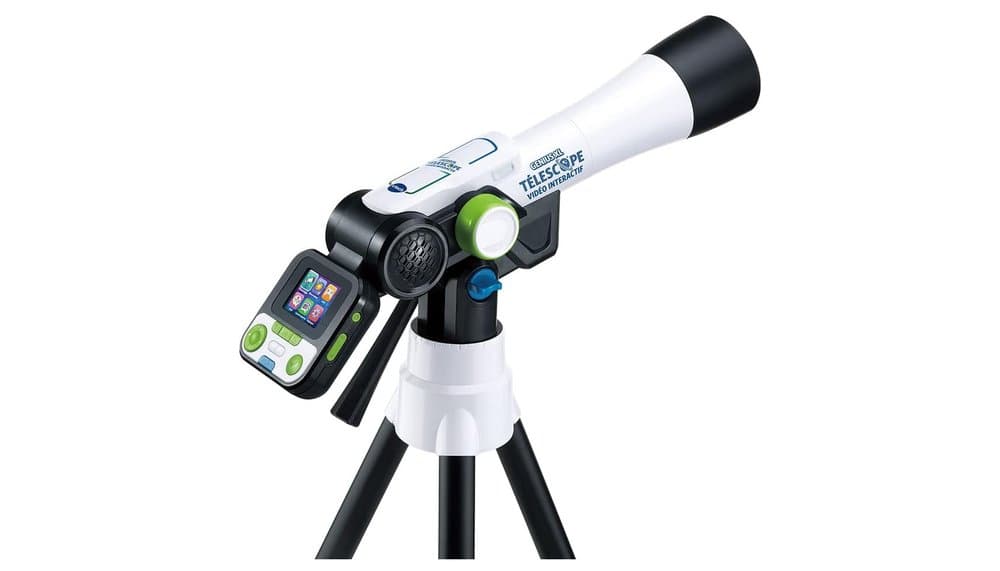
Analysis of the VTech Genius XL Interactive Video Telescope Kids Telescope
In the world of observing instruments, where ED glass, multi-coatings, and twilight factors are typically discussed, the VTech Genius XL Interactive Video Telescope holds a unique position. It is not a traditional optical instrument but an interactive educational toy designed to introduce children aged 7 and up to the wonders of the cosmos. Our analysis must therefore operate a paradigm shift: we are not judging the performance of an amateur astronomer's telescope, but the effectiveness of a pedagogical and fun tool for a first exploration.
For parents or educators seeking a first contact with the sky, this product warrants a detailed study. We will break down its specifications, its educational approach, and compare its promises with concrete feedback from the user community.
Strengths and Weaknesses
Strengths
- Complete and Structured Educational Approach: The NASA-certified educational content, with its 200+ media files and 650+ pieces of information, provides a solid and captivating foundation for learning.
- Very Child-Friendly Interface: The 2.4-inch color LCD screen and simplified controls eliminate the difficulties of manipulating and focusing a traditional eyepiece.
- Immediate Fun Experience: The combination of modes (adventure game, quiz, exploration) turns discovering astronomy into an engaging and varied activity.
- Easy Setup and Use: No tools are required for assembly, and a tripod is included, allowing for near-instantaneous use right out of the box.
- Excellent Scientific Awakening Tool: It perfectly achieves its primary mission: sparking interest and curiosity about space in a young audience.
Weaknesses
- Limited Optical Performance for Celestial Observation: The claims of "110x zoom" should be interpreted with caution; it does not enable detailed planetary observations (Saturn's rings, Jupiter's bands).
- Toy-Level Construction and Durability: The structure is entirely made of plastic and offers neither water resistance nor shock resistance comparable to a standard optical instrument.
- Small Screen Size: The 2.4-inch screen may feel restrictive for group sharing or appreciating fine details.
- Fixed Language: According to feedback, some models are only in French, which can be a barrier for non-French speaking users.
- Not Suited for Serious Astrophotography: While it allows capturing images to a micro-SD card, it is not designed for digiscoping with a smartphone or camera.
Detailed Analysis by Criteria
Optical Quality and Observing Performance
Here, we must clarify an essential point. Traditional optical specifications (light transmission, twilight factor, low-dispersion glass) simply do not apply to this product. It is not a high-precision optical system based on lenses or mirrors.
The advertised "110x zoom" is actually a combined magnification: a low base optical magnification is amplified digitally by the electronic system. As experts point out, this specification should not lead one to expect performance comparable to an astronomical telescope. According to user reviews, observing the Moon is possible and satisfactory for a child, but planets remain small bright dots without details. The primary function of the optics here is to provide a real image on the screen, sparing the child the sometimes complex gymnastics of eyepiece observation.
The field of view is dictated by the integrated camera and screen. It is sufficient for pointing at the Moon or distant terrestrial objects but cannot be compared to that of a spotting scope or binoculars.
Construction, Ergonomics, and Practical Use
The construction is that of a robust VTech electronic toy. The plastic housing is designed to withstand a child's handling, but it is neither waterproof nor fog-proof (no IP rating or nitrogen filling). Its weight of 1.34 kg makes it easily portable and manageable by a child with the tripod.
Ergonomics is its major strength. Using a screen and joystick is intuitive for the generation of children accustomed to digital interfaces. Automatic focus removes a major source of frustration for beginners. The minimum focus distance is not a critical parameter here, as the device is aimed at the sky or distant objects.
For eyeglass wearers, eye relief is no longer an issue since observation is done on a screen. This is a significant advantage over classical eyepieces.
Educational Content and Interactivity
This is the domain where the VTech Genius XL truly excels. The five game modes create a complete learning ecosystem:
- Telescope Mode: For real observation and image capture.
- Exploration Mode: The educational core, allowing browsing of NASA content by theme (solar system, constellations, etc.).
- Space Adventure Game: Applies knowledge in a fun way.
- Quiz Mode: Tests and validates acquired knowledge.
- Photo Gallery: Stores photos taken by the child.
The inclusion of 20 double-sided planet cards and the ability to save photos (via optional micro-SD card) further enrich the experience. This product is less an observing instrument and more a portable planetarium and interactive astronomy course.
Comparison with Market Segments
To properly situate it, let's compare it to the three typical segments of our domain:
- Educational Toy Segment (its true segment): It positions itself at the high end. It far surpasses cardboard toy telescopes or small plastic telescopes with miserable eyepieces through its interactivity, rich content, and real ease of use.
- Entry-Level "Serious" Segment (~100€ astronomical refractors): There is no comparison in terms of optical performance. A 70/700mm refractor on a basic equatorial mount will show significantly more detail on the Moon and planets. However, it will be much more difficult to set up, adjust, and risks discouraging a child without constant help from a passionate adult.
- Nature Observation Segment (binoculars, spotting scopes): It is not designed for this use. Its optics, screen, and lack of waterproofing make it unsuitable for serious birdwatching or wildlife observation.
Its value for money must therefore be evaluated against its objectives: to spark curiosity, educate autonomously, and provide a positive first "observing" experience. From this angle, and based on feedback, it represents very good value.
What Users and Testers Say
The synthesis of 221 customer reviews (with an average rating of 4.4/5) and available expert analyses online reveals very clear trends.
Recurring positive points are:
- Children's Enthusiasm: Comments like "children love it," "spend hours on it," "he enjoys it a lot" are numerous. The fun and interactive aspect is a success.
- Ease of Use: Parents highlight the simple handling and quick setup. It's a product a child can use relatively autonomously.
- Recognized Educational Value: The NASA content is highly appreciated. Users speak of a product that is "much more than a toy," "fun and educational," perfect for "introducing" a child.
- A Relevant Alternative to Classic Low-End Telescopes: Several reviews note that for a child, this tool is "ideal" compared to a "classic telescope... with difficult adjustments."
Frequent limitations and criticisms are:
- Realistic Expectations Necessary: The message is unanimous: "do not expect to observe Saturn or Jupiter." Experts and informed users remind that it is an "interactive scientific toy, not a high-performance astronomy instrument."
- Language Issues: Several international reviews report that the product is only in French, with no option to change, which can be a deal-breaker outside French-speaking countries.
- Sporadic Build Quality Issues: A few reports mention early failures (broken charger) or finish that could be improved, reminding that it is a consumer electronic product.
- Screen Sometimes Judged Small: While not the main criticism, the screen size is occasionally mentioned as a possible area for improvement.
Conclusion: Who is this "Telescope" Really For?
The VTech Genius XL Interactive Video Telescope is a product with a perfectly targeted mission. It does not aim for the budding amateur astronomer who wants to distinguish Saturn's rings, nor the birdwatcher who wants to identify plumage.
It is the ideal tool for:
- A curious child (ages 7-12) discovering space in class or through documentaries.
- A parent or educator wanting to offer a ready-to-use, engaging, and frustration-free educational experience.
- A first step before, potentially, purchasing a real astronomy instrument once the passion is confirmed.
If your goal is to offer hours of interactive, fun, and educational discovery centered on space, with the possibility of seeing the Moon "for real" on a screen, this product is an excellent recommendation. However, if you are looking for a first telescope capable of revealing the wonders of deep sky or the planets, it will point you towards the segment of traditional entry-level optical instruments. The VTech Genius XL does not replace a telescope; it precedes it and cultivates the desire to have one.
Technical Specifications
| Criterion | Detail |
|---|---|
| Product Name | VTech Genius XL Interactive Video Telescope Kids Telescope |
| Target Audience | Children aged 7 and up |
| Type | Interactive educational telescope with video screen |
| Screen | 2.4-inch color LCD |
| Advertised Magnification | Zoom up to 110x (optical + digital combination) |
| Educational Content | 200+ NASA images/videos, 650+ pieces of information, 20 planet cards |
| Modes | 5 modes: Telescope, Exploration, Adventure Game, Quiz, Photo Gallery |
| Storage | Internal memory + micro-SD card slot (card not included) |
| Mount | Tripod included |
| Power Supply | 4 AA batteries (included for testing) |
| Construction Materials | Plastic |
| Weight | 1.34 kg |
| Dimensions (assembled) | 57.2 x 65.4 x 92.4 cm |
| Warranty | Legal warranty of conformity (2 years in France) |
100% free and independent — All our articles are written independently, without any sponsorship. We may earn a commission on purchases made through our links, at no extra cost to you.
Articles you might like
Vanguard Endeavor HD65A Spotting Scope Review
Spotting scope with 65mm ED glass & 15-45x zoom for birding & hiking. Balanced performance & portability for serious nature observers.
Carson AdventurePak Kids' Exploration Tool Kit Review
Explore nature with this kid's 5-piece tool kit for outdoor adventure and educational discovery. Perfect for young explorers.
BOSTRON CY 10x50 Monocular Review & Test
Compact 10x50 monocular review: Analyzes optical clarity, field of view & build quality for hiking, nature & astronomy. See its true value.
Guides you might like
WiFi Trail Camera Guide
See wildlife discreetly from your couch! Learn how WiFi trail cameras let you monitor animals without disturbance and how to choose the right one.

Ultimate Travel Telescope Guide
Choose a portable, high-performance travel telescope to explore the universe from your backpack without compromising on essential astronomical views.
Ultimate Guide to Night Vision Binoculars
Choose the perfect night vision binoculars: Gen vs. digital? Unravel the tech to make your nighttime wildlife adventures a total success. Guide inside.