USCAMEL 20x50 Binoculars Review & Test
Published on 9 August 2026 · By OptiqueNature
Review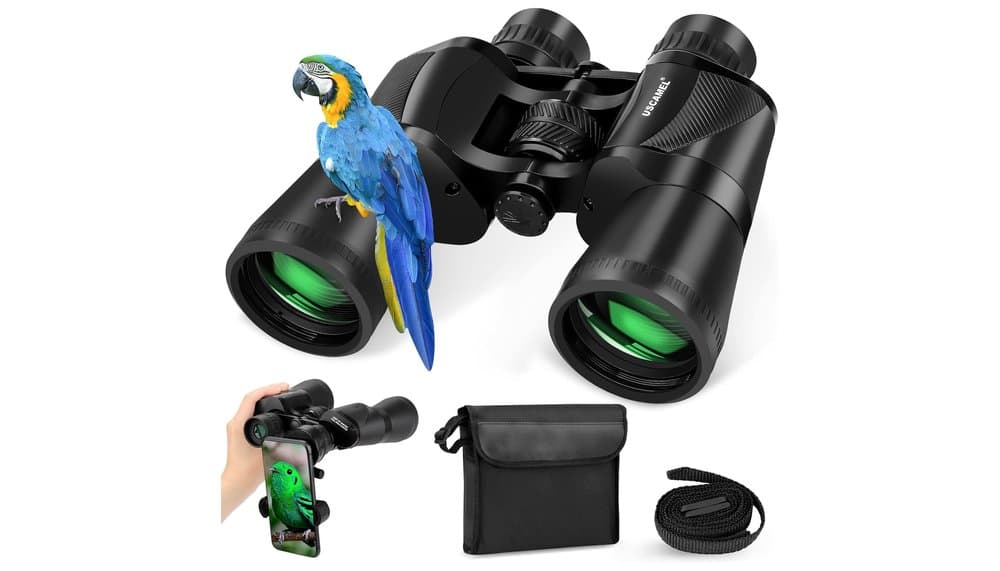
Analysis of USCAMEL 20x50 Binoculars for Bird Watching
The consumer binocular market is vast, and models advertised as "high power" for bird watching naturally attract attention. The USCAMEL 20x50 Binoculars for Bird Watching clearly position themselves in this category, promising striking detail through high magnification. However, what seems like a decisive advantage on paper can turn out to be a handicap in real-world conditions. We will dissect this product to understand who it is truly aimed at, by analyzing its specifications, construction, and, most importantly, by cross-referencing the manufacturer's promises with concrete feedback from the community and reviews from optics experts.
Strengths and Weaknesses
Strengths:
- High Magnification: The 20x theoretically allows for discerning details at great distances.
- Robust Construction: Waterproof (nitrogen purged) and shockproof design with rubber armor.
- Backward Compatibility: Includes a smartphone adapter (digiscoping) and a tripod mount.
- Apparent Value for Money: Presented as a complete package at an accessible price.
Weaknesses:
- Difficult Handling: The 20x magnification greatly amplifies hand shake, often requiring a tripod for a stable image.
- Reduced Field of View: Narrow view, complicating the location and tracking of moving birds.
- Unsuitability for Beginners: Considered a difficult choice for beginners in ornithology.
- Uneven Optical Quality: User feedback points to weaknesses in low-light conditions and sometimes finicky adjustments.
Detailed Analysis by Criterion
Optical Quality and Visual Performance
On paper, the specs announce a solid foundation: BAK-4 Porro prisms and Fully Multi-Coated (FMC) lenses. This combination is typical for the entry-level/mid-range segment and aims to maximize light transmission and contrast while minimizing chromatic aberrations.
However, practical reality nuances this picture. With a 50mm objective and 20x magnification, the exit pupil is only 2.5 mm (50/20). This is a low value. While it allows for an acceptable exit pupil in broad daylight, it explains user comments about less convincing performance in low light (twilight, dense woods) compared to 10x50 models (5mm exit pupil). The twilight factor is high (≈31.6), indicating good potential for distinguishing details in dim light, but this potential is limited by the actual light transmission of the optics.
The most critical point lies in the 20x50 combination. Expert ornithology testers consistently emphasize that 20x magnification is excessive for hand-held use. It drastically reduces image stability and, above all, the field of view. Compared to competing 8x42 or 10x50 models across all price ranges, the field of view of the USCAMEL 20x50 will be significantly narrower, making locating birds and tracking them much more tedious.
Construction and Ergonomics
The specifications boast a waterproof and nitrogen-purged construction, with a non-slip rubber coating. The stated weight of 780g is consistent for a 50mm format. This apparent robustness is an asset for outdoor use, resisting splashes and minor shocks.
The ergonomics of Porro prisms can offer a comfortable grip. The central focus wheel and the diopter adjustment on the right eyepiece are standard. Nevertheless, some user reviews mention that the focus wheel can be stiff to turn, which hinders responsiveness. The minimum focus distance is not specified, but on this type of model, it is generally several meters, making them poorly suited for observing insects or very close flowers.
Target Audience and Use Cases
Who are these binoculars truly useful for? Analyzing feedback and usage recommendations from experts helps clarify their positioning.
- Bird Watching (Birdwatching): This is the advertised use case, but it is misleading. The community of amateur birdwatchers and testers agree: 20x magnification is unsuitable for general birdwatching. It is reserved for very specific, static observations from a fixed point with a tripod (observing nests, distant lookout posts). For observation while walking or tracking birds in flight, 8x or 10x models are infinitely preferable.
- Wildlife Observation and Hiking: The weight and size are reasonable for hiking, but hand-held instability and the reduced field of view penalize them for following a moving animal.
- Digiscoping: The inclusion of a smartphone adapter is a notable plus. Coupled with the tripod mount, this can allow for capturing stable images or videos of distant objects, perhaps constituting the most coherent use for this high magnification.
- Light Astronomical Observation: The 20x50 can offer a first approach to lunar observation or some bright star clusters, always on a tripod. However, the 2.5mm exit pupil limits perceived brightness.
Value for Money and Alternatives
The USCAMEL 20x50 place themselves in the budget segment. At this price, expectations must be adjusted. One cannot expect the finish, adjustment precision, or optical quality (notably color rendition and edge sharpness) of mid-range models costing two to three times more.
For a similar budget, a buyer interested in ornithology would be well-advised to look for binoculars with 8x or 10x magnification and a 42mm objective. This configuration offers a much better balance between brightness, stability, field of view, and compactness, which perfectly matches the needs of a beginner. Established brands in the entry-level segment offer models in this configuration that will be more versatile and easier to handle.
Technical Specifications
| Criterion | USCAMEL 20x50 Specification |
|---|---|
| Model | USCAMEL 20x50 Binoculars for Bird Watching |
| Magnification | 20x |
| Objective Diameter | 50 mm |
| Prism | BAK-4 Glass Porro |
| Optical Coatings | Fully Multi-Coated (FMC) |
| Exit Pupil | 2.5 mm |
| Field of View at 1000m | Not specified (generally narrow on 20x) |
| Minimum Focus Distance | Not specified |
| Waterproofing | Yes, nitrogen purged |
| Coating | Non-slip rubber |
| Diopter Adjustment | Right eyepiece |
| Tripod Compatibility | Yes (adapter included) |
| Smartphone Adapter | Included |
| Weight | 780 g |
What Users Say
The synthesis of customer reviews and expert web analyses reveals clear trends.
Recurring positive points mainly concern the perceived quality for the price ("good value for money," "very good for the price"), the perceived robustness, and satisfaction with the inclusion of accessories (smartphone adapter, case). Some users, likely for very occasional or static uses, are fully satisfied with the sharpness and close-up power.
The negative points are more instructive about the product's limits:
- Instability: "it shakes all over the place" is a frequent comment, confirming the analysis on excessive magnification for hand-held use.
- Variable Optical Quality: Some feedback mentions issues with precise focusing ("adjustment knob very hard to turn"), an image that can appear blurry ("the magnification is a max X10..." implying disappointment compared to the 20x promise), and disappointing performance in low light.
- Accessory Ergonomics: The phone adapter, while appreciated in principle, is judged "difficult to use therefore useless" by some.
- Unsuitability for Active Birdwatching: This is the consensus on specialized forums: these binoculars are not the right tool for discovering field ornithology.
Conclusion
The USCAMEL 20x50 Binoculars for Bird Watching are a double-edged product. Their main selling point, the 20x magnification, is also their greatest weakness for the advertised use. The construction seems solid and the included accessories (tripod, smartphone adapter) offer interesting possibilities, notably for digiscoping from a fixed point.
However, the technical analysis and field feedback converge: these binoculars are not suited for classic bird watching or observing moving wildlife. Their difficult handling and reduced field of view destine them more for occasional, static use, from a balcony or a hide with a tripod, to observe a distant fixed point.
Our recommendation is unequivocal: if you are starting out in ornithology or looking for versatile binoculars for hiking and nature observation, prioritize a model with 8x or 10x magnification. You will gain in comfort, stability, and ease of use—qualities far more important than high magnification stated on a spec sheet. The USCAMEL 20x50 only find their audience among very specific users, aware of their limitations and seeking primarily high close-up power for fixed uses, even if it means sacrificing versatility and ease of use.
100% free and independent — All our articles are written independently, without any sponsorship. We may earn a commission on purchases made through our links, at no extra cost to you.
Articles you might like
Vanguard Endeavor HD65A Spotting Scope Review
Spotting scope with 65mm ED glass & 15-45x zoom for birding & hiking. Balanced performance & portability for serious nature observers.
Carson AdventurePak Kids' Exploration Tool Kit Review
Explore nature with this kid's 5-piece tool kit for outdoor adventure and educational discovery. Perfect for young explorers.
BOSTRON CY 10x50 Monocular Review & Test
Compact 10x50 monocular review: Analyzes optical clarity, field of view & build quality for hiking, nature & astronomy. See its true value.
Guides you might like
WiFi Trail Camera Guide
See wildlife discreetly from your couch! Learn how WiFi trail cameras let you monitor animals without disturbance and how to choose the right one.
Ultimate Travel Telescope Guide
Choose a portable, high-performance travel telescope to explore the universe from your backpack without compromising on essential astronomical views.
Ultimate Guide to Night Vision Binoculars
Choose the perfect night vision binoculars: Gen vs. digital? Unravel the tech to make your nighttime wildlife adventures a total success. Guide inside.