SVBONY SV406P ED Spotting Scope Review
Published on 31 July 2026 · By OptiqueNature
Review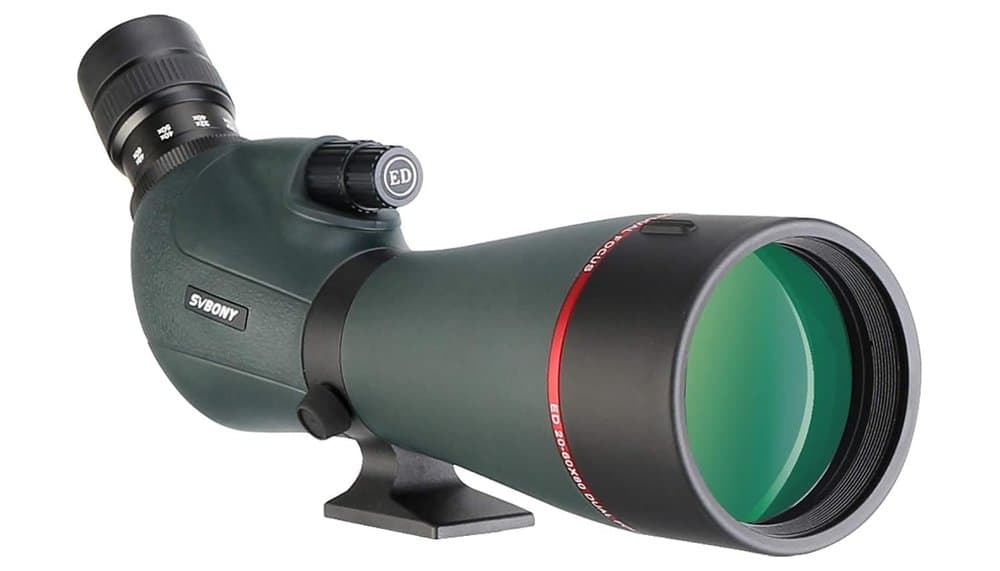
Introduction
In the world of spotting scopes for nature observation, finding a balance between optical performance, versatility, and budget is often a challenge. The SVBONY SV406P ED Spotting Scope has established itself as a serious instrument in the accessible segment. Armed with a technical specification that includes ED (Extra-low Dispersion) glass, a detachable zoom eyepiece, and a waterproof construction, it claims to offer an experience usually reserved for more expensive models. We analyze this spotting scope here by dissecting its specifications, cross-referencing community feedback and expert opinions, to determine what place it truly holds in the equipment of the naturalist, hiker, or amateur astronomer.
Key Strengths
- Superior optical quality for its price thanks to the ED glass element, which significantly reduces chromatic aberrations.
- Mechanical and optical versatility with a detachable 1.25" eyepiece and a dual-speed focusing system for precise adjustment.
- Robust and waterproof (IPX7) construction suitable for demanding outdoor use.
- Excellent value for money, offering features usually associated with higher-end ranges.
Key Weaknesses
- Limited performance at high magnification (60x) where the image can lose brightness and sharpness.
- Included zoom eyepiece with an adequate but not exceptional field of view, and whose soft eyecup can interfere with some accessories.
- Requires a stable tripod due to its weight and sensitivity to vibrations at high magnification.
- Limited compatibility with some third-party astronomical eyepieces, not all of them achieving focus.
Detailed Analysis of the SVBONY SV406P ED
Optical Quality and Field Performance
On paper, the specifications of the SV406P ED are ambitious. The 80mm objective is the key to its light-gathering capability. Combined with ED glass, it promises sharp images with control of color fringing (chromatic aberration) far superior to standard entry-level scopes. User feedback and expert tests converge on this point: sharpness and contrast are excellent in the low to mid zoom range (20x to 45x). Colors are described as natural and faithful, an asset for the precise identification of birds through plumage details.
The theoretical twilight factor is high (approximately 40 to 69 depending on magnification), and the exit pupil goes from 4mm at 20x to 1.33mm at 60x. In practice, this confirms what observers report: the instrument is bright and performs well up to about 40-45x. Beyond that, and particularly at 60x, brightness drops noticeably and the image can become "softer". This is a common characteristic of many zooms in this price range, but the presence of ED glass allows it to retain a usable image, where others would become unusable. Light transmission, aided by FMC (Fully Multi-Coated) treatments on the lenses and BAK-4 prisms, is considered very good for the category.
The field of view offered by the zoom eyepiece (not specified by SVBONY but estimated at approximately 40-20m at 1000m over the zoom range) is described as adequate without being extraordinary. Comparisons show it is similar to or slightly less than that of entry-level zoom eyepieces from major brands, but the sharpness extended over a large part of the field is a positive point noted.
Construction, Ergonomics, and Practical Use
The construction is a strong point. The scope is waterproof (IPX7 standard) and nitrogen-filled, protecting it from internal fogging. The rubber armor provides a good grip and protects against minor shocks. At 1.63 kg, it is not the lightest of the 80mm scopes, but its weight remains reasonable for hiking sessions or stationary observation. All testers agree that a solid tripod is essential, especially to exploit high magnifications or for digiscoping.
The ergonomics are marked by two key features. First, the dual-speed focus. A large knob for fast focusing and a small knob for fine adjustment. This function, often absent on competing models at this price, is highly praised by users, particularly for photography or observation of fine details. Second, the detachable 1.25" eyepiece opens the door to some versatility. It can be replaced by other astronomical eyepieces, although some reviews note focusing issues with specific models. The 18-20mm eye relief is comfortable and allows use with glasses, as the soft eyecup folds down.
The minimum focusing distance is about 6 meters, which is suitable for most wildlife observation, although specialized models can do better.
Versatility: Digiscoping and Astronomy
The SV406P ED shines through its versatility. For digiscoping, its official compatibility with the SVBONY SC001 WiFi camera is a plus, although feedback on this camera is mixed (complexity, average image quality). On the other hand, with a quality universal smartphone adapter, the results are very respectable, with dual-speed focusing greatly facilitating obtaining a sharp image on the phone's screen.
For occasional astronomy, it is a safe bet. Observers report impressive views of the Moon, clear and detailed, with visible control of chromatic aberrations on the limb. Bright planets like Jupiter (with its Galilean moons) and Saturn (showing its rings) are within its capabilities, as are bright star clusters (Pleiades). For deep-sky objects (nebulae, galaxies), the 80mm aperture offers a glimpse, but this is where its limits as a terrestrial (and not a pure astronomical) instrument become apparent.
Summary Technical Specifications
| Characteristic | SVBONY SV406P ED Specification |
|---|---|
| Objective Diameter | 80 mm |
| Magnification | 20-60x (zoom eyepiece included) |
| Special Optical Element | ED (Extra-low Dispersion) Glass |
| Coatings | FMC (Fully Multi-Coated) on lenses and prisms |
| Prism Type | BAK-4 Porro |
| Exit Pupil | 4 mm (at 20x) to 1.33 mm (at 60x) |
| Eye Relief | 18-20 mm |
| Waterproofing | IPX7 (Waterproof and nitrogen-filled) |
| Eyepiece Interface | Detachable 1.25" |
| Focusing | Dual-speed (coarse and fine) |
| Weight | 1.63 kg |
| Length | 40.5 cm |
| Included Accessories | Soft case, protective caps, cleaning cloth |
What Users Say: Summary of Reviews
Feedback from the community, with a very high overall rating, paints a clear consensus.
The recurring positive points are:
- Perceived image quality as excellent for the price: "clear", "bright", "sharp", "no visible chromatic aberration under normal conditions" are terms that constantly come up. The difference made by the ED glass is widely recognized.
- Reliability of dual-speed focus: Considered a "game-changer", it allows for highly precise adjustments, appreciated in digiscoping and for detailed observation.
- Finish and solidity: The instrument is perceived as well-finished, robust, and the soft case is considered good quality.
- Unbeatable value for money: This is the key argument. Many users compare it favorably to much more expensive established brand models, believing the performance difference does not justify the price gap.
The reported criticisms and limitations are:
- Quality drop at 60x: "A bit dark" and less sharp at maximum magnification is a frequent remark. Most users find their sweet spot between 20x and 45x.
- Compatibility issues: Some note that their smartphone adapter has trouble attaching securely to the soft eyecup, or that some third-party astronomical eyepieces cannot achieve focus.
- Tripod essential: Its weight and sensitivity to vibrations make hand-held use impossible except at very low magnification. A stable tripod is a necessity, not an option.
- Some quality control anomalies: Although rare, a few comments mention issues with lens gluing or centering, quickly resolved by customer service.
Conclusion: Who is this spotting scope for?
The SVBONY SV406P ED Spotting Scope is not a perfect instrument, but it hits very hard where it matters for the demanding yet budget-conscious observer. Its main asset is to offer truly superior optical quality, thanks to its ED glass and full coatings, in a price range where this technology is often absent.
We recommend it without hesitation to wildlife observers (birdwatchers, naturalists), hiker-photographers looking for a versatile tool for digiscoping, and occasional amateur astronomers wanting to discover the brightest celestial objects. It is also a wise choice for the hunter or sport shooter needing precise adjustment control.
On the other hand, those seeking exclusively absolute performance at very high magnification (60x and above) in extreme low-light conditions will likely need to turn to high-end models. Similarly, if absolute lightness is the number one priority for long hikes, models with a smaller objective (65mm) could be considered.
Ultimately, the SV406P ED brilliantly fulfills its role as an affordable "mid-range" spotting scope. It proves that it is possible to obtain serious image quality, reliable construction, and well-thought-out ergonomics without having to invest in premium products. It is an excellent entry point for quality observations and an instrument that can serve well for many years.
100% free and independent — All our articles are written independently, without any sponsorship. We may earn a commission on purchases made through our links, at no extra cost to you.
Articles you might like
Vanguard Endeavor HD65A Spotting Scope Review
Spotting scope with 65mm ED glass & 15-45x zoom for birding & hiking. Balanced performance & portability for serious nature observers.
Carson AdventurePak Kids' Exploration Tool Kit Review
Explore nature with this kid's 5-piece tool kit for outdoor adventure and educational discovery. Perfect for young explorers.
BOSTRON CY 10x50 Monocular Review & Test
Compact 10x50 monocular review: Analyzes optical clarity, field of view & build quality for hiking, nature & astronomy. See its true value.
Guides you might like
WiFi Trail Camera Guide
See wildlife discreetly from your couch! Learn how WiFi trail cameras let you monitor animals without disturbance and how to choose the right one.
Ultimate Travel Telescope Guide
Choose a portable, high-performance travel telescope to explore the universe from your backpack without compromising on essential astronomical views.
Ultimate Guide to Night Vision Binoculars
Choose the perfect night vision binoculars: Gen vs. digital? Unravel the tech to make your nighttime wildlife adventures a total success. Guide inside.