Svbonу MK127 Maksutov-Cassegrain Telescope OTA Review
Published on 9 July 2026 · By OptiqueNature
Review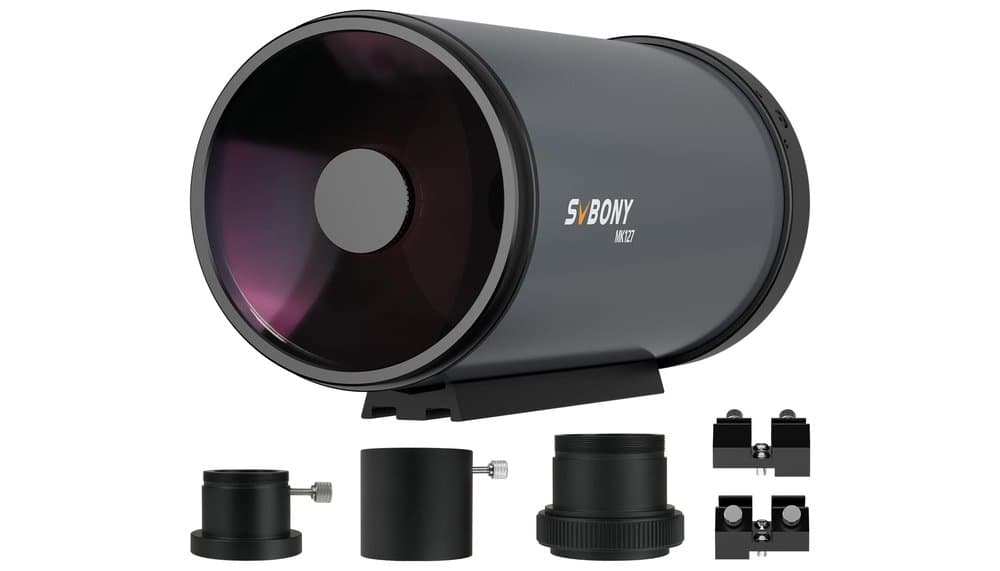
Introduction
The Svbony MK127 Astronomical Telescope Maksutov-Cassegrain OTA represents an interesting proposition in the universe of catadioptric instruments for amateur astronomers. In this article, we analyze this 127mm OTA (Optical Tube Assembly), its Maksutov-Cassegrain design, its performance, and its market positioning, based on its technical specifications and concrete user feedback. What we seek to understand is whether this optical tube manages to combine compactness, optical quality, and versatility for visual observation and planetary photography.
Strengths and Weaknesses
Strengths
- Corrected and Versatile Optics: The three-element Maksutov-Cassegrain design offers aberration correction (coma, astigmatism) and a built-in flat field, suitable for photography.
- Robust Build and Complete Finish: Users praise the build quality, the precise dual-speed focuser, and the inclusion of a 0.65x focal reducer to widen the field of view.
- Compatibility and Practical Interface: Presence of a native T2 (M42) interface, 2" and 1.25" adapters, and a standard dovetail plate for great flexibility.
Weaknesses
- Random Factory Collimation: Several reports indicate that manual collimation may be required upon receipt to obtain optimal image quality.
- Significant Weight: At nearly 3 kg, the tube demands a robust mount and stability, impacting its portability for quick uses.
- Acclimatization Time and Sensitivity: Like any closed system, it requires a significant thermal equalization time to avoid internal turbulence.
Detailed Analysis of the Svbony MK127
Optical Quality and Design
On paper, the MK127 relies on a proven optical design. The Maksutov-Cassegrain combines a front corrector lens (the meniscus) with a mirror system. This configuration allows for a long focal length of 1500mm (f/11.8) in a relatively short tube, a major compactness feature. The manufacturer highlights a built-in flat-field design which, combined with the system's aberration correction, aims to deliver sharp stellar images across the entire field, a notable advantage for photography.
The announced optical coatings are dielectric coatings with 99% reflectivity. In theory, this allows for optimal light transmission, high contrast, and suppression of ghosting. Unlike apochromatic refractors, this design is achromatic by nature, meaning it should exhibit no visible chromatic aberration, a point confirmed by users who note "very clean" images.
In terms of light transmission and exit pupil, the f/11.8 focal ratio makes it a relatively "slow" instrument. This results in a fairly small exit pupil with high-magnification eyepieces (e.g., a 10mm eyepiece gives an exit pupil of about 0.85mm). This is a typical characteristic of this type of instrument, geared towards high-resolution observation of planets and the Moon, rather than massive photon collection for faint deep-sky objects. Its deep-sky performance will be limited to the brightest objects (globular clusters, planetary nebulae).
Finish, Handling, and Compatibility
It is on ergonomics and finish that feedback is the most laudatory. The community notes a construction perceived as very solid, superior to some direct competitors. The dual-speed focuser is consistently described as very smooth and precise, allowing for fine focusing essential in planetary observation and photography.
The inclusion of a 0.65x focal reducer in the kit is a notable advantage. It changes the focal ratio to f/7.68, significantly widening the field of view and reducing exposure time for imaging, making it more versatile for larger targets like some nebulae.
Compatibility is another strong point. The presence of a direct T2 (M42) bayonet at the back of the tube, emphasized by testers, is a practical detail appreciated by astrophotographers, facilitating camera connection without additional adapters. The 2" and 1.25" interfaces allow the use of a wide range of eyepieces. The standard dovetail plate (Vixen type) ensures compatibility with the majority of mounts on the market.
The weight of 2.93 kg for the tube alone is an element to consider carefully. It requires a robust medium-sized equatorial or alt-azimuth mount for stable use, especially in photography. It is not an instrument to mount on a small, lightweight photo tripod.
Typical Use Cases
- Lunar and Planetary Observation (Visual): This is its area of excellence. The native long focal length and absence of chromatic aberration should provide detailed and contrasted images of the Moon, Jupiter, Saturn, or Mars. Feedback confirms "superb lunar views" and planetary performance "reasonable at 150x".
- Planetary and Lunar Astrophotography: The tube is designed for this. The precise focus, T2 interface, and mechanical stability make it a good candidate for use with planetary cameras. The focal reducer offers a wider composition option.
- Deep-Sky Observation (Visual, Limited): It will allow observation of the brightest objects (M13, M57, M42...), but its 127mm aperture and high focal ratio make it less suited for faint, diffuse nebulae than Newtonians of the same diameter or wider-field refractors.
- Terrestrial Observation (with Reducer): Theoretically possible with a correct-image diagonal, its long focal length and the fact that it produces an inverted image make it impractical compared to a classic spotting scope. This is clearly not its primary purpose.
Technical Specifications
| Characteristic | Detail |
|---|---|
| Designation | Svbony MK127 OTA (Optical Tube Assembly) |
| Optical Type | Maksutov-Cassegrain (catadioptric) |
| Diameter (Aperture) | 127 mm |
| Focal Length | 1500 mm (native) |
| Focal Ratio | f/11.8 (f/7.68 with the included 0.65x reducer) |
| Optical Coatings | High-reflectivity dielectric coatings (99%) |
| Focuser | Dual-speed (coarse and fine), manual |
| Interfaces | Native T2 (M42), adapters for 2" and 1.25" eyepieces included |
| Mounting Plate | Standard Vixen-type dovetail (210mm) |
| Included Accessories | Caps, SCT to 1.25" and 2" adapters, 0.65x focal reducer |
| Tube Length | Approximately 46 cm |
| Weight | 2.93 kg (tube only) |
What Users and Testers Say
An analysis of customer reviews and online discussions reveals clear trends, both very positive and with some important reservations.
Recurring Positive Points:
- Mechanical Quality and Finish: Terms like "robust," "well-built," "super creamy focuser," and "safe value" come up often. Many compare it favorably to established models from competing brands, noting an often superior finish.
- Optical Performance After Adjustment: Once properly collimated, users are unanimous about the sharpness and contrast of the images, especially on the Moon. The absence of chromatic aberration is consistently noted.
- Completeness of the Kit: The inclusion of the 0.65x focal reducer and adapters is highly appreciated, offering immediate versatility that competitors do not always provide at this level.
Negative or Critical Points:
- Factory Collimation: This is the main point of friction. Several reports indicate that the instrument may arrive requiring collimation. One MK127 user even notes having to partially disassemble the tube to access the collimation screws, which were fixed with some sort of "glue." This point therefore requires a certain technical skill or patience from a beginner user.
- Weight and Need for Stability: Its weight is frequently mentioned as requiring a solid mount. One user specifies that it is usable by day on a photo tripod with a fluid head only at low magnification.
- Thermal Acclimatization: Like all Maksutovs, its closed-tube design makes it sensitive to temperature differences. One buyer recommends an acclimatization time of at least 30 minutes before observation to avoid internal turbulence that degrades the image.
The overall rating of 4/5 on sales platforms reflects this assessment well: a product highly appreciated for its performance and value for money, but with a caveat regarding the quality control of initial collimation.
Conclusion
The Svbony MK127 Astronomical Telescope Maksutov-Cassegrain OTA positions itself as a serious and complete instrument for the amateur astronomer seeking a versatile tube, primarily geared towards high-resolution observation and planetary photography. Its major assets lie in its robust construction, its quality focuser, and the versatility offered by its included accessories, especially the focal reducer.
However, it is not without requirements. Its weight demands a stable mount, and feedback suggests one should be prepared to check, or even perform, its collimation to fully exploit its optical potential. It is therefore not necessarily an "out-of-the-box" instrument for an absolute beginner without any technical knowledge, but it constitutes an excellent platform for a motivated amateur wishing to progress in detailed visual observation and planetary imaging.
For those who accept this small initial learning curve, the MK127 offers, according to the community, optical performance and mechanical finish that often rival more established and sometimes more expensive products, making it a very interesting candidate in the 127mm Maksutov-Cassegrain segment.
100% free and independent — All our articles are written independently, without any sponsorship. We may earn a commission on purchases made through our links, at no extra cost to you.
Articles you might like
Vanguard Endeavor HD65A Spotting Scope Review
Spotting scope with 65mm ED glass & 15-45x zoom for birding & hiking. Balanced performance & portability for serious nature observers.
Carson AdventurePak Kids' Exploration Tool Kit Review
Explore nature with this kid's 5-piece tool kit for outdoor adventure and educational discovery. Perfect for young explorers.
BOSTRON CY 10x50 Monocular Review & Test
Compact 10x50 monocular review: Analyzes optical clarity, field of view & build quality for hiking, nature & astronomy. See its true value.
Guides you might like

WiFi Trail Camera Guide
See wildlife discreetly from your couch! Learn how WiFi trail cameras let you monitor animals without disturbance and how to choose the right one.
Ultimate Travel Telescope Guide
Choose a portable, high-performance travel telescope to explore the universe from your backpack without compromising on essential astronomical views.
Ultimate Guide to Night Vision Binoculars
Choose the perfect night vision binoculars: Gen vs. digital? Unravel the tech to make your nighttime wildlife adventures a total success. Guide inside.