Steiner Navigator 7x50 C Marine Binoculars Review
Published on 20 July 2026 · By OptiqueNature
Review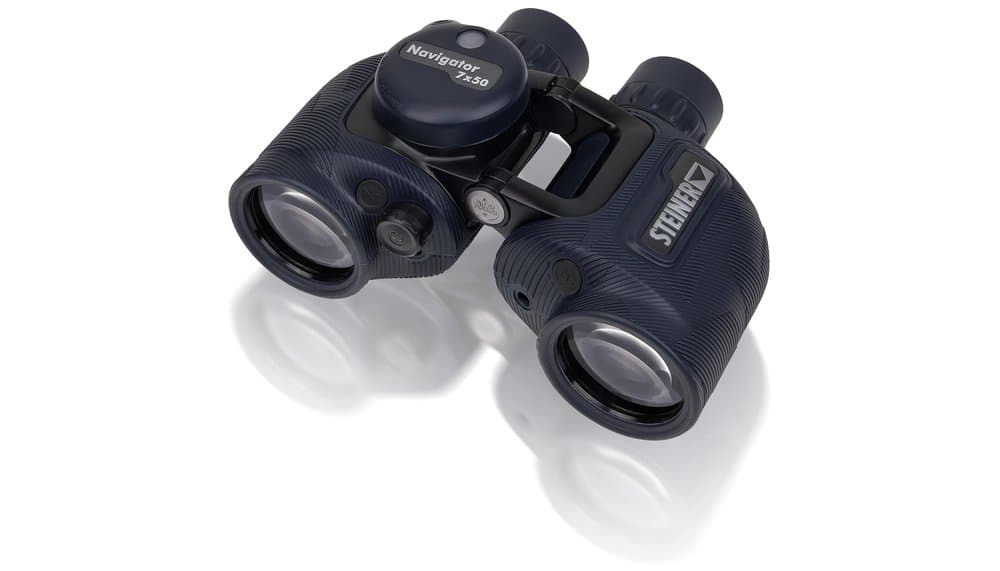
Introduction: A Maritime Icon Reinvented
In the world of marine binoculars, the name Steiner resonates with undeniable authority. The Navigator series embodies this reputation for ruggedness and optical performance suited for the most demanding conditions. The "C" generation of the Steiner Navigator 7x50 C Marine Binoculars brings notable evolutions, such as the new open bridge ("Open Bridge System") and an improved illuminated compass. Here we analyze this iconic product to determine if it deserves its place on deck, closely examining its specifications, real-world performance based on user feedback, and its relevance for nature observers.
Strengths and Weaknesses
Strengths
- High-end marine optics with the Auto-Focus system and High-Contrast coating for bright images and accurate colors, even in overcast conditions.
- Unbeatable ruggedness and waterproofing: Construction worthy of "German Engineering," waterproof to 5 meters, and nitrogen-purged.
- Perfectly integrated stabilized and illuminated compass, an indispensable and reliable navigation tool.
- Improved ergonomics thanks to the open bridge, allowing for a firm and comfortable grip, even with one hand.
- Complete user experience with comprehensive accessories and a ten-year warranty.
Weaknesses
- Significant weight and bulk: Clearly designed for the sea, their mass makes them poorly suited for hiking or prolonged lightweight use.
- Autofocus limiting for some uses: The Auto-Focus system, ideal for navigation, can be a hindrance for observers wanting to focus on very close objects (like wildlife at short range).
- Accessories sometimes criticized: According to feedback, some elements like the removable eyecups or the strap are perceived as being of lower quality than the binoculars themselves.
- A substantial investment primarily justified for intensive or professional nautical use.
Detailed Technical Analysis
Optical Quality and Visual Performance
The Steiner Navigator 7x50 C are built around a classic and proven optical formula for the marine environment: 7x50. The 7x magnification provides a sufficiently stable image, even on a moving boat, while the large 50 mm objectives guarantee exceptional brightness. This combination yields an exit pupil of 7.14 mm, far larger than the dilation capability of an adult human pupil (about 5-7 mm in full darkness). This means all collected light is usable, resulting in a very bright image, a decisive asset for night navigation or in poor visibility.
The twilight factor, calculated from the square root of (7x50), is approximately 18.7. This high value confirms their excellent low-light capabilities.
Their main optical argument lies in the Steiner Sports Auto-Focus system. After an initial diopter adjustment on each eyepiece, sharpness is ensured from 20 meters to infinity without any manipulation. For sailors scanning the horizon, spotting beacons, or monitoring other vessels, this feature is an invaluable gain in speed and simplicity. Expert testers emphasize that this optics are treated with Steiner's High-Contrast system, designed to maximize light transmission and improve contrast, particularly useful for cutting through sea haze and distinguishing details in flat lighting conditions.
The field of view is 115 meters at 1000 meters. While respectable for 7x50 binoculars, it is not the widest on the market in this category. Some competing models offer a slightly wider field. However, the community of marine users notes that sharpness is excellent across most of the field, without annoying distortion at the edges, which is often preferable to a wider field of lesser optical quality.
Design, Construction, and Handling
The ruggedness here is legendary. The housing is waterproof to a depth of 5 meters and nitrogen-purged, making it completely fog-proof. The NBR (Nitrile Butadiene Rubber) rubber armor provides a slip-resistant grip even with wet or gloved hands. These characteristics make it equipment capable of withstanding the harshest environments: salt spray, rain, moderate shocks, and temperature variations.
The major evolution of this "C" generation is the Open Bridge System. This design frees up the space between the two tubes, allowing for a more natural and ergonomic grip. Hands of all sizes can thus firmly wrap around the binoculars. This design also contributes to better weight distribution, despite the listed 1,115 grams. This substantial weight is the direct compromise of the large 50 mm objectives and a sturdy metal construction. They are clearly not intended to be worn on a shoulder strap for hours while hiking but are perfect for intensive, on-demand use on a boat.
The compass is a central element. It is a stabilized gimbal compass, visible in the right eyepiece. It is backlit (with momentary activation) for night reading. Testers note its accuracy and smoothness. An important detail noted by users: the compass works perfectly when the binoculars are held horizontally but can "stick" if the tilt is too pronounced. This is a normal characteristic of this type of stabilized marine compass, designed for use on a moving deck.
The eye relief is approximately 19 mm, which is very generous and allows comfortable use with glasses. The rubber eyecups are simply foldable.
Summary Technical Specifications
| Characteristic | Specification Steiner Navigator 7x50 C |
|---|---|
| Magnification | 7x |
| Objective Lens Diameter | 50 mm |
| Prism | Porro (standard for this type of marine binoculars) |
| Field of View at 1000m | 115 m |
| Exit Pupil | 7.14 mm |
| Eye Relief | ~19 mm |
| Close Focus Distance | 20 m (due to the Auto-Focus system) |
| Diopter Adjustment | On the right eyepiece |
| Waterproofing | Up to 5 m (Waterproof) |
| Gas Filling | Nitrogen (Fogproof) |
| Compass | Integrated, stabilized, backlit (press-button) |
| Weight | 1,115 g |
| Warranty | 10 years |
What Users and Experts Say
The synthesis of 140 customer reviews (with an average rating of 4.6/5) and expert analyses confirms and nuances the technical specifications.
The praise is unanimous on several points:
- Reliability and construction: The adjectives "robust," "waterproof," "solid" come up repeatedly. Professional users (like Thomas, who uses them "in the professional sector" of sailing) and amateurs confirm their resistance to marine conditions.
- Optical quality: The brightness and sharpness are consistently praised. A German user writes: "Das Durchschauen ist eine wahre Pracht" (Looking through is a true delight). The Auto-Focus system is particularly appreciated for its practical and infallible nature in navigation.
- Useful compass: The compass is described as accurate and well-integrated. Its momentary activation backlighting is judged sufficient and well thought out.
Criticisms and remarks mainly concern peripheral aspects or the inherent compromises of this type of product:
- Accessories: This is the most frequent point of friction. Dominique Lefebvre mentions that "the systems that hold the objective lens covers don't hold," having lost them quickly. Others deem the supplied case "cheap" or criticize the plastic carabiners on the strap, perceived as unworthy of the product.
- Weight: Many note their significant mass, which confines them to "boat deck" use rather than portable use.
- Auto-Focus Compromise: While an asset at sea, some nature observers (terrestrial birdwatching, for example) might find the minimum focusing distance of 20 meters limiting. This is not a flaw, but a usage-oriented characteristic.
One review summarizes the general feeling well: a British user finds them "Excellent value for money. Not quite in the same league as the Swarovski equivalent, but then they are 4 times more expensive...". This places the Steiners in an accessible high-end category, high-performing, but with some concessions on accessory finishes.
Conclusion: Who Are These Binoculars For?
The Steiner Navigator 7x50 C Marine Binoculars do not claim to be a universal pair of binoculars. They are the archetype of a specialized tool, designed to excel in a specific domain.
They are the reference for any navigator, whether an amateur sailor or professional. Their bright and auto-focus optics, reliable compass, and indestructible construction make them invaluable safety and comfort equipment at sea. For coastal surveillance, observing marine wildlife (whales, dolphins, seabirds) from a boat, or any nautical activity, they are perfectly suited.
On the other hand, for a hiker or terrestrial birder covering long distances, their weight and bulk will be handicaps. Their fixed-focus system also makes them poorly suited for digiscoping or observing very close objects.
Ultimately, if your world is that of water, spray, and distant horizons, the Steiner Navigator 7x50 C represent a solid and justified investment, offering a large part of the optical performance of the very top tier in an incredibly well-thought-out housing for the marine environment. You are buying here much more than a pair of binoculars: a reliable navigation companion for the years to come.
100% free and independent — All our articles are written independently, without any sponsorship. We may earn a commission on purchases made through our links, at no extra cost to you.
Articles you might like
Vanguard Endeavor HD65A Spotting Scope Review
Spotting scope with 65mm ED glass & 15-45x zoom for birding & hiking. Balanced performance & portability for serious nature observers.
Carson AdventurePak Kids' Exploration Tool Kit Review
Explore nature with this kid's 5-piece tool kit for outdoor adventure and educational discovery. Perfect for young explorers.
BOSTRON CY 10x50 Monocular Review & Test
Compact 10x50 monocular review: Analyzes optical clarity, field of view & build quality for hiking, nature & astronomy. See its true value.
Guides you might like
WiFi Trail Camera Guide
See wildlife discreetly from your couch! Learn how WiFi trail cameras let you monitor animals without disturbance and how to choose the right one.
Ultimate Travel Telescope Guide
Choose a portable, high-performance travel telescope to explore the universe from your backpack without compromising on essential astronomical views.
Ultimate Guide to Night Vision Binoculars
Choose the perfect night vision binoculars: Gen vs. digital? Unravel the tech to make your nighttime wildlife adventures a total success. Guide inside.