Sky-Watcher Skymax 150 Telescope Review
Published on 9 April 2026 · By OptiqueNature
Review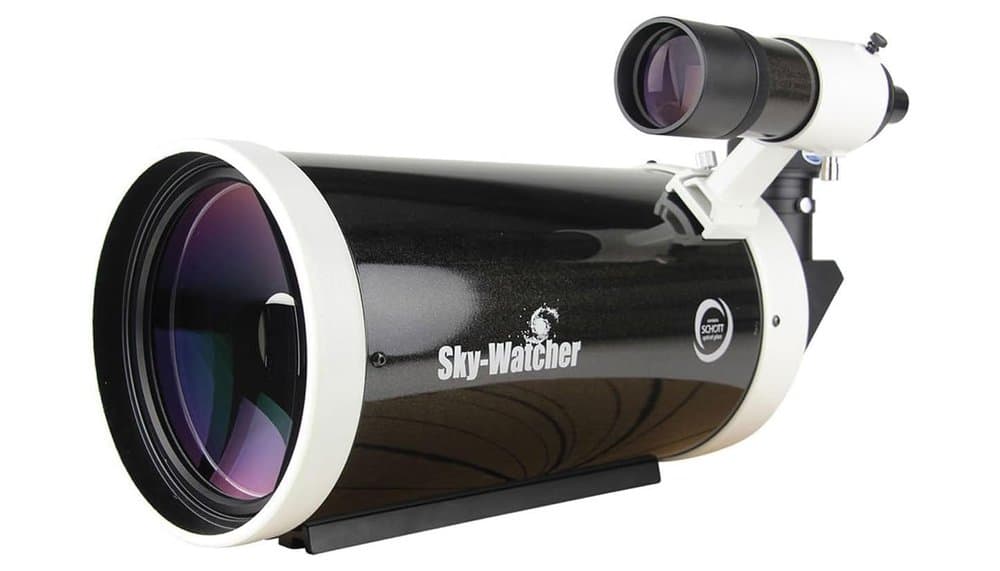
Analysis of the Sky-Watcher Skymax Maksutov-Cassegrain 150mm
Introduction
The world of catadioptric telescopes offers a unique compromise between power, portability, and optical quality. Among these instruments, the Sky-Watcher Skymax Maksutov-Cassegrain 150mm presents itself as a solution for the amateur astronomer wishing to combine a generous aperture with a compact format. Its Maksutov-Cassegrain design, with its meniscus corrector at the front of the tube, promises high-contrast, aberration-free images. We will dissect this instrument to determine if it lives up to its promises, analyzing its technical specifications, real-world performance according to the community, and its positioning against the competition.
Strengths
- Superior Optical Quality: The Maksutov-Cassegrain design is renowned for offering exceptional contrast and very sharp images, ideal for planetary and lunar observation.
- Remarkable Compactness: For a 150mm aperture, the tube is extremely short and easy to transport, a major asset for mobile astronomers.
- Native Long Focal Length: With a 1800mm focal length (f/12 focal ratio), it is naturally suited for high magnifications without always requiring a Barlow lens, simplifying the optical path.
- "Refractor-like" Rendering: Users and experts often emphasize that Maksutovs offer a rendering close to that of an apochromatic refractor, with very good control of chromatic aberrations.
- Robust Construction: The fully sealed tube and the use of quality materials contribute to good durability and protection against dust.
Weaknesses
- Long Thermal Stabilization Time: The thick meniscus corrector lens and sealed tube result in a significant cooldown time. A wait of 30 to 45 minutes may be necessary to achieve optimal performance, especially with large temperature differences.
- Relatively Narrow True Field of View: The long focal ratio (f/12) limits the field of view. It is less suited for observing extended deep-sky objects like large nebulae.
- Sensitive to Vibrations: The 1800mm focal length amplifies vibrations. An extremely stable and robust mount (such as an EQ5 or higher class) is essential to fully exploit the instrument's resolution.
- Cost of the Ecosystem: The initial cost of the optical tube does not include a mount adequate for its potential. The total investment (solid mount, possibly a focal reducer for wide-field astrophotography) can be significant.
Detailed Analysis
Optical Quality and Performance
The heart of this telescope lies in its Maksutov-Cassegrain design. Unlike the thin corrector plate of Schmidt-Cassegrains, the Sky-Watcher uses a thick meniscus corrector. According to technical analyses, this design effectively eliminates spherical aberration and offers superior contrast, a decisive asset for revealing subtle details in planetary atmospheres or the nuances of lunar terrain.
The specifications state a primary mirror made of borosilicate with an aluminum coating and a quartz overcoat, achieving a reflectivity of 94%. This figure, very good for consumer equipment, ensures optimal light transmission. The optical coatings (MHTC - Metal High Transmission Coatings) on the corrector aim to maximize transmission and minimize internal reflections.
With an aperture of 150mm (6 inches) and a focal length of 1800mm, we obtain an f/12 focal ratio. This makes it an instrument specialized in high-magnification objects. The theoretical resolving power is about 0.9 arcseconds, and the limiting magnitude is around 13.5, which is quite respectable for observing a wide range of deep-sky objects, even though its narrow field primarily destines it for planets, the Moon, and globular clusters.
Construction and Handling
The construction is fully metallic, giving a feeling of robustness and quality. The tube is sealed, which protects the mirrors from dust and humidity, an advantage for longevity. However, this seal also contributes to the longer thermal stabilization time mentioned earlier.
The weight of the optical tube alone is about 7.3 kg. Although compact, its mass and long focal length demand a mount capable of supporting it solidly. The standard Vixen dovetail allows it to be installed on most mounts on the market.
Its reduced size is its major asset: a tube only 40 cm long for a 150mm aperture. This makes it much more portable than a 150/750 Newtonian of comparable length, and more compact than a Schmidt-Cassegrain of the same diameter.
Included Accessories and Compatibility
The tube comes with a coherent set to get started:
- A 28mm 2" eyepiece offering low magnification (about 64x) and a clear field of view for locating objects.
- A decent quality 2" 90° diagonal.
- A 9x50 right-angle finderscope, sufficient for aiming.
The 2" eyepiece holder diameter is a real plus, allowing the use of modern wide-field eyepieces to maximize the field of view, despite the high f/ratio. For planetary or lunar astrophotography, its native long focal length is an advantage. For wide-field deep-sky, adding a dedicated focal reducer (like the Sky-Watcher 0.5x or 0.63x reducer) becomes almost essential.
Comparison with the Competition
Positioned in the intermediate-high-end segment of compact catadioptrics, the Skymax 150/1800 naturally compares to 150mm Schmidt-Cassegrain (SCT) models, like those from Celestron.
- Versus SCTs (f/10): The Maksutov generally offers better contrast and a slightly sharper image, at the cost of a somewhat narrower field and longer cooldown time. SCTs are often slightly more versatile due to their slightly faster f/ratio.
- Versus Maksutovs from other brands: It positions itself as a more accessible alternative than some high-end models (Intes-Micro, etc.), while offering a large part of their optical performance.
- Versus Newtonians of the same aperture: It wins in compactness and ease of maintenance (sealed optics), but loses in relative brightness (f/12 vs f/5 or f/8) and wide field. The Newtonian often offers a better price/performance ratio for the aperture.
Technical Specifications
| Characteristic | Specification |
|---|---|
| Designation | Sky-Watcher Skymax Maksutov-Cassegrain 150mm |
| Optical Type | Maksutov-Cassegrain |
| Diameter (Aperture) | 150 mm |
| Focal Length | 1800 mm |
| Focal Ratio | f/12 |
| Resolving Power | ~0.9 arcseconds |
| Limiting Magnitude | ~13.5 |
| Tube Length | Approximately 40 cm |
| Optical Tube Weight | 7.3 kg |
| Eyepiece Holder Diameter | 2" (with 1.25" adapter included) |
| Mount Type (Recommended) | Standard Vixen dovetail |
| Finderscope | 9x50 right-angle |
| Included Accessories | 2" 90° Diagonal, 28mm 2" Eyepiece |
What Users Say
A synthesis of community feedback and expert reviews reveals clear trends.
Recurring Positive Points:
- The optical quality is very widely praised. Users report extremely sharp and contrasty images of the Moon and planets. Jupiter and Saturn, in particular, reveal a multitude of details.
- The compactness is a major asset: "as long as a big camera lens" for considerable power.
- The finish and solidity of the assembly are appreciated.
- The native long focal length is seen as an advantage for planetary observation and lunar imaging, avoiding the need for a Barlow lens.
Points of Caution Raised:
- The cooldown time is systematically mentioned as the main drawback to anticipate. The telescope needs to be taken out well before the observing session.
- The necessity of a very stable mount is emphasized. Many indicate that a light mount is insufficient and that investing in a robust mount (EQ5, HEQ5 or equivalent) is crucial.
- The narrow field is confirmed. It is described as a specialized "planetary/lunar" instrument rather than an all-rounder.
- Some feedback mentions that the included finderscope, while functional, could be of better quality.
Experts confirm these trends, specifying that the Skymax 150 excels in its category for sharpness and contrast, positioning it as a preferred choice for the demanding observer of solar system objects.
Conclusion
The Sky-Watcher Skymax Maksutov-Cassegrain 150mm is not a universal telescope, and that is precisely where its strength lies. It is a specialized instrument, built for excellence in planetary and lunar observation. Its Maksutov optical design gives it a contrast and image sharpness that will appeal to purists, while its compactness makes it surprisingly portable for its aperture.
However, its acquisition requires careful thought. It demands patience (thermal stabilization) and an investment in a solid mount to express its full potential. Its narrow field primarily reserves it for high-magnification objects.
Who is it the right choice for? For the amateur astronomer with some initial experience, looking for a portable instrument offering first-rate optical performance on planets and the Moon, and ready to pair it with a mount worthy of the name. For those seeking a unique instrument for wide-field deep-sky or to start with a light mount, a Newtonian or Schmidt-Cassegrain will likely be more suitable.
In summary, the Skymax 150/1800 is like a high-quality telephoto lens in photography: a demanding tool, sometimes constraining, but which, in its area of expertise, delivers results difficult to match for its size. It is a companion of choice for those who wish to unravel the secrets of neighboring worlds.
100% free and independent — All our articles are written independently, without any sponsorship. We may earn a commission on purchases made through our links, at no extra cost to you.
Articles you might like
Vanguard Endeavor HD65A Spotting Scope Review
Spotting scope with 65mm ED glass & 15-45x zoom for birding & hiking. Balanced performance & portability for serious nature observers.
Carson AdventurePak Kids' Exploration Tool Kit Review
Explore nature with this kid's 5-piece tool kit for outdoor adventure and educational discovery. Perfect for young explorers.
BOSTRON CY 10x50 Monocular Review & Test
Compact 10x50 monocular review: Analyzes optical clarity, field of view & build quality for hiking, nature & astronomy. See its true value.
Guides you might like
WiFi Trail Camera Guide
See wildlife discreetly from your couch! Learn how WiFi trail cameras let you monitor animals without disturbance and how to choose the right one.
Ultimate Travel Telescope Guide
Choose a portable, high-performance travel telescope to explore the universe from your backpack without compromising on essential astronomical views.
Ultimate Guide to Night Vision Binoculars
Choose the perfect night vision binoculars: Gen vs. digital? Unravel the tech to make your nighttime wildlife adventures a total success. Guide inside.