Severnier 12x50 Monocular Telescope: Review & Test
Published on 27 April 2026 · By OptiqueNature
Review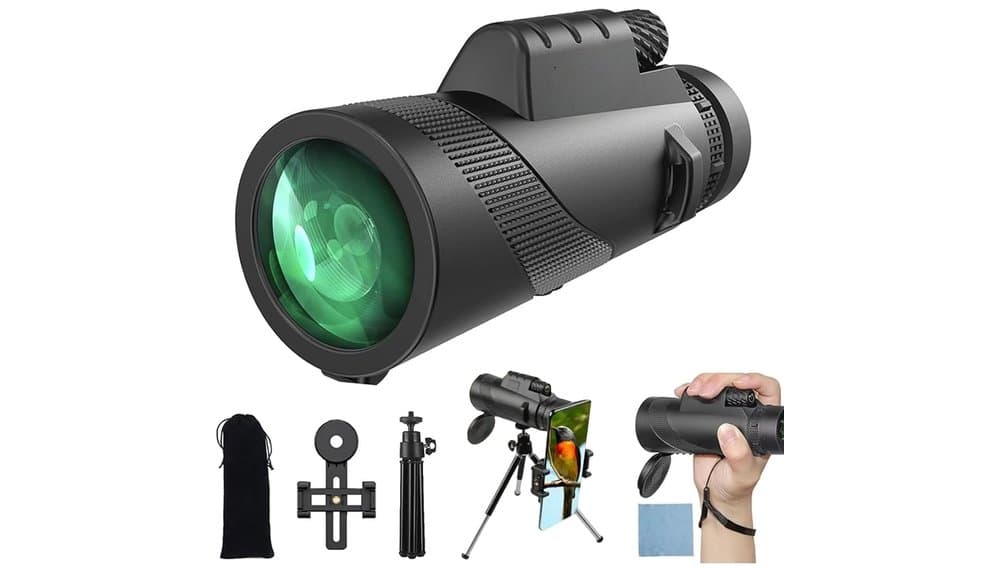
Analysis of the Severnier 12x50 Monocular Telescope: A Versatile, Rugged Monoscope
In the landscape of hobbyist optics, monoscopes are gaining popularity for their compactness and ease of use. The Severnier 12x50 Monocular Telescope positions itself as a versatile tool for casual observers, hikers, and sports enthusiasts. But beyond the marketing promises, what is this instrument really worth? This technical analysis dissects its specifications, design, and community feedback to determine its place in the observation product range.
Strengths
The strengths of the Severnier 12x50 lie in a set of technical features usually reserved for higher price segments, as well as a versatility appreciated by users.
- Superior Optics: The claim of ED (Extra-Low Dispersion) glass and BAK-4 prisms with phase coating is a major selling point. In theory, this should minimize chromatic aberrations (color fringing) and offer better contrast and increased resolution compared to models using standard glass or BAK-7 prisms.
- Versatility and Complete Accessories: The product comes with a substantial kit including a tripod and a smartphone mount, making it immediately operational for stationary observation or digiscoping (capturing images via phone). This inclusion is a real plus for its price.
- Compact and Lightweight: With its reduced dimensions (15 cm long) and a weight of only 350 grams, this monoscope is designed for mobility. It slips easily into a bag, a decisive argument for hikers or travelers.
- Waterproof and Robust Construction: The housing is advertised as waterproof and nitrogen purged, protecting it from internal condensation (fogproof). The rubber armor offers a secure grip, even in wet conditions.
Weaknesses
Despite its qualities, some compromises inherent to its design and positioning emerge from user feedback.
- Reduced Field of View: A magnification of 12x on a 50mm objective lens mechanically induces a relatively restricted field of view. Compared to 8x42 or 10x42 models, it will be more difficult to locate and follow moving objects, like birds in flight.
- Critical Hand-Held Stability: The 12x factor demands a very steady hand or the systematic use of the supplied tripod to avoid shakes that degrade the image. Prolonged hand-held observation can be tiring.
- Uneven Optical Quality at the Edges: While the center of the image is generally described as sharp, some testers report a loss of sharpness and distortions at the edges of the visual field, which is common on entry-level optics.
- Accessories of Limited Quality: The tripod and smartphone adapter, while useful, are often described as lightweight and "entry-level" quality. They get the job done but lack rigidity and finish for intensive use.
Detailed Technical Analysis
To understand the real performance of the Severnier 12x50, one must dissect its specifications and their implications in the field.
Optics and Image Quality The technical promises are ambitious. The ED glass and BAK-4 prisms with phase coating suggest an intention to compete with mid-range models. In practice, the community notes that light transmission is decent for an instrument of this diameter, offering a fairly clear image in daytime conditions and acceptable in early evening. The 4.16 mm exit pupil (50mm / 12x) is comfortable, but the twilight factor of 24.5 (√(12x50)) indicates this is not a specialized instrument for very low light. The FMC (Fully Multi-Coated) treatment on all lenses helps reduce glare and maximize brightness.
Construction and Ergonomics The waterproof and nitrogen-purged construction is a serious advantage for outdoor use, protecting it from sudden weather changes. The rubber coating provides a good grip. The featherweight 350g is a major asset for transport. The manual focus is precise, with a minimum focusing distance of about 2-3 meters according to feedback, which is sufficient for observing butterflies or close-up details. The eye relief is not explicitly stated, but the presence of fold-down eyecups indicates compatibility with glasses, even if the field of view may be reduced.
Technical Specifications Table
| Characteristic | Severnier 12x50 Specification |
|---|---|
| Magnification | 12x |
| Objective Diameter | 50 mm |
| Prism | BAK-4 with phase coating |
| Glass Type | ED (Extra-Low Dispersion) |
| Optical Coatings | FMC (Fully Multi-Coated) |
| Field of View | Not stated (typically narrow at 12x) |
| Exit Pupil | 4.16 mm |
| Twilight Factor | 24.5 |
| Waterproofing | Yes, nitrogen purged |
| Weight | 350 g |
| Included Accessories | Tripod, smartphone mount, case, strap, cloth |
Segmented Comparison
To properly situate the Severnier, it is useful to compare it to other offerings on the market.
- Budget Segment (under €50): The Severnier stands out for its optical claims (ED, BAK-4). Most direct competitors at this price use standard glass and BAK-7 prisms. It therefore offers a theoretically better price-performance ratio on paper.
- Mid-Range Segment (€100-250): Compared to established brands like Vortex, Hawke, or Nikon, the Severnier shows its limits. The mechanical finish, lifetime warranty, homogeneous optical quality across the entire field, and clarity of coatings are generally superior with these brands. The Severnier is an interesting compromise for someone seeking premium specifications at a contained price, but while accepting some variability in quality.
- Premium Segment (€250 and above): The comparison is not relevant. Products from brands like Zeiss, Swarovski, or Leica offer unmatched light transmission, visual comfort, and robustness, justifying their much higher price.
What Users Say
A synthesis of customer reviews and independent expert feedback paints a clear consensus on the product's real strengths and weaknesses.
Recurring Positive Points:
- Perceived Excellent Value for Money: Many users highlight the pleasant surprise at the performance for the asking price. The phrase "good for the price" comes up often.
- Extreme Compactness and Lightness: This is the acclaimed strength. The terms "small," "light," "fits in a pocket" are omnipresent. It advantageously replaces bulkier binoculars for a quick outing.
- Highly Appreciated Accessory Kit: The inclusion of the tripod and smartphone mount is a decisive argument for many, especially for basic digiscoping. Users report the system works adequately for capturing souvenir images.
- Satisfactory Central Sharpness: For general observation (landscapes, wildlife at a fixed distance, outdoor events), the sharpness in the center of the field is judged to be very decent, even good.
Raised Negative Points:
- Mandatory Stability: The majority of comments mention the necessity to use the tripod to get a stable image and fully utilize the 12x magnification. Hand-held observation is described as "shaky."
- Narrow Field of View: Several experienced users point out that the field is limited, making pointing and tracking moving subjects a bit tricky.
- Accessory Quality: While the tripod and adapter are present, their build quality is described as basic and sufficient for occasional use, but not for regular or demanding use.
- Optics Could Be Improved: Some feedback points out a drop in sharpness at the edges of the image and stray reflections under certain strong lighting conditions, tempering the enthusiasm generated by the "ED" and "BAK-4" mentions.
Conclusion: Who is this monoscope for?
The Severnier 12x50 Monocular Telescope is a product that cleverly leverages specifications to stand out in the ultra-competitive entry-level optics segment. Its true merit is offering, in an ultra-compact format and with a complete kit, theoretically superior optical characteristics (ED, BAK-4) to what is usually found at this price.
It is an excellent choice for the casual observer, hiker, or traveler who is primarily looking for an instrument that is easy to carry, versatile, and offers honest performance for panoramic observation, watching wildlife at a fixed distance, or outdoor events. The inclusion of the smartphone mount makes it a fun and economical gateway to digiscoping.
On the other hand, the demanding observer, the birding enthusiast who needs a wide field to follow birds, or the user seeking the best clarity in low light will need to look towards mid-range models from reputable brands. The Severnier's compromises—reduced field of view, need for stability, and uneven optical finish—are the flip side of its compactness and attractive price.
In short, this monoscope fulfills its role perfectly: that of a practical, complete, and performance-oriented optical companion for its price, provided one accepts its limits and systematically uses the supplied tripod to get the best out of it.
100% free and independent — All our articles are written independently, without any sponsorship. We may earn a commission on purchases made through our links, at no extra cost to you.
Articles you might like
BOSTRON CY 10x50 Monocular Review & Test
Compact 10x50 monocular review: Analyzes optical clarity, field of view & build quality for hiking, nature & astronomy. See its true value.
FunKind HC600Pro 4G Trail Camera Review
FunKind HC600Pro solar-powered 4G trail camera review. Analyzes real-time wildlife monitoring specs, solar/battery power, and performance data.
Haokoo Vision Nocturne 4K Night Vision Binoculars Review
Haokoo 4K Night Vision Binoculars review: See & record in total darkness. Compact, versatile for nature observation. High-definition digital performance.
Guides you might like
WiFi Trail Camera Guide
See wildlife discreetly from your couch! Learn how WiFi trail cameras let you monitor animals without disturbance and how to choose the right one.
Ultimate Travel Telescope Guide
Choose a portable, high-performance travel telescope to explore the universe from your backpack without compromising on essential astronomical views.
Ultimate Guide to Night Vision Binoculars
Choose the perfect night vision binoculars: Gen vs. digital? Unravel the tech to make your nighttime wildlife adventures a total success. Guide inside.