Retoo 16X52 Monocular Review and Test
Published on 22 August 2026 · By OptiqueNature
Review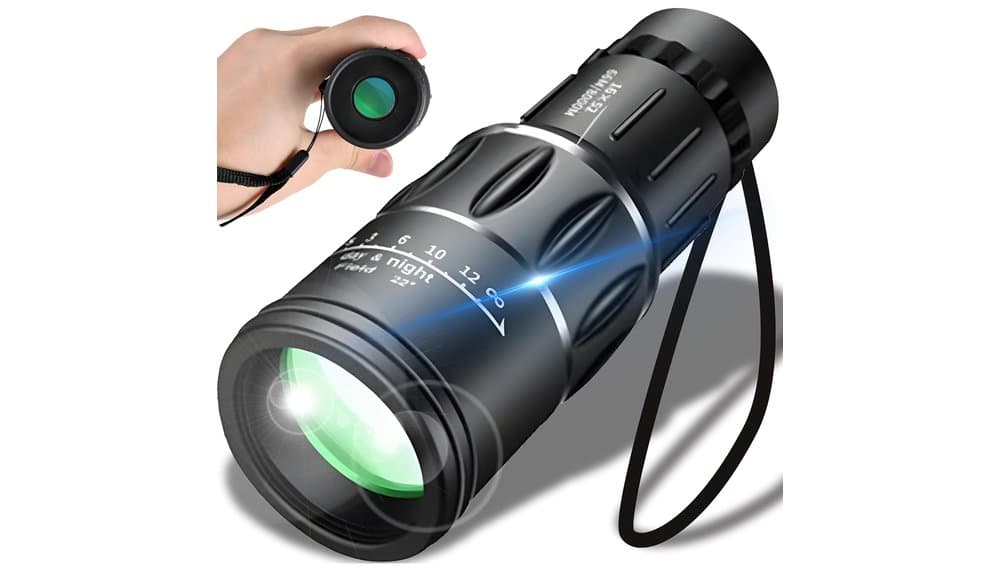
Analysis and Review of the Retoo 16X52 Monocular Telescope: Compact, but at What Cost?
In the monocular market, the offerings are vast, ranging from basic models to high-end optical instruments. The Retoo 16X52 Monocular Telescope positions itself as a portable and powerful solution for outdoor activities. But behind its promises of "powerful zoom" and "high-quality BAK-4 lens," what is this instrument really worth? Our analysis is based on its technical specifications, expert feedback, and, most importantly, the concrete reviews from users to determine if it is a reliable companion or a disappointing gadget.
Strengths and Weaknesses: The Quick Summary
Strengths:
- Ultra-compact format: Its dimensions (15 x 5.2 cm) and light weight (240g) make it an instrument easy to slip into a pocket.
- Practical included accessories: The carrying case, strap, and rubber eyecup are appreciated for nomadic use.
- Very low entry price: This is often its main argument against the competition.
- Claim of BAK-4 optics: In theory, the BAK-4 prism offers better light transmission and a sharper image than the BK-7 often used in entry-level models.
Weaknesses:
- Very disappointing optical quality: This is the number one complaint. Users report an almost total lack of sharpness gain compared to the naked eye.
- Extremely narrow field of view: A recurring problem that makes locating and tracking subjects very difficult.
- Major focusing issues: The focus ring does not seem to work correctly, unable to produce a sharp image at a distance.
- Low-end construction and finish: The "toy-like" feel is frequently mentioned, with doubts about its actual waterproofing.
- Misleading effective lens diameter: User tests indicate that the useful diameter of the front lens is well below the advertised 52mm.
Detailed Product Analysis
Optical Quality and Performance
On paper, the specs of the Retoo 16X52 announce a capable product: a 16x magnification coupled with a 52mm objective should theoretically offer a good compromise between power and brightness. The BAK-4 prism and multi-coatings promise a bright and contrasted image.
However, the reality of user feedback paints a radically different picture. The central problem is not brightness, but fundamentally flawed resolution and sharpness. Many testers emphasize that the image is no more detailed than with the naked eye, and that the focus ring brings no tangible improvement. One German-speaking user summarizes: "you can turn the focus ring, it changes a bit, but the maximum magnification achievable is exactly the same as with the naked eye."
The field of view is also singled out as being excessively reduced, making the observation experience frustrating, especially for tracking birds or moving animals. The theoretical exit pupil of 3.25mm (52/16) is correct for daytime use, but if the image lacks definition, this potential advantage is null.
Construction and Ergonomics
The construction is described as light and compact, with a non-slip surface. This is a positive point for transport. However, the feel in hand is often described as "plastic" or "toy-like." The mention of "waterproof" in some descriptions does not match the official technical specifications listed, which clearly indicate "Water Resistance Level: Not Water Resistant". Therefore, one should not count on any protection against the elements.
The soft rubber eyecup is present for comfort, but the eye relief is not specified. Based on feedback, it seems insufficient for eyeglass wearers, who have difficulty seeing the entire field of view.
Accessories and Practical Use
The kit is complete for nomadic use: a soft carrying case, a strap, and a rubber eyecup are included. The case allows it to be carried on a belt. The possibility of mounting it on a tripod (via a standard screw) is theoretically present, but the interest is limited by the mediocre optical performance.
For activities like light hiking where one just wants an occasional glance at a distant panorama, its format can be appealing. On the other hand, for demanding applications like detailed birdwatching, digiscoping (taking photos with a smartphone), or basic astronomy, its optical limitations make it unsuitable. Close focusing is also not mentioned as a strong point.
Technical Specifications
| Characteristic | Detail |
|---|---|
| Model | Retoo 16X52 Monocular Telescope |
| Magnification | 16x |
| Objective Diameter | 52 mm (claimed) |
| Prism | BAK-4 (claimed) |
| Optical Coatings | Multi-Coated |
| Focus | Manual (ring) |
| Dimensions (L x H) | 15 x 5.2 cm |
| Weight | 240 g |
| Water Resistance | No (according to official specs) |
| Eye Relief | Not specified |
| Included Accessories | Case, strap, eyecup |
What Users Say: A Clear Trend
The analysis of customer reviews, with an overall rating of 2.4/5 based on 23 evaluations, is unequivocal. The majority of comments are extremely negative, describing a product that does not keep its fundamental promises.
The recurring criticisms are:
- Lack of sharpness and detail: "You don't see better than with the naked eye," "the image is not sharp and you can't focus 100%," "vergueudung von resourcen" (waste of resources).
- Field of view too narrow: Often described as "very small" or "insufficient."
- Poor quality construction: Called a "toy," "speelgoed" (toy in Dutch), or "valeurs" (worthless).
- Ineffective focusing function: The adjustment ring does not allow for a satisfactory image.
The rare positive points focus almost exclusively on its very low price and compact format, with a few users comparing it to a simple "magnifying glass" for that price. No review praises its actual optical performance.
Conclusion: Who Might It Suit?
The Retoo 16X52 Monocular Telescope is a double-edged object. Its attractive price and pocket format can be misleading. However, our analysis converges on a severe conclusion: it is more of a low-end optical accessory than a reliable observation instrument.
Its major optical shortcomings – failing sharpness and a minuscule field of view – make it unsuitable for any serious use in nature, whether for birdwatching, wildlife observation, or even appreciating landscapes. The promises related to the BAK-4 glass and 16x magnification seem, in practice, purely theoretical and not realized by this product.
Our recommendation is clear: if you are looking for a monocular for occasional use with no particular expectations, at a minimal price, you might consider it as a curiosity. On the other hand, for any nature observation activity, even amateur, it is better to direct your budget, even a modest one, towards established brands in optics (like Bushnell, Celestron, or even some entry-level models from Nikon) which will offer an abyssal difference in image quality. The disappointment reported by the vast majority of users urges us to be very cautious. In the world of optics, as often, the price-performance ratio remains an implacable law.
100% free and independent — All our articles are written independently, without any sponsorship. We may earn a commission on purchases made through our links, at no extra cost to you.
Articles you might like
Vanguard Endeavor HD65A Spotting Scope Review
Spotting scope with 65mm ED glass & 15-45x zoom for birding & hiking. Balanced performance & portability for serious nature observers.
Carson AdventurePak Kids' Exploration Tool Kit Review
Explore nature with this kid's 5-piece tool kit for outdoor adventure and educational discovery. Perfect for young explorers.
BOSTRON CY 10x50 Monocular Review & Test
Compact 10x50 monocular review: Analyzes optical clarity, field of view & build quality for hiking, nature & astronomy. See its true value.
Guides you might like
WiFi Trail Camera Guide
See wildlife discreetly from your couch! Learn how WiFi trail cameras let you monitor animals without disturbance and how to choose the right one.
Ultimate Travel Telescope Guide
Choose a portable, high-performance travel telescope to explore the universe from your backpack without compromising on essential astronomical views.
Ultimate Guide to Night Vision Binoculars
Choose the perfect night vision binoculars: Gen vs. digital? Unravel the tech to make your nighttime wildlife adventures a total success. Guide inside.