QQ 20x50 ED Binoculars Review & Test
Published on 4 April 2026 · By OptiqueNature
Review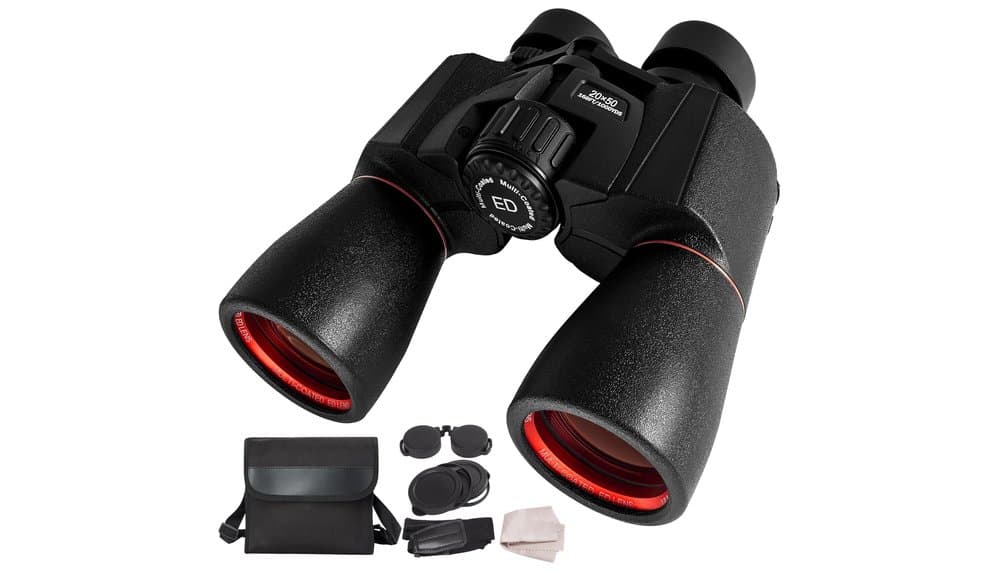
Introduction: High-Magnification Binoculars Within Reach, a Successful Compromise?
In the world of binoculars for nature observation, the 20x50 segment occupies a unique place. It promises powerful magnification for scrutinizing distant details, but also demands great stability and impeccable optical quality to avoid frustration. The QQ 20x50 ED Binoculars position themselves as a technically ambitious proposition at a very accessible price. They indeed incorporate premium optical elements, such as ED (Extra-low Dispersion) glass and BAK4 prisms, features usually reserved for more expensive models.
But do these "on paper" specifications translate into a satisfactory experience in the field? We will dissect this pair of binoculars through the prism of its technical characteristics, user community feedback, and the expectations related to its performance. Our goal is to determine for which type of observer this model represents a good choice, and where its inherent limits lie.
Strengths and Weaknesses
Before diving into the technical analysis, let's summarize what, based on available data, emerges as the main assets and pitfalls of these binoculars.
Strengths:
- Theoretically performant optics: The combination of ED glass and FMC (Full Multi-Coated) treatment on all lens surfaces promises good light transmission and reduced chromatic aberrations.
- Announced robust construction: The aluminum-magnesium alloy body, IPX8 waterproofing, and nitrogen filling are guarantees of durability for outdoor use.
- Contained weight for the format: At 875 grams, they remain relatively light for 20x50 binoculars, a crucial point for transport.
- Light delivery: The 22 mm diameter eyepiece and the 2.5 mm exit pupil (calculated) indicate a potentially bright image in good lighting conditions.
Weaknesses:
- Maximum stability requirement: The 20x magnification significantly amplifies hand tremors, making their use handheld very difficult, even unsuitable for long observations.
- Narrow field of view: Inherent to high magnification, it can make spotting fast-moving subjects (like birds in flight) more challenging compared to 8x42 or 10x42 models.
- Mixed user feedback on reliability: Reviews report inconsistency in build quality, with alignment (collimation) defects on some units.
- Limited comfort of use without support: Their main flaw is not optical, but ergonomic: they almost systematically require a brace (tree, wall) or a tripod to be fully usable.
Detailed Performance Analysis
Optics: ED Promise and Field Reality
On paper, the technical sheet is attractive. ED (Extra-low Dispersion) lenses are meant to limit chromatic aberrations – those colored fringes (often purple or green) on high-contrast edges. For a model at this price, their presence is a notable argument. Coupled with the FMC multi-coating on all air-to-glass surfaces and quality BAK4 prisms, the announced light transmission of 90 to 95% seems credible for offering a clear image.
However, the user community provides crucial nuances. While several note good center sharpness and faithful colors under optimal conditions, the resolution and suppression of aberrations at the edge of the field or in high-contrast conditions (dark branches against a bright sky) obviously do not rival high-end models. The high twilight factor (31.6) is a mathematical indicator of performance in low light, but it is largely dependent on the quality of the coatings. Here, it suggests decent potential for basic astronomical observation (Moon, star clusters) or at dusk, but not for genuine night vision.
Mechanics and Ergonomics: Between Robustness and Precision
The IPX8 waterproof and fog-proof (nitrogen) construction is a serious asset for birdwatchers or hikers facing inclement weather. The alloy body and silicone armor should absorb minor shocks. The fast focus via the central wheel is also noted as positive by satisfied users.
The major stumbling block, intrinsic to any 20x magnification, is stability. The 22 mm eyecup offers good comfort and an unobstructed field of view, even for eyeglass wearers. But with an exit pupil of only 2.5 mm (50/20), eye positioning must be very precise and held steady. The slightest tremor is multiplied, making the image unusable handheld after a few seconds. This drastically limits their use while walking or for tracking moving subjects. A support (tripod with adapter, often not included) becomes almost indispensable.
The minimum focus distance not being specified in the specs, one can assume it is not a strong point of this model, the compromise generally being made on close-focus ability in favor of long-distance performance.
Use Cases: Who Are They For?
- Birdwatching (static): Potentially interesting from a fixed hide to observe plumage details on a distant perch, provided a tripod is used. Unsuitable for active "birding" on the move.
- Light astronomy: Their 50mm diameter and 20x magnification make them a decent instrument for observing the Moon in detail or the largest star clusters, always on a tripod.
- Wildlife observation at fixed distance: From a mountain viewpoint or an observation post, for scrutinizing chamois or deer without disturbing them.
- Sporting events (stadium): For distant seats, the magnification is a plus, but the need to brace one's elbows or use a support is prohibitive for sustained use.
- Hiking / Light travel: Their weight is acceptable, but the bulk and especially the requirement for a support make them a specialist's choice rather than an all-purpose pair for hiking.
Technical Specifications Table
| Characteristic | Specification QQ 20x50 ED |
|---|---|
| Magnification | 20x |
| Objective Diameter | 50 mm |
| Prisms | BAK4 (barium glass) |
| Lens Coating | FMC (Full Multi-Coated) on all surfaces |
| Special Glass | ED (Extra-low Dispersion) |
| Eyepiece Diameter | 22 mm |
| Eyecup | Twisting, with click stops |
| Waterproofing | IPX8, nitrogen filled |
| Weight | 875 g |
| Field of View at 1000m | Not specified (generally narrow on 20x) |
| Exit Pupil | 2.5 mm (calculated: 50/20) |
| Twilight Factor | 31.6 (calculated: √(20x50)) |
| Minimum Focus Distance | Not specified |
| Body Material | Aluminum-magnesium alloy with silicone armor |
What Users and Testers Say: A Mixed Experience
The synthesis of customer feedback and available analyses paints a contrasted picture, explaining the average rating of 3.6/5.
The praise mainly concerns the perceived optical quality for the price. Satisfied users describe images as "clear", "sharp", and "bright" under good conditions, highlighting the initial good value for money. The ease of focusing and the robust feel of the construction are also mentioned.
The recurring criticisms are more revealing of the product's limits:
- Quality Control Issues: Several reviews report collimation defects (the two optical axes are not parallel), causing double vision, headaches, and making use impossible. This points to inconsistency in manufacturing.
- The 20x Magnification, a False Good Idea: Many buyers underestimate the impact of stability. Their most frequent feedback is: "impossible to hold steady without support." Some even note that the label says 20x but the sensation in use is less, although this more often relates to the effect of shaking than an actual deception about the real magnification.
- Accessories and Finishes: The accessories (strap, case) are often described as low-end. The quality of eyecups and focus wheels can vary from unit to unit.
Conclusion: A Niche Instrument with Attractive Specifications
The QQ 20x50 ED Binoculars embody the paradox of a product with alluring technical specifications – ED glass, FMC coatings, BAK4, IPX8 waterproofing – but whose use is constrained by an inescapable ergonomic reality: 20x magnification is very demanding in terms of stability.
Therefore, they cannot be recommended as a primary or all-purpose pair for a birdwatcher or hiker. On the other hand, they find their purpose as a secondary and specialized instrument for an observer already equipped with a standard pair (8x42 or 10x42) and who seeks increased close-up power for static and prepared uses (hide, fixed observation point, basic astronomy), with the mandatory addition of a tripod.
The main risk, highlighted by the reviews, is not the theoretical optical performance, but the quality control lottery. Purchasing this model implies scrupulously checking the collimation upon receipt. For a similar budget, a buyer looking for a pair for general, handheld use would be better off turning to a model with more reasonable magnification (10x) and less ambitious optical characteristics, but with better-established reliability. The QQ 20x50 ED are aimed at an informed user, aware of their limits, and willing to accommodate the indispensable support that comes with them.
100% free and independent — All our articles are written independently, without any sponsorship. We may earn a commission on purchases made through our links, at no extra cost to you.
Articles you might like
Vanguard Endeavor HD65A Spotting Scope Review
Spotting scope with 65mm ED glass & 15-45x zoom for birding & hiking. Balanced performance & portability for serious nature observers.
Carson AdventurePak Kids' Exploration Tool Kit Review
Explore nature with this kid's 5-piece tool kit for outdoor adventure and educational discovery. Perfect for young explorers.
BOSTRON CY 10x50 Monocular Review & Test
Compact 10x50 monocular review: Analyzes optical clarity, field of view & build quality for hiking, nature & astronomy. See its true value.
Guides you might like
WiFi Trail Camera Guide
See wildlife discreetly from your couch! Learn how WiFi trail cameras let you monitor animals without disturbance and how to choose the right one.

Ultimate Travel Telescope Guide
Choose a portable, high-performance travel telescope to explore the universe from your backpack without compromising on essential astronomical views.
Ultimate Guide to Night Vision Binoculars
Choose the perfect night vision binoculars: Gen vs. digital? Unravel the tech to make your nighttime wildlife adventures a total success. Guide inside.