Optus 7-21x21 Zoom Monocular Review
Published on 25 September 2026 · By OptiqueNature
Review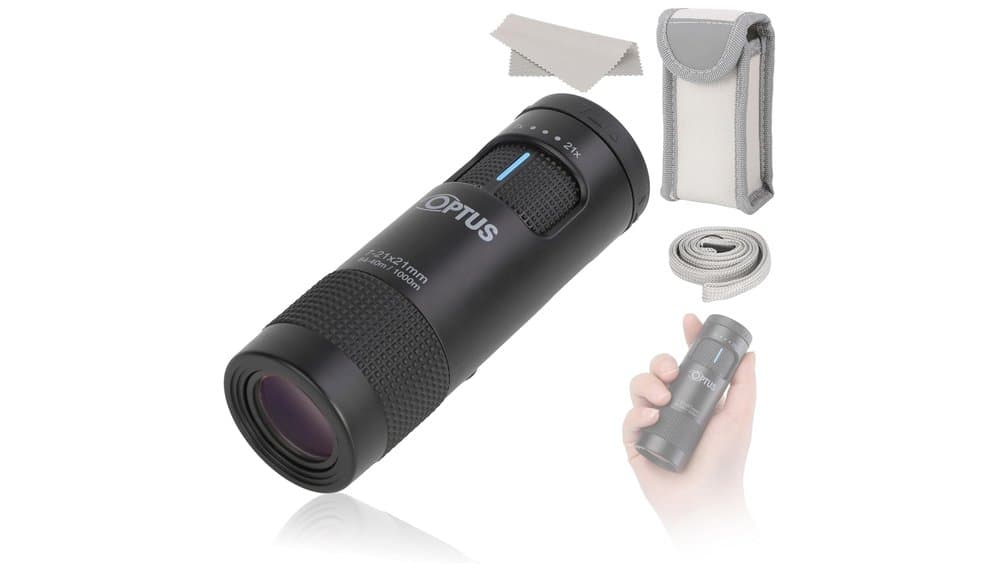
Detailed Analysis of the Optus 7-21x21 Zoom Monocular
For the nature observer looking for a compact and versatile instrument, the monocular often represents the ideal compromise between lightness and capability. The Optus 7-21x21 Zoom Monocular clearly positions itself in this niche, promising a variable zoom ranging from 7x to 21x in an ultra-lightweight format. But beyond the marketing promises, what is this instrument really worth for field practice? We have analyzed its technical specifications, compared its performance to user and expert feedback, to offer you a clear view of its strengths and limitations.
Strengths
- Extreme compactness and lightness: A featherweight of about 80 grams with minimal dimensions.
- Versatility of progressive zoom: A magnification range from 7x to 21x adaptable to different situations.
- Practical construction: Integrated tripod threading and twist-up eyecup for glasses wearers.
- Size/performance ratio: An interesting proposition for occasional and nomadic observation.
Weaknesses
- Limited optical performance: Narrow field of view, marked drop in brightness at maximum zoom, and modest image quality at the periphery.
- Perceived fragility: Lens and eyepiece caps that fit poorly, finish mainly in plastic.
- Stability requirements: Usage beyond 12x is almost impossible without support (tripod or stable rest).
- Low intrinsic brightness: 21mm objective poorly suited for observation in low light or at dawn/dusk.
Presentation and Positioning
The Optus 7-21x21 presents itself as a companion for hiking and spontaneous exploration. Its main argument lies in its pocket format and negligible weight (75g), allowing it to be taken anywhere without effort. The progressive zoom from 7x to 21x is a strong marketing asset, suggesting complete adaptability, from panorama to detailed observation. We are clearly looking at an entry-level or secondary equipment product, designed for light and occasional use rather than for prolonged and demanding observation sessions.
Detailed Technical Analysis
Let's dive into the heart of the matter: what do the specifications and optics of this monocular tell us about its real capabilities?
Optics and Visual Performance
The designation "7-21x21" is key: the first number indicates the minimum magnification (7x), the second the maximum magnification (21x), and the third the objective lens diameter (21mm). This last point is crucial.
- Brightness and Exit Pupil: A 21mm objective is small. The exit pupil (objective diameter / magnification) is an indicator of perceived brightness. At 7x, it is 3mm (21/7), which is correct in full daylight. But at 21x, it drops to only 1mm (21/21). This tiny exit pupil means the image will become significantly darker at maximum zoom and will be very sensitive to eye placement. This is not an instrument designed for low-light observation.
- Field of View: The official specifications do not mention it, but user feedback converges on one point: the field is narrow, especially at high magnifications. This is a mechanical consequence of a zoom with a small objective. This makes pointing and tracking moving objects (like a bird) more difficult.
- Image Quality: According to feedback, sharpness is acceptable at the center of the image at low and medium zoom, but it degrades noticeably at the edges ("schnell wird es zum Rand hin verschwommen und verzerrt"). No mention of ED (Extra-low Dispersion) glass or advanced multi-coatings is made by the manufacturer, suggesting standard optics. The twilight factor (square root of (magnification x objective diameter)) is 12.1 at 7x and 21 at 21x. This theoretical figure is correct at 21x, but it is severely limited by the small exit pupil and the likely modest light transmission of the lenses.
- Zoom and Focus: The zoom is progressive and the focus adjustment is manual. Users note that after a zoom change, a re-focus adjustment is often necessary ("bei Zoomen muss die Schärfe etwas nach justiert werden").
Construction and Ergonomics
- Sturdiness and Weatherproofing: The monocular is mainly made of plastic, which explains its featherweight but gives an impression of relative sturdiness. No indication of waterproof or fogproof (nitrogen purged) resistance is provided. It is therefore an instrument for dry weather.
- Practical Elements: The presence of a tripod thread (1/4") is a real plus, almost indispensable for using the 21x without shake. The twist-up eyecup is well-regarded for comfort, whether wearing glasses or not. The minimum focus distance is not specified, but it seems suitable for common close-up observations.
- Accessories: Feedback is unanimous in criticizing the front and rear caps, which fit very poorly and detach easily. The included soft carrying case is therefore essential to protect them.
Table of Technical Specifications
| Characteristic | Optus 7-21x21 Specification |
|---|---|
| Magnification | Variable, 7x to 21x |
| Objective Diameter | 21 mm |
| Exit Pupil | From 3 mm (at 7x) to 1 mm (at 21x) |
| Prism | Likely roof type, not specified |
| Optical Coatings | Not specified (likely basic anti-reflection coatings) |
| Field of View | Not specified (narrow according to users) |
| Minimum Focus Distance | Not specified |
| Eye Relief | Adapted via the twist-up eyecup |
| Gas Filling | No mention (not waterproof/fogproof) |
| Tripod Thread | Yes, 1/4" |
| Weight | ~ 75-80 grams |
| Included Accessories | Case, strap, cleaning cloth |
What Users Say: Summary of Feedback
The analysis of customer reviews and tester feedback (such as from the Amazon Vine program) reveals a consistent and nuanced picture.
Recurring Positive Points:
- Compactness and Lightness: This is the major asset. "Ultraleichtes Monokular", "perfekt für Rucksack", "immer im Familienwanderrucksack drin". Users love being able to take it without thinking.
- Usefulness of the Zoom: The possibility to switch from 7x to 21x is appreciated for its adaptability, even if 21x requires a tripod.
- Perceived Value for Money: For its price and category, many consider it decent. "Für den Preis und bei dem Gewicht" a good product.
- Presence of the Tripod Thread: Considered a significant advantage for such a small instrument.
Highlighted Criticisms and Limitations:
- Average Optical Quality: Terms like "Kunststofflinsen" (plastic lenses), "einfache Qualität" come up. Sharpness is not perfect, especially at the edges of the field of view.
- Problem with the Caps: A near-unanimous criticism: "Die Deckel lösen sich leicht", "Objektivabdeckungen sitzen recht lose und fallen leicht ab". This is an annoying design flaw.
- Low Brightness: It is clear this is not an instrument for dawn or dusk. Its small exit pupil limits it to daytime use.
- Need for Support at Max Zoom: "21x aus der Hand raus ist fast sinnlos, da kann man den eigenen Puls sehen" (At 21x, it's almost useless handheld, you can see your own pulse). Tripod use is highly recommended beyond 12x.
Comparison and Market Value
To properly situate the Optus 7-21x21, it must be compared to three segments:
- Budget (Entry-level): Compared to other fixed-magnification, low-priced monoculars (e.g., 8x25 or 10x25), the Optus offers the versatility of zoom, but often at the expense of brightness and optical simplicity. A fixed monocular can offer a clearer image and a wider field at an equivalent price.
- Mid-range: Here, you find models with larger objectives (25mm, 30mm), often waterproof, with superior optical coatings. The Optus does not compete on image quality or robustness, but retains an incomparable weight/format advantage.
- High-end: "Premium" monoculars (like those from Vortex, Leica, or even some Bushnell models) offer ED optics, waterproof construction, and precise mechanics. The Optus is simply not in the same category.
Its value lies in its niche: it is a supplementary tool, for backup or initial discovery. It will not replace a quality pair of binoculars for a serious birder, but it will be perfect for the hiker who wants an occasional look at a landscape, an animal, or a monument.
Typical Use Cases: Who Is It For?
- Lightweight Hiking and Trekking: Its featherweight makes it the ideal candidate for those who don't want to be burdened but desire some reach.
- Occasional Nature Observation: For roughly identifying a bird or observing an animal at a fixed distance (with a tripod).
- Travel and City Trips: Perfect for slipping into a backpack to observe architecture or an urban scene.
- Beginners or Young Naturalists: An inexpensive tool to get introduced to magnification and observation.
It is, however, poorly suited for:
- Observation in low light (dawn, dusk, dense forest).
- Active birdwatching (tracking birds in flight) due to the narrow field and shake at high magnification.
- Serious digiscoping (image quality will not be sufficient).
- Astronomy, except for very basic Moon observation (with a tripod).
Conclusion
The Optus 7-21x21 Zoom Monocular is a product that perfectly assumes its design choices. It is an instrument that deliberately sacrifices optical performance and robustness on the altar of weight and compactness. Therefore, one should not expect crystalline clarity, a wide field of view, or an all-terrain construction.
On the other hand, if your need boils down to having a small, versatile, and ultra-light magic eye, always within reach in a jacket pocket or backpack, then it fulfills its role perfectly. The progressive zoom offers real flexibility of use, and the presence of a tripod connection is a welcome touch. The major flaws (caps, low brightness at high zoom) are the price to pay for this miniaturization.
Our verdict: It is an ideal secondary outing companion, but it can in no way constitute your primary observation instrument if you are demanding about image quality. For its target audience – the light hiker, the occasional traveler, or the curious person wanting a discreet tool – it represents a valid and practical option.
100% free and independent — All our articles are written independently, without any sponsorship. We may earn a commission on purchases made through our links, at no extra cost to you.
Articles you might like
Vanguard Endeavor HD65A Spotting Scope Review
Spotting scope with 65mm ED glass & 15-45x zoom for birding & hiking. Balanced performance & portability for serious nature observers.
Carson AdventurePak Kids' Exploration Tool Kit Review
Explore nature with this kid's 5-piece tool kit for outdoor adventure and educational discovery. Perfect for young explorers.
BOSTRON CY 10x50 Monocular Review & Test
Compact 10x50 monocular review: Analyzes optical clarity, field of view & build quality for hiking, nature & astronomy. See its true value.
Guides you might like
WiFi Trail Camera Guide
See wildlife discreetly from your couch! Learn how WiFi trail cameras let you monitor animals without disturbance and how to choose the right one.
Ultimate Travel Telescope Guide
Choose a portable, high-performance travel telescope to explore the universe from your backpack without compromising on essential astronomical views.
Ultimate Guide to Night Vision Binoculars
Choose the perfect night vision binoculars: Gen vs. digital? Unravel the tech to make your nighttime wildlife adventures a total success. Guide inside.