Opaita 20x32 Compact Binoculars Review
Published on 7 April 2026 · By OptiqueNature
Review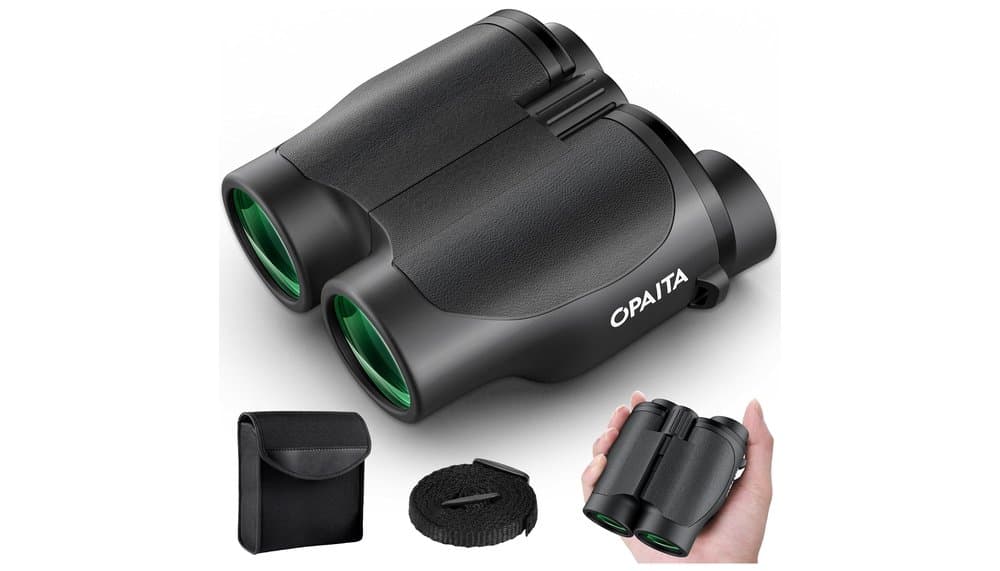
Introduction
In the compact binocular market, the offerings are vast and it can be difficult to discern true value for money from simple marketing arguments. The Opaita 20x32 Compact Binoculars present themselves as a versatile, high-magnification solution, targeting families, hikers, and nature observation enthusiasts alike. With a stated 20x32 specification, they promise distant details in a reduced format. But how do they really perform once confronted with the practical demands of birdwatching or outdoor activities? Here, we analyze this product exhaustively by cross-referencing its technical specifications with concrete feedback from the user community and fundamental optical principles.
Strengths and Weaknesses
Strengths
- Perceived excellent value for money: The vast majority of user reviews highlight a strong feeling of getting great value for the asking price.
- Compactness and lightness: Their small format and weight of approximately 400 grams make them easy to carry on hikes or travels.
- Ease of use: The central focus is described as smooth and precise, accessible to beginners and children.
- Generally satisfactory image: For casual use, testers report a clear, bright image with good color rendering in adequate lighting conditions.
- Good minimum focusing distances: Allowing observation of close subjects (around 3 meters according to one tester), an asset for hide (blind) observation or observing insects.
Weaknesses
- Disputed 20x magnification that is difficult to exploit: Several independent testers and optical principles suggest the actual magnification is lower (around 10x-12x). A true 20x on a 32mm objective lens poses major challenges for stability and brightness.
- Compromised image stability: On paper, a 20x magnification absolutely requires the use of a tripod, which contradicts the promise of "hand-held" use for dynamic activities.
- Basic construction quality and accessories: The case is judged to be poorly protective and the neck strap is described as cheap and uncomfortable for long sessions.
- Risk of collimation defects: As with many entry-level models, some feedback mentions problems with optical alignment (double vision or black spots), rendering the product unusable.
- Imprecise technical sheet and potentially misleading marketing: The claim of "99% light transmission" is an unrealistic theoretical figure for this segment, and the mention of "Bak4 prisms" without details on coatings (phase, dielectric) casts doubt on real-world performance in contrast and resolution.
Detailed Analysis
Optical Performance: Between Promises and On-the-Ground Reality
On paper, the specs announce a 20x32 duo. It is this combination that must be scrutinized most carefully. A magnification of 20x is very demanding. The twilight factor (√(20x32) ≈ 25.3) is theoretically high, but the exit pupil (32/20 = 1.6 mm) is very small. An exit pupil of 1.6mm means very little light reaches your eye. This implies that perceived brightness will be poor in low-light conditions (dense forest, dawn, dusk), contrary to what a 32mm objective lens might suggest. For daytime use, it can remain acceptable, but it is not an instrument for low light.
Feedback from experts and knowledgeable users, like one noting "the magnification is more like 10x", raises a crucial point. A true 20x on such a compact base would result in an extremely narrow field of view and unmanageable instability when hand-held. The community notes that the image is "surprisingly clear" and "sharp", which tends to confirm that the effective magnification is likely more moderate (around 10x-12x), allowing for a more stable and brighter image. Bak4 prisms are a mid-range standard ensuring a round and full image, but without mention of phase correction or dielectric coatings on the prism mirrors, one can expect correct contrast and color fidelity, but nothing exceptional.
Construction and Ergonomics: Compact but with Compromises
The featherweight and rubber armor are consistently praised. They offer a good grip and resistance to minor shocks. The "Water Repellent" mention must be understood: it is not watertight under immersion (waterproof) nor a guarantee against fogging (nitrogen purged). The binoculars will resist splashes or light rain, but not immersion or prolonged use in bad weather.
The interpupillary distance and eye relief are not specified. However, feedback indicates they are usable by children and eyeglass wearers (provided the eyecups are folded down), suggesting adequate eye relief. The central focus is described as fluid and precise, a positive point for tracking moving objects like birds.
Recommended (and Not Recommended) Use Cases
Suitable Uses:
- Casual daytime observation: Garden, park, zoo.
- Light hiking and travel: For their compactness, to be used for short observations of landscapes or points of interest.
- Initiation for children or beginners: Simplicity of use and contained price.
- Sports events or outdoor concerts (with the reservation about true magnification).
Unsuitable Uses:
- Astronomical observation: The 1.6mm exit pupil and probable lack of high-performance optical coating make the image too dark and planetary details impossible to resolve.
- Serious birdwatching in low light (forests, dawn/dusk).
- Quality digiscoping: Hand-held vibrations and possible optical aberrations at the edges will degrade photo quality.
- Use in heavy rain or extreme conditions (lack of certified waterproofing).
Value for Money in the Competitive Landscape
The most unanimous conclusion among users is one of excellent value for money. One tester even favorably compares the Opaita 20x32 to much more expensive Decathlon models. This positioning is clear: it is an entry-level product that outperforms optical toys but does not rival mid-range references (like Nikon Prostaff, Vortex Diamondback) or high-end ones (like Swarovski, Zeiss).
Its value lies in offering, for a minimal budget, a decent observation experience that is compact and simple. The buyer must, however, be aware that they are making compromises on spec accuracy, accessory durability, and long-term reliability (risk of decollimation). It is an ideal "first try" purchase before investing in more specialized optics.
Summary Technical Sheet
| Characteristic | Opaita 20x32 Specification |
|---|---|
| Model | 20x32 Compact Binoculars |
| Claimed Magnification | 20x |
| Objective Lens Diameter | 32 mm |
| Prisms | Bak4 (inverted Porro type) |
| Optical Coatings | Multi-coated (no mention of phase/dielectric coatings) |
| Field of View (at 1000m) | Not specified |
| Exit Pupil | 1.6 mm (theoretical, based on 32/20) |
| Twilight Factor | ~25.3 (theoretical) |
| Eye Relief | Not specified (usable with glasses according to feedback) |
| Minimum Focus Distance | ~3 meters (according to user feedback) |
| Water Resistance | Water Repellent - NOT waterproof/fogproof |
| Tripod Mount | Yes (not always present on compacts) |
| Weight | ~395 g |
| Included Accessories | Case, neck strap, cleaning cloth, objective and ocular lens caps |
What Users Say: A Summary of Reviews
The 1,189 reviews, with an overall rating of 4.4/5, reveal a clear trend: satisfaction is high for leisure and family use. Here are the recurring points:
The Praise (majority):
- "Excellent value for money" is the most cited phrase. Users are pleasantly surprised by the perceived quality for the price.
- "Clear and bright image", "adequate sharpness" for standard daytime use.
- "Compact and light", easy to slip into a bag and use for the whole family, including children.
- "Precise and smooth focus", allowing for easy focusing.
Recurring Reservations and Criticisms:
- The actual magnification is questioned. Several reviews, including a detailed one, indicate that the magnification is actually closer to 10x or 12x, not 20x. This is the main point of dissonance between the product sheet and real-world experience.
- Uneven build quality. A few reports mention collimation problems (images not merging, "black spots") making the unit defective. This is a known risk at the low end of the market.
- Low-quality accessories. The case is judged too soft and poorly protective, and the neck strap is described as uncomfortable ("rough").
- A minority highlights the limitations in low light, which is consistent with the small theoretical exit pupil.
Conclusion
The Opaita 20x32 Compact Binoculars are the perfect example of a product that excels in its price segment without delivering on all the promises of its technical sheet. Their main strength is offering a simple, enjoyable, and portable observation experience at a very accessible cost, which the community overwhelmingly confirms.
However, the technical analysis and the most critical feedback force us to temper expectations. The claim of 20x magnification seems greatly exaggerated, and the actual performance corresponds more to a pair of 10x or 12x binoculars – which is, in reality, a much more usable format for hand-held use. The optical coatings, while correct, do not reach the advertised level (99% transmission), and the water resistance is limited.
Final Verdict: We recommend these binoculars as an excellent choice for initiation or as secondary equipment for families, occasional hikers, or beginner observers who do not wish to invest heavily. On the other hand, for the serious birdwatcher, hunter, or astronomy enthusiast, the compromises on optical precision, robustness, and transparency of specifications are too significant. It is then better to direct one's budget towards mid-range models from established brands, whose characteristics are certified and performance is guaranteed in demanding conditions.
100% free and independent — All our articles are written independently, without any sponsorship. We may earn a commission on purchases made through our links, at no extra cost to you.
Articles you might like
Vanguard Endeavor HD65A Spotting Scope Review
Spotting scope with 65mm ED glass & 15-45x zoom for birding & hiking. Balanced performance & portability for serious nature observers.
Carson AdventurePak Kids' Exploration Tool Kit Review
Explore nature with this kid's 5-piece tool kit for outdoor adventure and educational discovery. Perfect for young explorers.
BOSTRON CY 10x50 Monocular Review & Test
Compact 10x50 monocular review: Analyzes optical clarity, field of view & build quality for hiking, nature & astronomy. See its true value.
Guides you might like
WiFi Trail Camera Guide
See wildlife discreetly from your couch! Learn how WiFi trail cameras let you monitor animals without disturbance and how to choose the right one.
Ultimate Travel Telescope Guide
Choose a portable, high-performance travel telescope to explore the universe from your backpack without compromising on essential astronomical views.
Ultimate Guide to Night Vision Binoculars
Choose the perfect night vision binoculars: Gen vs. digital? Unravel the tech to make your nighttime wildlife adventures a total success. Guide inside.