Carson Bandit BA-825 Monocular Review
Published on 17 April 2026 · By OptiqueNature
Review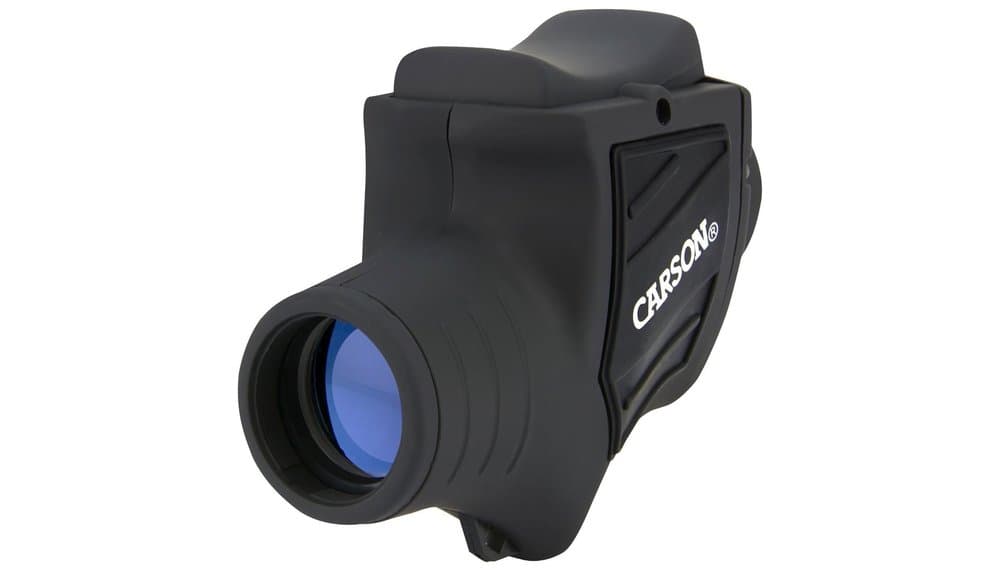
Comprehensive Analysis: The Carson Bandit BA-825 Monocular
In a world often dominated by binoculars, the monocular seeks its place as the ideal compromise tool: ultra-compact, lightweight, and quick to use. The Carson Bandit BA-825, presented as the world's first monocular that can be held and adjusted with one hand, clearly targets this niche. But beyond the marketing pitch, what is it really worth for the nature observer? We dissect this product by cross-referencing its technical specifications with concrete feedback from the community and field expectations.
Strengths and Weaknesses
Strengths:
- Truly unique and appreciated one-handed manipulation.
- Extreme compactness and lightness, ideal for hiking.
- Quick focus principle for fast focusing.
- Perceived value for money considered fair for occasional use.
Weaknesses:
- Construction perceived as fragile, especially the rubber eyecup.
- Limited minimum focus distance (from ~2.5m).
- Basic optics (BK-7 lenses, simple coatings) limiting performance in low light.
- Absence of robust features (waterproofing, nitrogen filling).
Detailed Analysis by Criteria
Optical Quality and Visual Performance
The Carson Bandit BA-825 is advertised with BK-7 prisms and "ultra-clear" lenses with a coated treatment. Here, we must be clear: this is entry-level optics.
BK-7 prisms are an economical standard, offering good general clarity but typically presenting more chromatic aberration (colored fringes on strong contrasts) and slightly lower light transmission than high-end BAK-4 prisms. The "ultra-clear" and "coated" description suggests anti-reflective treatment on some surfaces, but not a complete multi-coating (Fully Multi-Coated) which would maximize brightness.
With an objective lens diameter of 25 mm and a magnification of 8x, we get an exit pupil of 3.1 mm (25/8). This is adequate for daytime use but will become limiting at dusk, where the adult human eye can open up to 5-7 mm. The twilight factor is approximately 14.1 (√(8x25)), which is modest. In summary, the optics are designed for daylight.
The field of view is unfortunately not specified in the official specs. According to user feedback, it is described as adequate for the format, but not exceptional. Compared to competitors in the same price range, it likely falls in the low average, without offering the immersion of a wide angular field.
Construction, Ergonomics, and Durability
This is where opinions diverge the most. On one hand, the compactness (11.4 x 8.9 x 5.1 cm) and feather-light weight (158g) are unanimously praised. It's a product you forget in a pocket or clipped to a bag.
The one-handed "quick focus" system is its main selling point. A push-button on top allows focusing without letting go of the monocular. Testers and users confirm this system works and is intuitive, particularly useful if holding a hiking pole, a camera, or in situations requiring a quick reaction.
However, the build quality is the main point of concern. Several users report that the rubber eyecup detaches very easily, making it vulnerable to loss. The rubber armor is thin and the product as a whole does not give an impression of all-terrain ruggedness. It is crucial to note that there is no mention of waterproofing or fogproof resistance. The lack of nitrogen filling makes it vulnerable to condensation from thermal shocks. This is not a tool for rain or humid environments.
Practical Use in the Field
- Bird/Wildlife Watching: Suitable for occasional daytime observation, to identify a bird in the garden or follow an animal at medium distance. Its quick focus is a plus. Its low-light limitation and close focus fault handicap it for observation in dense undergrowth or at dusk.
- Hiking / Trekking: This is its ideal domain. Its size and weight make it a perfect companion for those wanting to lighten their pack as much as possible without giving up minimal observation capability.
- Digiscoping / Photography: Not designed for this. The lack of threading for an adapter and limited optical quality do not recommend it.
- Astronomical Observation: Only for occasional curiosity of the Moon or spotting constellations. The small objective diameter and narrow exit pupil radically limit celestial performance.
- Eyeglass Wearers: The eye relief not being specified makes it difficult to judge. Users who wear glasses do not frequently criticize it, suggesting it may be acceptable, but not generous.
The crucial point of the minimum focus distance: An expert user clearly points it out: the minimum focus is about 2.5 meters. This is a significant limitation for those wanting to observe insects, flowers, or small details at less than one meter. This product is not designed for macrophotography.
What Users and Testers Say
The synthesis of customer reviews (with an average rating of 4/5) paints a consistent profile.
Praise consistently focuses on:
- The ease of one-handed use, deemed "brilliant" and "practical".
- The image clarity considered very decent for the price in normal light conditions.
- The compactness and lightness, allowing it to be "taken anywhere".
Recurring criticisms concern:
- The perceived build quality, seen as fragile ("toy", "not a heavy duty tool"). The problem of the eyecup peeling off is specifically and frequently mentioned.
- The minimum focus distance being too great for certain uses.
- Disappointed expectations regarding magnification for those imagining it equivalent to higher power (which is a misunderstanding of the standard 8x for this format).
The community consensus is that it is a good supplementary tool, practical and light, but with compromises on robustness and limited optical performance. It is often purchased as a "first monocular" or for a very specific use (lightweight hiking).
Summary Technical Sheet
| Criterion | Carson Bandit BA-825 Specification |
|---|---|
| Magnification | 8x |
| Objective Diameter | 25 mm |
| Exit Pupil | 3.1 mm |
| Prisms | BK-7 |
| Optical Coatings | Coated |
| Minimum Focus Distance | ~2.5 meters (according to feedback) |
| Focus System | Quick Focus (one-handed push-button) |
| Waterproof / Fogproof | Not specified (likely none) |
| Weight | 158 grams |
| Dimensions (L x W x H) | 11.4 x 8.9 x 5.1 cm |
| Eye Relief | Not specified |
Conclusion: Who is the Bandit BA-825 For?
The Carson Bandit BA-825 is not a versatile or high-performance monocular. It is a tool specialized in ultra-portability and rapid one-handed manipulation.
It will suit the lightweight hiker or trekker perfectly, who wants a basic observation instrument without weighing down their pack, and who will use it mainly in daylight in dry weather. Its unique focus system also makes it a relevant choice for activities where one hand is often occupied (pole, balance, etc.).
On the other hand, you should avoid it if you are looking for:
- Ruggedness for intensive use or in bad weather.
- Advanced optical performance in low light or with a wide field.
- A short close focus distance for observing small details.
- A main "all-terrain" monocular for serious wildlife observation.
Its positioning is clear: it is a practical and accessible pocket companion, but one must accept the limitations inherent in its economical and ultra-lightweight design. For a similar budget, a traditional monocular with manual focus might offer better optics or a more solid construction, but it would then lose that unique one-handed manipulation advantage which defines the Bandit's identity.
100% free and independent — All our articles are written independently, without any sponsorship. We may earn a commission on purchases made through our links, at no extra cost to you.
Articles you might like
BOSTRON CY 10x50 Monocular Review & Test
Compact 10x50 monocular review: Analyzes optical clarity, field of view & build quality for hiking, nature & astronomy. See its true value.
FunKind HC600Pro 4G Trail Camera Review
FunKind HC600Pro solar-powered 4G trail camera review. Analyzes real-time wildlife monitoring specs, solar/battery power, and performance data.
Haokoo Vision Nocturne 4K Night Vision Binoculars Review
Haokoo 4K Night Vision Binoculars review: See & record in total darkness. Compact, versatile for nature observation. High-definition digital performance.
Guides you might like
WiFi Trail Camera Guide
See wildlife discreetly from your couch! Learn how WiFi trail cameras let you monitor animals without disturbance and how to choose the right one.

Ultimate Travel Telescope Guide
Choose a portable, high-performance travel telescope to explore the universe from your backpack without compromising on essential astronomical views.
Ultimate Guide to Night Vision Binoculars
Choose the perfect night vision binoculars: Gen vs. digital? Unravel the tech to make your nighttime wildlife adventures a total success. Guide inside.