Omegon N 76/300 DOB Tabletop Dobsonian Telescope Review
Published on 22 September 2026 · By OptiqueNature
Review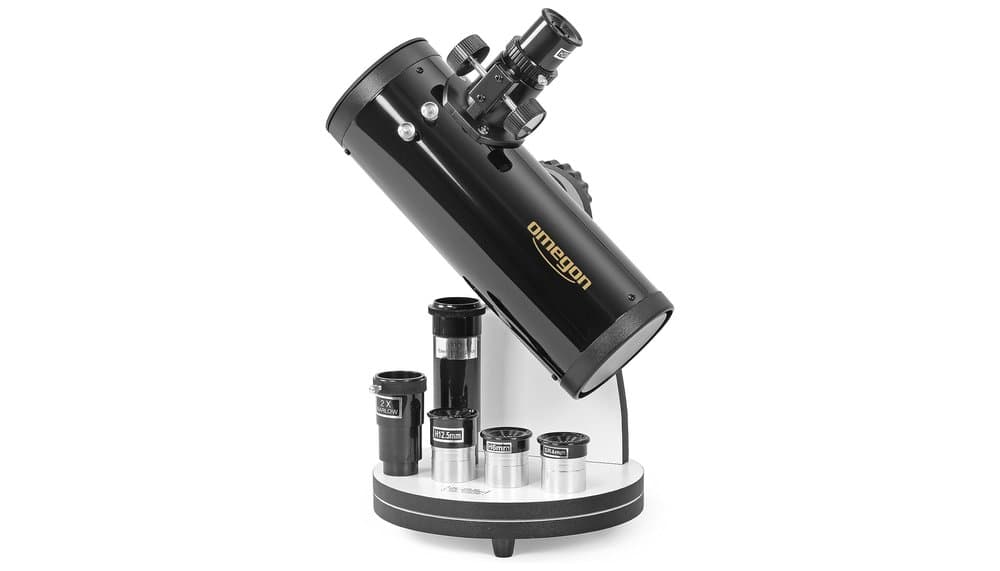
Comprehensive Analysis: Omegon N 76-300 DOB Tabletop Dobson Telescope
In the world of beginner astronomy instruments, small tabletop Dobsonian telescopes hold a special place. The Omegon N 76-300 DOB Tabletop Dobson Telescope is a typical representative, promising simplicity and discovery. We will dissect this instrument based on its technical specifications, feedback from the amateur astronomy community, and expert analyses available online. The goal is to clearly determine who it is for, what it truly allows you to observe, and where its limitations lie.
Strengths and Weaknesses
Strengths:
- Simplicity and Robustness: Intuitive tabletop Dobsonian mount, quick assembly, solid construction suitable for handling by children.
- Extreme Portability: Compact size (~40 cm tube) and light weight (~1.6 kg), ideal for transport and storage.
- Complete Kit: Supplied with several eyepieces and a Barlow lens, offering a range of magnifications right out of the box.
- Excellent Entry-Level Value: Positioned as a very financially accessible initiation instrument.
Weaknesses:
- Limited Optical Aperture: A 76 mm mirror restricts brightness and resolving power, limiting deep-sky observations.
- Entry-Level Accessories: The optical quality of the supplied eyepieces is basic, and the finder (porrofinder) is often considered impractical.
- Usage Comfort: Absolutely requires a table or a stable support at a good height, which can be uncomfortable for an adult during long sessions.
- Basic Focuser: The focusing mechanism is often described as imprecise and delicate.
Detailed Product Analysis
Design and Handling
The Omegon N 76-300 DOB is above all an instrument designed for absolute simplicity. Its tabletop Dobsonian mount made of wood (or particle board) is its main asset. According to user feedback, it allows for pointing at the sky intuitively, without the complications of an equatorial mount. The azimuth and altitude movements are smooth, which facilitates manual tracking of celestial objects for a beginner. Its compactness is universally praised: it can be transported like hand luggage and stored effortlessly.
However, this compactness has a downside. To be used, the telescope must be placed on a stable support at a suitable height. Testers emphasize that use on the ground is impossible and that a garden table or a low wall is necessary. For an adult, the position can quickly become uncomfortable, confirming the observations of some buyers who primarily intend it for children and teenagers.
Optical Performance and Observing Capabilities
Here, we must distinguish marketing promises from physical reality. On paper, the 76 mm aperture and 300 mm focal length (f/ratio ≈ 3.9) define a bright instrument but with a relatively narrow field of view.
- Lunar Observation: This is its area of excellence. The community agrees that views of the Moon are satisfying and detailed. The main craters, seas, and mountain ranges are clearly visible. The brightness provided by the aperture makes the image pleasant.
- Planetary Observation: Performance is decent under good atmospheric conditions. Jupiter and its four main moons (the Galilean satellites) are visible, as well as the planet's two main cloud bands. Saturn and its rings are identifiable, although the image remains small. Venus and Mars appear as bright disks without notable detail. The limited resolving power of the 76 mm aperture prevents any fine observation of planetary details.
- Deep Sky: Capabilities are, logically, restricted. Open star clusters like the Pleiades (M45) or the Beehive Cluster (M44) perform well. The Orion Nebula (M42) is visible as a fuzzy, bright patch, which is already an achievement for such a small instrument. In contrast, most faint galaxies and nebulae will remain out of reach, especially under skies with some light pollution.
The quality of the supplied eyepieces (H 20mm, H 12.5mm, H 6mm, SR 4mm) is typical of the entry-level segment. They do the job but lack sharpness at the edges and eye comfort (especially the SR 4mm). Experts often recommend quickly investing in a mid-range eyepiece, like a 6 or 9 mm Plössl, to significantly improve comfort and clarity on planets.
Comparison and Target Audience
The Omegon N 76-300 DOB does not exist in a vacuum. It faces direct competitors like the SkyWatcher Heritage 76 or the Bresser Nano 76. Analysis of the community shows that the differences between these models are minimal, often concerning base design or finish. The choice then comes down to details, availability, or the composition of the accessory kit.
Its target audience is perfectly defined:
- Parents wishing to introduce a child (from 6-8 years old) to astronomy without a significant investment.
- The absolute adult beginner who wants to test their interest in the hobby before investing in a more serious instrument.
- The nomadic astronomer looking for a second ultra-portable telescope for vacations or getaways under dark skies.
It should not be considered a "family telescope" in the sense that a passionate adult will quickly find its limits. It is a stepping-stone telescope.
Technical Specifications
| Feature | Detail |
|---|---|
| Type | Newtonian Telescope on a tabletop Dobsonian mount |
| Diameter (Aperture) | 76 mm |
| Focal Length | 300 mm |
| Focal Ratio (f/D) | f/3.9 |
| Mount | Dobsonian (azimuth) in wood, "tabletop" format |
| Optical Tube | Closed construction, length ~40 cm |
| Finder | Porrofinder (reflex sight) |
| Eyepiece Diameter | 1.25" |
| Supplied Accessories | Eyepieces H 20mm, H 12.5mm, H 6mm, SR 4mm; 2x Barlow Lens; 1.5x Erecting Lens |
| Weight | ~1.6 kg |
| Main Uses | Lunar observation, basic planetary observation, bright star clusters |
What Users and Experts Say
The synthesis of customer reviews and expert analyses available online paints a clear consensus.
Praise consistently focuses on:
- Ease of Use: "Rapidissimo da usare", "perfect for beginner", "works perfectly and will truly please even the most novice."
- Perceived Quality for the Price: "What quality! What a beautiful product!", "Good value for money", "Excellent product for the price."
- Results on the Moon: "the image is of good quality", "moon sightings which were amazing."
- Portability: "compact and light, ideal for travel."
Reported criticisms and limitations are recurrent:
- An Instrument for Children: A German review summarizes this sentiment: "Nicht für Erwachsene" (Not for adults), calling it a "Kinderspielzeug" (child's toy).
- Difficulty Pointing: Some beginners note the difficulty finding objects without a good finder: "not easy to start and especially to find the moon with."
- Basic Accessories: The limited quality of the eyepieces and finder is a point often raised in technical analyses.
- Managing Expectations: The community reminds that this is a small beginner's telescope, whose performance cannot compete with larger aperture instruments.
Conclusion
The Omegon N 76-300 DOB Tabletop Dobson Telescope is a tool that perfectly fulfills a very specific mission: to spark astronomical curiosity without creating technical or financial frustration. It is an excellent first contact with the sky.
Its objective analysis shows that one should not look for a versatile or high-performance instrument in it. Its optical limits (76 mm aperture) and ergonomic limits (tabletop use) are inherent to its compact and economical design. On the other hand, its strengths – simplicity, robustness, portability, and complete kit – make it a very compelling proposition for its target audience.
We recommend it without reservation for a child or teenager whose interest in science you wish to nurture, or for a curious adult wanting to confirm their attraction to astronomical observation before a larger investment. For those who will accept its limits as the price to pay for simplicity and mobility, it will offer beautiful first emotions under the stars and the Moon. For the observer already seeking in-depth performance, it will be necessary to look towards models with a larger aperture (114 mm or 130 mm minimum) and a mount more suited to adult size.
100% free and independent — All our articles are written independently, without any sponsorship. We may earn a commission on purchases made through our links, at no extra cost to you.
Articles you might like
Vanguard Endeavor HD65A Spotting Scope Review
Spotting scope with 65mm ED glass & 15-45x zoom for birding & hiking. Balanced performance & portability for serious nature observers.
Carson AdventurePak Kids' Exploration Tool Kit Review
Explore nature with this kid's 5-piece tool kit for outdoor adventure and educational discovery. Perfect for young explorers.
BOSTRON CY 10x50 Monocular Review & Test
Compact 10x50 monocular review: Analyzes optical clarity, field of view & build quality for hiking, nature & astronomy. See its true value.
Guides you might like
WiFi Trail Camera Guide
See wildlife discreetly from your couch! Learn how WiFi trail cameras let you monitor animals without disturbance and how to choose the right one.

Ultimate Travel Telescope Guide
Choose a portable, high-performance travel telescope to explore the universe from your backpack without compromising on essential astronomical views.
Ultimate Guide to Night Vision Binoculars
Choose the perfect night vision binoculars: Gen vs. digital? Unravel the tech to make your nighttime wildlife adventures a total success. Guide inside.