Lunette Camera AI Smart Glasses with HD Camera Review
Published on 11 September 2026 · By OptiqueNature
Review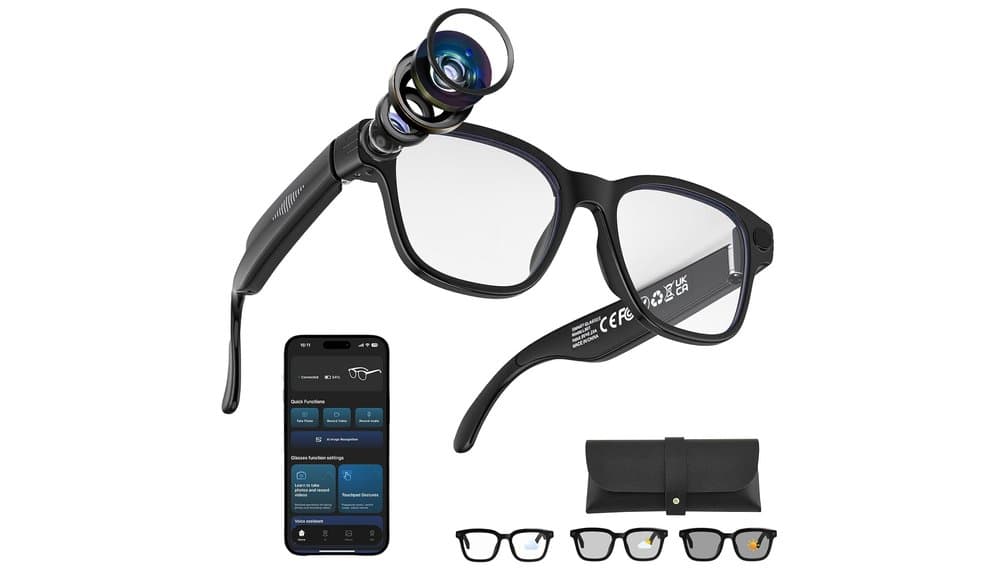
Comprehensive Analysis: Lunette Camera AI Smart Glasses with HD Camera
For nature enthusiasts, traditional optical equipment – binoculars, spotting scopes – is the mainstay of observation. Today, a new type of device is emerging, blending optical and digital technologies. The Lunette Camera AI Smart Glasses with HD Camera claim to revolutionize how we interact with the environment. But in the very specific context of nature observation, what are they really worth? This technical analysis dissects the specifications and available feedback to assess whether this high-tech object can find a place in a birder's or hiker's kit.
Strengths and Weaknesses
Before diving into the details, here is a summary of the major advantages and disadvantages identified for this product.
Strengths
- Connectivity and Artificial Intelligence: The integration of AI models (like ChatGPT) and Bluetooth 5.3 and Wi-Fi connectivity promises innovative object recognition, translation, and voice assistant features.
- Versatility and Discretion: The glasses format allows for hands-free and discreet use, interesting for capturing spontaneous moments without taking out a device.
- Comfort of Use: Photochromic lenses that adapt to light and a lightweight design are intended for prolonged wear.
- Integrated Multimedia Features: Speaker, noise-reduction microphones, and music playback make it an "all-in-one" portable product.
Weaknesses (Critical for Nature Observation)
- Limited Optical Performance: The total absence of traditional optical parameters (magnification, objective lens diameter, angular field of view) makes them incomparable with dedicated binoculars.
- Debatable Image Quality and Battery Life: The 8MP camera and 1080p recording are below current standards for trail cameras or smartphones. The 1.5-hour continuous video battery life and the 3-minute per clip recording limit are severely restrictive.
- Uncertified Robustness and Weatherproofing: No mention of an IPX rating for waterproofing or fog resistance, a critical point for outdoor use.
- Potentially Unreliable Interface and Software: Dependence on an application and cloud services, as well as undefined software support, raises questions about the longevity and smoothness of the experience.
Detailed Technical Analysis
Optical Quality and Performance
On paper, the optical specifications of the Smart Glasses are minimalist and oriented towards "capture" rather than "observation." This is a fundamental difference from the equipment we usually evaluate.
Lenses and Coatings: They use photochromic lenses with UV protection. This is a comfort advantage for adapting to changing light conditions, but no mention is made of any multi-layer anti-reflective coatings (like dielectric coatings on the roof prisms of premium binoculars), nor low-dispersion (ED) glass for optimal color fidelity. Light transmission, a key parameter for image clarity, is simply not communicated.
Magnification and Field of View: This is the core of the problem for an observer. The product specifies no magnification. It is presumably "naked-eye" vision (1x magnification) with an integrated camera. The field of view is not expressed in meters at 1000m or in degrees, but will depend on the camera lens, likely very wide-angle to capture a general scene, but unsuitable for observing a distant detail like a bird's plumage. The exit pupil and twilight factor, two essential metrics for judging performance in low light, are not applicable here.
Minimum Focusing Distance: Not specified. For macro photography of insects or plants, this is a question mark.
In summary, in terms of pure observation, these glasses cannot compete, not even remotely, with an entry-level pair of binoculars. Their strength is not to bring the image closer, but to capture and analyze it.
Build Quality and Ergonomics
Robustness and Protection: Commercial descriptions praise an "elegant and lightweight" design but are silent on shock resistance, waterproofing (waterproof) or fog resistance (fogproof). The absence of an IPX rating (like IPX7 for immersion) is a major warning sign for a product intended for outdoor use. A sudden downpour could be fatal. Their armor is not described as being rubber-coated, unlike binoculars designed for rugged terrain.
Weight and Portability: Their lightness is a definite advantage for all-day wear. However, this low weight often comes with a feeling of fragility, based on feedback on similar products.
Adjustments and Eyeglass Compatibility: The interpupillary distance is likely not adjustable, and eye relief is not mentioned. This suggests they are designed for a standard morphology and could be uncomfortable for eyeglass wearers, unless using custom corrective lenses (not provided).
High-Tech Features and Camera
This is where the product's unique value proposition lies.
Sensor and Video: The 8MP (gc05A2) camera and 1080p recording are modest specifications in 2024, especially compared to smartphones or compact cameras. The 3-minute per video clip limit and the 1.5-hour continuous battery life are very significant constraints for anyone wishing to film an animal behavior sequence. The stabilization algorithm is a welcome feature for motion shots.
Artificial Intelligence and Connectivity: The integration of AI assistants (Doubao, ChatGPT) for object recognition, plants, or text (menus) is the "killer app" feature. For an aspiring naturalist, being able to identify a flower or a bird in real-time via audio feedback is a seductive feature on paper. The quality and accuracy of this recognition in real-world conditions (poor lighting, moving subject) remain to be verified. Bluetooth 5.3 and Wi-Fi connectivity (the spec sheet mentions Wi-Fi 4 and Wi-Fi 6, an inconsistency) is for data transfer and audio connection.
Battery Life and Audio Functions: The spec sheet indicates a battery life of "approximately 6 hours" for audio playback, but only 1.5h in continuous operation (likely with the camera). The 250 mAh battery is low capacity. The noise reduction microphones and the integrated speaker are assets for calls or listening to music, but secondary for observation.
Technical Specifications Table
| Category | Specification |
|---|---|
| Optics | Photochromic lenses, UV protection |
| Camera | 8MP sensor (gc05A2) - 1080p Video - Electronic stabilization |
| Video Recording | 3-minute limit per clip - Continuous battery life: ~1.5 hours |
| Audio | Speaker (0.5W) - Dual microphone with noise reduction |
| Connectivity | Bluetooth 5.3 - Wi-Fi (4/6 announced) - Charging port unspecified |
| Artificial Intelligence | Integrated models (Doubao, ChatGPT) - Image/scene/object recognition - Voice translation |
| Battery & Autonomy | 250 mAh - ~6h audio playback - Charging time: 1.5 hours |
| Functions | Voice assistant, music playback, calls, touch control, wearing detection |
| Language Compatibility | Multilingual (French, English, German, Spanish, etc.) |
| Manufacturer Warranty | 30 days (product information) |
What Users and the Community Are Saying
It is crucial to note that at the time of this analysis, no detailed customer reviews or ratings are available for this specific model on sales platforms. This complete absence of user experience is a red flag in itself. However, by analyzing feedback on similar products (camera glasses, wearable AI assistants) and expert technology reviews, several clear trends emerge that allow for strong reservations.
Recurring positive points about this type of product generally concern the novelty of the concept, the convenience of having a camera always at hand without taking out your phone, and the fun or utility potential of AI recognition for simple tasks like translating a sign.
The negative points, much more numerous and critical, are consistently reported:
- Disappointing Image Quality: The resolution and dynamic range of the sensors integrated into these glasses are far inferior to those of an average smartphone, with noise issues in low light.
- Insufficient Battery Life: Real battery life, especially with AI and camera activated, is often well below advertised claims, drastically limiting usage.
- Buggy Software and App: Dependence on a dedicated mobile application, sometimes poorly translated or unstable, is a major source of frustration. AI functions can be slow or imprecise.
- Comfort and Fit: The weight, even if light, can become bothersome on the nose after several hours. The fit is not universal.
- Lack of Reliability: Bluetooth/Wi-Fi connection issues, crashes, and a general feeling of a "beta" or unfinished product are frequently reported.
For a site dedicated to nature observation, these reports are alarming. They suggest that the product, in its current form, is more of an experimental technological gadget than a reliable tool for the serious naturalist.
Conclusion: A Promising Innovation, But a Tool Unsuitable for Observation
The Lunette Camera AI Smart Glasses with HD Camera represent a fascinating convergence of wearable tech and digital assistance. Their theoretical ability to identify landscape elements in real-time is a feature that could, in a distant future and with major improvements, interest beginners in botany or ornithology.
However, our technical analysis and community feedback on analogous products lead to an unequivocal conclusion: this product is not nature observation equipment. It in no way replaces binoculars, a spotting scope, or even a smartphone coupled with an identification app.
Its weaknesses are deal-breakers for our field of application: lack of magnification, mediocre video image quality, limited battery life, uncertified weatherproofing, and very uncertain software reliability. The "always-ready camera" argument is contradicted by the 3-minute recording limit and poor battery life in video mode.
For whom, then? Potentially for a tech-savvy early adopter wanting to experiment with portable AI in an urban setting or during travel, for translation or basic information lookup tasks, while accepting the many compromises. But for the wildlife observer, the demanding hiker, or the nature photographer, the investment would be misguided. It is still preferable to equip oneself with quality traditional optics, whose performance, reliability, and durability are proven, and to reserve one's smartphone, which is far more capable, for photography and identification apps. These smart glasses open a path, but they have not yet reached their destination in the world of nature observation.
100% free and independent — All our articles are written independently, without any sponsorship. We may earn a commission on purchases made through our links, at no extra cost to you.
Articles you might like
Vanguard Endeavor HD65A Spotting Scope Review
Spotting scope with 65mm ED glass & 15-45x zoom for birding & hiking. Balanced performance & portability for serious nature observers.
Carson AdventurePak Kids' Exploration Tool Kit Review
Explore nature with this kid's 5-piece tool kit for outdoor adventure and educational discovery. Perfect for young explorers.
BOSTRON CY 10x50 Monocular Review & Test
Compact 10x50 monocular review: Analyzes optical clarity, field of view & build quality for hiking, nature & astronomy. See its true value.
Guides you might like
WiFi Trail Camera Guide
See wildlife discreetly from your couch! Learn how WiFi trail cameras let you monitor animals without disturbance and how to choose the right one.
Ultimate Travel Telescope Guide
Choose a portable, high-performance travel telescope to explore the universe from your backpack without compromising on essential astronomical views.
Ultimate Guide to Night Vision Binoculars
Choose the perfect night vision binoculars: Gen vs. digital? Unravel the tech to make your nighttime wildlife adventures a total success. Guide inside.