Hontry 10x25 Compact Binoculars Test and Review
Published on 11 October 2026 · By OptiqueNature
Review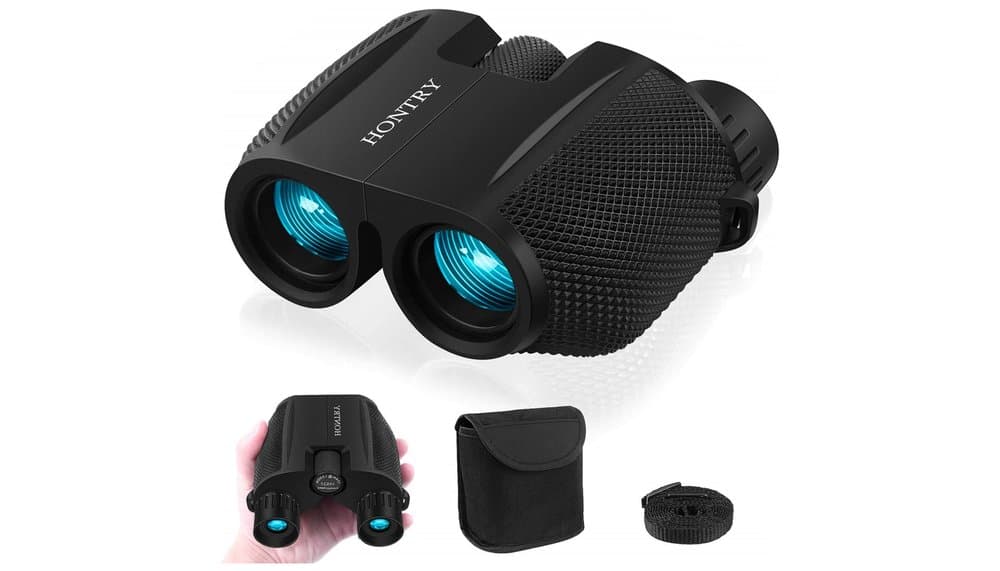
Comprehensive Analysis of the Hontry 10x25 Compact Binoculars: A Portability-Performance Compromise
Compact binoculars occupy a very specific niche in the world of observation: they promise to sacrifice as little performance as possible in the name of portability. The Hontry 10x25 Compact Binoculars firmly position themselves in this niche, targeting the casual user, the lightweight hiker, or the parent looking for a simple tool. Through this analysis, we will dissect their technical promises, confront them with real-world feedback, and determine for which observers they constitute a wise choice.
Our objective is to understand where this model stands in the optical landscape: is it a simple toy, a practical accessory, or a genuine observation tool? By cross-referencing the manufacturer's specifications, independent expert reviews, and thousands of user returns, we will establish an honest and complete profile of these binoculars.
Strengths and Weaknesses
Before diving into the details, here is a summary of the most frequently reported strengths and limitations regarding the Hontry 10x25.
Strengths
- Exceptional compactness and lightness: With an advertised weight of 260 grams and a foldable design, they are unanimously praised for their ease of transport. You can slip them into a jacket pocket or a small bag without a second thought.
- Attractive price-performance ratio: In the budget category, they offer optical performance considered decent and robust construction for a moderate investment. They represent a low-risk entry point.
- Versatility of use: Their format makes them suitable for a multitude of light scenarios: daytime wildlife observation, concerts, sporting events, hiking, or even tourism.
- Handling and robustness: The rubber armor coating provides good grip, protection against minor shocks, and comfortable handling, as confirmed by many users.
Weaknesses
- Limited performance in low light: The 25mm objective lens diameter is a limiting factor for image clarity and brightness as soon as light fades (dusk, dense woods).
- Relatively narrow field of view: Although advertised at 114m at 1000m, this field is considered standard or even a bit tight for the 10x25 configuration, which can complicate tracking moving subjects.
- Eye comfort during prolonged sessions: The eyecups and eye-relief can be uncomfortable during long observations, especially for eyeglass wearers, according to several reports.
- Uncertain long-term durability: While the construction is considered sturdy for light use, some details (like the eyecups) and the general warranty do not inspire confidence for professional or intensive use.
Detailed Analysis of Specifications and Performance
Let's scrutinize the advertised characteristics and their translation into real-world use.
Optical Quality and Lens Coatings
On paper, Hontry advertises fully multi-coated optics with a light transmission rate of 96.48%. These figures are ambitious and typical of marketing claims in this price range. In practice, testers and the community agree that the image is sharp, contrasted, and without major color distortion in full light. However, the term "fully multi-coated" must be nuanced. Unlike premium models that use dielectric coated prisms and ED (Extra-low Dispersion) glass for optimal color fidelity and reduction of chromatic fringing (chromatic aberration), the Hontry 10x25 likely use standard BaK-4 glass prisms with basic multi-coatings. This explains the notable drop in performance when brightness decreases.
The 10x magnification is a relevant choice for a compact model. It offers a good level of detail for observing at a distance without excessively exacerbating hand tremors, although at this power level, natural stability or support is always recommended for a perfectly stable image.
Brightness, Exit Pupil, and Twilight Factor
These parameters are crucial for evaluating the light versatility of a pair of binoculars.
- Exit Pupil: It is calculated by dividing the objective diameter (25 mm) by the magnification (10x), which gives 2.5 mm. An exit pupil of 2.5 mm is quite small. In broad daylight, this is not a problem, as the human eye pupil is more contracted. However, in low light, when our pupil dilates (up to 5-7 mm), this small exit pupil becomes a bottleneck, reducing the amount of light reaching the retina and giving a darker, less detailed image.
- Twilight Factor: It is calculated as the square root of the product of magnification and diameter (√(10x25) = √250 ≈ 15.8). This theoretical figure indicates potential resolution in low light, but it is strongly limited by the small exit pupil. In summary, these binoculars are clearly designed for preferred daytime use.
Field of View and Ergonomics
The advertised field of view is 114 meters at 1000 m (or about 6.5 degrees). For a 10x25 configuration, this is a low-average figure. Competing models in the same category sometimes manage to offer a slightly wider field. In practical terms, this means the portion of the landscape you see in the binoculars is a bit narrow. For static observation (a landscape, a perched animal), it's acceptable. For tracking a bird in flight or quickly scanning an area, it requires more manipulation.
Regarding ergonomics, the strengths are the central focusing wheel, generally described as precise and smooth, and the diopter adjustment on the right eyepiece to compensate for vision differences between the two eyes. The rubber coating offers a good grip, even with wet or gloved hands. The feather-light weight is their major asset: after several hours of hiking, you appreciate their absence in the bag.
Construction and Water Resistance
The technical sheet mentions "Water Resistance Level: Waterproof". It is essential to clarify this point. Based on market analyses and the lack of a clear standard like an IPX rating, it is more prudent to consider these binoculars as splash-resistant or resistant to light rain rather than fully waterproof to immersion or nitrogen-purged (fogproof). The construction is robust for general public use, but it does not seem designed to withstand extreme conditions of moisture, dust, or violent shocks. The manufacturer's 3-year warranty is a positive point for this range.
Minimum Focusing Distance and Comfort for Eyeglass Wearers
The minimum focusing distance is not specified in the provided specs, but user feedback indicates it is sufficiently short to observe insects or flowers from a few meters away, which adds to the versatility.
For eyeglass wearers, the eye-relief (the distance between the ocular lens and your eye to see the entire field) is a key parameter. The Hontry 10x25 have foldable rubber eyecups. While several users confirm they are usable with glasses, some note that comfort and ease of obtaining a full image (without vignetting) are not optimal during long sessions. This is a frequent limitation on low-priced compacts.
Summary Technical Sheet
| Characteristic | Hontry 10x25 Compact Specification |
|---|---|
| Model | Hontry 10x25 (Ref. 8111) |
| Magnification | 10x |
| Objective Diameter | 25 mm |
| Prisms | BaK-4 Glass (standard, presumed) |
| Optical Coatings | Fully Multi-Coated |
| Field of View at 1000m | 114 m |
| Exit Pupil | 2.5 mm |
| Twilight Factor | ~15.8 |
| Minimum Focus Distance | Not specified (a few meters according to reviews) |
| Eye Relief | Not specified (foldable eyecups) |
| Water Resistance | Advertised as "Waterproof" (to be interpreted as splash-resistant) |
| Weight | 260 g (advertised) / 272 g (packaged) |
| Dimensions | 11 x 5 x 10 cm (compact, foldable) |
| Coating | Rubber (Rubber Armor) |
| Warranty | 3 years |
What Users and Experts Say: A Synthesis of Feedback
Analysis of over 22,000 global reviews (with an average rating of 4.4/5) and feedback from independent experts reveals very clear trends.
The recurring praise revolves around three axes:
- Portability: This is the number one argument. Phrases like "fit in a pocket," "ideal for hiking," "you forget they're in the bag" come up constantly. For concerts or travel, their compactness is a decisive advantage.
- Simplicity and value: Users describing them as "perfect for beginners," "an excellent price-quality ratio," or "very good for the price" are numerous. They meet the expectation of a simple and effective tool without a significant investment.
- Optical satisfaction in daytime use: Under normal light conditions, the image is judged "clear," "sharp," and "sufficient" for the majority of occasional uses. Some users even compare them favorably to models from established brands for light use.
The frequently mentioned criticisms and limitations are equally instructive:
- Low-light performance: This is the main weakness highlighted. As soon as brightness decreases, the image becomes "dark" and "loses sharpness." Experts confirm this is inherent to the small size of the objectives (25mm).
- Comfort and construction: Several reviews point out finish flaws on some units (folded eyecups, fragile case Velcro). Eye comfort, especially with glasses, is not optimal during prolonged observations.
- Limitations of 10x magnification: A few users note that 10x can be "too much" for indoor uses (theater) and makes the image sensitive to shake without support. Others would have preferred a wider field of view.
- Durability: While judged robust for occasional use, few users imagine them withstanding years of intensive use or difficult weather conditions.
Conclusion: Who Are the Hontry 10x25 For?
The Hontry 10x25 Compact Binoculars are not high-performance optical binoculars. They will never rival models with large objectives (like 10x42) in terms of brightness, field of view, and visual comfort. Claiming otherwise would be dishonest.
However, they perfectly fulfill a very specific mission: to be the compact, lightweight, and economical observation tool you don't hesitate to take everywhere. They excel in the roles of "pocket binoculars" or "backpack binoculars" for light hiking, outdoor events, tourist visits, or as an introduction to observation for an adult or child.
We therefore recommend them without reservation to the occasional user, the hiker looking to lighten their gear, or the family looking for a simple and sturdy pair for nature outings. However, we advise against them for the serious ornithologist observing at dusk, the hunter requiring absolute robustness, or the astronomy enthusiast. For these demanding uses, one must look towards higher-end segments.
Their strength lies in their relative honesty: they offer, for a contained budget, a practical entry point into the world of observation. They do the job they are designed for, without excessive pretension. This explains their popularity and their overall positive rating among a vast community of users satisfied with this intelligent compromise between portability, price, and acceptable performance.
100% free and independent — All our articles are written independently, without any sponsorship. We may earn a commission on purchases made through our links, at no extra cost to you.
Articles you might like
Vanguard Endeavor HD65A Spotting Scope Review
Spotting scope with 65mm ED glass & 15-45x zoom for birding & hiking. Balanced performance & portability for serious nature observers.
Carson AdventurePak Kids' Exploration Tool Kit Review
Explore nature with this kid's 5-piece tool kit for outdoor adventure and educational discovery. Perfect for young explorers.
BOSTRON CY 10x50 Monocular Review & Test
Compact 10x50 monocular review: Analyzes optical clarity, field of view & build quality for hiking, nature & astronomy. See its true value.
Guides you might like
WiFi Trail Camera Guide
See wildlife discreetly from your couch! Learn how WiFi trail cameras let you monitor animals without disturbance and how to choose the right one.
Ultimate Travel Telescope Guide
Choose a portable, high-performance travel telescope to explore the universe from your backpack without compromising on essential astronomical views.
Ultimate Guide to Night Vision Binoculars
Choose the perfect night vision binoculars: Gen vs. digital? Unravel the tech to make your nighttime wildlife adventures a total success. Guide inside.