Flintronic 12x42 HD Binoculars: Test & Review
Published on 1 July 2026 · By OptiqueNature
Review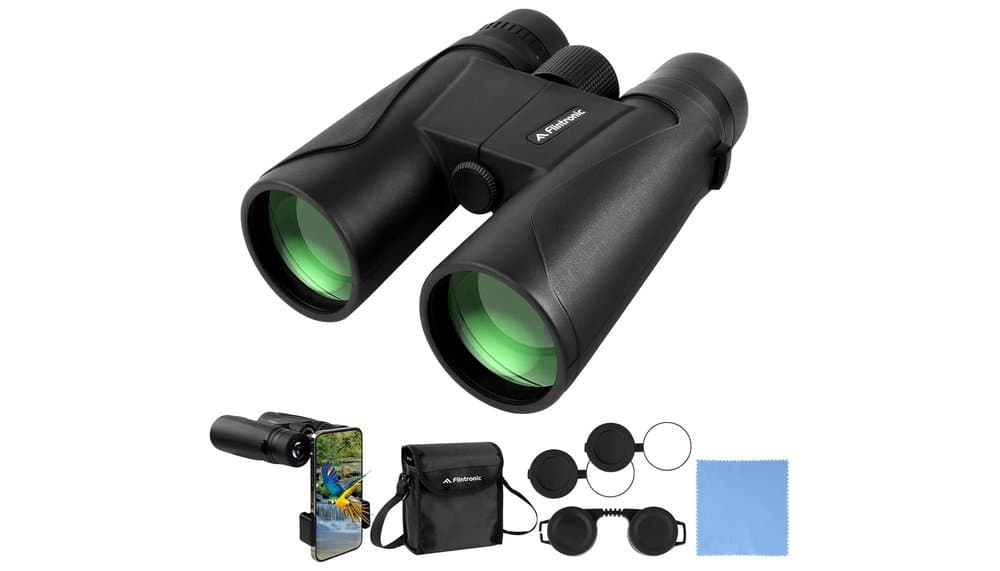
Introduction
In the world of nature observation, choosing binoculars is a delicate balance between power, brightness, portability, and budget. The Flintronic 12x42 High Definition Binoculars position themselves as a proposition combining high magnification with a relatively compact format. On paper, they promise to cover a wide range of activities, from birdwatching to casual astronomy, all accompanied by accessories like a smartphone adapter. But what are they really worth when confronted with the demands of observers and technical comparisons? We analyze this pair of binoculars here by dissecting its specifications, cross-referencing community feedback, and contextualizing it within the current optical landscape.
Strengths and Weaknesses
Strengths
- High and versatile magnification: A 12x offers appreciable range for observing details at a distance, useful for discreet wildlife or landscapes.
- Complete accessory kit: The inclusion of a universal smartphone adapter and a retractable support for basic digiscoping is a major asset for sharing observations.
- Announced robust construction: The promise of a waterproof (IP55) and fog-proof housing, reinforced with rubber, suggests outdoor use without excessive precautions.
- Theoretically correct optics: The combination of a BAK4 prism and Fully Multi-Coated (FMC) lenses constitutes, on paper, a solid foundation for good light transmission.
Weaknesses
- Compromised stability: The 12x magnification, without stabilization, is very sensitive to hand tremors. Prolonged use without support or a tripod can be tiring and counterproductive.
- Restricted field of view: A field of 87m at 1000m is narrow for the category, making locating and tracking moving objects (birds in flight) more difficult.
- Mixed ergonomics and build quality: User feedback regularly points to problems with a fragile diopter adjustment, a "plastic" feel, and sometimes an interpupillary distance adjustment unsuitable for all adult faces.
- Limited low-light performance: With an exit pupil of 3.5mm and likely average light transmission, twilight performance lags behind better-quality 8x42 or 10x42 models.
Detailed Technical Analysis
Optical Performance: What the Numbers Say
The heart of the analysis lies in interpreting the specifications. The Flintronic 12x42 rely on a Porro prism architecture (implied by the dimensions and shape), using a BAK4 prism. This barium glass, of higher quality than BK7, reduces light loss and edge-of-field aberrations. Coupled with a Fully Multi-Coated (FMC) coating, this should ensure that all air-to-glass interfaces are treated with multiple anti-reflection layers. Theoretically, this maximizes light transmission and contrast. However, the lack of mention of dielectric coatings on the prisms or ED (Extra-low Dispersion) glass suggests possible chromatic aberration (slight color fringing on high-contrast edges), especially with 12x magnification.
The twilight factor (√(42x12) ≈ 22.4) is high, suggesting good detail resolution capability in attenuated light. But this theoretical calculation is highly dependent on the actual transmission quality. The exit pupil (42/12 = 3.5mm) is the real indicator of comfort in low light. At 3.5mm, it is smaller than the maximum pupil diameter of a young adult in the dark (about 7mm), and well below the 5mm+ offered by 8x42 models. This means that in low-light conditions, the image will appear significantly less bright than in binoculars with the same objective diameter but lower magnification.
The field of view of 87m at 1000m (about 5.0°) is, as noted, quite narrow. For comparison, mid-range 12x42 binoculars often offer a field exceeding 100m/1000m. This reduced field can give a "looking through a tunnel" sensation, a flaw often accentuated by insufficient eye relief. The specifications do not mention it, but user feedback indicates it might be borderline for eyeglass wearers, requiring the rubber eyecups to be rolled down.
Construction and Ergonomics: Between Promises and Realities
The technical sheet highlights a waterproof (IP55) and fog-proof construction, typically achieved by nitrogen purging. The IP55 rating means protection against dust and low-pressure water jets from all directions, sufficient for a rain shower but not for immersion. The rubber armor should absorb minor shocks and improve grip.
However, several reviews highlight a feeling of general fragility, notably on the central focusing wheel and the diopter adjustment located on the right eyepiece. These elements, often made of plastic on entry-level models, can lack precision and durability. The weight of 700g is reasonable for the format, but stability remains the main ergonomic challenge with this magnification.
Use Cases: Who Are They Really For?
- Birdwatching / Wildlife: The 12x is useful for stationary observation of perched birds or distant, immobile animals. On the other hand, the narrow field and sensitivity to tremors make them poorly suited for rapid spotting or tracking birds in flight.
- Hiking / Travel: The format is compact, but the 12x magnification is often excessive for use while walking or for admiring landscapes. An 8x42 or 8x32 pair would be more versatile and stable.
- Sporting or Cultural Events: The range is appreciable for shows in large stadiums, but the reduced field of view can be frustrating.
- Casual Astronomy: The 12x and 42mm objective allow observation of some lunar details or the brightest star clusters, but the absence of a standard tripod thread (a clamp is often provided with the phone adapter) limits prolonged sessions.
- Digiscoping: The included smartphone adapter is a strong argument. It allows for basic photos and videos of observations. The quality will be limited by the optics of the binoculars and smartphone, but it's an appreciable feature for a non-expert audience.
Recap of Technical Specifications
| Characteristic | Flintronic 12x42 HD Specification |
|---|---|
| Magnification | 12x |
| Objective Diameter | 42 mm |
| Prism | BAK4 (Porro) |
| Optical Coatings | Fully Multi-Coated (FMC) |
| Field of View at 1000m | 87 meters |
| Field of View (degrees) | Approximately 5.0° |
| Exit Pupil | 3.5 mm |
| Eyepiece Diameter | 20 mm (according to sheet) |
| Water Resistance | IP55 (water jets) |
| Gas Filling | Fog-proof (likely nitrogen) |
| Minimum Focusing Distance | Not specified (generally >5m on this type) |
| Eye Relief | Not specified (likely ~10-12mm) |
| Weight | 700 grams |
| Included Accessories | Universal smartphone adapter, phone holder, straps, case, cloth |
What Users and Testers Say
The synthesis of available customer reviews and expert feedback paints a mixed picture, often confirming the technical analysis.
Recurring positive points revolve around the perceived good deal for the price, especially with the inclusion of the smartphone adapter. For occasional or beginner users, the image is judged "clear" and "bright enough" during the day. The fast delivery and responsive customer service mentioned in the description are also noted. Some find them perfect for an introduction to observation without a heavy investment.
The negative points are more specific and revealing:
- Construction problems: Several reviews denounce a "toy-like" or "plastic" build quality. Mentions of a diopter adjustment that malfunctions or non-smooth focusing appear.
- Unsuitability for some adults: One critic highlights a problem with an overly limited interpupillary adjustment (the distance between the eyepieces), preventing correct adjustment for their eyes, leading them to label them as "binoculars for children".
- Instability: The difficulty in stabilizing the image at 12x without support is frequently cited as the main flaw in use.
- Limited optical performance: Feedback points to a "pale" image, a lack of sharpness especially at the edges, and the appearance of chromatic aberration ("rainbow" effect) on contrasting edges. One user summarizes: "it's the same as having nothing", indicating disappointment with the real gain offered by the zoom.
- Confusion over models: Product sheets sometimes mix 12x42 and 12x32 references, creating confusion among buyers.
Conclusion
The Flintronic 12x42 High Definition Binoculars embody a typical compromise of entry-level products. Their main appeal lies in the proposition of strong magnification (12x) and a complete accessory kit (notably the phone adapter) at a very affordable price. For an occasional user, curious to discover observation or needing a secondary pair for one-off events without extreme demands, they may suffice.
However, our technical analysis and the synthesis of user feedback clearly show their limits. The non-stabilized 12x magnification, the narrow field of view, optics that show their limitations in terms of sharpness and chromatic aberration control, and a construction whose durability is questioned make them a poorly recommended choice for regular and demanding practice like serious birdwatching or long observation sessions. The ergonomics may also not suit all body types.
Ultimately, these binoculars find their place as a tool for initiation or as a backup, provided one is aware of their weaknesses and the stabilization effort required. For more frequent practice, investing in an 8x42 or 10x42 pair from a recognized optical brand, even entry-level, will generally offer a much more refined and satisfying long-term user experience, at the expense of maximum magnification and the included smartphone accessory. The choice boils down to prioritizing versatility, comfort, and image quality, or the zoom factor and rock-bottom price.
100% free and independent — All our articles are written independently, without any sponsorship. We may earn a commission on purchases made through our links, at no extra cost to you.
Articles you might like
Vanguard Endeavor HD65A Spotting Scope Review
Spotting scope with 65mm ED glass & 15-45x zoom for birding & hiking. Balanced performance & portability for serious nature observers.
Carson AdventurePak Kids' Exploration Tool Kit Review
Explore nature with this kid's 5-piece tool kit for outdoor adventure and educational discovery. Perfect for young explorers.
BOSTRON CY 10x50 Monocular Review & Test
Compact 10x50 monocular review: Analyzes optical clarity, field of view & build quality for hiking, nature & astronomy. See its true value.
Guides you might like
WiFi Trail Camera Guide
See wildlife discreetly from your couch! Learn how WiFi trail cameras let you monitor animals without disturbance and how to choose the right one.
Ultimate Travel Telescope Guide
Choose a portable, high-performance travel telescope to explore the universe from your backpack without compromising on essential astronomical views.
Ultimate Guide to Night Vision Binoculars
Choose the perfect night vision binoculars: Gen vs. digital? Unravel the tech to make your nighttime wildlife adventures a total success. Guide inside.