Celestron UpClose 60mm Spotting Scope Review
Published on 12 April 2026 · By OptiqueNature
Review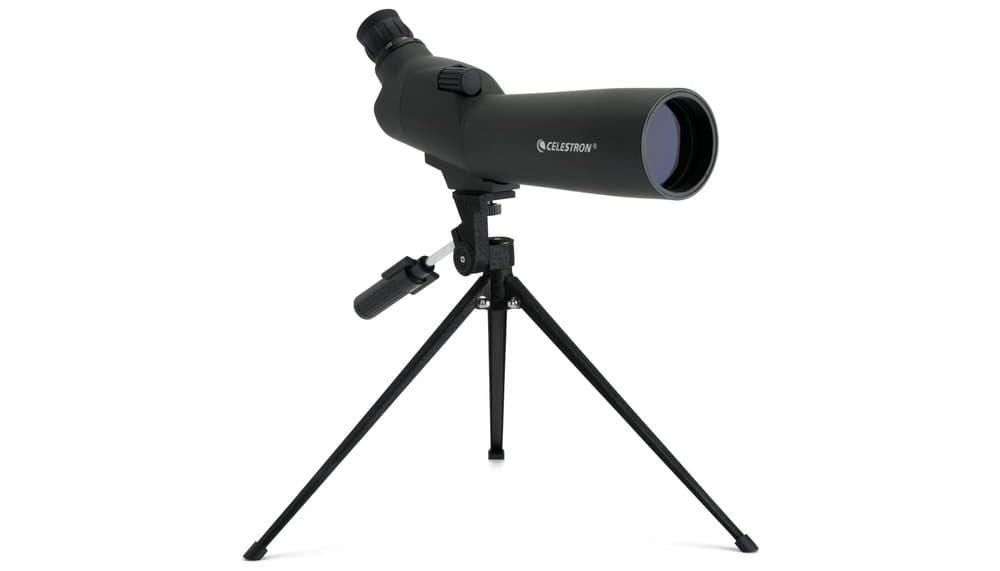
Introduction
The Celestron 52223 UpClose 60mm Spotting Scope is a very common terrestrial observation instrument, often presented as a complete entry-level solution. Positioned in the budget segment, it promises versatility and simplicity for activities like wildlife watching or target shooting. But beyond the marketing promises, what is this product really worth? We analyze its performance here based on its technical specifications, detailed feedback from the user community, and recurring findings from independent testers.
Strengths
Based on the synthesis of feedback, three main strengths stand out for the Celestron UpClose 52223.
An attractive price-performance ratio for beginners. This is the point most unanimously praised by users. For a modest budget, the buyer receives a complete set: the spotting scope itself, a hard aluminum case, a soft case, a small tabletop tripod, and basic accessories. This bundled offer is considered an excellent entry point for discovering observation without a significant investment.
Well-thought-out ergonomics and versatility. The 45-degree angled body is regularly cited as a major asset for comfort, especially during prolonged observation from a bench or seated position. The large, textured manual focus ring is described as precise and pleasant to use. The ability to zoom from 20x to 60x offers real flexibility to adapt the magnification to the observed scene.
Complete delivery and solid construction. Users are often pleasantly surprised by the quality of the hard case, judged to be very protective. The body of the spotting scope is described as robust, covered with a rubber armor that protects it from minor shocks and provides a firm grip. The fold-down eyecup is also appreciated as it facilitates use for eyeglass wearers.
Weaknesses
The product's limitations are just as clearly identified by the community and experts.
Limited optical performance at high magnifications. This is the most recurring criticism. While the image is judged to be clear and bright at low and medium magnifications (up to about 40x), it degrades significantly beyond that. Users report a significant loss of brightness and sharpness at 60x, as well as the appearance of chromatic aberrations (colored fringes on high-contrast edges). The fully coated optics are a basic standard that cannot compete with the multi-coated optics or extra-low dispersion (ED) glass of higher-end models.
A minimalist and unstable included tripod. The small included metal tabletop tripod is almost universally described as the weak point of the kit. Its lightness and low stability make it sensitive to vibrations and wind, severely limiting its practical utility whenever conditions are not perfectly calm. The majority of users end up using it with a more robust standard photo tripod.
Unspecified waterproofing and limitations in low light. Unlike other models, the specifications and feedback do not attest to a waterproof and nitrogen-purged construction. This makes it vulnerable to internal condensation in case of sudden temperature changes and limits its use in humid conditions. With a 60mm objective lens and basic optical coatings, its light transmission is not optimal for observation in twilight light.
Detailed Analysis by Use
For target shooting (25m, 50m, 100m): This is the application where feedback is the most positive and consistent. Shooters state that the Celestron 52223 is perfectly suited for observing hits up to 100 meters, even with .22 LR caliber. Sharpness and brightness are judged excellent within this distance range with optimal magnification around 40x. At 200 meters, opinions are more divided: it's possible, especially with larger calibers, but performance is at its limit, requiring good ambient light.
For nature observation and hiking: Its moderate weight and practical case make it an acceptable companion for occasional observation outings. However, its field of view (from 2.5° at 20x to 1.3° at 60x) is relatively standard, even a bit narrow at high magnifications compared to some competitors. For digiscoping (smartphone photography), it can work in daylight with an adapter, but the degraded image quality at high zoom and aberrations will be a hindrance.
For casual astronomy: As mentioned by some users, it allows for spectacular observation of the Moon and to distinguish Saturn's rings or Jupiter's main moons. This makes it a tool for astronomical curiosity, but its optical limits and the absence of an equatorial mount confine it to a very basic introductory role.
For intensive use and in all weather conditions: This is where its compromises become apparent. The construction, although robust for normal use, is not intended to withstand extreme conditions. The lack of guaranteed waterproofing and the average quality of the included tripod make it an instrument rather for occasional use in fair weather.
Technical Specifications
| Characteristic | Detail |
|---|---|
| Model | Celestron 52223 UpClose Spotting Scope |
| Objective Lens Diameter | 60 mm |
| Magnification | 20x to 60x Zoom |
| Eyepiece | Integrated Zoom, Kellner type |
| Body Angle | 45° Angled Body |
| Field of View | 2.5° at 20x (approx. 130 ft/1000 yds) - 1.3° at 60x (approx. 65 ft/1000 yds) |
| Eye Relief | 15 mm to 11 mm (fold-down eyecup) |
| Optical Coatings | Fully Coated Optics |
| Construction | Rubber armor, metal body |
| Focus | Manual, via toothed wheel |
| Minimum Focus Distance | Not specified, but very short according to users |
| Waterproof / Fogproof | Not specified by the manufacturer |
| Included Accessories | Metal tabletop tripod, hard aluminum case, soft carrying case, eyepiece and objective lens covers, cleaning cloth. |
| Approximate Weight | About 2 kg (scope only) |
What Users and Experts Say
Analyzing hundreds of customer reviews and expert feedback online reveals very clear trends.
Praise focuses mainly on:
- The price/performance ratio: The phrase constantly recurs. For its price, the kit is perceived as extremely complete and offering good performance under standard use conditions.
- Usefulness for shooting: It is the sport shooting community that praises it most frankly. It fills a specific need at a cost much lower than the specialized spotting scopes often offered in gun shops.
- Robustness and accessories: The aluminum case is frequently mentioned as an unexpected, high-quality bonus. The general construction of the spotting scope inspires confidence.
Criticisms and reservations highlight:
- Optical drop-off at 60x: This is the most frequently reported flaw. "Unusable at 60x", "loss of brightness and blur at maximum zoom", "better not to exceed 40x" are typical comments. This confirms the limits of basic optics and simple zoom eyepieces.
- The poor quality of the included tripod: It is described as "unstable", "too light", "a toy". The majority agree that a complementary purchase of a proper photo tripod is almost necessary for serious use.
- Chromatic aberrations: Colored fringes (often purple or green) on the edges of high-contrast objects are noted, particularly at high magnifications. This is an expected characteristic in this price range due to the absence of ED glass.
Web experts generally summarize the Celestron 52223 as a good choice for a beginner or occasional user who wants to discover terrestrial observation without spending a lot. They advise, however, to keep its limitations in mind: it is not designed to compete with mid-range or high-end instruments in terms of image sharpness, light transmission, or durability in difficult conditions.
Conclusion
The Celestron 52223 UpClose 60mm Spotting Scope is a product that perfectly assumes its positioning. It does not claim to be an optical reference, but rather an affordable and practical access solution to observation.
The verdict is clear: it is an excellent purchase for a sport shooter looking to see their hits up to 100-200m, or for an occasional naturalist who needs a versatile and portable instrument for occasional outings. Its main merit is to provide, in a single package, everything needed to get started.
On the other hand, if your needs lean towards intensive observation in low light (birds at dawn), a requirement for extreme sharpness and contrast, or regular use in rain or demanding environments, its compromises will quickly become frustrations. In that case, you need to look towards higher segments, where ED glass, multi-coatings, and waterproof constructions justify a larger investment.
In short, the Celestron UpClose 60mm delivers on its promises for a specific audience. For those whose expectations align with its real capabilities, it represents solid value and a perfectly satisfactory starting point in the world of distance observation.
100% free and independent — All our articles are written independently, without any sponsorship. We may earn a commission on purchases made through our links, at no extra cost to you.
Articles you might like
BOSTRON CY 10x50 Monocular Review & Test
Compact 10x50 monocular review: Analyzes optical clarity, field of view & build quality for hiking, nature & astronomy. See its true value.
FunKind HC600Pro 4G Trail Camera Review
FunKind HC600Pro solar-powered 4G trail camera review. Analyzes real-time wildlife monitoring specs, solar/battery power, and performance data.
Haokoo Vision Nocturne 4K Night Vision Binoculars Review
Haokoo 4K Night Vision Binoculars review: See & record in total darkness. Compact, versatile for nature observation. High-definition digital performance.
Guides you might like
WiFi Trail Camera Guide
See wildlife discreetly from your couch! Learn how WiFi trail cameras let you monitor animals without disturbance and how to choose the right one.

Ultimate Travel Telescope Guide
Choose a portable, high-performance travel telescope to explore the universe from your backpack without compromising on essential astronomical views.
Ultimate Guide to Night Vision Binoculars
Choose the perfect night vision binoculars: Gen vs. digital? Unravel the tech to make your nighttime wildlife adventures a total success. Guide inside.