Celestron StarSense Explorer DX 102AZ Telescope Review
Published on 21 August 2026 · By OptiqueNature
Review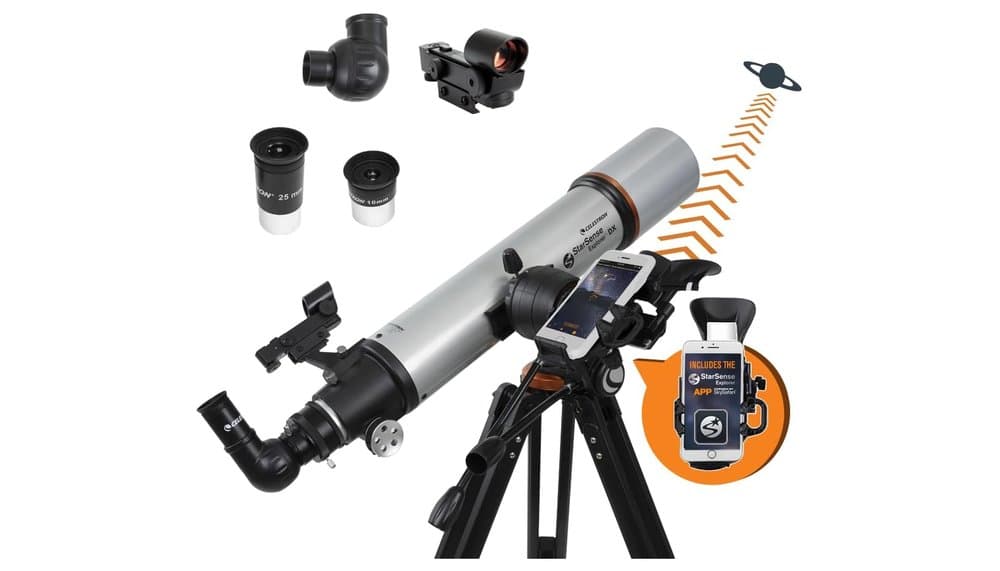
The Celestron StarSense Explorer DX 102AZ Refractor Telescope: A Revolution for Beginners?
Amateur astronomy is a fantastic hobby, but the initial hurdle is often the same: successfully pointing your instrument at the most interesting celestial objects. The Celestron StarSense Explorer DX 102AZ offers a radical answer to this problem by integrating smartphone-guided technology. Here, we analyze this flagship product to understand if it delivers on its promises of simplicity and performance, based on its specifications, expert feedback, and community reviews.
What Celestron Offers
The Celestron StarSense Explorer DX 102AZ presents itself as a complete package for starting astronomy. It is an achromatic refractor telescope with a 102 mm aperture and a 660 mm focal length (f/6.5 ratio). It is equipped with an XLT optical coating (StarBright XLT) designed to maximize light transmission. The mount is a robust manual alt-azimuth mount, set on an adjustable-height tripod.
The truly disruptive feature lies in its StarSense system. It includes a proprietary smartphone dock that, coupled with the dedicated app, uses the phone's camera to analyze the star field. A patented algorithm then calculates the exact position of the tube and guides the user, via on-screen arrows, to thousands of celestial objects selected in the application.
Strengths: Simplicity and Integrated Technology
According to user feedback and expert testing, this telescope's advantages are clear and perfectly target the novice.
- A Virtually Non-Existent Learning Curve: This is the most praised point. The StarSense technology eliminates the need to know how to read a star chart or align a complex motorized mount. As an experienced user summarizes in their review, the app guides with remarkable precision, often placing the desired object directly in the center of the eyepiece's field of view. This function transforms an observing session into a guided and fun treasure hunt.
- A Stable and Suitable Mount: The manual alt-azimuth mount is described as stable for its segment. Slow-motion controls are integrated and facilitate tracking objects once they are centered. The whole setup is considered sufficiently solid and manageable to be transported.
- A Complete and Well-Thought-Out Kit: The package comes ready to use with two eyepieces (25mm and 10mm), a straight-through diagonal, a classic red dot finder (useful if one doesn't want to use the smartphone), the StarSense dock, and the tripod. This completeness avoids the need for immediate additional purchases for first use.
- Honorable Planetary and Lunar Performance: With its 102 mm aperture, the refractor offers good light-gathering capability. Users report satisfying views of the Moon, Jupiter with its bands and Galilean moons, and Saturn's rings. For a beginner, these first observations are often a source of great wonder, as evidenced by several comments.
Weaknesses and Inherent Limitations
No instrument is perfect, and the DX 102AZ presents compromises related to its design and positioning.
- Chromatic Aberration: As a short-focus (f/6.5) achromatic refractor, it is prone to color fringing (often purple) on the edges of very bright objects like the Moon or Venus. This is a typical optical limitation of this type of instrument in this price range. More demanding users regarding image purity note this.
- Room-for-Improvement Stability: Although generally appreciated, the mount and tripod can exhibit vibrations that take a few seconds to settle after an adjustment, especially at high magnifications. This is typical of lightweight aluminum tripods.
- A Performance/Price Ratio Focused on Technology: On paper, the optical specs of a 102 mm refractor can be compared, in terms of light-gathering power, to those of a 130 mm or larger Dobsonian-type telescope, often cheaper. The price of the DX 102AZ is largely explained by the integrated StarSense technology. You are paying for ease of use and the guided experience, not for the absolute largest aperture.
- Dependence on Technology: The optimal experience requires a compatible smartphone (iOS 18+ or Android 12+). Without it, you revert to a classic manual telescope with a red dot finder. Some also lament the absence of detailed paper manuals.
Detailed Analysis by Use Segment
For Beginner Astronomy: This is clearly where this product excels. It addresses the main frustration of the novice: "where to point?" The app functions as a personal tutor, making the discovery of deep-sky objects (nebulae, clusters, galaxies) immediately accessible. The optical quality is more than sufficient for gratifying first observations.
For Planetary and Lunar Observation: It is a good instrument. The 102 mm aperture allows magnifications around 120x-150x with additional eyepieces, revealing details on the planets. Chromatic aberration will be visible on the Moon but does not prevent observation.
For Deep Sky (Nebulae, Galaxies): Its capabilities are real but limited by the aperture. It will show the brightest objects (the Orion Nebula, the Hercules Cluster) under a properly dark sky. To go further on faint objects, an instrument with a larger aperture would be necessary.
For Portability and Travel: With a total weight of about 6.5 kg, it is relatively portable. The mount disassembles and the tube is of reasonable size, allowing it to be loaded into a car for an outing under a more preserved sky.
Comparison with the Competition:
- Versus Classic Dobsonian Telescopes: A 150mm or 200mm Dobsonian will offer much brighter and more detailed images of deep-sky objects for a similar or lower budget. However, it requires knowing how to manually find your way around the sky (which can be learned) and is often more cumbersome.
- Versus Motorized "GoTo" Telescopes: Traditional GoTo systems (mounts that point automatically) are often more expensive and require an alignment procedure that can be daunting. The StarSense system is often described as more intuitive and faster to set up, although requiring manual manipulations to follow the arrows.
What Users Say: Summary of Reviews
Customer and reviewer feedback paints a strong consensus, with nuances.
Recurring Positive Points:
- StarSense technology is a "game-changer" for beginners. The ease of finding objects is the number one compliment.
- The build quality is considered good for the price, with a robust mount.
- First impressions (seeing Saturn's rings, the Moon) are described as "magical" and "breathtaking."
- Assembly is simple and achievable in about thirty minutes.
Points of Caution or Negatives:
- Tripod stability is sometimes criticized, with vibrations requiring a few seconds' wait for the image to stabilize, especially in the wind.
- Some users received damaged packages or with missing parts (notably the app activation code), highlighting logistical issues.
- Some feel that the provided eyepieces are "entry-level" quality and that an investment in a higher-quality eyepiece (e.g., a 13mm or 17mm) and possibly a Barlow lens significantly improves the experience.
- For very demanding planetary observation, the limitations of the achromatic optics (chromatic aberration) become noticeable.
Technical Specifications
| Feature | Detail |
|---|---|
| Type | Achromatic Refractor |
| Objective Diameter (Aperture) | 102 mm |
| Focal Length | 660 mm (f/6.5) |
| Optical Coatings | XLT Coatings (StarBright XLT) |
| Mount | Manual Alt-Azimuth with Slow-Motion Controls |
| Tripod | Aluminum, Adjustable Height |
| Finder | StarPointer Red Dot Finder + StarSense Smartphone Dock |
| Included Eyepieces | 25 mm (26x) and 10 mm (66x) |
| Diagonal | 90° Erecting Diagonal (for correct-image viewing) |
| StarSense Compatible | iOS smartphones (iPhone XR/XS and later, iOS 18+) and Android (Android 12+) |
| Total Weight (approx.) | 6.5 kg |
Conclusion: Who is this telescope for?
The Celestron StarSense Explorer DX 102AZ is not just a telescope; it is a rethought initiation experience. It deliberately sacrifices the last word in pure optical performance (where a large Dobsonian would win) for a major advantage: accessibility and the elimination of frustration.
It is the ideal instrument for:
- The absolute beginner who wants to avoid initial discouragement and get straight to the joy of discovery.
- The parent wanting to share astronomy with their children in an interactive and fun way.
- The casual hobbyist who values simplicity and quick setup.
On the other hand, it will be less suitable for:
- The experienced observer primarily seeking the largest aperture and best optical correction for the price.
- The one who prefers to learn to navigate manually in the sky and considers that an integral part of the hobby.
Our Verdict: The Celestron StarSense Explorer DX 102AZ perfectly accomplishes its mission. It uses modern technology (the smartphone) to solve the oldest problem for the beginner astronomer. If its price reflects this innovation more than exceptional optical prowess, it offers in return an immediate success and satisfaction rate that is rare in this segment. For anyone wishing to try astronomy without hassle and with the guarantee of seeing magnificent things from the very first night, it represents a very convincing choice.
100% free and independent — All our articles are written independently, without any sponsorship. We may earn a commission on purchases made through our links, at no extra cost to you.
Articles you might like
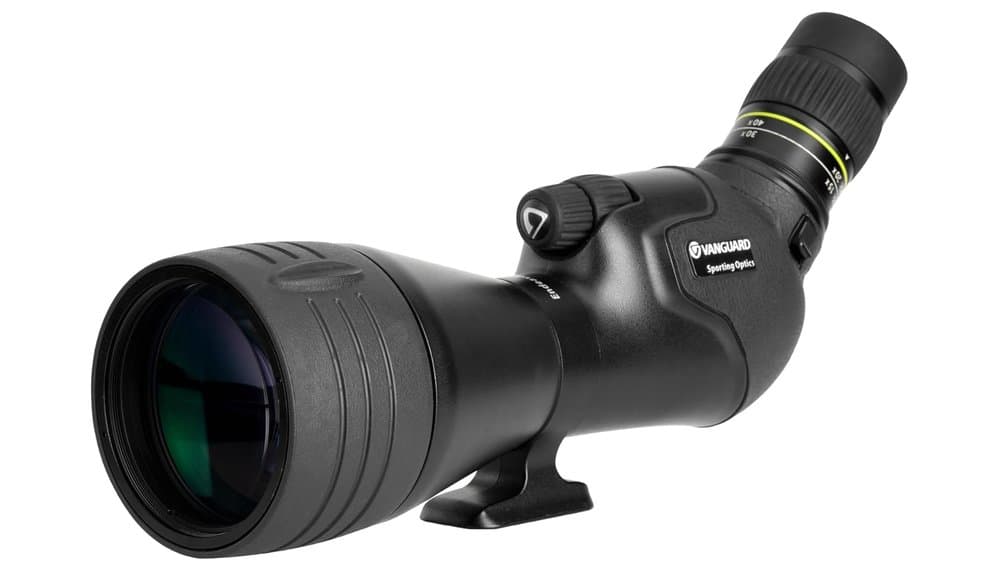
Vanguard Endeavor HD65A Spotting Scope Review
Spotting scope with 65mm ED glass & 15-45x zoom for birding & hiking. Balanced performance & portability for serious nature observers.
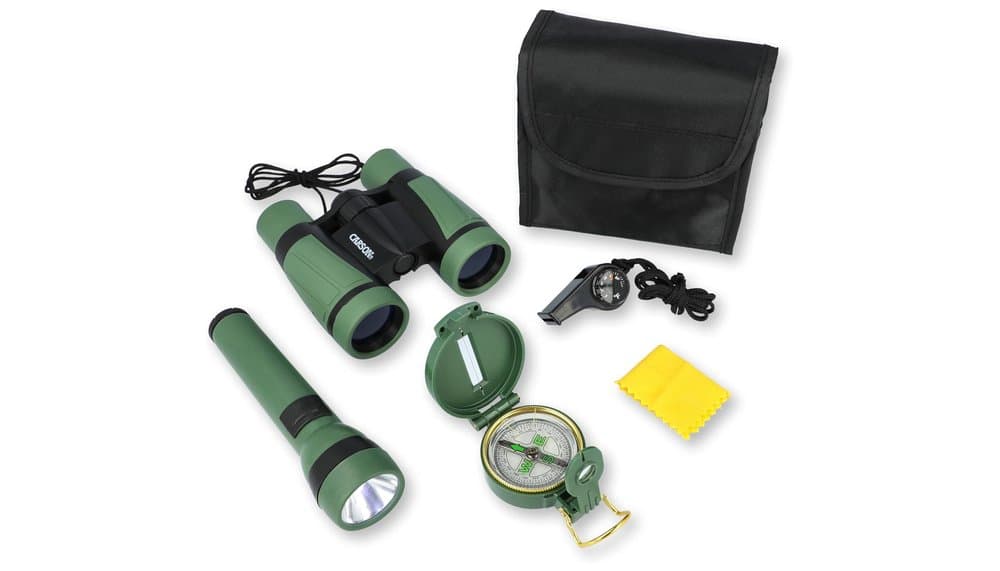
Carson AdventurePak Kids' Exploration Tool Kit Review
Explore nature with this kid's 5-piece tool kit for outdoor adventure and educational discovery. Perfect for young explorers.
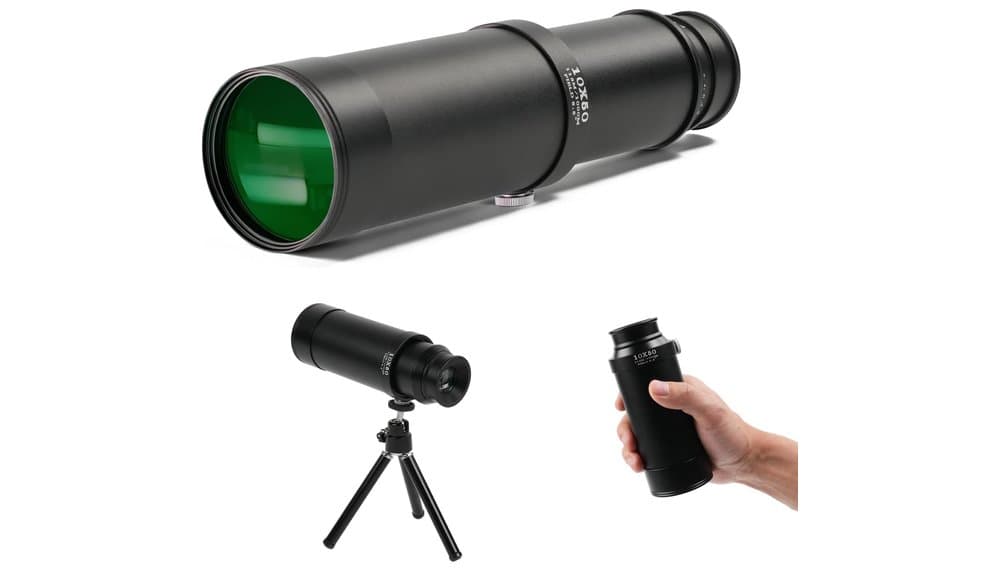
BOSTRON CY 10x50 Monocular Review & Test
Compact 10x50 monocular review: Analyzes optical clarity, field of view & build quality for hiking, nature & astronomy. See its true value.
Guides you might like
WiFi Trail Camera Guide
See wildlife discreetly from your couch! Learn how WiFi trail cameras let you monitor animals without disturbance and how to choose the right one.
Ultimate Travel Telescope Guide
Choose a portable, high-performance travel telescope to explore the universe from your backpack without compromising on essential astronomical views.
Ultimate Guide to Night Vision Binoculars
Choose the perfect night vision binoculars: Gen vs. digital? Unravel the tech to make your nighttime wildlife adventures a total success. Guide inside.