BOSSDUN ED 20-60x80 Spotting Scope Review
Published on 7 August 2026 · By OptiqueNature
Review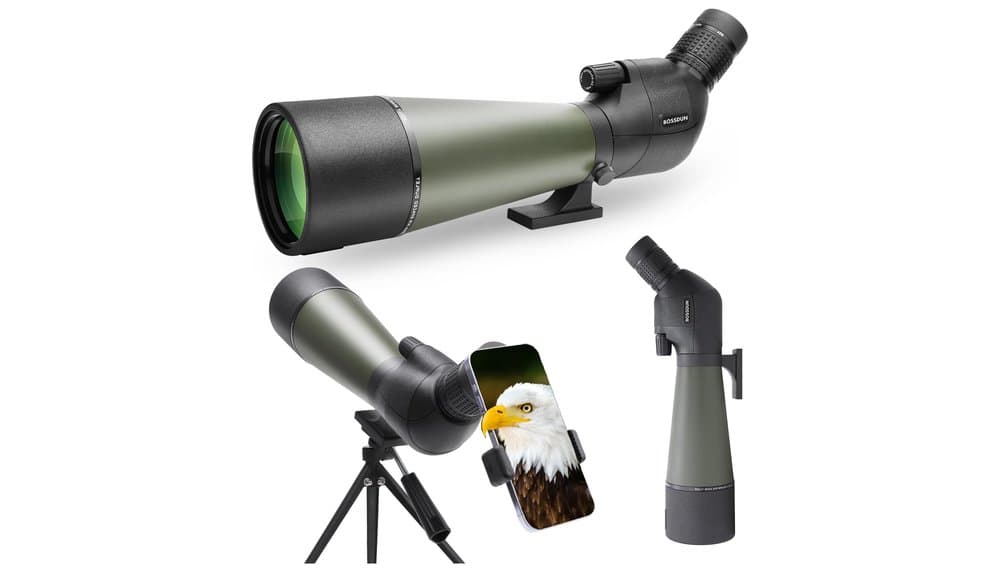
Introduction
In the world of nature observation, where optical quality and versatility are paramount, affordable spotting scopes receive particular attention. The BOSSDUN ED 20-60x80 model positions itself as a comprehensive proposal, promising performance worthy of more expensive equipment thanks to its ambitious technical specifications. This zoom scope, with its large 80 mm objective and ED (Extra-low Dispersion) glass, clearly targets demanding observers wishing to explore wildlife, the night sky, or capture images without breaking the bank. We will dissect this offering to determine if it lives up to its promises, analyzing its strengths, weaknesses, and market position, based on its technical characteristics and feedback from the user community.
Strengths
- Optics equipped with ED glass: The inclusion of Extra-low Dispersion glass is a major argument for this price segment. On paper, this should significantly reduce chromatic aberrations (color fringing), a common flaw in entry-level models, to offer better contrast and a more natural image.
- Large objective diameter (80 mm) and brightness: The 80 mm objective captures a substantial amount of light. Coupled with a BAK4 prism and FMC (Fully Multi-Coated) treatments, this translates to a high twilight factor and a generous exit pupil at low magnifications, ideal for observation in low light, at dawn or dusk.
- Very complete accessory kit: The scope comes with a tripod, a smartphone adapter for digiscoping, a carrying case, and sunshades. This offers a turnkey solution, particularly attractive for beginners who do not wish to purchase these accessories separately.
- Waterproof and Fogproof construction: The O-ring seals and nitrogen purging provide protection against the elements. This is an essential feature for durable outdoor use, allowing it to withstand rain, humidity, and temperature variations without internal damage.
Weaknesses
- Optical performance at zoom limit: As is often the case with wide-range zooms, user feedback indicates a noticeable drop in sharpness and brightness at maximum magnification (60x). The image can become softer, less contrasted, and more sensitive to vibrations.
- Limited quality of included tripod: The community notes that the included tripod is lightweight and not very adjustable in height. Its stability is deemed insufficient, especially at high magnifications where the slightest tremor is amplified, often forcing users to invest in a more robust model.
- Relatively narrow field of view: The advertised field of view (172 feet at 1000 yards at lowest magnification) is acceptable but does not stand out compared to some competitors in the same range. This can be a disadvantage for tracking birds in flight or scanning vast landscapes.
- Build quality and finish: Although generally considered good for the price, some reviews point out elements such as the smartphone mount which may arrive damaged or finishes that, without being bad, are reminiscent of the budget segment. Long-term durability under intensive use remains a question.
Detailed Analysis of the BOSSDUN ED 20-60x80
Optical Quality and Field Performance
On paper, the specs of the BOSSDUN ED 20-60x80 announce a winning formula for an ambitious entry-level spotting scope. The ED glass is the key element here. Its role is to correct the major flaw of simple optics: light dispersion which creates purple or green fringes on high-contrast edges. According to user feedback, this technology bears fruit. Testers emphasize that images are generally sharp, with faithful colors and good contrast up to about 40-45x. Chromatic aberration is well controlled, which is a significant improvement over non-ED models.
Light transmission is boosted by the 80mm FMC objective / BAK4 prism combination. The BAK4, of higher quality than BK7, offers a perfectly round exit pupil and better light efficiency. The result, calculated by the twilight factor (approximately 40 to 69 depending on magnification) and the exit pupil (4 mm at 20x, 1.33 mm at 60x), indicates very decent brightness in normal daytime conditions and still usable in low light at low power. This is an asset for wildlife observation during active hours.
However, the limit of the optical system clearly appears when the zoom is pushed to its maximum. At 60x, the exit pupil becomes very small (1.33 mm), which drastically reduces perceived brightness and makes the image darker. Feedback confirms this technical analysis: the community notes a loss of sharpness and increased sensitivity to atmospheric turbulence beyond 50x. In practice, the usable magnification for daily use is rather between 20x and 45x.
Construction, Ergonomics and Practical Use
The scope adopts a 45° angled design, much more comfortable for prolonged observation, particularly for astronomical observation or from a fixed point, than straight models. The soft rubber eyecup is adjustable, and according to the specifications, the eye-relief (distance at which the eye must be placed to see the entire field) seems sufficient for most eyeglass wearers, although this depends on each individual's morphology.
The waterproof and nitrogen-purged construction is a serious asset. It allows it to withstand rain showers and prevents internal fogging during sudden temperature changes. The exterior rubber armor coating provides a good grip, protection against minor shocks, and tactile insulation. The integrated telescopic sunshade is a useful feature for blocking stray reflections.
The minimum focusing distance (close focus) is advertised at 5 meters. This is an acceptable distance for observing insects, flowers, or relatively close birds, adding to the scope's versatility.
Accessories and Added Value
The accessory kit is a strong selling point. The presence of a smartphone adapter allows for easy entry into digiscoping – capturing photos or videos through the eyepiece. Users confirm its usefulness, describing it as "simple and effective." However, its sturdiness and alignment precision can vary.
The included tripod is the weak point of the kit. Lightweight and often of fixed or poorly adjustable height, it is unanimously described as the weakest link. For serious use, especially at high magnifications, replacing it with a more stable model with a fluid head is almost essential. The carrying case, on the other hand, fulfills its role of basic protection for storage and transport.
Typical Use Cases
- Birdwatching and wildlife observation: This is its preferred domain. The brightness and sharpness at medium magnification make it a suitable tool for identifying birds from a hideout or garden. Its weight (approximately 2.1 kg with accessories) makes it more suitable for semi-fixed use than for long hikes.
- Digiscoping (photography with smartphone): Thanks to the included adapter, this is an immediately accessible feature. The quality of the images obtained will be highly dependent on the stability of the setup (hence the importance of a good tripod) and the optical sharpness of the scope.
- Light astronomical observation: The large 80 mm aperture allows for observing the Moon with great detail, bright planets (Jupiter, Saturn), and star clusters. The variable zoom is practical, but the limitations at 60x and the need for a very stable tripod are fully felt.
- Static targets (shooting, landscape): For tracking impacts at moderate distances or appreciating landscapes, its versatility is appreciated. The field of view is not the widest, but it remains sufficient for these uses.
Technical Specifications
| Characteristic | BOSSDUN ED 20-60x80 Specification |
|---|---|
| Magnification | Variable 20x to 60x |
| Objective Diameter | 80 mm |
| Prism | Porro BAK4 |
| Optical Coatings | FMC (Fully Multi-Coated), ED Glass |
| Field of View | 172 ft @ 1000 yd / 62 ft @ 1000 yd (20-60x) |
| Exit Pupil | 4.0 mm - 1.33 mm (20-60x) |
| Twilight Factor | ~40 - ~69 (20-60x) |
| Minimum Focus | ~5 meters |
| Eyepiece Design | 45° Angled |
| Waterproofing | Yes, O-ring seals, nitrogen purged |
| Exterior Coating | Rubber armor |
| Included Accessories | Tripod, smartphone adapter, case, sunshade, cleaning cloth |
| Weight (indicative) | ~2.1 kg (complete kit) |
What Users Say
The synthesis of 84 customer reviews (average rating of 4.1/5) and independent expert feedback paints a clear consensus.
The recurring positive points are:
- Perceived excellent value for money: This is the leitmotif. Phrases like "for this price, I am extremely satisfied" and "excellent price/performance ratio to start with" come up constantly. Users are pleasantly surprised by the level of detail and brightness offered.
- Satisfactory optical performance under normal conditions: Sharpness is considered good, especially at low and medium magnifications. The effect of ED glass in limiting color fringing is noticed and appreciated.
- Usefulness of the smartphone adapter: The possibility of doing digiscoping immediately is a big plus. Users are happy to be able to share or record their observations.
- Overall sturdiness and correct finishes: The scope itself is perceived as well-built, waterproof, and giving an impression of robustness.
The most frequent criticisms concern:
- The quality of the included tripod: It is described as "a bit light," "not height-adjustable," and generally not stable enough. Many consider it necessary to change it for serious use.
- The drop in quality at high magnification: Comments such as "on the max setting, we lose a bit of quality" or "limited to 50m" [in sharpness] confirm the physical optical limitation of the zoom at its extremity.
- Issues with accessories: A few remarks report a phone mount arriving damaged or finishes that could be improved on kit elements.
Conclusion
The BOSSDUN ED 20-60x80 Spotting Scope is a convincing proposition that hits the mark in its market. It brings features usually reserved for higher segments – notably ED glass and waterproof construction – in a complete and accessible package. Its true asset is providing a serious entry point into quality observation, whether for wildlife, astronomy, or digiscoping, without requiring an exorbitant initial investment.
However, it does not escape the compromises of its category. The user must accept that the maximum magnification of 60x is more of an emergency reserve than a daily working setting, and that the included tripod is only a first step, quickly replaced by enthusiasts. These limitations are clearly highlighted by the user community.
In the end, this scope finds its perfect place as a first complete instrument for a passionate amateur who wants to explore different fields of observation without breaking the bank, or as a backup/secondary piece of equipment for a more experienced observer. It excels in good light conditions at reasonable magnifications and, in this regard, largely honors its promises for its positioning. For those who accept its limits and are willing to potentially invest in a more solid tripod, the BOSSDUN ED 20-60x80 represents a smart and high-performing choice.
100% free and independent — All our articles are written independently, without any sponsorship. We may earn a commission on purchases made through our links, at no extra cost to you.
Articles you might like
Vanguard Endeavor HD65A Spotting Scope Review
Spotting scope with 65mm ED glass & 15-45x zoom for birding & hiking. Balanced performance & portability for serious nature observers.
Carson AdventurePak Kids' Exploration Tool Kit Review
Explore nature with this kid's 5-piece tool kit for outdoor adventure and educational discovery. Perfect for young explorers.
BOSTRON CY 10x50 Monocular Review & Test
Compact 10x50 monocular review: Analyzes optical clarity, field of view & build quality for hiking, nature & astronomy. See its true value.
Guides you might like
WiFi Trail Camera Guide
See wildlife discreetly from your couch! Learn how WiFi trail cameras let you monitor animals without disturbance and how to choose the right one.
Ultimate Travel Telescope Guide
Choose a portable, high-performance travel telescope to explore the universe from your backpack without compromising on essential astronomical views.
Ultimate Guide to Night Vision Binoculars
Choose the perfect night vision binoculars: Gen vs. digital? Unravel the tech to make your nighttime wildlife adventures a total success. Guide inside.