ZWO Seestar S50 Smart Telescope Review
Published on 3 October 2026 · By OptiqueNature
Review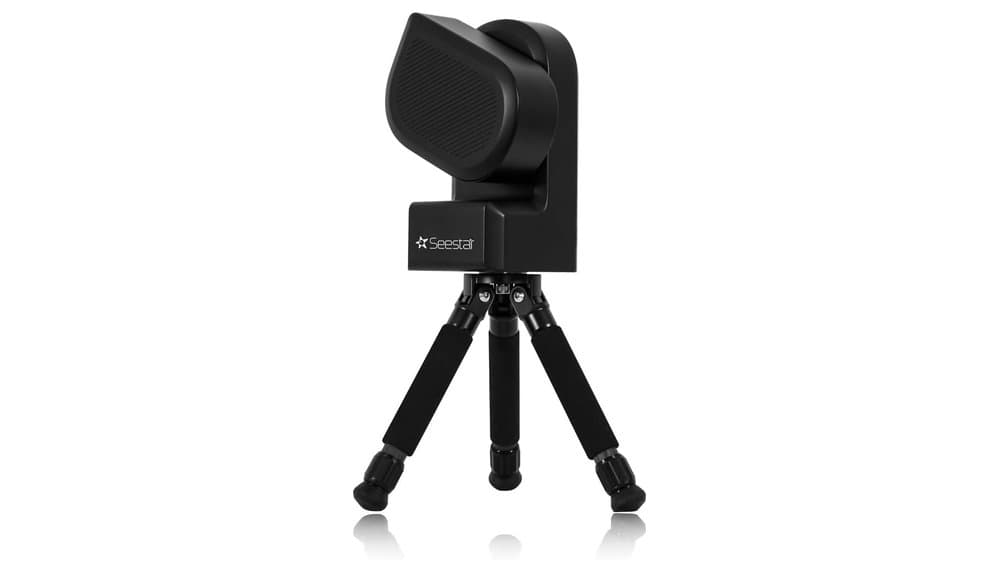
Introduction
The ZWO Seestar S50 Intelligent Telescope is not a traditional optical instrument. It represents a new category of devices: the all-in-one digital telescope. Designed by ZWO, a major player in astrophotography, it promises to democratize access to deep-sky observation by automating the most complex technical processes. For our nature observation-focused website, such a product raises questions: can it truly serve the beginner amateur astronomer or even the curious field observer? We have analyzed its specifications, expert reviews, and community feedback to determine its place in the observation ecosystem.
Strengths
- Revolutionary Simplicity: Setup in a few minutes and an intuitive app make astrophotography immediately accessible.
- All-in-One & Portable Design: Lightweight and compact, it integrates telescope, mount, camera, and battery, ideal for on-the-go sessions.
- Impressive Deep-Sky Results: Capable of capturing nebulae, galaxies, and star clusters with surprising clarity for its format.
- Advanced Automation: Automated GoTo pointing, focusing, tracking, and live stacking.
Weaknesses
- Limited Planetary Capabilities: Its aperture and focal length are not suited for detailed planetary observation.
- Dependence on App and Electronics: The experience is entirely tied to the smartphone and software stability.
- Less Versatile Than a Classic Optical Telescope: It does not allow for direct visual observation at the eyepiece and its use is focused on digital imaging.
Detailed Analysis
Optical Quality and Imaging Performance
The Seestar S50 is built around a 50mm diameter apochromatic (APO) objective lens. According to specifications, this design aims to minimize chromatic aberrations, a crucial point for obtaining sharp, contrast-rich stellar images. The fixed focal length is 250mm (f/5), a bright aperture ratio favorable for capturing faint deep-sky objects.
Unlike traditional instruments, the "scope" does not project light onto an eyepiece, but onto a dedicated digital sensor. It is this sensor, coupled with real-time processing software, that generates the final image. Expert testers note that this optical and electronic combination allows for results that rival, in ease and rendering, far more complex and expensive astrophotography setups. Light transmission and twilight factor, key metrics for binoculars and spotting scopes, are less relevant here; it is the sensor's sensitivity and the efficiency of the software processing that take precedence.
Construction, Ergonomics, and Field Use
Weighing approximately 3 kilograms, the S50 is remarkably portable. Its integrated housing protects it from dust, and its construction seems robust for consumer use. Experts note it requires no additional accessories to function: its internal battery offers up to 6 hours of autonomy, and its integrated tripod is sufficient for quick setup on a table or stable ground. This is a major asset for the observer who wants to enjoy a clear night without heavy logistics.
The ergonomics are entirely dictated by the dedicated mobile app. The interface allows selecting an object from a catalog, and the telescope automatically slews to and tracks it. Live stacking is the flagship feature: the object's image builds up and improves progressively on screen over seconds and minutes, virtually eliminating the need for image processing knowledge.
Use Cases and Versatility
The ZWO Seestar S50 excels in a specific niche: deep-sky and lunar astrophotography for beginners and time-pressed amateurs. It is ideal for someone who wants to discover nebulae or galaxies and quickly share a surprising result without going through hours of setup and post-processing.
Conversely, its utility for other activities in our field is very limited. It is not designed for daytime observation (birdwatching, wildlife), nor for traditional digiscoping. Its minimum focusing distance is not a defined parameter for terrestrial subjects. For the visual astronomer who enjoys directly scrutinizing the sky through an eyepiece, or for the planetary specialist seeking the most detail possible, this instrument will not be the right choice.
Value for Money and Positioning
The Seestar S50 occupies a unique position. Compared to a traditional entry-level telescope, its purchase price may seem high, but it actually includes a quality motorized mount, an astronomy camera, and specialized software. If one were to assemble equivalent performance equipment (excluding ease of use), the cost would be significantly higher.
It positions itself not as a direct competitor to optical telescopes, but as a disruptive alternative solution. For a budget similar to a good mid-range traditional optical setup, the user buys a turnkey experience, at the expense of versatility and the "purity" of visual observation. For its target audience – complete novices or amateurs wanting to simplify their sessions – the community considers the value for money to be excellent.
Technical Specifications
| Characteristic | Detail |
|---|---|
| Type | Intelligent digital telescope (apochromatic lens + sensor) |
| Aperture | 50 mm |
| Focal Length | 250 mm (f/5) |
| Mount | Integrated motorized alt-azimuth, with GoTo and auto-tracking |
| Focusing | Automatic |
| Sensor | Dedicated CMOS sensor (unspecified) |
| Power | Internal battery (approx. 6h autonomy) |
| Connectivity | Built-in Wi-Fi for smartphone app connection |
| Weight | Approximately 3 kg (with integrated tripod) |
| Key Feature | Live stacking (real-time image stacking) |
| Software | Dedicated mobile app (iOS/Android) with object catalogs |
What Users Say
A synthesis of expert reviews and customer feedback reveals a strong consensus, with clear points of satisfaction and identified limitations.
Praise is unanimous on ease of use and immediate satisfaction. Terms like "revolutionary," "magical," and "plug-and-play" come up constantly. Users, especially beginners, are amazed at being able to capture the Orion Nebula or Saturn's rings (even if small) on their first night. Portability is also highly praised, with many highlighting the advantage of being able to take it on vacation to a dark sky site.
The points of frustration or limitation are clearly identified:
- Planets: This is the main compromise. Users expect detailed images of Jupiter or Mars and are disappointed by the small disk the instrument returns. Experts remind that this is simply not its purpose.
- Technological Dependence: Some reports mention app bugs, Wi-Fi connection difficulties, or necessary updates. The experience is at the mercy of the electronics and software.
- Waiting for Processing: While live stacking is a miracle for some, others find the wait time to get a beautiful image (several minutes) a bit long and would prefer instant visual observation.
Overall, the community highly recommends it as a first astrophotography instrument or as a secondary instrument for experienced amateurs who want a quick, hassle-free setup.
Conclusion
The ZWO Seestar S50 Intelligent Telescope is much more than just a telescope. It is a phenomenon of simplification that has succeeded in its goal: making the beauty of the deep sky accessible to everyone, literally with one click. Our objective analysis shows it deliberately sacrifices versatility and high planetary resolution in favor of an integrated, portable, and incredibly gratifying user experience for the novice.
It will not replace the spotting scope of the passionate birder nor the high-end apochromatic telescope of the demanding astronomer. However, for anyone dreaming of starting astrophotography without facing a discouraging technical barrier, or for the amateur who wants a quick and fun window to the cosmos, the Seestar S50 stands out as an extremely convincing and justified option. It redefines expectations for an entirely new category of observers.
100% free and independent — All our articles are written independently, without any sponsorship. We may earn a commission on purchases made through our links, at no extra cost to you.
Articles you might like
Caytail 4K 48MP Hunting Camera Review & Test
In-depth review of the Caytail 4K 48MP trail camera with included SD card. We analyze specs and real user feedback on its true field performance.
Vanguard Endeavor HD65A Spotting Scope Review
Spotting scope with 65mm ED glass & 15-45x zoom for birding & hiking. Balanced performance & portability for serious nature observers.
Carson AdventurePak Kids' Exploration Tool Kit Review
Explore nature with this kid's 5-piece tool kit for outdoor adventure and educational discovery. Perfect for young explorers.
Guides you might like
WiFi Trail Camera Guide
See wildlife discreetly from your couch! Learn how WiFi trail cameras let you monitor animals without disturbance and how to choose the right one.
Ultimate Travel Telescope Guide
Choose a portable, high-performance travel telescope to explore the universe from your backpack without compromising on essential astronomical views.
Ultimate Guide to Night Vision Binoculars
Choose the perfect night vision binoculars: Gen vs. digital? Unravel the tech to make your nighttime wildlife adventures a total success. Guide inside.