Tiiyee HD 40x60 Night Vision Monocular Review
Published on 16 September 2026 · By OptiqueNature
Review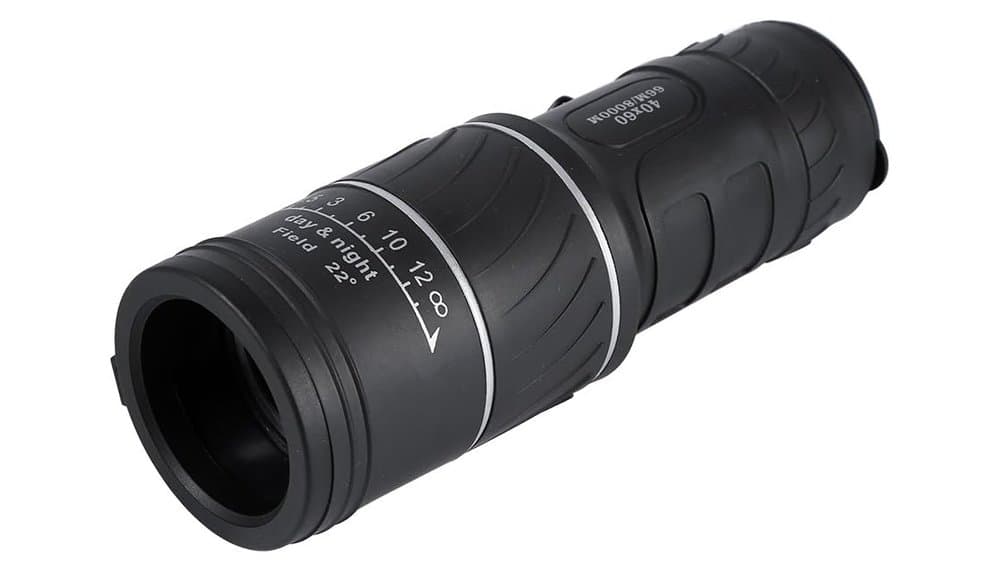
Technical and Practical Analysis of the Tiiyee HD 40x60 Night Vision Monocular Telescope
The market for monoculars is vast, ranging from entry-level instruments to high-end models for demanding observers. The Tiiyee HD 40x60 Night Vision Monocular Telescope clearly positions itself in the budget category, promising versatility, night vision, and durability. In this analysis, we will dissect its advertised specifications and compare them with feedback from the user community and testers to determine its real place in a nature observer's equipment.
Key Strengths
- Asserted Compactness and Light Weight: Its format is unanimously recognized as practical for transport.
- Effective Close Focus Performance: The ability to focus on very close subjects is an asset for garden observation.
- Presence of a BAK4 Prism: On paper, this specification is a guarantee of better light transmission compared to the standard BK7 in budget models.
- Claims of Durability: Waterproofing and a shock-resistant structure are advertised for outdoor use.
Key Weaknesses
- Misleading Magnification Claims: The "40x60" designation is widely considered marketing and does not match real performance.
- Average to Poor Optical Quality at the Edges: Users report a loss of sharpness and contrast at the edges of the image.
- Limited Low-Light Performance: The advertised "night vision" is highly exaggerated; the device struggles at dusk.
- Build Details Below Specifications: The actual objective lens diameter appears to be smaller than advertised.
Detailed Analysis by Feature
Optical Quality and Visual Performance
On paper, Tiiyee relies on a seductive technical argument: BAK4 prism and FMC (Fully Multi-Coated) lens coatings. In theory, this duo should ensure decent light transmission, reducing internal reflections and improving contrast. However, analysis of field feedback is less flattering.
According to testers and users, image quality is mixed. While the center of the image may be acceptable for a product at this price, sharpness drops significantly at the periphery, with a blurring effect and loss of contrast described as "matschig" (mushy) by a German-speaking tester. The advertised field of view (approximately 22° according to markings on the product) is considered quite narrow, which can make tracking birds in flight or quickly finding a subject somewhat less easy compared to equivalent models.
The most controversial point is the magnification. According to the unanimous opinion of amateur experts who have left detailed feedback, the "40x60" designation is absolutely fanciful. A 40x magnification on a 50mm (or even 60mm) objective lens would be unusable hand-held and would produce a very dark and unstable image. In reality, the markings on the monocular itself indicate 12x50, which is a much more credible and typical configuration for a general-purpose monocular. This marketing confusion severely harms the product's credibility.
The night vision, suggested by the name, must be understood with great caution. No light amplification system (intensifier tube) is present. It is merely an optic that, thanks to its theoretical 50mm objective, gathers more light than the naked eye. Feedback confirms that its use in conditions of very low light is very limited, even disappointing.
Build, Ergonomics, and Durability
The Tiiyee HD 40x60 is described as compact, light (approx. 300g), and easy to handle with one hand. Opinions converge on this point: it is a product that easily slips into a backpack or jacket pocket, fulfilling its "pocket" ambition.
The claims of waterproofing and shock resistance are difficult to verify without laboratory tests. No indication of an IP rating (like IPX7) is provided, which casts doubt on the actual level of protection. The quality of materials is perceived as acceptable for the price, but no more. One tester even measured an objective lens diameter of less than 40mm, while the technical sheet mentions 50mm, raising questions about the reliability of the specifications.
An important ergonomic point is the focus. Several users describe it as precise and allowing for a remarkably short minimum focus distance, on the order of 5 meters or less. This characteristic makes it a relevant tool for observing birds near a feeder or insects.
For eyeglass wearers, the eye relief is not clearly specified. Feedback is mixed: some users wearing glasses have not reported major problems, while others noted difficulty seeing the entire field of view or observed more stray reflections.
Synthesized Technical Specifications
| Characteristic | Advertised / Observed Specification | Analysis Notes |
|---|---|---|
| Model Designation | 40x60 (marketing) / 12x50 (engraved on device) | The 40x60 designation is erroneous. The actual configuration is 12x50. |
| Objective Lens Diameter | 50 mm (advertised) / < 40 mm (measured by a tester) | Concerning discrepancy between product sheet and physical reality. |
| Prism | BAK4 | A theoretical positive point for light transmission. |
| Optical Coatings | FMC (Fully Multi-Coated) | The execution quality of coatings is judged as average by users. |
| Field of View | ~22° (according to engraving on device) | Field considered fairly narrow. |
| Minimum Focus Distance | Not specified / < 5 meters (according to feedback) | Practical strong point for close observation. |
| Waterproofing | "Waterproof" advertised | No certified standard mentioned. Caution advised. |
| Dimensions (L x W x H) | Approx. 18 x 7 x 7 cm | Compact and portable format confirmed. |
| Weight | Approx. 300 g | Light, suitable for hiking. |
What Users Say: Summary of Reviews
The 55 global reviews, with an average rating of 3.1/5, paint a contrasting picture where disappointment coexists with relative satisfaction for basic use.
The recurring positive points revolve around reduced size and ease of transport. The good close focus capability is also praised by several. For users with modest expectations – a curiosity for walks, checking a target at 25 meters – the product is sometimes judged "sufficient" or "the perfect low-cost compromise."
The criticisms, however, are more numerous and specific. Lack of sharpness, especially at the edges, and disappointing low-light performance come back as leitmotifs. The feeling of having been misled by the "40x60" and "Night Vision" specifications generates many low ratings and comments like "disappointing," "overhyped," or "do not buy." The overall optical quality is described as "average" by the more demanding testers, who note issues with reflections and mediocre contrast.
A detailed expert review in German summarizes the dilemma well: for a very limited budget, this monocular can serve as a stopgap, but one must accept its limits and not believe the marketing promises.
Conclusion: Who is this Monocular For?
The Tiiyee HD 40x60 Night Vision Monocular Telescope is an ambiguous product. It does not keep its most audacious promises: it offers neither 40x magnification, nor true night vision, nor perfectly sharp optics across the entire field. Its name and initial description create unrealistic expectations that inevitably lead to disappointment.
However, considering it for what it really is – an economical, compact, and light 12x50 monocular – it finds a niche. It may suit a child discovering observation, an occasional hiker wanting a light backup tool in their bag without a significant investment, or a user with a very occasional need for close-up viewing (garden observation, short-distance checks).
For a serious birder, a hunter needing reliable optics at dusk, or an amateur of light astronomy, the optical compromises and questionable claims make it hardly recommendable. In these segments, directing one's budget towards established brands in nature optics, even on entry-level models, will be a much more satisfying long-term investment.
In summary: This monocular is a very low-cost backup accessory with limited performance. Its main asset is its compactness. Its main flaw is a marketing communication that vastly overestimates its real capabilities. The buyer must adjust their expectations accordingly.
100% free and independent — All our articles are written independently, without any sponsorship. We may earn a commission on purchases made through our links, at no extra cost to you.
Articles you might like
Caytail 4K 48MP Hunting Camera Review & Test
In-depth review of the Caytail 4K 48MP trail camera with included SD card. We analyze specs and real user feedback on its true field performance.
Vanguard Endeavor HD65A Spotting Scope Review
Spotting scope with 65mm ED glass & 15-45x zoom for birding & hiking. Balanced performance & portability for serious nature observers.
Carson AdventurePak Kids' Exploration Tool Kit Review
Explore nature with this kid's 5-piece tool kit for outdoor adventure and educational discovery. Perfect for young explorers.
Guides you might like
WiFi Trail Camera Guide
See wildlife discreetly from your couch! Learn how WiFi trail cameras let you monitor animals without disturbance and how to choose the right one.
Ultimate Travel Telescope Guide
Choose a portable, high-performance travel telescope to explore the universe from your backpack without compromising on essential astronomical views.
Ultimate Guide to Night Vision Binoculars
Choose the perfect night vision binoculars: Gen vs. digital? Unravel the tech to make your nighttime wildlife adventures a total success. Guide inside.