SVBONY SV28 100mm Spotting Scope Review
Published on 31 August 2026 · By OptiqueNature
Review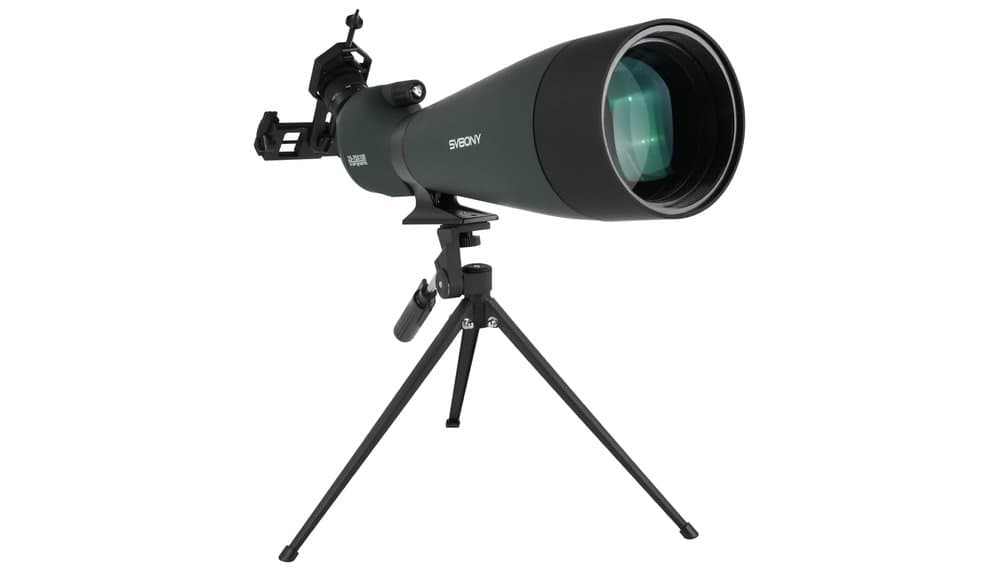
Introduction
In the often expensive world of field optics, the budget segment attracts particular attention. Do manufacturers promise too much for too little, or do they manage to deliver valid instruments without breaking the bank? Today, we examine a product that embodies this question: the Line 1: SVBONY SV28 100mm Spotting Scope. This model, frequently sold as a kit with a tripod and smartphone adapter, aims to be a versatile tool for nature observation and more. We will dissect its specifications, compare its promises with real-world feedback, and determine for whom this spotting scope is a wise choice.
Strengths & Weaknesses
Strengths
- Excellent value for money for a complete setup (scope, tripod, adapter).
- Large 100mm aperture offering significant light-gathering potential on paper.
- Overall robust build with a rubber armor and a sense of decent finish for its segment.
- Claimed versatility of use, from birdwatching to basic astronomy and sport shooting.
- Included zoom eyepiece (25-75x) covering a wide magnification range.
Weaknesses
- Limited optical performance at high magnifications, with sharpness significantly degrading towards 75x.
- Claim of maximum magnification (75x) deemed misleading by many users, the actual perceived magnification often being much lower.
- Basic quality included accessories: tripod often described as unstable and smartphone adapter poorly designed.
- Lens and eyepiece covers reputed not to stay in place properly.
- Very small exit pupil diameter at high magnifications, making observation uncomfortable.
Detailed Analysis of the SVBONY SV28 100mm
Optical Quality: Theory vs. Field Reality
On paper, the SV28's specifications are enticing for its price. The 100mm objective lens is its main selling point. The theoretical relative brightness factor is high, and the twilight factor suggests respectable performance in low light. The use of a BAK-4 Porro prism and FMC (Full Multi-Coated) treatment on the lenses is standard for the segment, aiming to maximize light transmission and contrast.
However, analysis of user feedback and expert tests reveals a gap between theory and practice. The community agrees that the image is adequately bright and contrasted at low to medium magnifications (up to about 40x). This is where the product is most pleasant to use for general observation.
The major problem arises with the zoom ring. According to user feedback, the advertised maximum magnification of 75x is excessively optimistic. One tester states: "if I accept that the minimum is x25, then the maximum is x40 or thereabouts." Even when reaching this real magnification, sharpness drops drastically, the image becomes soft, and chromatic aberrations (color fringing on contrasts) can become pronounced. This is explained by the absence of ED (Extra-low Dispersion) glass and the inherent limitations of a budget optical system pushed to its extremes. The exit pupil, which is about 4mm at 25x (100/25), drops to a tiny 1.3mm at the theoretical 75x, explaining the sensation of a dim image and the critical eye positioning at this level.
The advertised field of view (78-39 feet at 1000 yards) is typical for a zoom in this category. It is neither particularly wide nor restrictive, but remains usable for spotting.
Build, Weatherproofing, and Ergonomics
The build quality is often cited as a positive point. The rubber armor offers a good grip and protection against minor shocks. The 45-degree angled eyepiece is preferred for prolonged observation, especially for astronomical observation or from a fixed position, as it avoids having to place one's head in line with the tube.
Regarding waterproofing and fogproofing, the manufacturer claims them, but reviews do not allow for long-term verification under extreme conditions. The design seems sufficient nonetheless to withstand common weather (light rain, humidity).
Ergonomics are mixed. The focus wheel is precise but requires very fine movements, especially at high magnification. The zoom ring is described as firm and pleasant. The adjustable twist-up eyecup is an appreciated plus, allowing eyeglass wearers to enjoy the full field of view. On the other hand, the weight of 1683 grams (scope alone around 1.5kg) makes it an instrument to be mounted on a tripod rather than carried by hand over long distances.
The minimum focusing distance is not specified in the provided specs, but users do not report it as a problematic point for terrestrial observation.
Included Accessories and Compatibility
This is a crucial point for the SV28, sold as a "kit." Feedback is clear: the included tripod is unanimously considered the weak link. Too light, unstable, and often of insufficient height for standing observation, it forces the majority of serious users to acquire another one. This directly affects the perception of the "good deal."
The smartphone adapter is the other problematic accessory. Many reviews describe it as "catastrophic," "difficult to install," and "poorly designed." The main complaint is that it often attaches to the focus ring, causing it to turn with the phone, making digiscoping (photo/video) very cumbersome.
The mention of "compatible with cameras" should be interpreted with caution: it requires a specific adapter not included. Digiscoping remains possible with the smartphone mount, but requires patience and meticulous adjustments, and will never be as convenient as with a dedicated, higher-quality system.
Typical Use Cases
- Birdwatching / Wildlife Observation: Suitable for beginners or very occasional use, mainly at low to medium magnifications. The demanding observer will be frustrated by the lack of resolution and detail on plumage at a distance.
- Sport Shooting: This is one of its best applications, according to users. For checking hits at 50m or 100m, the optical quality around 30-40x is sufficient and the value for money is then perceived as very good.
- Hiking / Field Observation: Its moderate weight allows it to be carried, but its size remains substantial. It's a compromise.
- Basic Astronomy: Allows observation of the Moon with interesting details (craters) at medium magnifications. For planets, the optical limits will be quickly reached.
- Digiscoping: Possible, but complicated and unpredictable with the provided adapter. Results will be modest.
Technical Specifications
| Characteristic | Specification for the SVBONY SV28 100mm |
|---|---|
| Objective Diameter | 100 mm |
| Magnification | 25 - 75x (continuous zoom) |
| Eyepiece | Integrated 25-75x zoom, 45° angled |
| Prism Type | Porro BAK-4 |
| Optical Coatings | FMC (Full Multi-Coated) |
| Field of View | 78 - 39 ft @ 1000 yds |
| Exit Pupil | 4.0 - 1.3 mm (theoretical) |
| Eyepiece Diameter | 21 mm |
| Eye Relief | 14-16 mm |
| Focusing | Manual |
| Eyecup | Adjustable twist-up eye relief |
| Waterproof | Claimed |
| Fogproof | Claimed |
| Armor | Rubber |
| Weight | Approx. 1683 g (with accessories) |
| Included Accessories | Table tripod, smartphone adapter, case, cleaning cloth |
What Users and Experts Say
The synthesis of nearly 4000 customer reviews and available expert analyses online paints a clear consensus.
Praise mainly focuses on perceived value. Phrases like "unbeatable value for money," "excellent for the price," or "does the job perfectly for shooting" constantly recur. Satisfied users are those who have calibrated their expectations according to the very low price. They praise the sturdier-than-expected build, the adequate brightness for standard daytime use, and having a complete kit to get started.
Criticisms are also very recurrent and targeted:
- The 75x magnification is considered "fictitious" or unusable. Sharpness collapses well before. The useful range is between 25x and 40-50x maximum.
- The accessories are of poor quality. The tripod is described as "unstable" and "awful." The smartphone adapter is regularly called a "catastrophe" and difficult to use.
- The protective lens/eyepiece covers do not stay on, an annoying detail often mentioned.
- Focusing requires great delicacy, especially at high magnification, and eye positioning is critical to avoid vignetting.
Web experts confirm this analysis, positioning the SV28 as an absolute entry-level choice. They emphasize that it is a very accessible entry point to try out an activity, but one must be prepared to accept its optical and mechanical limits. They often compare it to the brand's higher-end models (like those with ED glass) which offer much better sharpness and aberration control, for a more significant investment.
Conclusion
The Line 1: SVBONY SV28 100mm Spotting Scope is a product that perfectly illustrates the inherent compromise in the budget segment. It is an entry-level spotting scope that surprises with its robust build and versatility, but quickly reminds you of its limits when you push its capabilities.
Our analysis leads to an unequivocal conclusion: it is a wise purchase only if your expectations are perfectly aligned with what it can offer. It excels as a first instrument for short/medium-range sport shooting, or for very occasional naturalist observation without pretense. The buyer must consider the tripod and smartphone adapter as basic bonuses and be ready to replace them for serious use.
On the other hand, for the regular birdwatcher, the digiscoping photographer, or the amateur demanding optical detail, its shortcomings at high magnifications and the mediocre quality of its accessories will quickly become frustrating. In that case, it would be wiser to consider a mid-range model, possibly with a smaller objective but better optical quality (ED glass).
In summary, the SVBONY SV28 100mm is not an excellent spotting scope, but it can be an excellent first spotting scope on a tight budget, provided it is used within its optical comfort zone and its accessories are seen as a starting point rather than a definitive solution.
100% free and independent — All our articles are written independently, without any sponsorship. We may earn a commission on purchases made through our links, at no extra cost to you.
Articles you might like
Caytail 4K 48MP Hunting Camera Review & Test
In-depth review of the Caytail 4K 48MP trail camera with included SD card. We analyze specs and real user feedback on its true field performance.
Vanguard Endeavor HD65A Spotting Scope Review
Spotting scope with 65mm ED glass & 15-45x zoom for birding & hiking. Balanced performance & portability for serious nature observers.
Carson AdventurePak Kids' Exploration Tool Kit Review
Explore nature with this kid's 5-piece tool kit for outdoor adventure and educational discovery. Perfect for young explorers.
Guides you might like
WiFi Trail Camera Guide
See wildlife discreetly from your couch! Learn how WiFi trail cameras let you monitor animals without disturbance and how to choose the right one.
Ultimate Travel Telescope Guide
Choose a portable, high-performance travel telescope to explore the universe from your backpack without compromising on essential astronomical views.
Ultimate Guide to Night Vision Binoculars
Choose the perfect night vision binoculars: Gen vs. digital? Unravel the tech to make your nighttime wildlife adventures a total success. Guide inside.