SVBONY SA401 APO Spotting Scope Review
Published on 13 August 2026 · By OptiqueNature
Review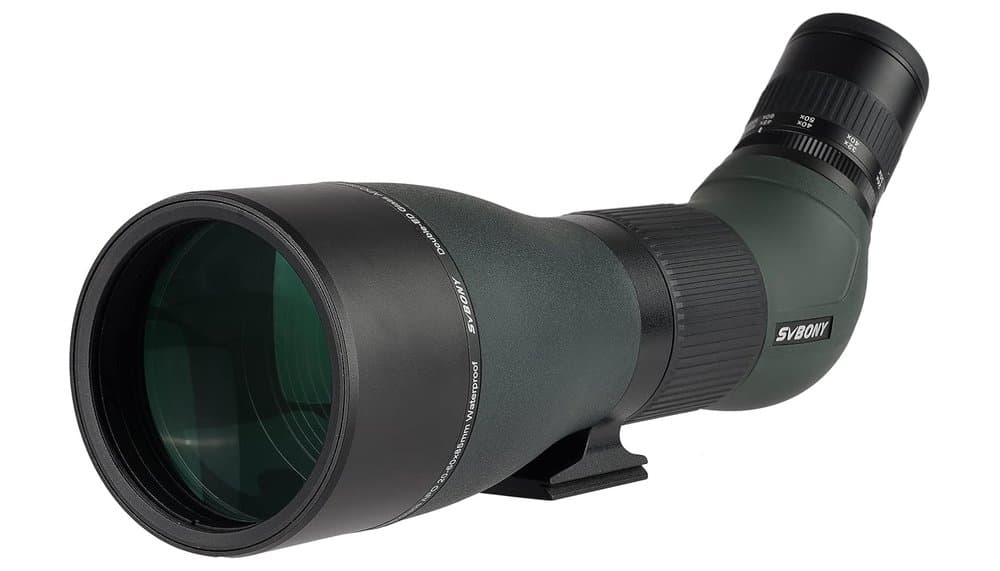
Analysis of the SVBONY SA401 APO 20-60x85mm Spotting Scope
Introduction
In the demanding world of nature observation, the spotting scope is a precision tool. The SVBONY SA401 APO 20-60x85mm presents itself as an ambitious instrument, offering apochromatic (APO) optics at a generally accessible price point. We analyze its performance, design, and value for money based on its technical specifications, community feedback, and market expectations.
Strengths
- Apochromatic (APO) Optics: The optical system, including ED (Extra-low Dispersion) glass lenses, promises superior chromatic correction, limiting color fringing and offering remarkable sharpness.
- Zoom Versatility: The 20-60x zoom covers a wide range of situations, from wide-field scanning to detailed observation of distant subjects.
- Robustness and Weatherproofing: Waterproof (IPX6) and fog-proof construction ensures reliable use in all weather conditions.
- Perceived Value for Money: User feedback unanimously highlights that the optical performance exceeds expectations for its price segment.
Weaknesses
- Significant Minimum Focus Distance: With a reported minimum focus distance of 7.5 meters, it is less suited for observing very close subjects (insects, small birds at close range).
- Demanding Focus Ring: Some users note that the focus ring can be a bit stiff and has a long throw, which, while favoring millimeter precision, can slow down rapid adjustments.
- Weight and Bulk: At 2.19 kg with an 85mm diameter tube, this is an instrument that requires a stable tripod and is not designed for lightweight hiking.
Detailed Analysis
Optical Quality and Performance
The heart of the SA401 APO is its apochromatic optical system. According to the specifications, it integrates ED glass and Fully Multi-Coated (FMC) treatments. This combination aims to maximize light transmission and minimize chromatic aberration, a common flaw in entry-level models.
User feedback confirms this ambition. Recurring terms are "sharp images", "bright", "contrasty" and "no chromatic aberration". One tester even reports that the image quality rivals that of premium brand instruments, like Zeiss, in natural light conditions. The 85mm objective diameter is a major asset for brightness, especially in low light (dusk), offering a generous exit pupil (from 4.25mm at 20x to 1.4mm at 60x). This translates into a clear and usable image even at maximum magnification during the day.
The 20-60x zoom range is practical, but as is often the case, image quality is optimal in the lower half of the range (20-40x). Users note that even at 60x, the image remains usable in full light, which is a sign of quality in optics manufacturing and lens coatings.
Build and Ergonomics
The build is described as solid, with a rubber armor providing a good grip. The helicoid focus wheel is precise, although some find it a bit firm. Its long throw is a technical choice that allows for very fine focusing, appreciated for digiscoping or astronomical observation.
Its IPX6 waterproofing makes it resistant to the elements, a must for birdwatchers or hunters. The integrated telescoping sunshade is a practical detail to avoid glare. The eyepiece is detachable and uses a standard interface, theoretically allowing the use of other eyepieces with adapters (like the mentioned SA406), thus broadening its uses, particularly towards astronomy.
Field Use
- Birdwatching and Nature Observation: Its strong point. The brightness and sharpness allow for distinguishing plumage details even at a distance. The minimum distance of 7.5m can be a limitation for observing very discreet birds at close range.
- Digiscoping: The APO optical quality and fine focus make it a serious candidate. The presence of a standard threaded ring allows mounting adapters for smartphones or compact cameras.
- Light Astronomy: Users are unanimous: the Moon is "brilliant" and details are "sharp". Some even report having distinguished Jupiter's equatorial bands and observed the Orion Nebula, confirming its capabilities in planetary and deep-sky astronomy with a suitable eyepiece.
- Hiking: Its weight (2.2 kg) and size make it a sedentary instrument. Transport is possible, but it requires a robust tripod to be fully exploited, which further adds weight to the kit.
Comparison with the Competition
Positioned in the mid-range segment, the SA401 APO stands out for its "APO" approach at a contained price. Compared to entry-level models (without ED/APO), it clearly outperforms in resolution and chromatic correction. Compared to major premium names (Kowa, Swarovski, Zeiss), it offers, according to users, 80 to 90% of the performance for a fraction of the price. It likely sacrifices on ultra-light transmission, extreme eye comfort (high-index glass), and ergonomic finesse, but constitutes an excellent compromise for the demanding enthusiast.
Technical Specifications
| Feature | Detail |
|---|---|
| Model | SVBONY SA401 APO |
| Objective Diameter | 85 mm |
| Magnification | 20-60x (continuous zoom) |
| Optical Type | Apochromatic (APO) system with ED glass |
| Coatings | Fully Multi-Coated (FMC) |
| Prism | Porro prism |
| Field of View | Not precisely specified (to be determined at 20x and 60x) |
| Minimum Focus Distance | ~7.5 meters (according to feedback) |
| Waterproofing | IPX6 (weatherproof) |
| Filling | Nitrogen / Fog-proof |
| Focus Type | Manual helicoid wheel |
| Eyepiece Diameter | Detachable, standard interface (SA406 adapter for 1.25" eyepieces) |
| Threading | Standard threading for tripod/photo adapter |
| Weight | 2.19 kg (scope only) |
| Dimensions (L x W x H) | ~38 x 18 x 14 cm |
What Users Say
A synthesis of customer reviews and online expert feedback paints a very favorable consensus.
Recurring positive points are:
- Exceptional optical quality for the price: This is the recurring theme. Users employ terms like "brutal", "impressive", "rivals much more expensive products".
- Absence of chromatic aberration: The APO promise is kept. Color fringing (purple/green) on high-contrast edges is almost non-existent, even at high magnification.
- Brightness and sharpness: The 85mm objective and FMC coatings offer a clear, bright, and sharp image "edge to edge", even in low-light conditions.
- Versatility: Its use is appreciated for both daytime birdwatching and light astronomy with a suitable adapter.
Mentioned negatives or limitations:
- Focus: The ring is sometimes described as too stiff or having a too long throw, which can slow down the rapid acquisition of a moving subject.
- Weight and need for a stable tripod: This is obvious for such an instrument, but it is emphasized: vibrations are amplified at high magnification, requiring a quality support.
- Minimum focus distance: 7.5 meters is a significant distance that can limit some close-range nature observation uses.
Conclusion
The SVBONY SA401 APO 20-60x85mm presents itself as a disruptor in the spotting scope market. It is not perfect: its focus ergonomics could be smoother and its weight makes it a rather sedentary instrument. However, its main argument is undeniable: it offers superior-level optical quality at an affordable price.
For the demanding nature observer, the beginning digiscoping photographer, or the astronomy enthusiast looking for a versatile and high-performing alternative without breaking the bank, this model is a serious and very well-argued option. User feedback, almost unanimous on image fineness and chromatic correction, confirms that Svbony has succeeded with this SA401 APO in creating an instrument that commands respect and redefines expectations in its price category. It is a wise investment for those who prioritize pure optical performance.
100% free and independent — All our articles are written independently, without any sponsorship. We may earn a commission on purchases made through our links, at no extra cost to you.
Articles you might like
Caytail 4K 48MP Hunting Camera Review & Test
In-depth review of the Caytail 4K 48MP trail camera with included SD card. We analyze specs and real user feedback on its true field performance.
Vanguard Endeavor HD65A Spotting Scope Review
Spotting scope with 65mm ED glass & 15-45x zoom for birding & hiking. Balanced performance & portability for serious nature observers.
Carson AdventurePak Kids' Exploration Tool Kit Review
Explore nature with this kid's 5-piece tool kit for outdoor adventure and educational discovery. Perfect for young explorers.
Guides you might like
WiFi Trail Camera Guide
See wildlife discreetly from your couch! Learn how WiFi trail cameras let you monitor animals without disturbance and how to choose the right one.
Ultimate Travel Telescope Guide
Choose a portable, high-performance travel telescope to explore the universe from your backpack without compromising on essential astronomical views.
Ultimate Guide to Night Vision Binoculars
Choose the perfect night vision binoculars: Gen vs. digital? Unravel the tech to make your nighttime wildlife adventures a total success. Guide inside.