SPORTARC Night Vision Monocular Test & Review
Published on 25 March 2026 · By OptiqueNature
Review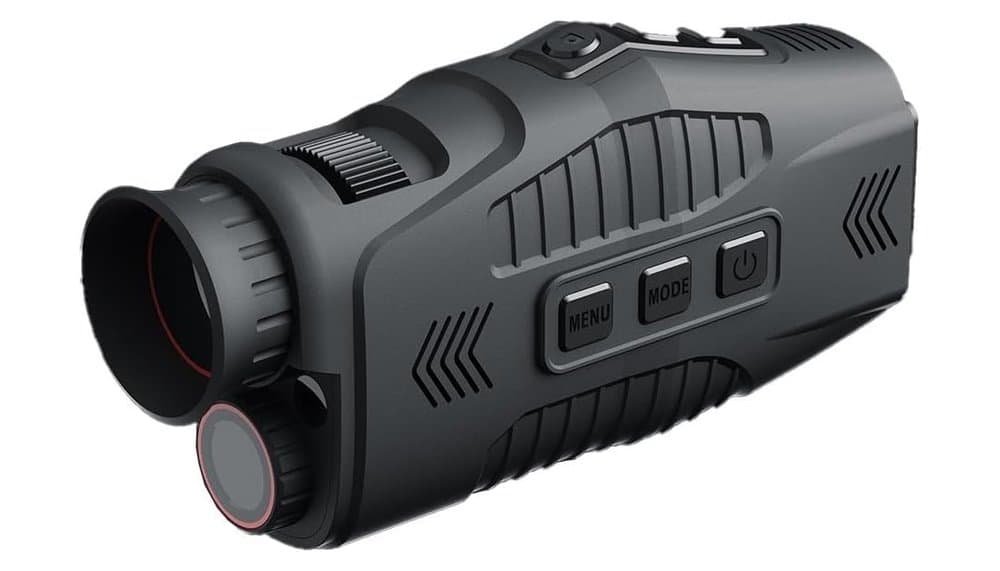
Introduction
The SPORTARC Night Vision Monocular Device presents itself as a compact and affordable digital night vision device. In a natural optics market where low-light performance is paramount, this type of product attracts the attention of night hikers, wildlife observers, and beginner astronomy enthusiasts. We will dissect this equipment to understand what it truly offers. Our analysis is based exclusively on its detailed technical specifications and on feedback from users who have tested the product in the field. The goal is to determine if its promises (800 meters of range, 1080P) hold up to practical examination and what its positioning is compared to traditional optical offerings.
Strengths
- Asserted Compactness and Lightness: Weighing only 100 grams with reduced dimensions, its design is clearly aimed at extreme portability.
- Integrated Aiming Functionality: A laser pointer or reticle (according to reviews) can be projected, offering utility for spotting or, with an adapter, for use on a Picatinny-type platform.
- Claimed Ease of Use: The controls are described as simple, and the device is presented as suitable for beginners, with quick familiarization.
- Battery Life and Capture Versatility: The device integrates a battery, records photos and videos to a microSD card, functioning as an all-in-one system.
Weaknesses
- Image Quality in Real Conditions: User feedback indicates resolution and sharpness below the expectations generated by the paper specifications, with notable degradation when using digital zoom.
- Very Narrow Field of View: A 10° field of view is extremely restricted for nature observation, making locating and tracking objects or animals difficult.
- Uncertain Construction and Sealing: No mention is made of a waterproof certification or fogproof nitrogen purging, which is a serious question mark for use in damp outdoor conditions.
- Disappointment with Effective Range: The promise of 800 meters of vision in total darkness is tempered by users, who report a practical observation distance much lower, especially without an external infrared source.
Detailed Technical and Practical Analysis
Optical Quality and Low-Light Performance
Here, we leave the realm of traditional glass and prism optics and enter that of digital. The SPORTARC is not a light amplification scope (generation 1, 2, or 3) but a digital camera system coupled with an infrared illuminator.
- Sensor and Lens: The lens has a diameter of 24 mm and an aperture of F/1.2, which is theoretically very bright. The sensor produces 960P (1280x960) video and photos up to 10 megapixels (by interpolation). However, the small size of the sensor and lens fundamentally limits the amount of light collected. Testers emphasize that the image becomes noisy and lacking in detail in conditions of very low brightness.
- Light Transmission and "Twilight Factor": These classic optical concepts do not apply directly. Performance depends on the sensitivity of the electronic sensor and the power of the integrated IR illuminator (3W, 850nm). It is this IR projector, invisible to the naked eye but detected by the sensor, that illuminates the scene in total darkness. Its real range is well below the advertised 800m, as confirmed by users.
- Zoom and Field of View: The 10x zoom is digital. This means it enlarges the central image from the sensor while severely degrading the resolution. Coupled with a 10° field of view (for comparison, a standard pair of binoculars often offers 60 to 70°), the observation experience is very "tunnel-like" and poorly suited to scanning a landscape or tracking a moving animal.
- Eyepiece and Observation Comfort: The screen is a 1.54" TFT. The eye-relief is not specified, but screens are generally tolerant for eyeglass wearers. The limited resolution of the screen and the potential image lag can cause eye strain during prolonged observation.
Construction, Ergonomics, and Durability
- Robustness: The housing is made of ABS, a resistant technical plastic that does not suggest high-end construction. No indication of nitrogen filling or certified sealing gaskets (like an IPX rating) is provided. For an activity in the great outdoors, this is a major handicap against moisture, mist, or dust.
- Ergonomics: Its lightness is an asset for transport. The controls seem grouped and accessible. However, the manual operation of the focus, coupled with the sensitivity of the digital zoom, requires an adaptation period to obtain a clear image.
Use Cases: For Whom and For What?
- Nocturnal Wildlife Observation: Limited. The narrow field and low-light image quality make it poorly suited for observing elusive wild animals or enjoying a natural scene. It can be used to check for the presence of an animal at short distance (a few tens of meters) around a campsite, but not for qualitative observation.
- Hiking / Nighttime Safety: Useful for navigating on a very dark trail, checking a nearby noise, or reading a map. Its compactness is a real plus here.
- Basic Astronomy: Very limited. It may provide a coarse view of the Moon, but the low resolution and lack of a stable mount do not allow for serious planetary or stellar observation.
- Digiscoping: This is an intrinsic concept of the device, as it directly captures photos and videos. However, the quality will be that of a small, low-sensitivity action camera, well below a smartphone coupled with a quality optical scope.
- Use as a Sight: The presence of a red dot or reticle (confirmed by a user) and its advertised compatibility with air or hunting weapons (with an adapter) make it a hybrid product. This is probably one of its most concrete usage points for a certain clientele, despite an accuracy that will not rival a dedicated optical sight.
Synthesized Technical Specifications
| Feature | SPORTARC Night Vision Monocular Detail |
|---|---|
| Type | Digital night vision monocular with electronic sensor + IR illuminator |
| Video Resolution | 960P @ 30 fps (1280 x 960) |
| Photo Resolution | Up to 10 MP (interpolated) |
| Zoom | Digital zoom 10x |
| Lens | Diameter: 24 mm, Aperture: F/1.2, Field of view: 10° |
| Screen | 1.54-inch TFT |
| Advertised Range | Up to 800 m (in total darkness with IR) |
| IR Illuminator | 3W, wavelength 850 nm (faintly visible red light) |
| Focus | Manual |
| Storage | microSD card (up to 128 GB) - not included |
| Power Supply | Integrated lithium-ion battery (charges via Mini USB) |
| Construction | ABS plastic housing |
| Weight | 100 g |
| Dimensions (LxHxD) | Approximately 120 x 150 x 60 mm |
| Special Features | Photo/video capture, reticle/red dot, video playback. |
What Users Say: Summary of Feedback
Customer reviews, although few, draw a fairly clear consensus on the product's real strengths and limitations.
Recurring Positive Points:
- Several users confirm the compactness and practicality of the device.
- The unexpected functionality of the laser pointer/reticle is praised, adding value for spotting.
- In "restlicht" (residual light) conditions, some find it effective at short distance.
- The ease of use is mentioned.
Frequent Criticisms and Disappointments:
- The effective range is much lower than the advertised 800 meters. One user notes that "you can't see very far" in infrared mode.
- The image quality is considered mediocre, especially when digital zoom is used. Images lack detail and sharpness.
- The very narrow field of view is a handicap for observation.
- The English manual is sometimes missing or unclear.
- The general impression is that of a product with "theoretical" specifications that are overstated, but which can be useful for simple, short-range applications.
Conclusion: A Supplementary Tool with Limited Scope
The SPORTARC Night Vision Monocular Device is not an optical observation instrument in the traditional sense. It should be seen as a compact digital camera-sight equipped with an infrared projector.
Its main asset is its multi-format nature: it combines in a single lightweight object a basic night vision tool, a recorder, and a pointer. This may suffice for very specific needs: checking a noise at the bottom of the garden at night, guiding oneself on an ultra-light hike, or using it as an economical sight for recreational shooting activities.
However, for the demanding nature observer, its limitations are prohibitive. The disappointing image quality, the catastrophically narrow field of view, and the presumed lack of waterproofing place it well below the performance of a simple pair of binoculars with a good twilight factor, let alone an entry-level light amplification monocular.
Our Verdict: This product finds its place as a low-cost utility gadget for occasional, short-distance uses. It will appeal to those seeking above all compactness and basic "multitasking" functionality. On the other hand, for any serious activity involving wildlife observation, astronomy, or use in damp conditions, it is better to direct one's budget, even a modest one, towards proven quality classic optics. The technical promises on paper do not withstand the constraints of the field, confirming that in the realm of optics, electronic specifications cannot replace the quality of lenses and suitable optical design.
100% free and independent — All our articles are written independently, without any sponsorship. We may earn a commission on purchases made through our links, at no extra cost to you.
Articles you might like
Caytail 4K 48MP Hunting Camera Review & Test
In-depth review of the Caytail 4K 48MP trail camera with included SD card. We analyze specs and real user feedback on its true field performance.
Vanguard Endeavor HD65A Spotting Scope Review
Spotting scope with 65mm ED glass & 15-45x zoom for birding & hiking. Balanced performance & portability for serious nature observers.
Carson AdventurePak Kids' Exploration Tool Kit Review
Explore nature with this kid's 5-piece tool kit for outdoor adventure and educational discovery. Perfect for young explorers.
Guides you might like
WiFi Trail Camera Guide
See wildlife discreetly from your couch! Learn how WiFi trail cameras let you monitor animals without disturbance and how to choose the right one.
Ultimate Travel Telescope Guide
Choose a portable, high-performance travel telescope to explore the universe from your backpack without compromising on essential astronomical views.
Ultimate Guide to Night Vision Binoculars
Choose the perfect night vision binoculars: Gen vs. digital? Unravel the tech to make your nighttime wildlife adventures a total success. Guide inside.