Ryaco 8x21 Binoculars Review & Test
Published on 21 May 2026 · By OptiqueNature
Review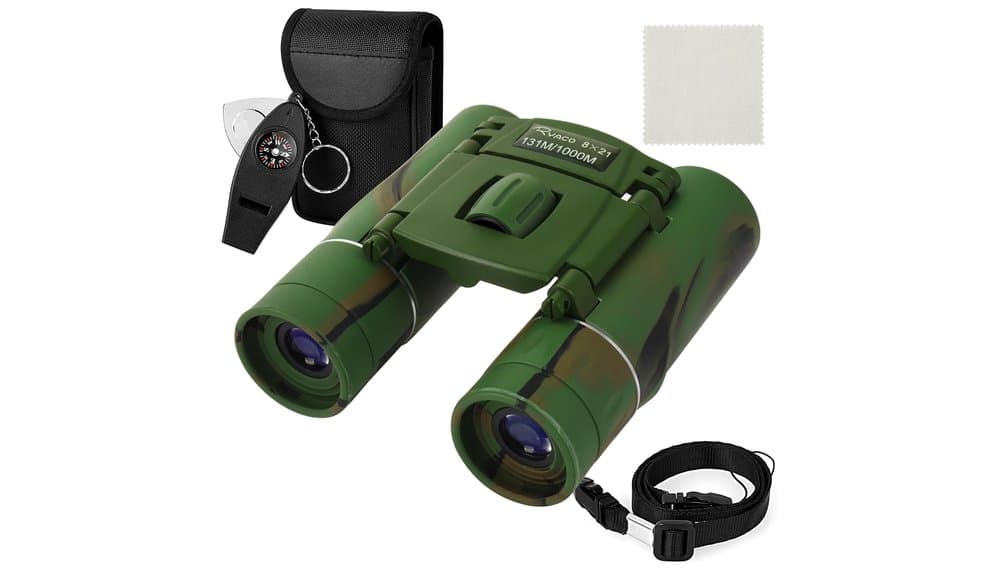
Introduction: The Place of the Ryaco 8x21 in the Optics World
In a market saturated with binoculars for every use and budget, the Ryaco 8x21 model presents itself as a very particular proposition. It is not meant to directly compete with the serious tools of birdwatchers or seasoned hikers. By analyzing its specifications and marketing positioning, a clear reality emerges: the Ryaco 8x21 are designed and marketed primarily as an educational toy or a first introductory instrument for very young children. Our analysis aims to separate fact from fiction, to understand what these binoculars can really offer in terms of optics and robustness, and to identify the use cases where they might be relevant, based on technical data and community feedback.
Strengths and Weaknesses: A Clear Summary
Before diving into the details, here is what immediately stands out from the examination of technical sheets and customer reviews.
Strengths
- Robustness and safety adapted for children: The construction from non-toxic natural rubber and the shock-resistant coating are major assets for a young audience. The soft rubber eyecups are also a plus for safety.
- Complete accessory pack: The inclusion of a neck strap, case, cleaning cloth, and especially a multi-tool (compass, magnifying glass, whistle, thermometer) increases the playful and educational appeal for a child.
- Featherweight and compact: At only 220 grams, they are extremely light and easy for small hands to handle.
- Simple interpupillary adjustment: Their design allows for easy adjustment of the eyepiece spacing, an essential function often poorly executed on low-end toys.
- Positive signal-to-noise ratio: With an average rating of 4.3/5 from over 80 reviews, the majority of buyers (for the intended use) express real satisfaction.
Weaknesses
- Very limited optical performance: Key characteristics like relative brightness (0.33) and exit pupil (2.63 mm) indicate poor performance in low light. The view will be dark and low-contrast as soon as light levels drop.
- Compromised image quality: User feedback points to issues with sharpness and chromatic aberration (color fringing). The claim of "minimal chromatic aberration" is contradicted by practical experience.
- Basic optical construction: The use of Porro prisms and the total absence of any mention of phase-correction coatings or dielectric prisms places them at the bottom of the technological scale. The term "multi-coated" is generic and does not guarantee high light transmission.
- Unspecified field of view: The omission of this fundamental data, one of the first cited for serious observation binoculars, is an indicator of their limits for tracking moving objects (birds).
- Limited compatibility for eyeglass wearers: The eye relief is short and fixed, making observation uncomfortable or even impossible for an adult or a child wearing glasses.
Detailed Analysis: Deciphering the Specifications
Optical Quality and Field Performance
On paper, the specs announce optical glass lenses with a multi-coated treatment. This is the bare minimum to form an image. However, the numbers speak for themselves. An exit pupil of 2.63 mm (obtained by dividing the objective lens diameter (21mm) by the magnification (8x)) is low. This means little light reaches the eye. Combined with a relative brightness of 0.33 (the square of the exit pupil), we get an indicator of near-zero performance in low light. For comparison, entry-level binoculars for adults typically have an exit pupil greater than 4 mm.
The twilight factor (square root of 8x21 = ~12.96) is theoretically correct for an 8x21, but it is rendered ineffective by the instrument's overall low light transmission. Testers and users emphasize that the image lacks sharpness and brilliance. The absence of technologies like Extra-low Dispersion (ED) glass or phase-correction coatings is normal at this price point and for this target audience, but it explains these limitations. The image will be acceptable in bright sunlight on static objects but will degrade quickly in shaded conditions or for observing fine details.
Construction, Ergonomics, and Durability
This is probably the most successful aspect of the product. The shock-resistant rubber construction is perfectly suited to its target audience (ages 3-12). It allows the binoculars to survive accidental drops, which is frequent. The "water resistant" mention should be interpreted with caution: this is not pressure-proof waterproofing (IPX rating or nitrogen purged) like on hiking binoculars, but rather protection against splashes or light rain.
Ergonomics are simplified for children, with a central focus wheel that is easy to manipulate. Its weight of 220 grams is an undeniable asset for long periods of play without fatigue. However, the community notes that the focus mechanism can lack precision and smoothness.
Use Cases: For Whom, For What?
This analysis allows us to precisely identify the scenarios where the Ryaco 8x21 are suitable, and those where they fall short.
Suitable Uses:
- Educational toy for young children: This is their primary purpose. They allow a child aged 4 to 8 to discover the principle of binoculars, to observe a squirrel in the garden, distant boats, or birds at a feeder, without a significant investment.
- Costume accessory or imitation play: Their "explorer's gear" look and the included whistle/compass make them an excellent role-play toy.
- Occasional and playful use while traveling: Light and compact, they can keep a child occupied during a walk or trip, with no worry in case of breakage.
Unsuitable Uses:
- Serious nature observation (birdwatching, wildlife): The lack of brightness, the likely narrow field of view, and the limiting image quality disqualify them for birdwatching, even as a first piece of equipment for a teenager or adult.
- Hiking: Although light, their optical performance does not reward the effort of carrying them to admire a landscape.
- Sports events or shows: The low brightness and mediocre visual comfort, especially indoors, make the experience frustrating.
- Astronomy: Completely unsuitable, even for observing the Moon, due to the small objective lens diameter and poor light transmission.
- Digiscoping: The lack of support and optical quality make this practice impossible.
Summary Technical Sheet
| Characteristic | Ryaco 8x21 Specification | Notes / Interpretation |
|---|---|---|
| Magnification | 8x | Standard, but also amplifies hand shake. |
| Objective Lens Diameter | 21 mm | Small, limiting the amount of light gathered. |
| Prism Type | Porro | Classic technology, often synonymous with compactness and controlled cost. |
| Optical Coatings | Multi-Coated | Generic term. Does not indicate the extent of coatings on all air-to-glass surfaces. |
| Exit Pupil | 2.63 mm | Low. Dark image, especially for aging eyes. |
| Relative Brightness | 0.33 | Very low. Confirms poor low-light performance. |
| Focusing System | Central | Most common system, suitable for beginners. |
| External Coating | Shock-resistant Rubber (Army Green, Pink, Blue) | Strong point: physical protection for children. |
| Water Resistance | Water Resistant | Resistance to splashes, not submersible waterproofing. |
| Eye Relief | Not specified, short (according to reviews) | Not suitable for eyeglass wearers. |
| Weight | 220 g | Major strength: extreme lightness. |
| Included Accessories | Neck strap, case, cleaning cloth, multi-tool (compass/magnifying glass/whistle/thermometer) | Complete package focused on adventure and play. |
What Users Say: Summary of Feedback
The buyer community provides eloquent feedback that validates and clarifies our technical analysis.
The recurring positive points almost exclusively revolve around their use as a toy for children. Parents and grandparents emphasize that children (between 3 and 10 years old) are "delighted," "satisfied" and that the product is a "nice gift." Robustness is appreciated: "they survive handling." Some adults note that they work "like real binoculars" for very occasional and basic use, such as watching the stage in a theater or observing from a window. Compactness and price are also cited as assets.
The critical negative points confirm the optical limits. The main complaint concerns image quality. Reviews explicitly mention: "You see blurry even when well adjusted," "they are not powerful at all," or sharpness issues. This corroborates the low optical specs and the likely poor collimation (optical alignment) common on very low-cost products. The expectations of adults using them for serious activities are therefore systematically disappointed. The finish and precision of the mechanisms (focus) are also sometimes described as "approximate."
The trend is clear: when evaluated as a toy, they receive high ratings (4 to 5 stars). When evaluated as an optical instrument, the rating drops (1 to 2 stars).
Conclusion: An Optical Toy, Nothing More, Nothing Less
The Ryaco 8x21 Binoculars find their place in a very specific niche: that of the first observation accessory for a curious young child. As a robust and complete educational toy with its playful accessories, they fulfill their mission perfectly. They introduce binocular handling without financial risk in case of breakage.
However, it is crucial to understand what they are not. They are in no way binoculars intended for nature observation, hiking, or any regular use by a teenager or adult. Their optical performance is very limited, with a dark and soft image, which excludes them from serious activities.
Our recommendation is therefore clear: buy the Ryaco 8x21 for a child under 10, as a tool for play and fun discovery. For any buyer looking for a reliable instrument for birdwatching, hiking, or travel, it is necessary to look to the higher segment of entry-level binoculars for adults, where technologies like full multi-coatings, roof prisms with phase-correction coatings, and a waterproof construction make an astronomical difference in the quality of the visual experience. The Ryaco 8x21 are a first step into the world of optics, but it is only a first step.
100% free and independent — All our articles are written independently, without any sponsorship. We may earn a commission on purchases made through our links, at no extra cost to you.
Articles you might like
Caytail 4K 48MP Hunting Camera Review & Test
In-depth review of the Caytail 4K 48MP trail camera with included SD card. We analyze specs and real user feedback on its true field performance.
Vanguard Endeavor HD65A Spotting Scope Review
Spotting scope with 65mm ED glass & 15-45x zoom for birding & hiking. Balanced performance & portability for serious nature observers.
Carson AdventurePak Kids' Exploration Tool Kit Review
Explore nature with this kid's 5-piece tool kit for outdoor adventure and educational discovery. Perfect for young explorers.
Guides you might like
WiFi Trail Camera Guide
See wildlife discreetly from your couch! Learn how WiFi trail cameras let you monitor animals without disturbance and how to choose the right one.
Ultimate Travel Telescope Guide
Choose a portable, high-performance travel telescope to explore the universe from your backpack without compromising on essential astronomical views.
Ultimate Guide to Night Vision Binoculars
Choose the perfect night vision binoculars: Gen vs. digital? Unravel the tech to make your nighttime wildlife adventures a total success. Guide inside.