QAXRZCUCD Mini Trail Hunting Camera Test
Published on 29 August 2026 · By OptiqueNature
Review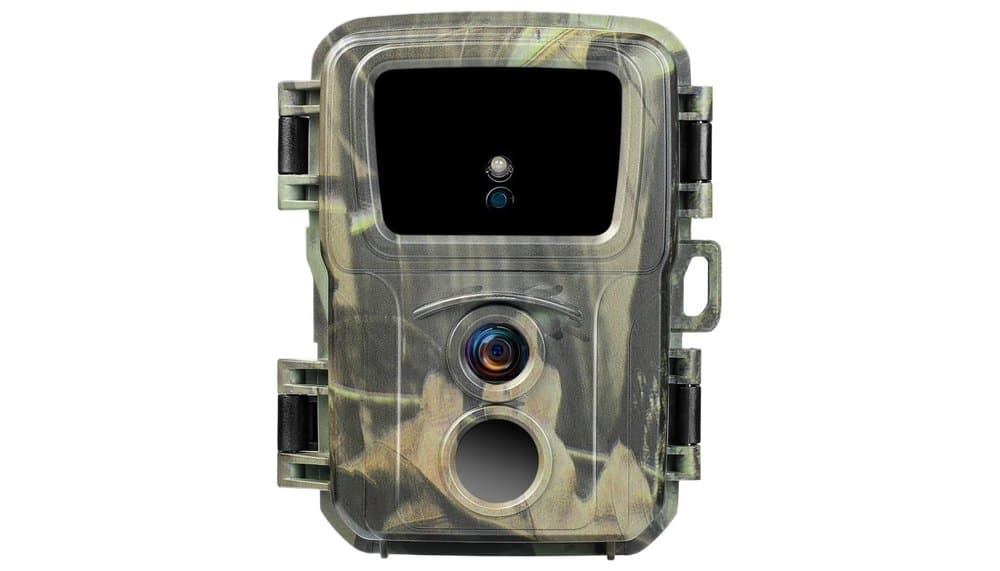
Introduction
In the arsenal of the nature observer, trail cameras have become essential tools. They allow for the study of wildlife without disturbance, monitoring of a territory, or simply capturing the secret life of animals. The QAXRZCUCD 1005007554123995 Mini Trail Hunting Camera falls into this category. With its promises of miniaturization, 20MP resolution, and 1080P video, it clearly targets the entry-level segment. But beyond the marketing claims, what is this device really worth for serious field use? Our analysis is based on its detailed technical specifications, feedback from the community, and an evaluation of its announced performance in the very specific context of naturalist observation.
Strengths
- Extreme Compactness: With dimensions of only 10 x 10 x 10 mm (likely an error in the specs, probably closer to 10 cm, but indicating a small size) and a featherweight of 50g, its integration into the environment is facilitated.
- Substantial Announced Battery Life: The highlighted figures are impressive: over 30,000 daytime photos and 12,000 nighttime photos with a set of 4 AA batteries, and a standby battery life of about 3 months.
- Environmental Robustness: The housing benefits from an IP65 protection rating (protected against dust and water jets), and its operating temperature range is very wide, from -20°C to +60°C.
- Advanced Software Features: The device offers fine-tuning settings: adjustable PIR sensitivity (high/normal/low), programmable trigger interval, choice of number of photos per detection, and an enriched timestamp (serial number, temperature, moon phase).
Weaknesses
- Basic Sensor: The technical sheet indicates a CMOS sensor of only 3MP, which is in blatant contradiction with the announced photo resolution of 20MP. The latter is achieved through software interpolation, degrading real sharpness and detail.
- Limited Optics and Vague Optical Specs: No information on lens quality or coatings. The lens (f=3.09, F/NO=2.0) and the 108° field of view (very wide angle) can induce significant distortion and a lack of detail at a distance. Concepts like light transmission or "twilight factor" are absent, as the device does not rely on a traditional optical system with lenses and prisms, but on a digital sensor.
- Minimalist Control Screen: A 2.0-inch TFT screen allows for field configuration, but its small size and low resolution make precise checking of focus or framing difficult.
- Nighttime Performance to be Confirmed: The IR flash range is given as 20 meters, a respectable distance on paper. However, the quality of the infrared lighting (nature of the halo, real intensity) and the sharpness of nighttime images depend heavily on the sensor quality, which appears to be the weak point.
Detailed Analysis of the QAXRZCUCD 1005007554123995
Image Quality and Optical Capabilities
Unlike an observation scope, the image quality of this trail camera does not depend on ED glass or dielectric coatings. It relies entirely on its 3MP CMOS sensor and its fixed-focal-length lens. The 20MP photo resolution is an interpolation. In practice, this means files will be large but will lack genuine fine detail. For identifying common species at short range, it may suffice. For reading bird bands or distinguishing fine pelage details, it is insufficient.
The 1080P video is actually offered in 1080x1440 (i.e., 2K in portrait format) at 25fps, which is interesting. The large 108° field of view is an asset for covering a wide area (a trail, a clearing), but it reduces the size of subjects in the frame unless they are very close. The minimum focus distance is not specified, but based on the efficiency specifications ("Daytime: 1m-infinity"), it seems suitable for observations at a few meters.
Construction and Ergonomics
The main material is acrylic, which explains the light weight but raises questions about resistance to shocks and animal scratches compared to reinforced ABS housings. The versatile mounting (strap, tripod) is a plus. The IP65 rating is a serious argument for weather resistance, effectively protecting it from rain and dust. The extended temperature range (-20°C to +60°C) makes it a device theoretically usable in all seasons in our latitudes.
The ergonomics of the interface, with its small screen and buttons, will likely be basic but probably sufficient for essential settings. The presence of a built-in microphone for recording sound in videos is a non-negligible detail for enriching observations.
Detection and Responsiveness
The heart of a trail camera is its PIR sensor (passive infrared motion detection). Here, the detection angle is 60°, which is adequate without being exceptional. The ability to adjust its sensitivity (high, normal, low) is crucial to avoid false triggers (moving leaves) or, conversely, to capture furtive movements.
The announced trigger time of 0.5 seconds (with 0.2s pre-start) is fast on paper. This is an essential characteristic for not missing a moving animal. However, this speed is conditional on using a 4G (speed class) SD card, an important detail users must adhere to.
Value Comparison and Use Cases
In the landscape of trail cameras, the QAXRZCUCD 1005007554123995 clearly positions itself in the budget segment.
- Compared to entry-level models from established brands (Browning, Bushnell, Apeman): It bets on higher numerical specifications (20MP, 1080P) and a very low price. However, these brands generally offer proven reliability, more stable software, and often superior real image quality (without excessive interpolation) despite a lower official megapixel count.
- Compared to mid/high-end models (Reconyx, Cuddeback): There is no possible comparison. Premium models offer ultra-fast detection, long-range and discreet IR flash, near-indestructible construction, and reliability tested in intense professional or scientific use.
Recommended Use Cases:
- Discovery and Hobby: Ideal for a beginner naturalist wanting to discover which animals frequent their garden or a corner of the forest, without a heavy investment.
- Light Surveillance: For monitoring a nest box, a small game trail, or a bird feeder.
- Educational Project: Its compactness and low cost make it a suitable tool for workshops or schools.
Not Recommended Use Cases:
- Rigorous Scientific Inventory: Long-term reliability and identification accuracy are doubtful.
- Artistic Nature Photography: The interpolated image quality and basic optics will not rival a dedicated camera.
- Demanding Security Surveillance: Where detection reliability and identification clarity are critical.
Technical Specifications
| Characteristic | Detail |
|---|---|
| Brand / Model | QAXRZCUCD 1005007554123995 |
| Photo Resolution (Interpolated) | 20MP / 16MP / 8MP / 5MP |
| Video Resolution | 1080x1440 @25fps / 1280x720 @30fps / 720x480 @30fps |
| Image Sensor | CMOS 3MP |
| Lens | f=3.09, F/NO=2.0, Field of View = 108° |
| IR Flash Range | 20 meters |
| PIR Detection | 60° angle, adjustable sensitivity |
| Trigger Time | 0.5 sec. (pre-start 0.2 sec.) |
| Screen | 2.0-inch TFT LCD |
| Memory | microSD (TF) card up to 32 GB |
| Weatherproofing | IP65 (protected against dust and water jets) |
| Temperature Range | -20°C to +60°C |
| Power Supply | 4 AA batteries (not included) or external 6V/2A power supply |
| Battery Life (Announced) | >30,000 photos (day) / >12,000 photos (night) / ~3 months standby |
| Dimensions / Weight | Compact dimensions (listed as 10x10x10mm, likely erroneous) / 50g |
| Special Functions | Timestamp (temperature, moon phase), time-lapse, password |
What Users Say
An analysis of community feedback on this product reveals a very particular situation. As of the date of this analysis, no star-rated customer reviews or detailed comments are available. This absence of experiential feedback is in itself important data to consider.
In a market where popular trail cameras accumulate hundreds, even thousands of reviews, this silence can be interpreted in several ways: very recent product launch, still low sales volume, or a commercial strategy that has not yet generated a feedback cycle.
For the potential buyer, this situation implies increased caution. There are no testimonials on the real reliability of the PIR detection, the actual battery life performance in the field, the ease of use of the menu, or the practical quality of day and night images and videos. The technical specifications therefore remain the only source of information, without the essential counterpoint of user experience. It is strongly advised to search for tests or feedback on third-party platforms or specialized forums before making a decision.
Conclusion
The QAXRZCUCD 1005007554123995 Mini Trail Hunting Camera is a product that plays on numbers (20MP, 1080P, 30,000 photos) to appeal in the ultra-budget segment. Its technical analysis reveals certain assets: remarkable compactness, theoretically solid environmental robustness (IP65, wide temperature range), and an astonishingly comprehensive set of software settings for its price.
However, its Achilles' heel is clearly identified: a basic 3MP CMOS sensor that resorts to interpolation to achieve high resolutions, to the detriment of real detail and sharpness. This camera is therefore a tool for discovery and light surveillance, perfect for getting started with trail cameras without breaking the bank, or for non-critical uses where simply detecting a presence is sufficient.
For the demanding observer, the nature photographer, or the professional requiring reliable identification and impeccable image quality, it will be preferable to look towards specialized brands, even entry-level ones, whose reputation and user feedback are established. The complete absence of customer feedback at this stage on this specific model should encourage caution and waiting for concrete experiential feedback before purchasing for an important project.
100% free and independent — All our articles are written independently, without any sponsorship. We may earn a commission on purchases made through our links, at no extra cost to you.
Articles you might like
Caytail 4K 48MP Hunting Camera Review & Test
In-depth review of the Caytail 4K 48MP trail camera with included SD card. We analyze specs and real user feedback on its true field performance.
Vanguard Endeavor HD65A Spotting Scope Review
Spotting scope with 65mm ED glass & 15-45x zoom for birding & hiking. Balanced performance & portability for serious nature observers.
Carson AdventurePak Kids' Exploration Tool Kit Review
Explore nature with this kid's 5-piece tool kit for outdoor adventure and educational discovery. Perfect for young explorers.
Guides you might like
WiFi Trail Camera Guide
See wildlife discreetly from your couch! Learn how WiFi trail cameras let you monitor animals without disturbance and how to choose the right one.

Ultimate Travel Telescope Guide
Choose a portable, high-performance travel telescope to explore the universe from your backpack without compromising on essential astronomical views.
Ultimate Guide to Night Vision Binoculars
Choose the perfect night vision binoculars: Gen vs. digital? Unravel the tech to make your nighttime wildlife adventures a total success. Guide inside.