Nikon Sportstar EX 8x25 Binoculars Review & Test
Published on 10 April 2026 · By OptiqueNature
Review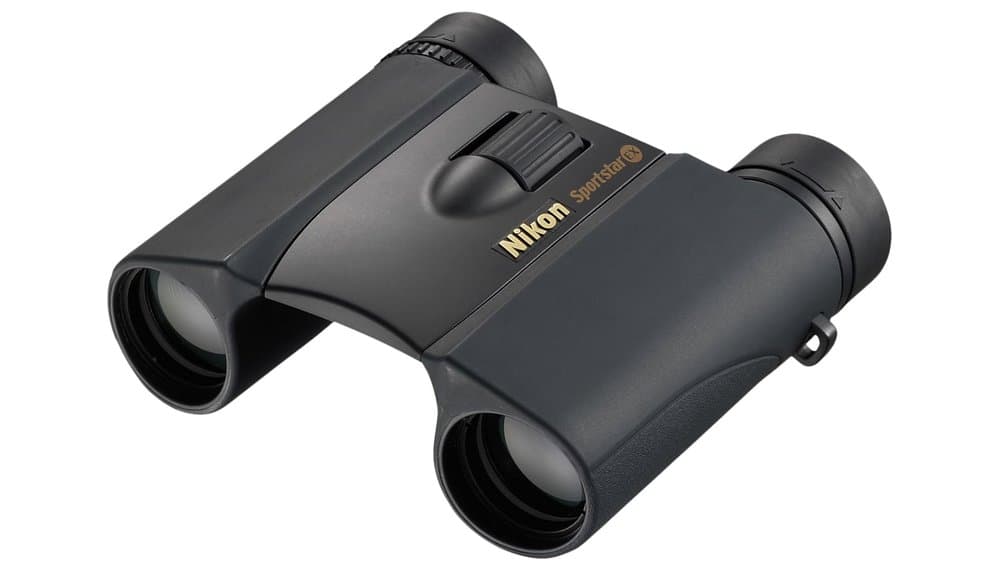
Analysis of the Nikon Sportstar EX 8x25: A Reliable Compact with a Generous Field of View
Compact binoculars represent a delicate balance between performance and portability. In this category, often dominated by very economical products with dubious finishes or, conversely, by high-end references with prohibitive prices, the Nikon Sportstar EX 8x25 seeks to position itself as a reliable and versatile option. We will dissect this product from every technical angle, relying on its specifications, expert feedback, and the collective experience of hundreds of users. Is it the ultimate hiking companion or just an optical gadget?
Strengths
- Exceptionally wide field of view for the 8x25 category.
- Compactness and lightness (about 300g) ideal for mobility.
- Robust construction and waterproof with nitrogen purging.
- Smooth central focusing and simple diopter adjustment.
- Interesting price/performance ratio in the serious entry-level segment.
Weaknesses
- Limited brightness in low-light conditions, typical of the 25mm objective lens diameter.
- Difficult adaptation for eyeglass wearers with insufficient eye relief.
- Absence of high-end optical coatings (no phase-correction coatings).
- Basic accessories: eyepiece and objective lens caps are not attached.
Detailed Analysis
The Nikon Sportstar EX 8x25 is clearly designed for the active user. Its technical specifications and field feedback converge towards a product that prioritizes certain compromises to achieve its main goal: to be taken everywhere.
Optical Performance: The Good and the Less Good
On paper, the optical specifications announce a classic configuration: 8x magnification paired with 25 mm diameter objective lenses. This combination offers a good balance between image stability and compactness. The calculated twilight factor (√(8x25) = √200 ≈ 14.14) is modest, which theoretically limits performance in low light. The exit pupil (Objective Diameter / Magnification = 25/8 ≈ 3.1 mm) confirms this trend: it is suitable for daytime observation but will be insufficient in the evening or under dense forest cover.
However, where this model stands out is its field of view. With 143 meters at 1000 meters (an angular field of 8.2°), it significantly surpasses most of its direct competitors in this compact category. Expert testers and users agree in highlighting that this wide field is its major asset: it makes spotting and tracking subjects (a bird in flight, a moving animal) much easier and more pleasant than on models with a narrower field.
The lenses benefit from multi-layer coating, a mention found both in official specs and feedback. User reviews generally report an image that is sharp, clear, and precise in full daylight. On the other hand, as expert analyses point out, the absence of phase-correction coatings on the roof prisms and ED (Extra-low Dispersion) glass is noticeable under certain conditions. This can result in a slight loss of contrast and more pronounced chromatic aberrations (color fringing on strong contrasts), particularly at the edge of the field or in very bright light. One user even compares this to a "slight whitish tint" and "halation on the edge of the image".
Construction and Ergonomics: The Bet on Robust Compactness
The technical specifications indicate a weight of 300 grams and very reduced folded dimensions. This is a unanimously praised success. Users describe them as "compact, light", "ideal for travel" and "that can go with you anywhere". The construction with a rubber armor provides a good grip and protection against minor shocks.
The "Water Resistant" mention and expert confirmations regarding nitrogen purging ensure basic waterproofing and resistance to fogging, sufficient to withstand a rain shower or high humidity. However, one review mentions a problem with internal fogging, which could indicate a manufacturing tolerance or an isolated failure, but serves as a reminder that this is not a professional level of resistance.
The most criticized ergonomic point concerns adaptation for eyeglass wearers. The eye relief is insufficient. The eyecups simply retract by pushing them, without a locking notch, and even when retracted, they do not leave enough space. Eyeglass wearers often have to remove their glasses for comfortable observation, otherwise they suffer from a "tunnel effect" and a significant loss of the field of view. Experts confirm this and even recommend that non-eyeglass wearers keep the eyecups retracted for the maximum field.
The minimum focusing distance is about 2 meters according to feedback (official specs indicate 2.3m for the 10x25 model), which is acceptable for observing insects or close-up details.
Recommended (and Not Recommended) Use Cases
Cross-referencing the data, here are the scenarios where the Nikon Sportstar EX 8x25 excels or, conversely, shows its limitations:
Ideal for:
- Hiking and trekking: Its lightness and compactness make it an obvious choice.
- Wildlife observation and occasional daytime birdwatching: Its wide field of view is a precious asset for locating animals.
- Outdoor sporting events or tourist visits.
- Observers wanting a reliable "pocket-sized" secondary pair, to complement with more performant binoculars for specific uses.
Less suitable for:
- Eyeglass wearers: The experience will be frustrating.
- Observation in low light (dusk, dark forest): The image will quickly become dark and lack contrast.
- Intensive use for astronomy: The small objective lens diameter and lack of specific coatings limit performance.
- Serious digiscoping: The short eye relief and basic optics are not suited for it.
Synthetic Technical Specifications
| Characteristic | Value / Description |
|---|---|
| Model | Nikon Sportstar EX 8x25 DCF (BAA710AA) |
| Magnification | 8x |
| Objective Lens Diameter | 25 mm |
| Prisms | Roof Prisms |
| Optical Coatings | Multi-layer (Full Multi-coated) |
| Field of View at 1000m | 143 m (8.2°) |
| Exit Pupil | 3.1 mm |
| Minimum Focus Distance | ~ 2 m (according to user feedback) |
| Eye Relief | Insufficient for eyeglass wearers (exact value not published) |
| Waterproofing | Yes (Water Resistant), nitrogen purged |
| Weight | Approximately 300 g |
| Focus | Central |
| Coating | Rubber armor |
| Manufacturer Warranty | 10 years |
What Users Say: Summary of Reviews
The analysis of nearly 1900 customer reviews (with an average rating of 4.7/5) and expert feedback reveals very clear trends.
Recurrent praise:
- Compactness and lightness: This is the most acclaimed point. Users love being able to slip them into a jacket pocket or a small bag without being burdened.
- Wide field of view: Many are pleasantly surprised by the expanse of the field, which they find "quite wide" and "perfect" for panoramic observation and tracking.
- Sharpness and ease of focusing: Under normal light conditions, the image is described as "sharp", "clear" and "precise". The focusing wheel is judged to be smooth and precise.
- Price/Performance ratio: A large majority believes that for their price, they offer tangible Nikon optical quality, far superior to no-name products in the same price range.
- Overall robustness: The construction inspires confidence and seems to withstand the conditions of normal outdoor use.
Highlighted criticisms and limitations:
- Major problem for glasses: This is the most frequent complaint among concerned users. The eye relief is unanimously recognized as too short, making use with glasses uncomfortable and greatly limiting the field of view.
- Room for improvement in brightness: As expected for a 25mm, several reviews note that the image becomes "dark" or "dull" in the late afternoon or under overcast skies.
- Low-end accessories: The eyepiece and objective lens caps are systematically described as "light", "unattached" and easily lost. This is a point of frustration.
- Chromatic aberrations: Some more knowledgeable users, in comparison with other models, notice color fringing (chromatism) in high-contrast situations.
- Unstable eyecups: Their simple mechanism (without notches) is perceived as a weak point, making them insecure once extended.
Conclusion: Who is this the right choice for?
The Nikon Sportstar EX 8x25 Binoculars are not a binocular with transcendent optical performance. They will not rival premium models equipped with ED glass and phase-correction coatings. However, they do not claim to do so.
Our analysis reveals that they perfectly fulfill their primary mission: to be a reliable, bright-in-daylight, and incredibly easy-to-carry pocket binocular. Their oversized field of view for their category is their secret weapon, offering a rare ease of use at this level of compactness.
The conclusion is therefore clear. These binoculars are an excellent option for the hiker, traveler, or occasional observer who primarily seeks to avoid being weighed down and to have correct and pleasant vision in good light. For them, they represent an excellent price/performance ratio within the Nikon ecosystem.
On the other hand, they are not suitable for eyeglass wearers and will disappoint anyone needing an instrument that performs well in low light or for light astronomical observations. For these uses, one must either consider models with a larger objective lens diameter (like 8x32), or accept raising their budget towards high-end compacts.
In summary, the Nikon Sportstar EX 8x25 is the robust and simple companion you forget in your bag, but which is always there when you need it for a quick, clear look at the world.
100% free and independent — All our articles are written independently, without any sponsorship. We may earn a commission on purchases made through our links, at no extra cost to you.
Articles you might like
Caytail 4K 48MP Hunting Camera Review & Test
In-depth review of the Caytail 4K 48MP trail camera with included SD card. We analyze specs and real user feedback on its true field performance.
Vanguard Endeavor HD65A Spotting Scope Review
Spotting scope with 65mm ED glass & 15-45x zoom for birding & hiking. Balanced performance & portability for serious nature observers.
Carson AdventurePak Kids' Exploration Tool Kit Review
Explore nature with this kid's 5-piece tool kit for outdoor adventure and educational discovery. Perfect for young explorers.
Guides you might like
WiFi Trail Camera Guide
See wildlife discreetly from your couch! Learn how WiFi trail cameras let you monitor animals without disturbance and how to choose the right one.
Ultimate Travel Telescope Guide
Choose a portable, high-performance travel telescope to explore the universe from your backpack without compromising on essential astronomical views.
Ultimate Guide to Night Vision Binoculars
Choose the perfect night vision binoculars: Gen vs. digital? Unravel the tech to make your nighttime wildlife adventures a total success. Guide inside.