K&F Concept 8-32X50 HD Zoom Monocular Review
Published on 7 March 2026 · By OptiqueNature
Review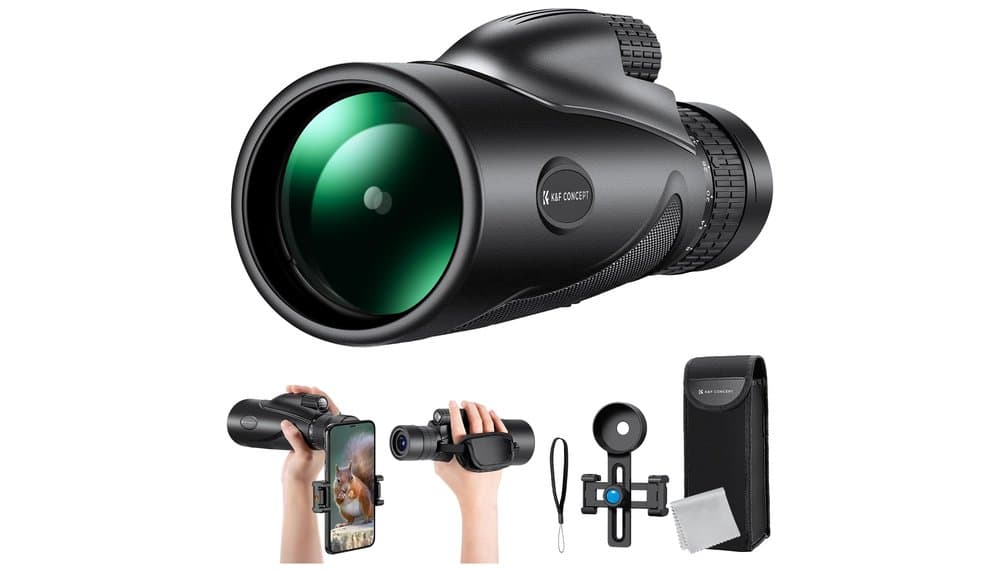
Introduction
The world of outdoor observation is a constant balancing act between power, portability, and price. In this landscape, the K&F Concept 8-32X50 HD Continuous Zoom Monocular Telescope presents itself as an ambitious tool, promising extreme versatility thanks to its zoom range from 8x to 32x. This variable magnification monocular clearly targets the observer who wants a single piece of equipment for all situations, from panoramic reconnaissance to detailed observation of distant subjects. But such a wide zoom range raises questions about optical and mechanical compromises. Here we analyze its performance based on its technical specifications, expert feedback, and the collective experience of its users.
Strengths
- Continuous Zoom Versatility: The ability to continuously adjust magnification from 8x to 32x is its main selling point. This allows for quick adaptation to different situations, from wide scanning of a landscape (8x) to examining a distant detail (32x), without changing equipment.
- Built-in "Digiscoping" Compatibility: The inclusion of a smartphone clip in the box is a major practical advantage. This immediately transforms the monocular into a basic digiscoping scope, accessible for capturing observations or sharing views.
- Robust and Waterproof Construction: Specifications and user feedback confirm quality construction with a non-slip rubber coating and an IP66 rating. This waterproofing effectively protects it against dust and powerful water jets, essential for hiking use or in changing weather.
- Ergonomics and Complete Accessories: The design includes a focus wheel reported as precise, an eyecup that folds down for eyeglass wearers, a wrist strap, and a 1/4 inch tripod thread. Its compact size (approx. 630g) makes it a portable companion.
Weaknesses
- Noticeable Performance Drop at High Magnification: This is the most frequent critical point. Beyond 20-24x, and especially at 32x, testers and users note a significant drop in brightness, contrast, and sharpness. The image becomes duller and less detailed.
- Narrow Field of View at High Magnification: As dictated by the laws of optics, the field of view drastically reduces at the highest magnifications. This makes pointing and tracking a moving subject very difficult by hand and can be frustrating for bird-in-flight observation.
- High Stability Requirement: From 20x upwards, and imperatively above that, handheld use becomes problematic due to shake. Comfortable use almost systematically requires stable support or a tripod, which limits its spontaneity.
- Marketing Accuracy on Magnification: Some experienced users question the actual magnification at 32x, estimating it is lower than expected, closer to an effective 22-25x when compared to other calibrated instruments.
Detailed Analysis of the K&F Concept 8-32X50 HD
Optical Quality and Performance
On paper, the specs announce a solid foundation: a BAK4 prism (superior to BK7 for exit pupil circularity and reducing edge-of-field aberrations) and Full Multi-Coated (FMC) lenses. The manufacturer claims a light transmission rate of 99%, a figure that should be understood as a theoretical maximum over a specific part of the spectrum. In practice, based on community feedback, the image is clear, sharp, and bright in the low to mid zoom range (8x to 20x). Colors are well rendered and sharpness is satisfactory for this price category.
However, optical physics imposes its limits. With an objective lens of 50mm, the exit pupil (obtained by dividing the objective diameter by the magnification) varies considerably:
- At 8x: Exit pupil of 6.25mm (very bright, ideal in low light).
- At 32x: Exit pupil of only 1.56mm.
This small exit pupil at 32x explains the sensation of significant brightness reduction. The twilight factor (√(50x32) ≈ 40) is theoretically high, but the light loss and potential degradation of resolution at this extreme magnification limit its real usefulness in low light. The eye relief is suitable for eyeglass wearers thanks to the fold-down eyecup, an appreciated ergonomic point.
Construction, Waterproofing, and Handling
The construction is unanimously praised. The rubber armor with a granular texture offers an excellent grip, even in wet weather or with light gloves. The IP66 rating (dust-tight and protected against powerful water jets) places it in a reliable category for demanding outdoor use. Its weight of approximately 630 grams is a good compromise: it gives a feeling of sturdiness without being cumbersome.
The focus wheel is described by users as precise and offering a "smooth" travel, without mechanical play. The zoom wheel, while functional, operates in a range where optical performance does not follow linearly. The minimum focus distance is not explicitly given in the provided specs, but reviews suggest it is sufficiently short for occasional close-up observations.
Use Cases and Value
This monocular finds its audience in versatile and recreational uses:
- Hiking and Travel: Its compactness and waterproofing make it an excellent companion for a quick look.
- Casual Wildlife Observation: Ideal for static observation at low and medium magnification, or for spotting an animal before bringing out more specialized binoculars or a spotting scope.
- Amateur Digiscoping: The included clip opens the door to photo and video with a smartphone, with the inherent limitations of stability and optical quality at high zoom.
- Outdoor Sports or Cultural Events: The zoom range allows adaptation to distance.
Its main asset is the price-performance ratio in the budget category. It outperforms entry-level products with its optical materials (BAK4, FMC) and finish. It obviously does not compete with high-end monoculars (like those from Zeiss, Swarovski, or even certain Vortex models) in terms of light transmission, color rendition, wide field of view, and high-magnification resolution. It positions itself more as a more versatile and better-finished alternative to a low-end compact binocular, but with the expected optical limitations of such a wide zoom range on a model at this price point.
Technical Specifications
| Characteristic | Detail |
|---|---|
| Model | K&F Concept 8-32X50 HD Continuous Zoom Monocular Telescope |
| Magnification | Continuous, from 8x to 32x |
| Objective Diameter | 50 mm |
| Prism | BAK4 |
| Optical Coatings | Full Multi-Coated (FMC) |
| Waterproofing | IP66 (protected against dust and powerful water jets) |
| Eyepiece | Fold-down for eyeglass wearers |
| Focus | Manual via wheel |
| Tripod Interface | 1/4 inch thread |
| Included Accessories | Smartphone clip, wrist strap, microfiber cloth, carrying case |
| Approximate Dimensions | 175 x 75 x 150 mm |
| Weight | Approximately 630 g |
What Users Say
The synthesis of nearly 1,400 reviews (average rating of 4.2/5) and online expert feedback paints a clear consensus.
Recurring positive points revolve around the excellent perceived quality for the price. Terms like "solid," "well-finished," "precise mechanics" often come up. The versatility of the zoom is praised for its practicality, and the image clarity between 8x and 20x satisfies the majority of casual users. The inclusion of the smartphone clip is consistently cited as a big plus. Portability and ergonomics are also praised.
The most frequent criticisms converge on the limitations of high magnification. Many users note that the image becomes "dull," "not very bright," or "lacking sharpness" beyond 24x. The very narrow field of view at 32x is a drawback for many. Some optics enthusiasts, comparing with other equipment, feel the advertised 32x magnification is overrated in practice. Finally, the need for a tripod to use the high end of the zoom range is highlighted as a constraint for mobile use.
Conclusion
The K&F Concept 8-32X50 HD Continuous Zoom Monocular Telescope is a product that understands the expectations of the general public well: offering maximum functionality (wide zoom, digiscoping, robustness) for a constrained budget. Its commercial success is deserved on this ground. It excels as a versatile and portable tool for hikers, travelers, and occasional observers who will mainly use its low and medium magnifications.
However, our analysis confirms that its maximum zoom range (26x-32x) is more of a marketing argument than a practical everyday reality. Optical performance declines significantly there. Therefore, one should not buy it expecting high-end spotting scope performance at 32x.
In summary, it is an excellent "all-terrain" monocular up to 20-24x, well-built and well-equipped. For anyone primarily seeking a simple, robust, and flexible instrument for general observation, and who sees high magnification as an occasional bonus requiring a tripod, it represents a very good choice. For intensive use at high magnification or in difficult lighting conditions, it will be preferable to turn towards fixed-magnification instruments or those with a more restricted zoom range, in a higher price bracket.
100% free and independent — All our articles are written independently, without any sponsorship. We may earn a commission on purchases made through our links, at no extra cost to you.
Articles you might like
Caytail 4K 48MP Hunting Camera Review & Test
In-depth review of the Caytail 4K 48MP trail camera with included SD card. We analyze specs and real user feedback on its true field performance.
Vanguard Endeavor HD65A Spotting Scope Review
Spotting scope with 65mm ED glass & 15-45x zoom for birding & hiking. Balanced performance & portability for serious nature observers.
Carson AdventurePak Kids' Exploration Tool Kit Review
Explore nature with this kid's 5-piece tool kit for outdoor adventure and educational discovery. Perfect for young explorers.
Guides you might like
WiFi Trail Camera Guide
See wildlife discreetly from your couch! Learn how WiFi trail cameras let you monitor animals without disturbance and how to choose the right one.
Ultimate Travel Telescope Guide
Choose a portable, high-performance travel telescope to explore the universe from your backpack without compromising on essential astronomical views.
Ultimate Guide to Night Vision Binoculars
Choose the perfect night vision binoculars: Gen vs. digital? Unravel the tech to make your nighttime wildlife adventures a total success. Guide inside.