FTVOGUE FTVOGUE590rxitkc7 Telescope Eyepiece Camera Review
Published on 15 August 2026 · By OptiqueNature
Review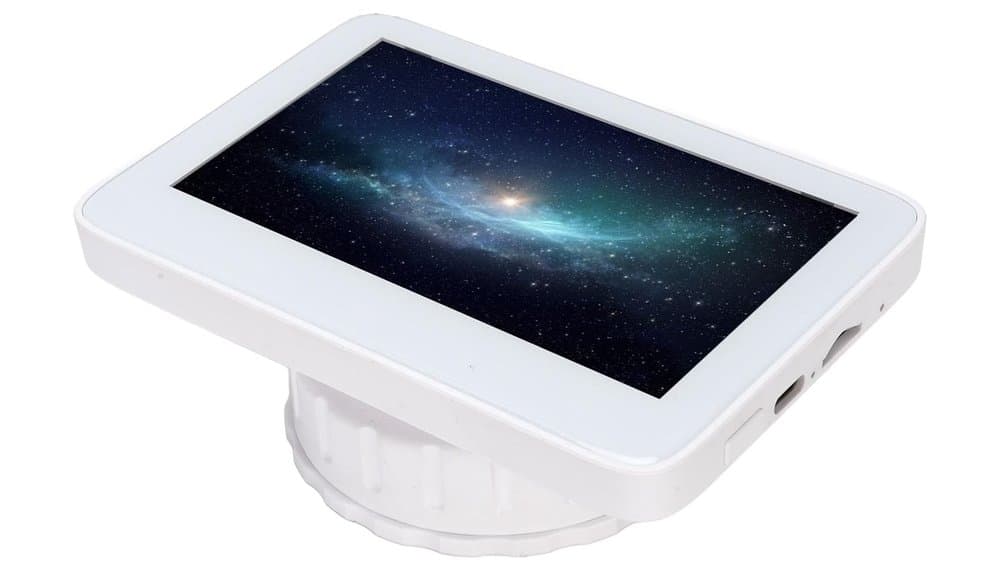
Complete Analysis: The FTVOGUE FTVOGUE590rxitkc7 Eyepiece Camera
In the world of optical observation, the digitization of direct viewing is a democratizing trend. The FTVOGUE FTVOGUE590rxitkc7 Telescope Eyepiece Camera fits right into this movement. It is neither a classic spotting scope nor an optical eyepiece, but an electronic eyepiece with an integrated screen, designed to replace the eye behind the instrument. Who is it for, and what is it truly worth based on its specifications and early feedback? That is what we analyze here.
Strengths & Weaknesses
Strengths:
- Immediate Integrated Display: The 5-inch IPS screen eliminates the need to connect a smartphone or external camera, radically simplifying setup.
- Announced Broad Compatibility: Its standard eyepiece design theoretically allows it to adapt to a wide range of telescopes, monoculars, and binoculars.
- Notable Autonomy: A 2000 mAh battery promises up to 160 minutes of use, an asset for prolonged sessions in the field.
- Ease of Use: No complex diopter adjustment, no eye alignment issues. The image is directly on the screen.
Weaknesses:
- Limited Sensor Image Quality: The 8.3MP sensor (12MP interpolated) and 30fps 4K video are entry-level specs in electronic imaging, far from the performance of a good camera or a dedicated astronomy camera.
- Purely Digital Zoom: The 5x zoom inevitably degrades image quality by enlarging pixels, unlike optical zoom.
- Modest Resolution Screen: A 720 x 1280 pixel screen on 5 inches offers low pixel density, which can limit the perception of fine details.
- Lack of User Feedback: At this stage, the absence of verified user reviews and independent expert tests prevents validating the manufacturer's promises under real-world conditions.
Detailed Product Analysis
Principle of Operation and Target Audience
The FTVOGUE590rxitkc7 is essentially a small digital camera mounted in an eyepiece-format housing, coupled with a screen. It is placed directly into your instrument's eyepiece holder. The light collected by your telescope or binocular objective hits its CMOS sensor, and the image is processed and displayed in real time on the integrated screen. This fundamentally distinguishes it from classic "digiscoping" solutions that require a smartphone adapter.
This product primarily targets two profiles:
- Casual observers or families looking for a simple and collective solution to share an observation (birds, landscapes, the Moon) without passing the instrument around.
- Users for whom visual comfort is problematic (focusing issues, significant differences between the two eyes) and who prefer a screen image.
It will, however, be very limited for serious amateur astronomers targeting planets or deep-sky objects, and for demanding wildlife photographers, due to the inherent limitations of its sensor and image processing.
Optical Performance and Image Quality: Examining the Specs
Here, two things must be separated: the performance of the host optical instrument (your telescope) and that of the FTVOGUE camera. The electronic eyepiece is the weak link in the chain in terms of optical fidelity.
On paper, the specs announce 4K video resolution (3840x2160) and a 12MP photo resolution. It is crucial to note that the photosensitive sensor is 8.3MP. The 12MP is therefore very likely achieved through software interpolation, a technique that adds calculated pixels without recovering additional physical detail. The real quality will be that of an 8MP sensor.
The concept of light transmission, central in classic optics, is replaced by sensor sensitivity and signal processing quality. Without data on pixel size (in microns) or ISO range, we remain in the dark. Based on the product's positioning, one can expect decent performance in daylight, but a rapid degradation in low light (dusk, night sky) with the appearance of digital noise.
The 5x digital zoom is a marketing argument to be used with caution. It enlarges the image by stretching pixels, leading to a loss of sharpness and a pixelation effect. It will never replace optical zoom via a lens or a variable focal length eyepiece.
Build, Ergonomics, and Handling
The housing is made of ABS, a robust and lightweight technical plastic. Its dimensions (approximately 13.4 x 8.9 cm) and weight (275g) make it a relatively compact accessory, but one that will add significant mass to the instrument's balance point. The presence of a rubber armor is not mentioned, suggesting a smooth plastic finish.
The major ergonomic question is that of physical adaptation. Compatibility with "standard models" is stated, but the exact barrel diameter (1.25" or 2"?) is not specified. This is a critical point to check before any purchase. The claimed autonomy of nearly 3 hours is a real positive point for a field outing, provided it is confirmed.
File management via microSD card (up to 512 GB) is standard. The lack of wireless connectivity (Wi-Fi) is noteworthy; transfer is done by cable. This simplifies reliability but reduces versatility.
Market Comparison and Value for Money
The market for electronic eyepieces is developing. The FTVOGUE clearly positions itself in the economical entry-level segment. It distinguishes itself from more expensive solutions with its integrated screen, an "all-in-one" approach.
- Compared to traditional eyepieces (even high-end ones), it does not compete in raw optical quality, light transmission, or apparent field of view. It's a paradigm shift: convenience versus optical fidelity.
- Compared to smartphone mounts, it offers a more stable and dedicated setup, but the screen of a recent smartphone will often be of much higher definition. Its advantage is autonomy and independence.
- Compared to dedicated astronomy cameras (like ZWO ASI), it is simpler to use but infinitely less performant for serious imaging, especially in low light.
Its interest in terms of value for money rests entirely on the "easy and shared viewing" use in adequate light conditions. For diurnal, family-friendly nature observation, it may offer value. For any demanding crepuscular, astronomical, or photographic use, its technical limitations place it behind.
What Users Say
A striking fact regarding the FTVOGUE590rxitkc7 is the complete absence of verified customer reviews and documented expert feedback available to date. Sales pages show no star ratings or constructive criticism. This lack of feedback is important data in itself.
It means that:
- The product is very recent on the market.
- No medium-term user experience has been publicly shared to confirm its reliability, real ease of compatibility, or the validity of technical promises (autonomy, actual image quality).
- Potential buyers are navigating blindly, relying solely on the manufacturer's specifications, which carries a risk.
In such a context, it is imperative to be cautious. Trends observed on similar products often point to gaps between announced specifications and practice, particularly regarding sharpness at full aperture, resistance to glare (lens coatings not specified), and robustness of connectors. For the FTVOGUE, these questions remain unanswered.
Technical Specifications
| Characteristic | Detail |
|---|---|
| Model | FTVOGUE FTVOGUE590rxitkc7 |
| Type | Electronic Eyepiece Camera with integrated screen |
| Photosensitive Sensor | 8.3 Megapixels (Effective) |
| Photo Resolution | 12 MP (Interpolated) |
| Maximum Video Resolution | 4K UHD (3840 x 2160) at 30 frames per second |
| Screen | 5 inches, IPS, "Full Viewing Angle", 720 x 1280 pixels |
| Zoom | 5x digital zoom |
| Compatibility | Standard telescope, binocular, monocular eyepiece holders |
| Battery | Integrated 2000 mAh Li-ion |
| Claimed Autonomy | Up to 160 minutes |
| Storage | microSD card (supported up to 512 GB) - not included |
| Connectivity | Data port (cable included) |
| Construction | ABS housing |
| Dimensions (Product) | Approximately 133.7 x 89.4 x ? mm |
| Weight | 275 grams |
| Manufacturer Warranty | 90 days |
Conclusion
The FTVOGUE FTVOGUE590rxitkc7 Eyepiece Camera is a niche product that bets everything on simplicity and immediacy. By integrating a screen and a sensor into an eyepiece format, it elegantly solves the problem of implementing digital viewing for novices or group sharing contexts.
However, this convenience has a technical cost. Its specifications place it in a basic electronic imaging category. Optics connoisseurs will note the lack of information on anti-reflective coatings, the sensor's real quality in low light, and the inherent limitation of digital zoom. The modest definition screen is also a point of attention for those seeking to discern fine details.
Who is it recommended for? For enthusiasts wanting to easily digitize diurnal observation (birds in the garden, landscapes) with a basic telescope or spotting scope, and for whom professional image quality is not the priority. The promised autonomy is a real plus.
For whom is it insufficient? For amateur astronomers, dusk observers, wildlife photographers, and all users for whom optical fidelity, transmitted light, and image sharpness are paramount. In these cases, a good optical eyepiece coupled with a camera or specialized imaging device will remain a much more performant investment.
The total absence of user feedback is the main obstacle to a firm recommendation. This is a product that needs to be tested in the field to validate its reliability and real performance beyond the promises of its datasheet.
100% free and independent — All our articles are written independently, without any sponsorship. We may earn a commission on purchases made through our links, at no extra cost to you.
Articles you might like
Caytail 4K 48MP Hunting Camera Review & Test
In-depth review of the Caytail 4K 48MP trail camera with included SD card. We analyze specs and real user feedback on its true field performance.
Vanguard Endeavor HD65A Spotting Scope Review
Spotting scope with 65mm ED glass & 15-45x zoom for birding & hiking. Balanced performance & portability for serious nature observers.
Carson AdventurePak Kids' Exploration Tool Kit Review
Explore nature with this kid's 5-piece tool kit for outdoor adventure and educational discovery. Perfect for young explorers.
Guides you might like
WiFi Trail Camera Guide
See wildlife discreetly from your couch! Learn how WiFi trail cameras let you monitor animals without disturbance and how to choose the right one.
Ultimate Travel Telescope Guide
Choose a portable, high-performance travel telescope to explore the universe from your backpack without compromising on essential astronomical views.
Ultimate Guide to Night Vision Binoculars
Choose the perfect night vision binoculars: Gen vs. digital? Unravel the tech to make your nighttime wildlife adventures a total success. Guide inside.