Flintronic Night Hunting Camera Review & Test
Published on 2 May 2026 · By OptiqueNature
Review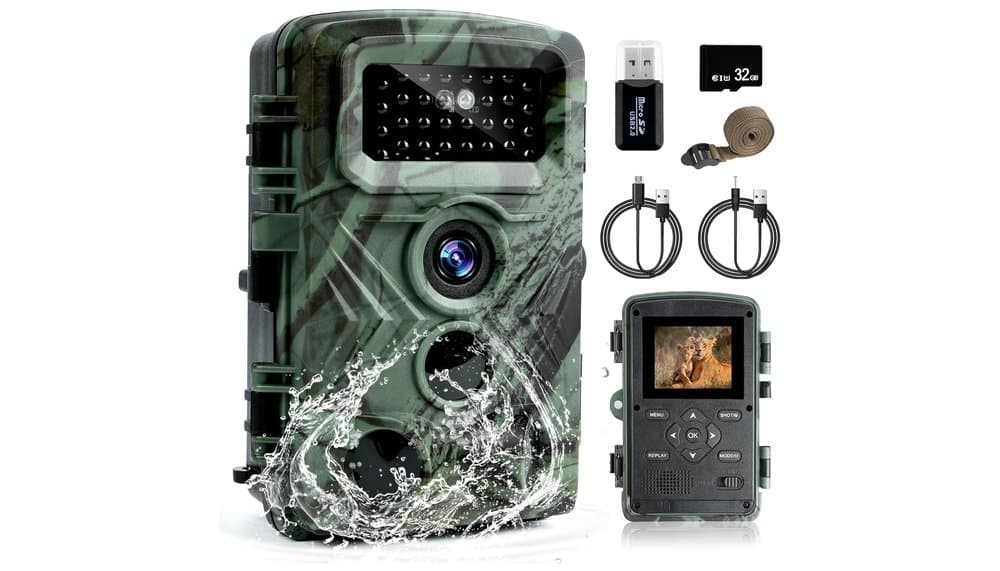
Analysis of the Flintronic Night Hunting Camera: A Versatile Trail Camera?
For nature watchers, land managers, or those curious to discreetly document wildlife, trail cameras have become an essential tool. The Flintronic Night Hunting Camera presents itself as a complete option, combining high resolution, night vision, and durability. But does this marketing promise hold up to field testing and early user feedback? Let's dive into a detailed technical analysis to separate fact from fiction.
Strengths
The Flintronic Night Hunting Camera's specifications are, on paper, impressive for its price segment. Its main selling points are its versatility and discreetness.
- Resolution and Sensor: The device promises 58MP photos and 2.7K video. These figures are very attractive and exceed common Full HD resolution, theoretically allowing for significant zooming or cropping without critical loss of detail for species identification.
- Invisible Night Vision: Equipped with 950nm infrared LEDs, the camera offers discreet nighttime illumination to avoid scaring animals. The 950nm wavelength is indeed in the "black" or "low glow" spectrum, less perceptible than typical 850nm red LEDs.
- Durability and Battery Life: The housing has an IP66 rating (dust-tight and protected against powerful water jets) and a wide operating temperature range (-10°C to +60°C). The advertised 6-month battery life using standard AA batteries is a major advantage for long-term deployments in nature.
- Trigger Speed and Field of View: A 0.3 to 0.6 second trigger speed and a 120° field of view are solid technical characteristics. They help capture moving animals with minimal blur and cover a wide area, reducing blind spots.
Weaknesses
Analysis of user feedback reveals recurring weaknesses that temper the excitement from the specifications.
- Inconsistent Optical Quality and Build: The main issue highlighted by the community is inconsistent manufacturing quality. Several users report focusing problems, with "opaque" lenses or consistently blurry photos, as noted by a disappointed customer: "The lens was opaque and, consequently, the photos came out blurry". This suggests variable quality control.
- Reliability in Damp Conditions: Despite the IP66 rating, some reports mention fogging or condensation inside the housing in cold or wet weather, leading to failure. One user summarizes: "with a bit of cold and bad weather they fog up and stop working". This calls into question the actual waterproofing and long-term durability.
- Interface and User Experience: Although not explicitly detailed in reviews, the lack of a proper control screen (a small 2-inch LCD is mentioned) and the reliance on an application or removing the SD card to configure and view media can be a drawback for some.
Detailed Analysis of Specifications
Let's break down the key features to understand their real-world implications.
Construction and Ergonomics
The camouflaged plastic housing weighs 430g (without batteries), making it easy to mount on a tree with the included strap. The design is focused on discreetness. However, feedback regarding condensation questions the reliability of the seal and resistance to extreme temperature cycles. Long-term durability against impacts or curious animals remains to be confirmed by prolonged use.
Optical Performance and Sensor
This is the heart of the matter. The 58MP and 2.7K figures are marketing at its core. In reality, the sensor is almost certainly a small CMOS whose native resolution is much lower; 58MP images are achieved through software interpolation, which can create artificial blur and digital noise, especially in low light. The actual quality of the lens glass and lens coating are not communicated and seem, based on reviews, to be the product's Achilles' heel. Light transmission and sharpness at the edges of the 120° field are likely mediocre.
Night Vision and Detection
The 34x 950nm IR LEDs are a good point. The advertised detection range is 20 meters. In practice, the effective range of IR illumination for a clear image will be lower, especially with a small sensor. The 0.3s trigger speed is adequate for trail camera use, but the delay between detections for rapid sequences must be considered.
Battery Life and Connectivity
The 6-month battery life is plausible under ideal conditions (low animal traffic, long intervals between triggers, mild temperatures). In winter or a high-traffic area, it will drop significantly. Storage on a microSD card (up to 128 GB) is standard. The absence of wireless connectivity (Wi-Fi, Bluetooth) means physically retrieving the card to view media, which can disturb the observation site.
Technical Specifications Table
| Feature | Flintronic Night Hunting Camera Details |
|---|---|
| Photo Resolution | 58 MP (interpolated) |
| Video Resolution | 2.7K |
| Night Vision | 950nm IR LEDs (x34), invisible |
| Field of View | 120° |
| Trigger Speed | 0.3 - 0.6 s |
| Detection Range | Up to 20 m |
| Battery Life | Up to 6 months (8x AA) |
| Resistance | IP66, -10°C to +60°C |
| Screen | 2-inch LCD |
| Storage | MicroSD Card (max 128 GB) - 32 GB included |
| Power | 8 AA batteries (not included) |
| Dimensions/Weight | 155x115x95 mm / 430 g |
What Users Say: A Marked Bipolarity
Analysis of customer reviews reveals a very mixed experience, explaining the average overall rating.
Highlighted positives revolve around basic functionality and perceived value for money for simple use. One satisfied user notes: "It fulfills its camouflage function and can go 2-3 months without changing the batteries. Even if it rains or snows, it keeps working". This indicates that some units perform as expected, offering discreet surveillance and good battery life.
The negatives are more technical and recurring, pointing to manufacturing defects:
- Faulty Image Quality: Problems with "opaque" or miscalibrated lenses render images unusable, a defect immediately visible.
- Lack of Waterproof Reliability: Failures due to condensation inside the housing, contradicting the IP66 rating, are reported.
- Inconsistent Quality: The strong divergence in reviews (5 stars vs 1 star) suggests random quality control from the factory. You either get a functional product or a defective one.
Conclusion: A Double-Edged Sword
The Flintronic Night Hunting Camera is an ambiguous product. On paper, its specifications (2.7K/58MP, 950nm IR, IP66, 6-month battery) make it a very attractive candidate in the entry-level/mid-range segment. It seems suited for occasional uses like monitoring a garden, a feeding station, or a small territory, where its versatility and battery life are appreciated.
However, analysis of field feedback casts a significant shadow over its long-term reliability. Recurring issues with condensation and random optical quality make it a risky bet. For a serious naturalist monitoring project, population study, or installation in a harsh and remote environment, this uncertainty is prohibitive.
Our verdict: This camera may suit a DIY enthusiast or a curious user willing to accept the risk of potentially having to return it due to a factory defect, and whose needs for absolute image quality are not critical. For a user demanding uncompromising reliability and consistent image quality for identifying individuals or publishing photos, it would be wiser to invest in a reputable brand whose quality control and durability are proven by the community, even at a higher price. The technical promise is there, but its fulfillment unfortunately depends on the "lottery" of the unit received.
100% free and independent — All our articles are written independently, without any sponsorship. We may earn a commission on purchases made through our links, at no extra cost to you.
Articles you might like
FunKind HC600Pro 4G Trail Camera Review
FunKind HC600Pro solar-powered 4G trail camera review. Analyzes real-time wildlife monitoring specs, solar/battery power, and performance data.
Haokoo Vision Nocturne 4K Night Vision Binoculars Review
Haokoo 4K Night Vision Binoculars review: See & record in total darkness. Compact, versatile for nature observation. High-definition digital performance.
Celestron Astro-FI 102 WiFi Reflector Telescope Review
Wireless Celestron Astro-FI 102 telescope review: Does smartphone control simplify stargazing for beginners or add unnecessary complication?
Guides you might like
WiFi Trail Camera Guide
See wildlife discreetly from your couch! Learn how WiFi trail cameras let you monitor animals without disturbance and how to choose the right one.

Ultimate Travel Telescope Guide
Choose a portable, high-performance travel telescope to explore the universe from your backpack without compromising on essential astronomical views.
Ultimate Guide to Night Vision Binoculars
Choose the perfect night vision binoculars: Gen vs. digital? Unravel the tech to make your nighttime wildlife adventures a total success. Guide inside.