Cowiewie Lightweight Telescope Review for Kids Beginners
Published on 28 March 2026 · By OptiqueNature
Review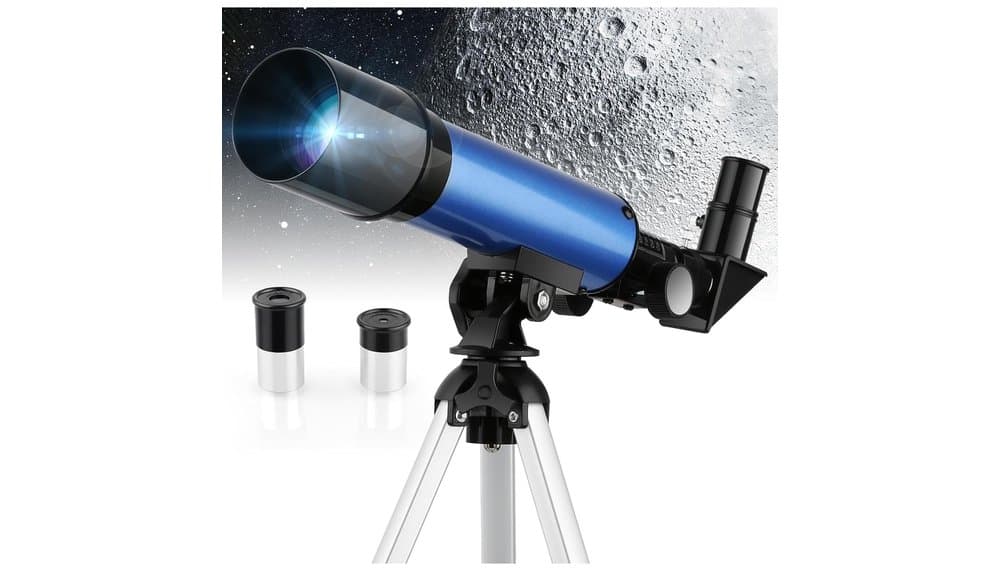
Analysis: Is the Cowiewie Lightweight Telescope with Tripod for Kids a Good Starter?
In the vast world of nature observation, astronomy holds a special place. It inspires dreams, but getting started in this field can seem intimidating, especially for younger enthusiasts. It is precisely in this niche that the Cowiewie Lightweight Telescope with Tripod for Kids positions itself. Marketed as a complete starter kit, it promises to demystify the starry sky for children. But what is its true value as an optical instrument? We analyze its specifications, user feedback, and market position to determine if it lives up to its educational promises without compromising on essentials.
Strengths
- Maximum Simplicity and Accessibility: Assembly and handling are described as intuitive, allowing the child to focus on observation, not technique.
- Versatility with the 45° Prism: The inclusion of an erecting 45° prism corrects the image, making the instrument usable for both lunar and terrestrial observation (landscapes, birds), significantly broadening its range of use.
- Complete and Portable Kit: The package includes two eyepieces and a lightweight tripod, forming a coherent and easily transportable set for family outings.
- Excellent Pedagogical Tool: Its design and simple operation make it an effective catalyst for sparking scientific and astronomical curiosity in a child.
Weaknesses
- Limited Astronomical Capabilities: The 50 mm aperture and short 360 mm focal length severely restrict its performance. It is essentially limited to detailed lunar observation.
- Basic Optical Quality: The supplied eyepieces are of the Huygens (H) type, an old and less performant design, with narrow fields of view and edge sharpness that diminishes.
- Entry-Level Construction and Finish: There are no indications of weather resistance (waterproofing, nitrogen purging), and the structure, while stable for its format, is not designed for intensive or professional use.
- Zero Growth Potential: This telescope is an end in itself. It does not allow for meaningful upgrades (like changing the mount or adding quality filters) to support a budding passion.
Detailed Analysis by Criterion
Optical Quality and Performance
On paper, the specifications list a 50 mm aperture and a 360 mm focal length. This combination immediately places the instrument in the category of very basic introductory astronomical telescopes. The two supplied H20 and H6 eyepieces offer magnifications of 18x and 60x. The 60x magnification is close to the useful theoretical maximum for such a diameter (approximately 2x per mm of aperture, i.e., 100x), but image quality at this level will be strongly limited by the small aperture and the eyepieces.
Testers and the community confirm that its standout performance is observing lunar craters, which is entirely possible and satisfactory for a beginner. On the other hand, planetary observation (Jupiter, Saturn) will be limited to seeing small bright dots without details, and deep-sky objects (nebulae, galaxies) will be largely out of reach.
The advertised field of view is 1.4° with the H20 eyepiece. This is a relatively narrow field, especially compared to modern wide-angle eyepieces which can offer more than double. This makes pointing at celestial objects slightly more tricky for a child. Regarding optical coatings and light transmission, information is lacking, but for a product in this positioning, one can expect simple anti-reflective coatings, without the sophistication of dielectric or phase coatings found on instruments for advanced amateurs.
Design, Sturdiness, and Ergonomics
The main advantage here is lightness and compactness. Weighing about 800 grams and with an optical tube length of 36 cm, it is easily handled by a child. The aluminum alloy tripod, although light, is judged sufficiently stable by users for stationary use on a flat surface, which is an important point to avoid constant vibrations that spoil observation.
The altazimuth mount is the simplest type: it allows up/down and left/right movements. It is perfectly suited for a first contact, although less smooth and precise than mounts with fine adjustment controls. No data indicates any resistance to the elements (IP rating, nitrogen purging). This is clearly an instrument for use in dry conditions.
The eye relief is not specified, but with Huygens eyepieces, it is generally short. Eyeglass wearers will likely have to remove them to see the full image. The minimum focusing distance for terrestrial observation is also not given, but feedback indicates it allows for satisfactory landscape viewing.
Value for Money and Positioning
The Cowiewie Telescope does not exist in a vacuum. It fits into a very specific segment: purely educational and discovery instruments. It should not be compared, even remotely, to entry-level astronomical telescopes or refractors for adults (like Sky-Watcher or Celestron with 70/80 mm apertures), which offer significantly better performance and growth potential for a slightly higher investment.
Its value lies entirely in its ready-to-use, simple, and unpretentious proposition. For a young child (6-10 years old) whose interest is yet to be confirmed, it is a coherent option. It offers an authentic observation experience (unlike a plastic optical toy) while minimizing complexity and financial risk. It is a stepping stone that can validate a passion, before potentially moving on to more serious equipment.
Technical Specifications
| Characteristic | Cowiewie Specification |
|---|---|
| Type | Astronomical Telescope (Refractor) |
| Objective Lens Diameter | 50 mm |
| Focal Length | 360 mm |
| Focal Ratio (f/) | f/7.2 |
| Supplied Eyepieces | H20mm (18x) and H6mm (60x) |
| Eyepiece Type | Huygens (H) |
| Field of View (with H20) | 1.4 degrees |
| Prism | 45° Erecting Prism (corrects image) |
| Mount | Manual Altazimuth |
| Tripod | Aluminum alloy, height ~36 cm |
| Total Weight | ~800 g |
| Primary Uses | Lunar observation, daytime terrestrial observation |
| Target Audience | Beginner Children (Introduction) |
What Users and Testers Say
Feedback from the community and expert analyses converge to paint a very consistent picture of the product.
Recurring positive points are:
- Simplicity and quick setup: "Very easy to use and doesn't move"; "assembles easily".
- Works as advertised for the Moon: "Allows observation of the moon, notably"; "lets you see craters".
- Ideal for children: "Perfect for a child"; "clearly oriented towards discovery"; "stimulates interest".
- Value for money for discovery: "Allows for discovery without breaking the bank".
- Appreciated versatility: Thanks to the 45° prism, it is used for "astronomy and landscapes".
Highlighted negative points or limitations are:
- Acknowledged technical limits: Experts emphasize that its capabilities are limited to "the Moon and a few bright celestial objects". It is systematically described as an "entry-level instrument with obvious limitations".
- Expected image quality for the segment: A photo shared by a user, taken with a smartphone through the eyepiece, is described by them as "not great", which is characteristic of basic digiscoping systems not designed for it.
- Perceived as a "scientific toy": The consensus is that it is a "good educational tool" and a "quality scientific toy", but not an instrument for a growing amateur.
Conclusion
The Cowiewie Lightweight Telescope with Tripod for Kids perfectly fulfills the mission it set for itself: to be an ultra-accessible and frustration-free entry point into astronomy for young children. Its technical analysis confirms it is a simple optical instrument, with performance deliberately limited to basic lunar and terrestrial observation.
Its strength is not in high-end specifications – it has no ED glass, no phase coatings, no waterproof construction – but in its successful pedagogical approach. It offers a genuine telescope experience, with quick setup, adequate stability, and an image that will impress a novice, all in a format suited to its target audience.
Our conclusion is therefore nuanced but clear: this product is an excellent gift option for a first discovery if expectations are properly calibrated. It is the equivalent of a first bicycle with training wheels: it teaches the fundamentals without risk. However, for a child whose passion is already established, or for an adult wanting to start seriously, it will quickly become limiting. In that case, it is preferable to consider an instrument from the "real" entry-level segment, which can offer a much wider field of exploration and support the observer's progression. The Cowiewie is a beginning, perhaps an end in itself, but rarely a step in an amateur astronomer's journey.
100% free and independent — All our articles are written independently, without any sponsorship. We may earn a commission on purchases made through our links, at no extra cost to you.
Articles you might like
BOSTRON CY 10x50 Monocular Review & Test
Compact 10x50 monocular review: Analyzes optical clarity, field of view & build quality for hiking, nature & astronomy. See its true value.
FunKind HC600Pro 4G Trail Camera Review
FunKind HC600Pro solar-powered 4G trail camera review. Analyzes real-time wildlife monitoring specs, solar/battery power, and performance data.
Haokoo Vision Nocturne 4K Night Vision Binoculars Review
Haokoo 4K Night Vision Binoculars review: See & record in total darkness. Compact, versatile for nature observation. High-definition digital performance.
Guides you might like
WiFi Trail Camera Guide
See wildlife discreetly from your couch! Learn how WiFi trail cameras let you monitor animals without disturbance and how to choose the right one.
Ultimate Travel Telescope Guide
Choose a portable, high-performance travel telescope to explore the universe from your backpack without compromising on essential astronomical views.
Ultimate Guide to Night Vision Binoculars
Choose the perfect night vision binoculars: Gen vs. digital? Unravel the tech to make your nighttime wildlife adventures a total success. Guide inside.