Celestron StarSense Explore LT114AZ Telescope Review
Published on 21 April 2026 · By OptiqueNature
Review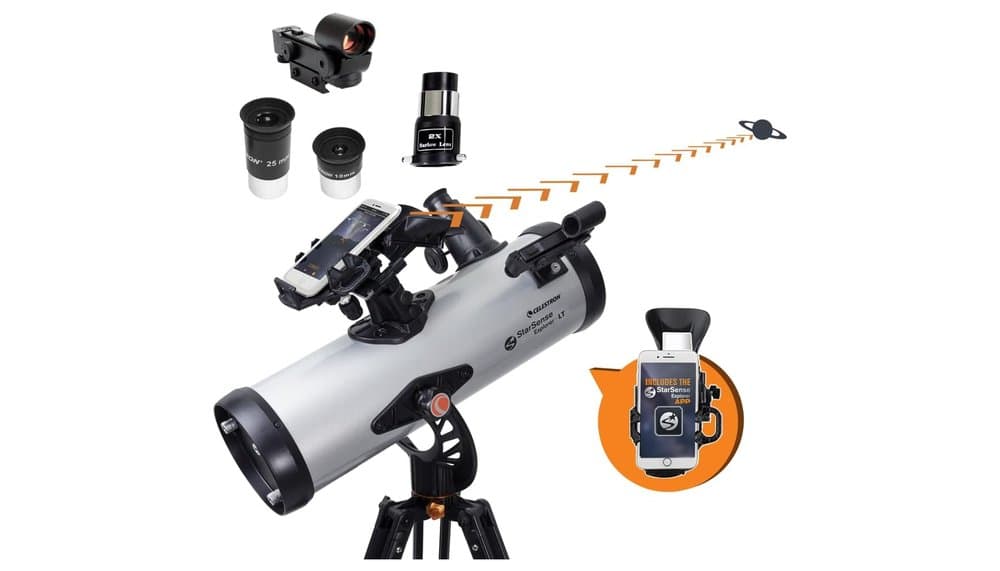
Complete Analysis of the Celestron StarSense Explore LT114AZ Newtonian Reflector Telescope
Entering the world of amateur astronomy can be intimidating. Between the complexity of the equipment and the difficulty of navigating the celestial sphere, many beginners give up before they've really started. The Celestron StarSense Explore LT114AZ positions itself as a solution to this problem, promising to revolutionize initiation through integrated smartphone technology. But is this innovation enough to make it a recommendable telescope? We analyze its specifications, design, and community feedback to determine its place in the landscape of observation instruments.
Strengths and Weaknesses
Strengths
- Revolutionary StarSense technology for beginners: The proprietary smartphone application literally guides the user to celestial objects, eliminating the steepest learning curve.
- Generous 114 mm aperture: A diameter that allows for good light gathering, essential for observing planets and some deep-sky objects like bright nebulae.
- Complete accessory kit: The inclusion of two eyepieces (25mm and 10mm), a 2x Barlow lens, and a red dot finder offers immediate versatility for different magnifications.
- Easy-to-use alt-azimuth mount: The handling is intuitive, without the complications of an equatorial mount, which perfectly suits the targeted novice audience.
Weaknesses
- Limited mechanical stability: According to feedback from experts and users, the tripod and mount can lack rigidity, causing vibrations that hinder observation at high magnification.
- Entry-level accessories: The included eyepieces are basic. To fully exploit the optical potential of the tube, an additional investment is often suggested by the community.
- Reported fragility on some components: Several user reviews point to reliability issues with the red dot finder and an after-sales service perceived as unresponsive outside the United States.
- Exclusively manual: Once the object is located by the app, tracking must be done by hand, which can be cumbersome for detailed planetary observation.
Detailed Analysis by Feature
Optical Quality and Performance
The Celestron StarSense Explore LT114AZ is a Newtonian reflector telescope. Its 114 mm diameter (4.5 inches) primary mirror and 1000 mm focal length (f/8.8) place it in the category of long focal length instruments, ideal for planetary and lunar observation.
On paper, the specs announce highly reflective coatings on the mirrors. This translates into good light transmission, allowing resolution of details on Jupiter's cloud bands, Saturn's rings, or lunar craters. The Newtonian optical formula, without a front lens, also avoids chromatic aberration. However, the quality of the mirrors and their collimation (alignment) are decisive. Testers emphasize that once well adjusted, this telescope offers sharp, contrasty images for its market segment.
The field of view depends directly on the eyepiece used. With the supplied 25 mm eyepiece, you get a magnification of 40x and a modest apparent field, typical of long focal lengths. This is not an instrument designed for wide stellar fields like the entire Orion Nebula, but rather for targeted observation of details.
Construction, Ergonomics, and Durability
The construction mixes lightweight materials (aluminum, plastic) for the mount and tripod, and a tube of adequate strength. The total weight of about 4.7 kg makes it a relatively portable instrument. However, criticism converges on rigidity. The manual alt-azimuth mount, while simple, and the single-leg tripod do not offer optimal stability. Users note that the slightest touch or a light wind causes vibrations that take several seconds to dampen, complicating observation above 150x.
The red dot finder is included for use without a smartphone. While the idea is good, its quality is regularly questioned in customer reviews, with frequent failures reported. The StarSense phone dock, on the other hand, is well designed and keeps the smartphone secure.
There is no mention of waterproofing or fogproofing. This telescope is clearly designed for use in dry weather and must be stored away from humidity.
The StarSense Explorer Technology: The Game-Changer
This is the heart of the product and its main selling point. The StarSense system uses your smartphone's camera and a patented algorithm to analyze the star field and calculate the telescope's position in real time. In practice, after a simple initial alignment (about 2 minutes), the application offers you a list of visible objects. You then simply move the tube following on-screen arrows until the target turns green.
Experts and novices agree that this technology radically changes the beginner experience. It removes frustration, makes sky exploration efficient and educational. Compatibility requires a relatively recent smartphone (iOS 18+ or Android 12+), which should be checked before purchase.
Value for Money and Use Cases
The Celestron StarSense Explore LT114AZ cannot be directly compared to classic Newtonian telescopes. Its price includes the proprietary StarSense technology. For a similar budget, one could get a Newton on a perhaps more robust mount, but without the pointing assistance.
Its value for money is therefore excellent for a specific profile: the perfect absolute beginner who values above all ease of discovery and lack of frustration. For lunar and planetary observation from one's backyard, it's a fantastic tool. On the other hand, for a slightly more experienced user ready to learn to read a star chart, or for practice involving astrophotography (requiring motorized tracking), other options will be more relevant.
For terrestrial observation (birds, landscapes), it is theoretically usable, but the basic alt-azimuth mount, the inverted image (normal for a Newtonian), and the bulk make it uncompetitive compared to a dedicated spotting scope or binoculars.
Technical Specifications
| Feature | Specification |
|---|---|
| Optical Type | Newtonian Reflector |
| Diameter (Aperture) | 114 mm |
| Focal Length | 1000 mm |
| Focal Ratio (f/) | f/8.8 |
| Mount | Manual Alt-Azimuth (Alt-Az) |
| Included Eyepieces | 25 mm (40x), 10 mm (100x) |
| Optical Accessories | 2x Barlow Lens |
| Finder | Red Dot Finder (and StarSense smartphone dock) |
| Exclusive Technology | StarSense Explorer App with dedicated dock |
| Smartphone Compatibility | iOS 18+ (iPhone XR/XS and above), Android 12+ |
| Approximate Weight | 4.72 kg |
| Manufacturer Warranty | 2 years |
What Users Say: Review Synthesis
Analysis of over 2000 global reviews (average rating of 4.2/5) and expert feedback reveals clear trends.
The praise is majority and centered on simplicity:
- A large majority of beginners praise the StarSense revolution. Phrases like "within minutes, I was seeing Saturn", "the app is a real guide" constantly reappear. It's the asset that justifies the purchase.
- The image quality for observing the Moon is almost unanimously praised. Planets like Jupiter and Saturn are also visible with their main details, fully satisfying novice expectations.
- Setup is considered fairly simple and quick (about 20-30 minutes).
Recurring criticisms focus on mechanics and service:
- The stability and vibration issue is the most frequently cited drawback by demanding users and testers. "It's very sensitive to touch", "you have to wait for it to stop shaking" are frequent remarks.
- The reliability of the red dot finder is called into question in several negative reviews, with early failures reported.
- Celestron's after-sales service for customers outside the USA is singled out in some Francophone feedback, describing silence after initial contact for a warranty claim. This point should be considered.
- A few users with some experience feel that the planetary performance, while decent, is not exceptional and can be matched by other instruments at a comparable budget, without the StarSense technology.
Conclusion
The Celestron StarSense Explore LT114AZ is not a perfect telescope from a pure opto-mechanical standpoint. Its mount and tripod lack mass and rigidity, and its accessories are basic. However, it fulfills a mission with remarkable efficiency: democratizing access to astronomy by removing the obstacle of pointing.
If you are a parent wanting to introduce a child, a curious adult with no prior knowledge of the sky, or if you've already given up on a traditional telescope out of frustration, this model is likely one of the best possible choices. The StarSense technology guarantees immediate successes and discoveries, which is invaluable for maintaining motivation.
On the other hand, if you are already an amateur capable of navigating with charts, if you prioritize absolute stability for prolonged observations, or if you plan a quick progression into astrophotography, the mechanical limits of the LT114AZ will quickly become apparent. In that case, it might be better to invest in a similar optic on a more robust mount and learn the sky through traditional methods. The Celestron StarSense Explore LT114AZ is first and foremost an exceptional sky teacher, but in an entry-level body.
100% free and independent — All our articles are written independently, without any sponsorship. We may earn a commission on purchases made through our links, at no extra cost to you.
Articles you might like
FunKind HC600Pro 4G Trail Camera Review
FunKind HC600Pro solar-powered 4G trail camera review. Analyzes real-time wildlife monitoring specs, solar/battery power, and performance data.
Haokoo Vision Nocturne 4K Night Vision Binoculars Review
Haokoo 4K Night Vision Binoculars review: See & record in total darkness. Compact, versatile for nature observation. High-definition digital performance.
Celestron Astro-FI 102 WiFi Reflector Telescope Review
Wireless Celestron Astro-FI 102 telescope review: Does smartphone control simplify stargazing for beginners or add unnecessary complication?
Guides you might like
WiFi Trail Camera Guide
See wildlife discreetly from your couch! Learn how WiFi trail cameras let you monitor animals without disturbance and how to choose the right one.
Ultimate Travel Telescope Guide
Choose a portable, high-performance travel telescope to explore the universe from your backpack without compromising on essential astronomical views.
Ultimate Guide to Night Vision Binoculars
Choose the perfect night vision binoculars: Gen vs. digital? Unravel the tech to make your nighttime wildlife adventures a total success. Guide inside.