Bushnell Spectator Sport 12x50 Binoculars Review
Published on 18 August 2026 · By OptiqueNature
Review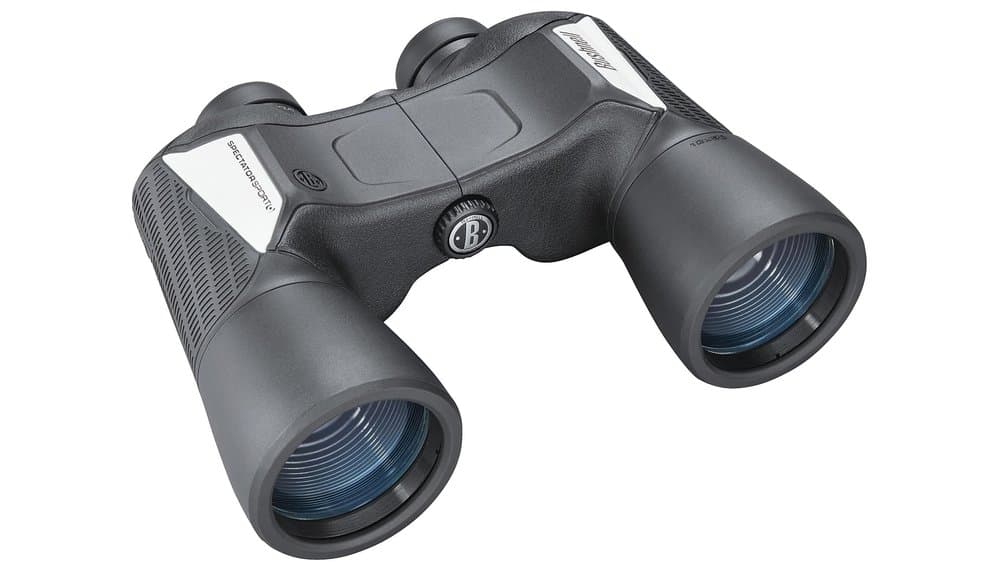
Analysis: Bushnell Spectator Sport 12x50, The Promise of Simple and Fast Observation
The Bushnell Spectator Sport 12x50 binoculars occupy an interesting niche in the consumer optics market. They promise a simplified observation experience thanks to a unique characteristic: the absence of manual focusing. Targeting the user who wants to observe quickly without worrying about adjustments, they present themselves as a "plug and play" tool for nature, sporting events, or the starry sky. Through this comprehensive analysis, we will dissect their technical specifications, confront marketing promises with user feedback, and evaluate their place in the ecosystem of observation instruments.
Strengths:
- Simplicity of use thanks to the Perma Focus system without manual focus.
- Multi-coated optics for good brightness.
- Waterproof and nitrogen purged construction.
- Ergonomic design with aesthetic customization elements.
- Powerful 12x magnification for bringing distant subjects closer.
Weaknesses:
- Limiting fixed focus, with a high minimum focus distance.
- Absence of diopter adjustment, problematic for astigmatism or large differences between eyes.
- Compromised stability at 12x without a tripod, amplifying shake.
- Honorable optical quality but below manual focus models in the same price range.
- Relatively narrow field of view for 12x50.
Detailed Analysis of Specifications and Performance
Optical Quality and Technical Characteristics
On paper, the Spectator Sport 12x50 specifications announce a solid consumer optic. The 12x magnification is significant, ideal for observing details at very long distances, like a perched bird of prey or players on a distant sports field. The 50mm objective promises good light gathering.
The lenses benefit from a multi-coated treatment. This is not the highest-end treatment (like "Fully Multi-Coated"), but it improves light transmission compared to untreated optics. ED (Extra-low Dispersion) glass or dielectric-coated prisms, components reserved for higher segments to reduce chromatic aberration (color fringing) and maximize brightness and contrast, are not found here.
The twilight factor (square root of 12x50 = ~24.5) and exit pupil (50/12 = ~4.2mm) are adequate. The theoretically high twilight factor is tempered by the quality of the lens coatings. The 4.2mm exit pupil is comfortable during the day but may seem limited in very low light conditions compared to 8x42 or 10x50 models where it is larger. The field of view is not specified in the provided data, but user feedback and comparisons with other Bushnell models suggest it is relatively restricted, typical of high-magnification, fixed-focus constructions, which can make tracking moving objects more difficult.
Ergonomics and Build
This is undoubtedly where Bushnell has invested the most in the design. Feedback agrees on a successful ergonomic design, with a rubber armor that offers a good grip and protection against minor shocks. Customization via interchangeable color plates is an aesthetic marketing point appreciated by some users.
The "Waterproof" and "Fogproof" (nitrogen purged) mention is crucial for a product intended for the outdoors. It guarantees protection against weather and sudden temperature changes, preventing internal condensation. The weight of approximately 875g is reasonable for a 12x50 format, but it must be considered that handheld stability at such magnification will always be a challenge.
The most notable feature, Perma Focus, deserves an in-depth analysis. The marketing speaks of "automatic focus" or "permanent focus". Experienced testers and users clarify this point: it is in fact a fixed focus set at the factory on infinity, with a very large depth of field. Concretely, everything beyond a certain distance (estimated by users between 15 and 30 meters depending on the model) appears sharp, without user action. However, any subject closer than this distance will be blurry. There is no electronic autofocus system.
A major ergonomic weak point, highlighted by the community, is the absence of an independent diopter adjustment on one of the eyepieces. This adjustment compensates for the difference in vision between the two eyes. Its absence can make the image permanently blurry for one eye for wearers of certain optical corrections, a deal-breaking disadvantage for some.
Typical Use Cases
- Wildlife observation and static birdwatching: Suitable for observing animals at a fixed, distant range (deer at the forest edge, birds on a lake). The lack of close focus and reduced field of view make them poorly suited for observation in dense forest or of small, mobile songbirds.
- Sporting events or concerts: Their simplicity of use and 12x magnification are perfect for getting a close-up view of a stage or field from distant stands. Fixed focus is an advantage here.
- Light hiking and landscape observation: Their waterproof construction and robustness are suitable, but their weight and bulk are greater than compact 8x32 or 10x42 models.
- Casual astronomy: Their 50mm objective gathers enough light to observe the Moon or star clusters, but the lack of fine focus and shake at 12x without a tripod limit the enjoyment.
- Digiscoping: Not recommended. The absence of precise focus adjustment and the eyecup likely not adapted for alignment with a smartphone make the exercise very difficult.
Technical Specifications Summary
| Characteristic | Bushnell Spectator Sport 12x50 Specification |
|---|---|
| Magnification | 12x |
| Objective Diameter | 50 mm |
| Prism | Type not specified (likely roof) |
| Optical Coatings | Multi-coated on all surfaces |
| Focus System | Perma Focus (fixed, factory-set) |
| Diopter Adjustment | No |
| Waterproof | Yes (Waterproof) |
| Fogproof | Yes (Fogproof) |
| Armor | Rubber |
| Minimum Focus Distance | Not communicated, estimated >15-20m |
| Eyeglass Compatibility | Yes, via twist-up eyecups (depending on design) |
| Weight | Approximately 875 g |
| Customization | Interchangeable color plates included |
What Users and Testers Say
Customer reviews, which show a very positive overall rating, allow us to identify clear trends and nuance the manufacturer's arguments.
Recurrent positive points:
- Ease of use: This is the most praised argument. Users appreciate being able to "just point and look", especially for distant action scenes (sports, aviation). "No more need to search for sharpness" is a frequent comment.
- Perceived brightness and clarity: Many find the image "clear", "sharp", and "bright" for the price, particularly in daytime observation. The simplicity of the optical system seems to offer good light transmission.
- Finish and ergonomics: The modern design, comfortable grip, and ability to change the color inserts are often cited as assets.
- Value for money: In the entry-level segment with special features (Perma Focus), they are judged to be competitive.
Highlighted negatives and limitations:
- Blur in close vision: This is the most frequent criticism. Many users are surprised they cannot focus on objects less than 20-30 meters away. "Useless for watching a bird in the garden" sums up this limitation well.
- Lack of diopter adjustment: Mentioned as a major flaw by connoisseurs, it can make the binoculars uncomfortable or unusable for those whose vision differs from one eye to the other.
- Instability at 12x: Many note that hand shake is amplified, often requiring the use of a support (tree, fence) or a tripod for prolonged observation.
- Confusion about the technology: As an experienced user points out, the term "Autofocus" or "Perma Focus" is often misinterpreted. They insist: "the focus is absolutely not automatic but it is fixed". This clarification is essential to understand the product.
- Field of view: Described as "adequate" but not wide, which can hinder tracking fast-moving subjects.
Conclusion: Who Are These Binoculars For?
The Bushnell Spectator Sport 12x50 are not versatile binoculars for the demanding observer. They embody a very oriented compromise. Their strength lies in radical simplicity of use for specific scenarios: observing static or distant moving objects, where speed of deployment trumps focus precision and field of view.
They will suit the occasional user who wants a tool without complication for sporting events, concerts, or panoramic observation from a fixed point. On the other hand, the birdwatcher, the hiker needing to observe at various distances, or the amateur astronomer seeking fine sharpness will find their fixed focus system and lack of diopter adjustment too limiting.
Compared to the competition, their value lies in their unique proposition. For a similar budget, one finds manual focus binoculars (like some Bushnell models or brands like Nikon, Celestron) that will offer better overall optical quality, diopter adjustment, and close focusing ability, at the cost of a slight complexity of use. The choice therefore boils down to a trade-off: the absolute simplicity of the Spectator Sport, or the versatility and control offered by traditional binoculars in the same price range. For a first pair of binoculars or a very specific use, they can satisfy; for regular and varied nature observation, their limitations will quickly be felt.
100% free and independent — All our articles are written independently, without any sponsorship. We may earn a commission on purchases made through our links, at no extra cost to you.
Articles you might like
Caytail 4K 48MP Hunting Camera Review & Test
In-depth review of the Caytail 4K 48MP trail camera with included SD card. We analyze specs and real user feedback on its true field performance.
Vanguard Endeavor HD65A Spotting Scope Review
Spotting scope with 65mm ED glass & 15-45x zoom for birding & hiking. Balanced performance & portability for serious nature observers.
Carson AdventurePak Kids' Exploration Tool Kit Review
Explore nature with this kid's 5-piece tool kit for outdoor adventure and educational discovery. Perfect for young explorers.
Guides you might like
WiFi Trail Camera Guide
See wildlife discreetly from your couch! Learn how WiFi trail cameras let you monitor animals without disturbance and how to choose the right one.
Ultimate Travel Telescope Guide
Choose a portable, high-performance travel telescope to explore the universe from your backpack without compromising on essential astronomical views.
Ultimate Guide to Night Vision Binoculars
Choose the perfect night vision binoculars: Gen vs. digital? Unravel the tech to make your nighttime wildlife adventures a total success. Guide inside.