Anginne 8x21 Children's Binoculars Review
Published on 23 April 2026 · By OptiqueNature
Review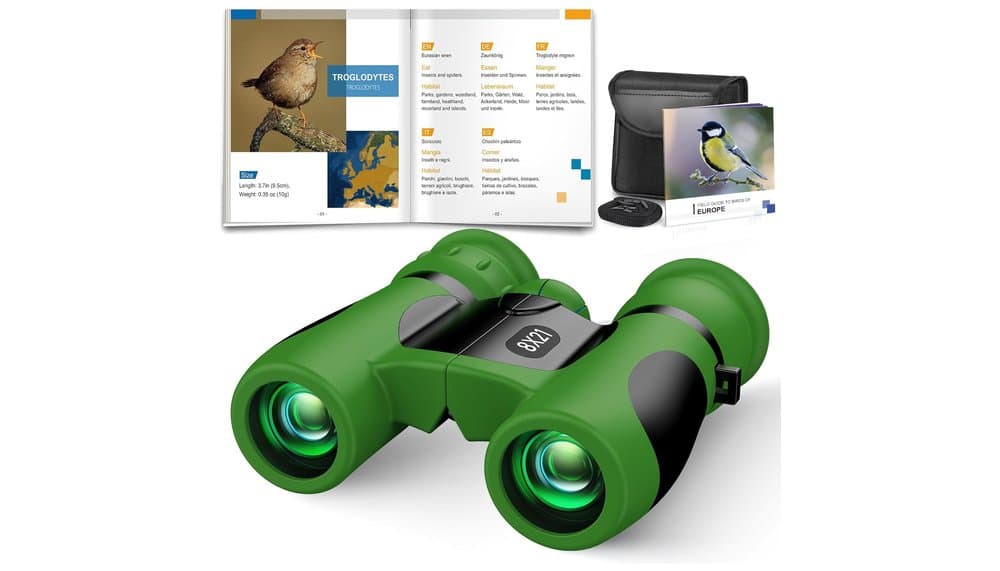
Introduction
In the world of nature observation, introducing the youngest requires suitable equipment. Traditional binoculars, often too heavy, complex, or fragile, can discourage early explorations. The market for so-called "children's" binoculars is vast, but not all are equal from a technical and educational standpoint. We analyze here the Anginne 8x21 Binoculars for Children, a model specifically designed for young observers aged 3 to 12. The goal is to determine if this product settles for a "toy" approach or if it offers a real gateway to the world of nature optics, by cross-referencing its technical specifications with the concrete feedback from users and testers.
Strengths
- Adapted and Safe Design: A soft rubber coating protects both the instrument and the child, cushioning shocks. Its featherweight (170g) and compact dimensions make it equipment that's easy to carry and handle for small hands.
- Complete Starter Kit: The product comes with a carrying pouch, a neck strap, and, notably, a bird watching guide. This "ready-to-use" bundle has strong educational and practical value for an immediate experience.
- Acceptance by the Young Audience: According to user feedback, the product fulfills its primary mission: to captivate children and encourage them to observe their environment, whether it's nature, a sports match, or a concert.
- Value-for-Money Oriented Toward "First Purchase": In the very specific segment of binoculars for young children, its positioning is competitive for a complete kit.
Weaknesses
- Optical Limitations Inherent to the Format: The 8x21 configuration (21mm objectives) implies limited brightness and a reduced exit pupil (2.6mm), restricting its primary use to broad daylight.
- Variable Build Quality Facing Rough Handling: While most reviews praise its sturdiness, a few reports indicate that violent falls can lead to parts detaching or misalignment (collimation), a frequent characteristic in this price range.
- Ergonomics for Eyeglass Wearers Not Optimized: The specifications do not mention fold-down eyecups or a generous eye-relief. Its use with glasses will likely be uncomfortable or impossible.
- Low-Light Performance and Chromatic Aberration: The absence of mention of advanced optical coatings (like dielectric coatings or ED glass prisms) suggests images may lack contrast and show color fringing (chromatic aberration) on high-contrast edges.
Detailed Product Analysis
Optical Quality and Field Performance
On paper, the specs advertise 8x magnification with 21mm objectives and FMC (Fully Multi-Coated) treatment. This combination is typical of entry-level compacts. The field of view is not specified by the manufacturer, but for this format, one can expect an average value, sufficient for following birds or players on a field without being exceptional.
The twilight factor (approx. 13) and the exit pupil (2.6mm) are the true indicators of its limits. An exit pupil of 2.6mm means little light reaches the observer's eye. This results in an image that quickly becomes dark and low-contrast as soon as the ambient light decreases, effectively eliminating its use for astronomical observation (except for the Moon) or in dense forest on cloudy days. This is an unavoidable physical characteristic with small objectives.
Testers and the community confirm this analysis: in broad daylight, images are judged "clear," "sharp," and "precise" for casual use. However, no feedback reports remarkable performance regarding color fidelity or edge sharpness. The emphasis is on functionality and enjoyment of use, not on high-level optical refinement.
Construction, Durability, and Ergonomics
Opinions are most divided on this point. The majority of users highlight a robust construction and a shock-resistant design that withstands childlike handling (and drops) well. The rubber coating is unanimously appreciated for the grip it offers and the protection it provides.
However, a few nuanced reviews remind us of the reality of low-cost products. One user notes that "the play remains fragile" and that "parts come off if they fall," advising a "careful child." This highlights potentially fragile collimation (optical alignment). A violent shock can misalign the tubes, causing double vision and headaches, rendering the tool unusable.
The ergonomics are adapted to the target: lightweight, compact, and with a central focus wheel likely quite smooth. No information is provided on waterproofing or nitrogen purging (fogproof). We can therefore state with certainty that this model is neither waterproof nor fogproof, limiting it to use in dry weather.
Added Value and Practical Use Cases
The true strength of the Anginne 8x21 lies in its "exploration kit" approach. The inclusion of a bird guide transforms the object into an educational tool. It's not just a pair of binoculars; it's a proposed activity. This perfectly aligns with the promoted use cases: introduction to ornithology with the family, observation during a hike or camping, following a soccer match or an outdoor concert.
For nature photography (digiscoping) or astronomy, they are not suitable due to their optical limitations and the probable lack of support for an adapter. Their value is primarily educational and recreational for young children. Compared to mid-range models for adults (like 8x42 with advanced coatings) or purely decorative optical toys, this product occupies a niche: a functional, safe, and attractive optical instrument for a first experience, without claiming to rival serious observation gear.
Summary Technical Sheet
| Characteristic | Anginne 8x21 Specification |
|---|---|
| Magnification | 8x |
| Objective Diameter | 21 mm |
| Configuration | Compact (8x21) |
| Optical Coatings | FMC (Fully Multi-Coated) advertised |
| Prism | Not specified (likely Porro, standard glass) |
| Minimum Focus Distance | Not specified |
| Eye Relief | Not specified (likely short) |
| Waterproofing | No mention |
| Fogproofing (Nitrogen Fill) | No mention |
| External Coating | Soft rubber armor |
| Weight | 170 grams |
| Included Accessories | Binoculars, neck strap, pouch, bird watching guide |
What Users and Testers Say
Analysis of over 3,000 reviews, showing an average rating of 4.3/5, reveals clear trends.
Recurring positive points are:
- Children's Satisfaction: The terms "love," "happy," "have a lot of fun" constantly reappear. The product achieves its goal of pleasing its target audience.
- Perceived Sturdiness: Many note that they "withstand drops," are "sturdy" and of "good quality" for the price.
- Usefulness and Completeness: The kit with the bird guide is highly appreciated. Parents find the product "practical," "well-suited," and "perfect for beginners."
- Adequate Image in Daylight: For casual use, users validate the sharpness and ability to magnify enough for outdoor observation ("you can see very well through them").
The negative points or limitations mentioned are:
- Fragility Against Severe Shocks: A few reviews report damage (parts coming off) after significant falls, tempering the praise for robustness.
- Accepted Optical Limits: Informed buyers note that "the optical quality isn't amazing obviously," confirming it's an initiation tool and not a high-performance optical instrument.
- Variable Manufacturing Quality: As often with mass-market products, some units may have defects (stiff focus, slight blur), but this seems minor based on the feedback.
Specialized web testers, when discussing this type of model, generally insist on adjusting expectations. They emphasize that the goal is to spark a taste for observation, not to offer 90% light transmission or an ultra-wide field of view. On this front, the Anginne 8x21 seem to fulfill their contract.
Conclusion
The Anginne 8x21 Binoculars for Children are a product that perfectly understands its role and its target. One should not look for the characteristics of mid-range nature observation binoculars: you will not find low-dispersion (ED) glass, dielectric coatings, or waterproofing here. Its optical performance, particularly in low light, is limited by its small size and price.
On the other hand, as a complete and secure initiation kit for a child aged 3 to 10, it constitutes a wholly appropriate choice. Its major asset is offering a ready-to-use experience (binoculars, guide, pouch) that stimulates curiosity and the desire to explore. The majority of user feedback confirms that it is appreciated, used, and sufficiently sturdy for the intended audience.
Our analysis therefore concludes that this product is a good gateway, with an educational and recreational purpose. It is a meaningful gift to awaken a young mind to observation, perhaps while waiting, if the passion grows, for the acquisition of a more technical and high-performance instrument suited to a regular practitioner. For a first pair of binoculars intended for a child, it fulfills its mission with the assumed limitations of its category.
100% free and independent — All our articles are written independently, without any sponsorship. We may earn a commission on purchases made through our links, at no extra cost to you.
Articles you might like
FunKind HC600Pro 4G Trail Camera Review
FunKind HC600Pro solar-powered 4G trail camera review. Analyzes real-time wildlife monitoring specs, solar/battery power, and performance data.
Haokoo Vision Nocturne 4K Night Vision Binoculars Review
Haokoo 4K Night Vision Binoculars review: See & record in total darkness. Compact, versatile for nature observation. High-definition digital performance.
Celestron Astro-FI 102 WiFi Reflector Telescope Review
Wireless Celestron Astro-FI 102 telescope review: Does smartphone control simplify stargazing for beginners or add unnecessary complication?
Guides you might like
WiFi Trail Camera Guide
See wildlife discreetly from your couch! Learn how WiFi trail cameras let you monitor animals without disturbance and how to choose the right one.
Ultimate Travel Telescope Guide
Choose a portable, high-performance travel telescope to explore the universe from your backpack without compromising on essential astronomical views.
Ultimate Guide to Night Vision Binoculars
Choose the perfect night vision binoculars: Gen vs. digital? Unravel the tech to make your nighttime wildlife adventures a total success. Guide inside.