AGARELE 20x50 Waterproof HD Binoculars Review
Published on 7 September 2026 · By OptiqueNature
Review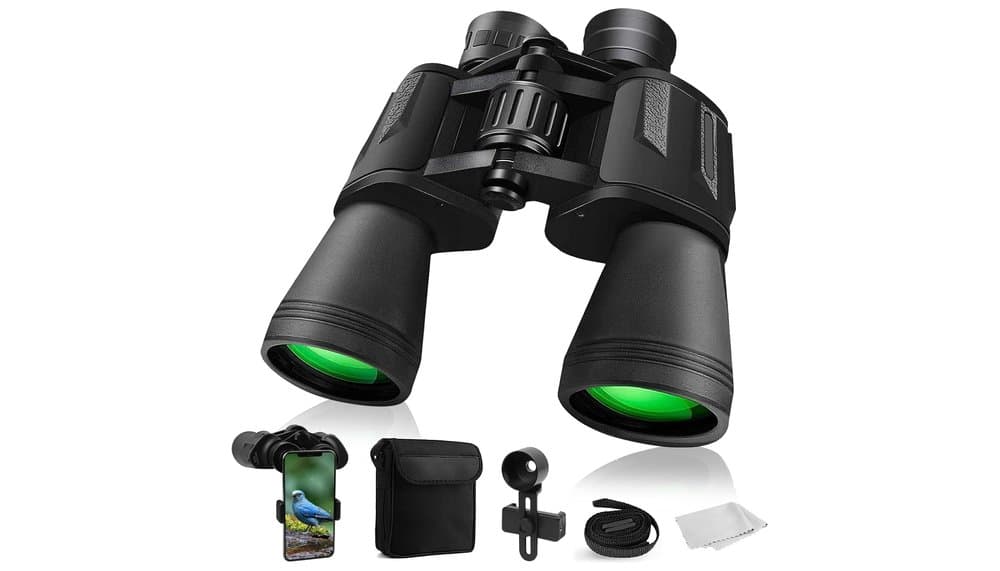
Introduction
High-magnification binoculars occupy a very specific niche in an observer's toolkit. With the AGARELE 20x50 Waterproof HD Binoculars, we enter the category of high-power instruments, promising to scrutinize distant details. The model clearly bets on a trio of attributes: a 20x magnification power, waterproof robustness, and HD imaging meant to guarantee clarity and brightness. On paper, it's an enticing proposition for demanding birdwatching or long-distance wildlife observation. But this 20x50 configuration is a delicate balance between power and stability. Through this article, we will dissect this offering by confronting its technical specifications with concrete feedback from the community and the expectations of our field: nature observation.
Strong Points
Analyzing user feedback and technical characteristics reveals several solid assets for the AGARELE 20x50.
- Perceived excellent value for money: This is the recurring theme in positive reviews. For a contained investment, users feel they are getting a complete and performant product.
- Robustness and complete finish: The waterproof construction and rubber armor are consistently praised. The accessory kit, including notably a functional smartphone adapter, a carrying case, and a neck strap, adds real perceived value.
- Clarity and brightness judged good in normal conditions: Users note a sharp image, with vibrant colors and good contrast for daytime observations. The advertised combination of BAK4 prisms and FMC coatings seems to yield satisfactory results at this price point.
- Handling and ergonomics: The non-slip coating and ergonomic shape are described as comfortable and secure, facilitating grip.
- Essential tripod compatibility: The presence of a standard tripod mount is not a gimmick on a 20x model, but a necessity. This feature is well integrated and allows image stabilization for prolonged observations.
Weak Points
The points of caution stem mainly from the very choice of the optical configuration and some limitations identified by users.
- Questioned magnification power: This is the most serious critical point. Several testers, some comparing with known 10x models, express doubts about the magnification actually reaching the advertised 20x, sometimes estimating it closer to 10-12x. This directly impacts the primary use case.
- Critical stability and weight for handheld use: The 20x magnification greatly amplifies the slightest tremor, making handheld observation difficult and tiring over time. Its weight of 820 grams contributes to this instability. A tripod often becomes mandatory, limiting spontaneity.
- Relatively narrow field of view: With an advertised field of 56m at 1000m, this model offers a limited angular field. For observing birds in flight or scanning a landscape, this requires more tracking and framing effort than models with a wider field.
- Low-light performance limited by the aperture: Despite the "Night Vision" qualifier in the marketing description, a 50mm objective is a compromise for a 20x. The exit pupil of 2.5mm (50/20) is small, meaning the image darkens significantly in twilight conditions compared to 10x50 or 8x42 models.
- Optical quality at the edges and diopter adjustment: Some feedback mentions sharpness that can drop at the edge of the field, and the diopter adjustment system (ring on the right eyepiece) may require careful handling for a perfect focus for both eyes.
Detailed Analysis by Criterion
Optical Quality and Performance
On paper, the specs announce a respectable technical base for the entry-level/price segment: roof prisms made of BAK4 glass (better than BK7) and FMC (Fully Multi-Coated) treatments on the lenses. This should, in theory, maximize light transmission and contrast.
However, the real implications must be understood. The coatings are "multi-coated," but the lens materials themselves are not at the ED (Extra-low Dispersion) level, found on mid-range and premium models. According to feedback trends, this translates into possible loss of sharpness and colored fringes (chromatic aberration) on strong contrasts (e.g., dark branch against a bright sky), especially at the image edges. Light transmission, although improved by the coatings, is physically limited by the small 2.5mm exit pupil. The twilight factor (√(20x50) ≈ 31.6) is high, suggesting a good ability to discern details under a given light, but the perceived brightness (linked to the exit pupil) will be low as soon as light fades.
For light astronomical observation (Moon, star clusters), the power is an asset, but the small exit pupil and possible aberrations will limit enjoyment compared to a dedicated 10x50 or 7x50 pair.
Construction, Ergonomics, and Durability
This is an area where the AGARELE seems well-rated. The community appreciates the feeling of solidity, the rubber armor that absorbs minor shocks and provides a good grip. The waterproof rating is crucial for outdoor use; it typically implies O-ring seals and nitrogen purging to prevent internal fogging (fogproof). It's a serious feature to withstand a rain shower or high humidity.
The weight of 820g is a double-edged sword: it contributes to the quality feel but weighs in the hand and worsens the stability problem at 20x. The ergonomics are suitable for use with or without gloves, and the central focus wheel is described as smooth by most.
For eyeglass wearers, the eye-relief (distance at which the eye must be placed to see the entire field) is not specified in the specs. Reviews do not mention it as a major problem, suggesting that the twist-up eyecups offer sufficient travel to adapt to many glasses, but this is not guaranteed for all.
Use Cases: Who Are They For?
- Bird and wildlife observation at fixed distance: Ideal for observing a nest, a hide, or a stationary animal at very long range, imperatively on a tripod. Their weight and narrow field make them poorly suited for "tracking" fast-moving forest birds.
- Terrestrial observation (hiking, landscapes): The power allows scanning of a distant detail (a rock face, a building), but the reduced field of view and handheld instability make them a supplementary tool rather than a primary pair for hiking.
- Sporting events or concerts: Provided you have a stable support point (railing, stand), the power can be appreciated for seeing details of the action on a large field or a distant stage.
- Digiscoping (smartphone photography): The inclusion of the smartphone adapter is a real plus. Coupled with the stability of a tripod, it can yield surprising results for capturing images of the Moon or distant animals, although quality depends largely on the phone's sensor.
- Light astronomy: A double-edged choice. The power is good for the Moon, but the small exit pupil and potential optical flaws limit deep-sky observation. A pair with a wider field and larger exit pupil is often more enjoyable.
Synthesized Technical Specifications
| Characteristic | Detail |
|---|---|
| Model | AGARELE 20x50 Waterproof HD Binoculars |
| Magnification | Advertised 20x |
| Objective Lens Diameter | 50 mm |
| Prism | Roof, BAK4 glass |
| Optical Coatings | FMC (Fully Multi-Coated) |
| Field of View | 56 m at 1000 m (Approximate angle: ~3.2°) |
| Exit Pupil | 2.5 mm (Calculation: 50/20) |
| Twilight Factor | ~31.6 (Calculation: √(20x50)) |
| Minimum Focus Distance | Not specified |
| Eye-Relief | Not specified, twist-up eyecups |
| Waterproofing | Advertised Waterproof |
| Gas Filling | Likely nitrogen (for fogproof, deduced from "waterproof") |
| Armor Material | Rubber |
| Tripod Compatibility | Yes, standard integrated adapter |
| Weight | 820 grams |
| Included Accessories | Binoculars, neck strap, carrying case, smartphone adapter, cleaning cloth, objective and eyepiece caps, manual. |
What Users Say: A Synthesis of Reviews
The overall rating of 4.4/5 from nearly 450 reviews speaks of majority satisfaction, but analysis of comments reveals clear trends.
Recurrent praise focuses on:
- The perceived image quality described as "sharp," "precise," "clear," and "bright" for the price.
- The solidity and finish, with special mention for the complete accessory kit, the smartphone adapter being judged "ingenious" and functional.
- The value for money, often qualified as "excellent," "incredible," or "exceptional."
- The ease of handling and ergonomics.
Frequent criticisms and reservations highlight:
- Serious doubts about the actual magnification. Several users state that the magnifying power seems lower than the advertised 20x, some estimating it closer to 8x or 10x. This is the most problematic friction point.
- The heaviness and especially the extreme handheld instability due to the high magnification, making a tripod almost mandatory for serious use.
- Disappointment for those expecting exceptional night vision performance, whereas it is a tool designed for daylight.
- A few rare mentions of initial adjustment difficulties or build quality that could be improved.
Conclusion
The AGARELE 20x50 Waterproof HD Binoculars present themselves as a hybrid and ambitious product. They offer, according to the community, a very complete and robust package for a tight budget, with honest optical performance in daylight and real versatility thanks to the smartphone adapter and tripod mount. The waterproof construction makes them a reliable companion for the field.
However, their main weakness is inherent to their central promise: the 20x magnification. Not only is its reality contested by several testers, but its mere value makes the instrument unwieldy and unstable without support. This makes them a niche pair, excellent for stationary and meticulous observations at very long distance (with a tripod), but poorly suited for classic, moving nature observation or spontaneous, mobile use.
Our verdict: These binoculars are a risky but potentially very satisfying buy for a specific user. If you are primarily looking for a high-magnification supplementary binocular pair to leave on a tripod at a fixed observation point (hide, garden, balcony), and your budget is tight, they fully deserve consideration. On the other hand, if you are looking for a versatile main pair for hiking, active birdwatching, or observation in low light, a model with more moderate magnification (8x or 10x) and a wider field of view, even in a similar price range, will likely be a wiser and more rewarding choice for everyday use. The gap between marketing specifications and the real user experience, particularly regarding magnification, invites adjusting expectations accordingly.
100% free and independent — All our articles are written independently, without any sponsorship. We may earn a commission on purchases made through our links, at no extra cost to you.
Articles you might like
Caytail 4K 48MP Hunting Camera Review & Test
In-depth review of the Caytail 4K 48MP trail camera with included SD card. We analyze specs and real user feedback on its true field performance.
Vanguard Endeavor HD65A Spotting Scope Review
Spotting scope with 65mm ED glass & 15-45x zoom for birding & hiking. Balanced performance & portability for serious nature observers.
Carson AdventurePak Kids' Exploration Tool Kit Review
Explore nature with this kid's 5-piece tool kit for outdoor adventure and educational discovery. Perfect for young explorers.
Guides you might like
WiFi Trail Camera Guide
See wildlife discreetly from your couch! Learn how WiFi trail cameras let you monitor animals without disturbance and how to choose the right one.
Ultimate Travel Telescope Guide
Choose a portable, high-performance travel telescope to explore the universe from your backpack without compromising on essential astronomical views.
Ultimate Guide to Night Vision Binoculars
Choose the perfect night vision binoculars: Gen vs. digital? Unravel the tech to make your nighttime wildlife adventures a total success. Guide inside.