ZWO Seestar S30 Smart Telescope Test & Review
Published on 14 April 2026 · By OptiqueNature
Review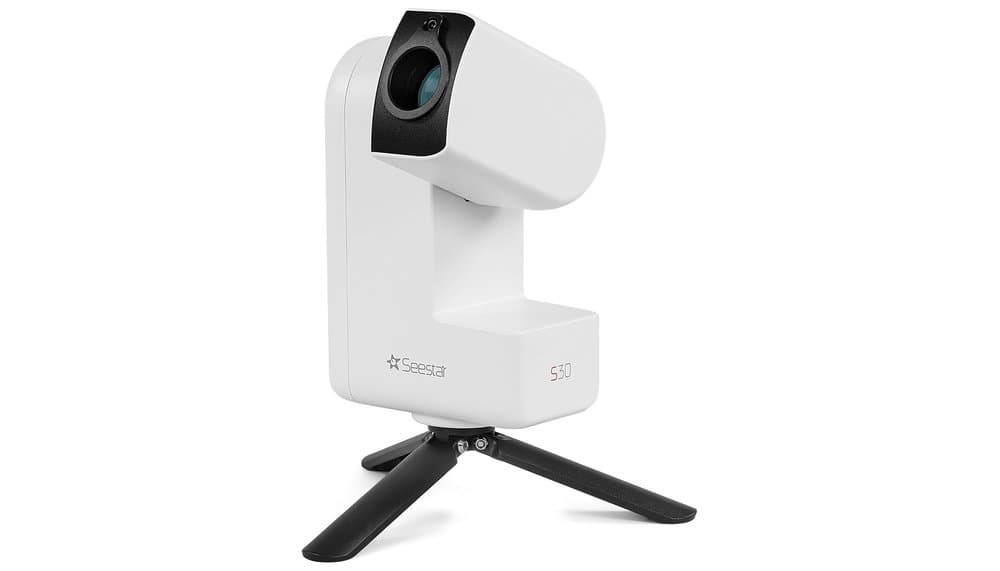
Introduction
The ZWO Seestar S30 is not a traditional telescope. It's a hybrid instrument that fuses optics, electronics, and computing to create a radically simplified experience for astronomical and terrestrial observation and photography. Presented as the more compact successor to the S50, it targets a new category of users: those seeking concrete results without the steep learning curve of classic setups. Our analysis goes beyond the specifications to understand if this "smart telescope" delivers on its promises of accessibility and quality.
Key Strengths
- Revolutionary Ease of Use: Automatic alignment and pointing (GoTo) eliminate the main technical barriers of amateur astronomy.
- Exceptional Portability: With a total package weight of 3.63 kg, its compact form makes it ideal for travel or use on a balcony.
- Powerful Integrated Image Processing: Stacking, noise reduction, and in-app processing functions provide final, shareable results directly.
- Versatility of Modes: It easily switches from deep-sky astrophotography to landscape mode or solar observation (filter included).
Weaknesses
- Inherent Optical Limits: The 30mm aperture is limiting for fine planetary resolution or light collection on very faint objects.
- Dependence on the App and Updates: The experience is entirely reliant on the ZWO software ecosystem and its long-term support.
- "Black Box" Experience: The automated process offers little room for advanced manual control, which may frustrate enthusiasts wanting to fine-tune everything.
- Variable Build Quality: Some user reports point to details in packaging or finish that could be improved upon receipt.
Detailed Analysis of the ZWO Seestar S30
Optical Design and Performance
The heart of the Seestar S30 is an apochromatic triplet (APO) lens with a 30mm aperture and 150mm focal length (resulting in a focal ratio of f/5). This APO design is crucial: it aims to minimize chromatic aberrations, those colored fringes that degrade contrast, especially on the Moon or in terrestrial observation. According to testers and photos shared by the community, this correction is generally effective for the format and price.
The 30mm aperture defines its scope. In astronomy, it allows for capturing vast celestial fields (like the Orion Nebula or the Andromeda Galaxy in their entirety thanks to its wide field) and star clusters with lots of character. On the other hand, as experts point out, it quickly reaches its limits on objects requiring high resolution (planetary details) or extreme light collection (very faint nebulae). For terrestrial observation, this aperture is sufficient in daylight, offering adequate brightness.
The Sony IMX662 sensor (a 1/2.8" color CMOS) and the presence of integrated filters (UV/IR-Cut and a dual-band filter for nebulae) are technical choices consistent with its mission as an "all-in-one imager." Light transmission is optimized by this configuration, though it cannot compete with larger aperture systems.
Build, Ergonomics, and Weatherproofing
With its reduced dimensions (approx. 20 x 10 x 14 cm) and contained weight, the S30 is a champion of portability. User feedback unanimously emphasizes this advantage: it slips into a backpack and sets up in seconds. The integrated tripod seems robust for its size, but it's designed for stability on a flat surface rather than resistance to vibrations or wind gusts.
The overall build, according to reviews, seems solid. However, a few isolated comments (like the one mentioning a damp smell or residue upon receipt) suggest that final quality control could sometimes be improved. There is no official information regarding a water and fog protection rating (waterproof/fogproof). Its sealed design and the lack of advertised seals suggest it should be handled with care in humid conditions or with significant temperature variations.
Ergonomics are centered on the app. The physical housing has almost no buttons. Focus adjustment is fully automatic, a point praised by beginners but which may lack manual precision for some purists. The eye relief concept does not apply here, as there is no eyepiece per se: the image is viewed and controlled on your smartphone or tablet screen.
Software and User Experience
This is the area where the Seestar S30 innovates the most. The dedicated app serves as the single command center. It manages the object catalog (over 4000 entries), automatic alignment via internal sensors and the smartphone's GPS, tracking, image capture, and real-time image processing.
Functions like automatic stacking (image stacking to reduce noise), noise reduction, and integrated processing styles turn raw data into presentable images within minutes. Testers emphasize that it's this automation that makes deep-sky objects accessible, even under light-polluted urban skies. The mosaic function for capturing very large objects is also a major asset.
The main pitfall, noted by some users, is dependence on this ecosystem. App updates are vital. Furthermore, the interface and tutorials are not always fully available in French, which can represent a language barrier for some.
Specific Use Cases
- Deep-Sky Astrophotography (nebulae, galaxies): This is its preferred domain. It excels at quickly producing colorful, detailed images of the brightest and most extended objects. The results, while far from the level of a dedicated multi-thousand-euro setup, are impressive for their accessibility.
- Lunar and Solar Observation: Performs well. The included magnetic solar filter (a real safety plus) allows for safe Sun observation. Lunar details are well rendered.
- Planetary Observation: This is its most obvious limitation, as confirmed by users. The 30mm aperture cannot reveal the fine structures of gas giant planets.
- Terrestrial Observation and Digiscoping: Landscape mode and the ability to record short videos make it a versatile tool for nature. Its autofocus and light weight are assets, although its minimum focusing distance (unspecified, but apparently very short based on test videos) and lack of optical zoom confine it to wide scenes.
Technical Specifications
| Feature | Detail |
|---|---|
| Instrument Type | Smart Telescope (Integrated Telescope/Motorized Alt-Az Mount) |
| Aperture (Lens) | 30 mm |
| Focal Length | 150 mm (Focal Ratio: f/5) |
| Optical Design | Apochromatic Triplet (APO) |
| Sensor | Sony IMX662 Color CMOS (1/2.8") |
| Mount | Integrated motorized Alt-Az, Automatic GoTo |
| Integrated Filters | UV/IR-Cut, Dual Band (OIII/H-alpha), Dark |
| Included Filter | Magnetic Solar Filter |
| Power | Internal rechargeable battery (via USB-C) |
| Connectivity/Control | Smartphone/tablet app (iOS/Android) |
| Main Modes | Deep Sky, Solar System, Landscape |
| Software Functions | Automatic Alignment, Stacking, Integrated Processing, Mosaic, Object Catalog |
| Dimensions (LxWxH) | Approx. 20.3 x 10.2 x 14 cm |
| Weight (product only) | Not specified, total package weight: 3.63 kg |
| Included Accessories | Integrated tripod foot, USB-C cable, Solar filter, Carrying bag, Manual |
What Users Are Saying
The reception of the ZWO Seestar S30 by the community is very positive, with an overall rating of 4.7/5 stars. The trends are clear.
The recurring positive points are:
- Extraordinary Ease of Use: This is the most frequent comment. Complete beginners, like Pascal who says "I have never used this kind of device... it's intuitive to get started," are delighted.
- Portability and Compactness: "Transportable anywhere" is a frequently cited quality, appreciated for travel or impromptu sessions.
- Impressive Results for the Investment: Many users, like Tetsuo Shima, concede that "it will never produce the photos of multi-thousand-euro equipment, but the result is very impressive." The ability to obtain nice images even in polluted urban areas is praised.
- Successful Automated Process: The GoTo alignment, tracking, and integrated processing are seen as major time-savers.
The criticisms and points of attention raised are:
- Limitation for Planets: Several reviews, including Tetsuo Shima's, clearly indicate it is "not recommended for planetary."
- Software Dependence and Language: A German user (digimax) regrets the lack of complete translation for the app and detailed manual.
- Inconsistent Build Quality: Isolated incidents, like the one reported by Deborah (damp smell, residue), show that quality control can sometimes falter, even if it doesn't seem to affect performance.
- Missing Accessories: The absence of a suitable power adapter is sometimes mentioned.
Conclusion
The ZWO Seestar S30 Smart Telescope is not made to replace the setup of an experienced astrophotographer. It invents its own category. It is a democratization instrument that brilliantly succeeds in its goal: making the beauty of the night sky and the basics of astronomical imaging accessible to almost everyone, quickly and without major frustration.
Its true talent lies in abstracting complexity. It trades a degree of manual control and ultimate performance for a fluid and rewarding experience. For the occasional nature observer, the hiker curious about the sky, or the beginning astronomer who wants to see concrete results before potentially diving into more complex equipment, the Seestar S30 represents very high perceived value.
If you accept its optical limits (especially for planets) and its philosophy as a "connected smart device," you will find in it a companion capable of revealing the universe with disconcerting ease. It's a product that doesn't speak to purists of fine mechanics, but speaks directly to our desire for contemplation and sharing, by eliminating the technical obstacles between our eyes and the stars.
100% free and independent — All our articles are written independently, without any sponsorship. We may earn a commission on purchases made through our links, at no extra cost to you.
Articles you might like
BOSTRON CY 10x50 Monocular Review & Test
Compact 10x50 monocular review: Analyzes optical clarity, field of view & build quality for hiking, nature & astronomy. See its true value.
FunKind HC600Pro 4G Trail Camera Review
FunKind HC600Pro solar-powered 4G trail camera review. Analyzes real-time wildlife monitoring specs, solar/battery power, and performance data.
Haokoo Vision Nocturne 4K Night Vision Binoculars Review
Haokoo 4K Night Vision Binoculars review: See & record in total darkness. Compact, versatile for nature observation. High-definition digital performance.
Guides you might like
WiFi Trail Camera Guide
See wildlife discreetly from your couch! Learn how WiFi trail cameras let you monitor animals without disturbance and how to choose the right one.
Ultimate Travel Telescope Guide
Choose a portable, high-performance travel telescope to explore the universe from your backpack without compromising on essential astronomical views.
Ultimate Guide to Night Vision Binoculars
Choose the perfect night vision binoculars: Gen vs. digital? Unravel the tech to make your nighttime wildlife adventures a total success. Guide inside.