SVBONY SV28 25-75x70 Monocular Review & Test
Published on 3 March 2026 · By OptiqueNature
Review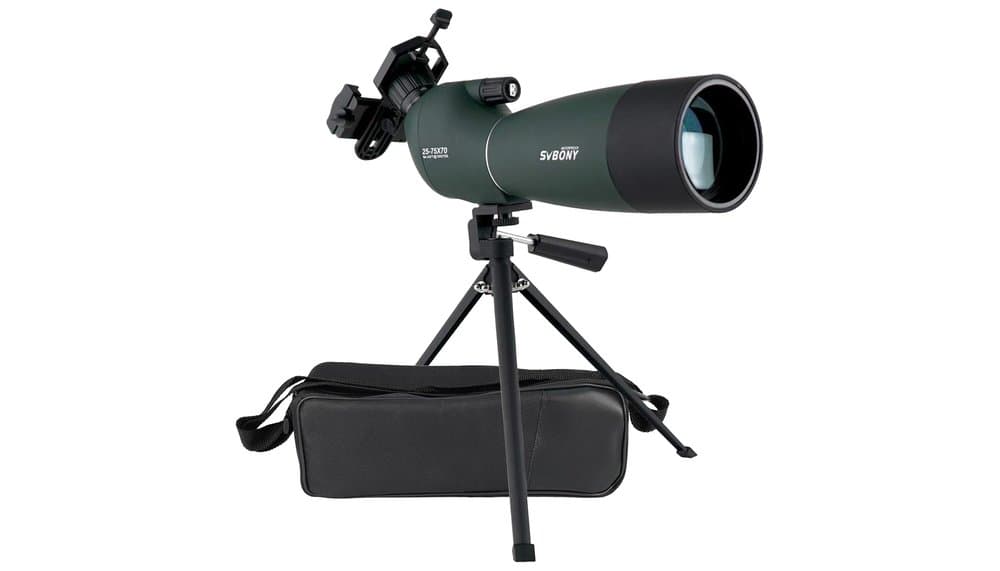
Comprehensive Analysis of the SVBONY SV28 25-75x70 Monocular: A Complete Entry-Level Kit
In a world of observation optics often dominated by very expensive brands, the SVBONY SV28 25-75x70 Monocular stands out as a serious contender for budget-conscious nature observers. With its extended zoom and large 70 mm front lens, it promises a lot. Here, we dissect its technical specifications, build, and real-world performance through the lens of user feedback and expert reviews.
Strengths and Weaknesses
Strengths
- Complete and Versatile: Comes with a tabletop tripod, smartphone adapter, case, and accessories, making it a ready-to-use kit.
- Attractive Theoretical Power: A 25-75x70 mm combination offers, on paper, significant range for the price.
- Robust and Weatherproof Build: The armor rubber coating and IP65 certification ensure a certain durability outdoors.
- Excellent Digiscoping Capability: The inclusion of a universal smartphone adapter makes it an immediate tool for sharing and capturing.
Weaknesses
- Limited Real Magnification: Users unanimously report that the effective maximum magnification is well below the advertised 75x.
- Optics with Compromises: The presence of chromatic aberrations, loss of sharpness at the edges, and a very narrow exit pupil at high magnifications limit comfort.
- Modest-Quality Accessories: The included tripod is considered too small for standing use, and the protective caps do not stay on well.
- Ergonomics Could Be Improved: The focusing is very sensitive and delicate, especially at high magnifications.
Detailed Analysis of Specifications and Performance
Optical Quality and Visual Performance
On paper, the specs announce a classic configuration for an entry-level instrument: a BAK-4 Porro prism and FMC (Fully Multi-Coated) coatings. This combination should, in theory, offer good light transmission and correct contrast.
However, analysis of field reports reveals intrinsic limits. According to users, the image is generally satisfactory at minimum magnification (25x), with correct brightness thanks to the 70 mm diameter. On the other hand, as soon as you zoom in, performance drops significantly. Brightness decreases sharply and chromatic aberrations (colored fringes on contrasts) become visible. The exit pupil, which is 2.8 mm at 25x (70/25), drops to only 0.93 mm at 75x (70/75). A figure below 2 mm is considered very narrow, making eye placement critical and the subjective image dim. This explains the many comments about the difficulty of obtaining a clear and comfortable image at high magnifications.
Regarding the advertised field of view (20m at 13m at 1000m), it is quite standard, even a bit narrow, for this type of zoom monocular. Do not expect a panoramic view, but it is sufficient for tracking a perched bird or observing a precise detail.
Build and Ergonomics
The community notes that the monocular is well built for its price. The rubber coating offers a good grip and protection against minor shocks. The IP65 waterproof and fog-proof certification is a real plus, allowing use in all weather without immediate fear for the instrument's integrity.
The most criticized element regarding ergonomics is the focusing mechanism. Testers point out that it is extremely sensitive and that the depth of field is very shallow, especially at high magnifications. A millimeter adjustment is necessary, which can be frustrating for beginners. The foldable eyecup with 16-14 mm eye relief is adequate for eyeglass wearers, although some need to adjust its position to avoid vignetting (black corners).
The included accessories are seen as a useful bonus but of basic quality. The tabletop tripod is stable on a flat surface but totally unsuitable for standing use outdoors. The smartphone adapter is functional once correctly mounted, but its installation is often described as non-intuitive and its attachment to the focusing ring can be cumbersome. The front and rear caps have an unfortunate tendency to not stay in place.
Typical Use Cases
- Wildlife Observation and Birdwatching: Ideal for static observation from a blind or fixed position (garden, window) with a sturdy tripod. The power allows seeing plumage details at medium distance. Its compactness compared to a spotting scope is an asset.
- Occasional Digiscoping: The inclusion of the smartphone adapter makes it an immediate tool for capturing images or videos to share. Quality will be limited by the optics of the monocular and smartphone, but sufficient to document an observation.
- Sport Shooting: Highly appreciated in this community for impact spotting at 50 or 100 meters. The stability provided by a tripod and the possibility of using the smartphone screen instead of the eyepiece are major advantages.
- Light Astronomy: Some users manage to observe the Moon and bright planets. However, the lack of a precise azimuth mount and optical limitations at high magnifications make it a very limited instrument for astronomy.
- Hiking and Travel: Its monocular format is more compact than a pair of binoculars, but its weight (approx. 800g with accessories) and the quasi-systematic need for a tripod for high magnifications make it a poorly suited companion for active walking.
Value for Money and Competition
Web experts agree that the SVBONY SV28 offers the best value for money in its budget category. It clearly beats "no-name" zoom monoculars at an equivalent price thanks to correct materials, acceptable finish, and the inclusion of practical accessories.
However, it occupies a very specific place. It cannot compete with monoculars or spotting scopes with ED (Extra-low Dispersion) glass or roof prisms from the mid-range segment, which offer much better clarity, contrast, and viewing comfort. Its comparison stops at the entry-level. Its main merit is providing a functional entry point into high-magnification observation without a significant investment, requiring the user to be patient and accept its optical limits.
Technical Specifications
| Characteristic | Detail |
|---|---|
| Model | SVBONY SV28 25-75x70 Monocular |
| Magnification | 25x to 75x (continuously variable) |
| Objective Diameter | 70 mm |
| Prism | Porro BAK-4 |
| Optical Coatings | FMC (Fully Multi-Coated) |
| Field of View | 20 m at 1000m (at 25x) / 13 m at 1000m (at 75x) |
| Exit Pupil | 2.8 mm (at 25x) to 0.93 mm (at 75x) |
| Diopter Adjustment | On the eyepiece |
| Eye Relief | 16 - 14 mm |
| Waterproofing | IP65 standard (protected against water jets and dust) |
| Exterior Coating | Armor rubber |
| Minimum Focus Distance | ~8 meters |
| Included Accessories | Universal smartphone adapter, tabletop tripod, carrying case, cleaning cloth, caps |
| Tripod Compatibility | Standard 1/4" threading |
| Eyepiece | Fixed, angled at 45° |
What Users and Experts Say
The synthesis of several hundred customer reviews and expert feedback reveals very clear trends.
Recurring Positive Points:
- Perceived excellent value for money for a first approach to high magnification.
- Brightness and sharpness are judged correct, even good, up to about 40-50x.
- The physical construction (armor, waterproofing) inspires confidence and exceeds expectations for the price.
- The fact that it is shipped complete with a smartphone adapter is a decisive argument for many.
- Its use for sport shooting is very often praised as a perfectly suited application.
Frequently Mentioned Criticisms and Limitations:
- The advertised 75x magnification is considered marketing. The majority of users estimate the useful maximum to be around 40x to 50x. Beyond that, the image becomes too dark and blurry.
- Focusing is extremely delicate and requires very precise manipulation, especially from 40x onwards.
- Chromatic aberrations (color fringing) are present, particularly on strong contrasts.
- The accessories, although appreciated for being included, are of very basic quality. The small tripod is unusable outdoors and the smartphone adapter can be tricky to adjust firmly.
- The user manual is often described as confusing or unclear.
Conclusion
The SVBONY SV28 25-75x70 Monocular is a product that perfectly assumes its positioning: a complete and economical initiation solution to the world of high-magnification observation. It excels as an immediate digiscoping tool and finds a highly appreciated niche application in sport shooting.
However, one must approach this purchase with full awareness. This is not a precision optical instrument. Its limitations – a real magnification lower than promised, optics presenting aberrations, and a demanding focusing ergonomics – are the price to pay for its very contained cost. It will suit the occasional observer, the curious beginner, or the user looking for a specific solution for the shooting range perfectly, but will frustrate those seeking a perfect, bright, and comfortable image at 75x. For the latter, one will need to turn, with a multiplied budget, to higher segments. The SV28 nonetheless remains the essential reference for a "starter kit" in its category.
100% free and independent — All our articles are written independently, without any sponsorship. We may earn a commission on purchases made through our links, at no extra cost to you.
Articles you might like
Carson AdventurePak Kids' Exploration Tool Kit Review
Explore nature with this kid's 5-piece tool kit for outdoor adventure and educational discovery. Perfect for young explorers.
BOSTRON CY 10x50 Monocular Review & Test
Compact 10x50 monocular review: Analyzes optical clarity, field of view & build quality for hiking, nature & astronomy. See its true value.
FunKind HC600Pro 4G Trail Camera Review
FunKind HC600Pro solar-powered 4G trail camera review. Analyzes real-time wildlife monitoring specs, solar/battery power, and performance data.
Guides you might like
WiFi Trail Camera Guide
See wildlife discreetly from your couch! Learn how WiFi trail cameras let you monitor animals without disturbance and how to choose the right one.
Ultimate Travel Telescope Guide
Choose a portable, high-performance travel telescope to explore the universe from your backpack without compromising on essential astronomical views.
Ultimate Guide to Night Vision Binoculars
Choose the perfect night vision binoculars: Gen vs. digital? Unravel the tech to make your nighttime wildlife adventures a total success. Guide inside.