Sky-Watcher 203-1200 Dobsonian Telescope Review
Published on 12 March 2026 · By OptiqueNature
Review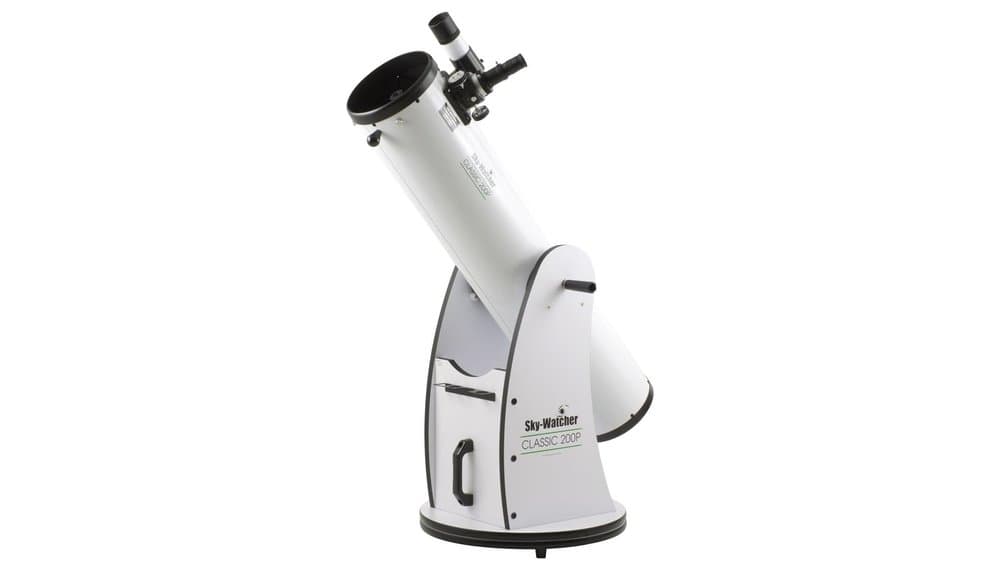
Introduction
The Sky-Watcher 203/1200 Dobsonian Telescope is a cornerstone in the world of amateur astronomical observation. In a market segmented between compact instruments and high-tech motorized models, this Dobsonian returns to the essentials: large aperture, simple mechanics, and raw optical performance. Primarily intended for visual observation, it promises to reveal hundreds of deep-sky objects while offering detailed views of the planets. Through this analysis, we will dissect its specifications, compare its promises with community feedback, and determine for which observer profile it constitutes the most relevant choice.
Strengths and Weaknesses
Strengths
- Exceptional aperture-to-price ratio: The 203 mm primary mirror offers a very large light-gathering surface for its segment, enabling particularly bright deep-sky observations.
- Simplicity and intuitiveness: The Dobsonian altazimuth mount requires no complex polar alignment. You point and observe, an immediacy praised by beginners.
- Versatile optical performance: Capable of providing detailed images of the Moon and planets (Jupiter, Saturn, Mars) while revealing a multitude of nebulae, clusters, and galaxies.
- Robustness and durability: The overall construction, with its solid tube and MDF/Formica wooden mount, is described as sturdy and built to last for many years.
- Relative transportability: Although bulky, the system easily separates into two main parts (tube and base) for transport by car to a dark-sky observing site.
Weaknesses
- Unsuitable for deep-sky astrophotography: The lack of motorization and an equatorial mount prevents the long exposures necessary for photographing galaxies and nebulae.
- Required maintenance: Like any Newtonian telescope, it requires regular collimation (mirror alignment), an operation to learn to maintain optimal images.
- Entry-level accessories: The supplied eyepieces (typically a 25mm and 10mm Super MA) are sufficient to start but are often the first accessory users seek to upgrade.
- Size and weight: With a tube 1.2 meters long, it requires adequate storage space and is not an instrument for astronomical hiking.
- Basic finder scope: The supplied red-dot finder or small optical finder is considered minimalistic by some, who replace it with a more capable model.
Detailed Analysis of the Sky-Watcher 203/1200 Dobsonian
Optical Quality and Field Performance
On paper, the specifications describe a Newtonian design telescope with a 1200 mm focal length (f/5.9). This relatively fast focal ratio is an effective compromise between planetary resolution and brightness for deep-sky. The 203 mm primary mirror is the heart of the system. Based on expert reviews and user feedback, the optical quality of these mirrors, often parabolic, is remarkable for the price, delivering sharp, contrasty images.
In practical terms, this translates to a proven ability to resolve Jupiter's cloud bands and the Cassini Division in Saturn's rings. For deep-sky, the large aperture makes the difference: where a 130 or 150 mm instrument only shows a fuzzy patch, the 203/1200 often reveals the structure of nebulae like M42 (Orion) or the stretched shape of galaxies like M81 and M82. Light transmission is high, typical of an all-mirror system, but greatly depends on coating quality and optical cleanliness.
Construction, Ergonomics, and Usability
The Dobsonian philosophy is centered on mechanical simplicity. The altazimuth mount made of laminated wood, featuring Teflon/Formica sliding bearings, is consistently described as smooth and precise in movement. This intuitive ergonomics is a major asset for family observation or for novices who want to focus on the sky and not on technique.
The tube, made of steel, is robust. However, its weight (approximately 10 kg for the tube alone) and length imply it is an instrument meant to be used from one's backyard or transported by car to a site. It is neither waterproof nor anti-dew, which is standard for the category. Storing it away from humidity is imperative.
A crucial point raised by the community is collimation. Mirrors can become slightly misaligned during transport. Learning to realign the secondary and primary mirrors using a dedicated tool (collimation cap or laser, not supplied) is a necessary step to fully exploit the instrument's potential. Users confirm that after a short learning curve, this operation becomes quick and routine.
Value for Money and Competitive Segments
The Sky-Watcher 203/1200 occupies a pivotal position. In the budget segment (below 150 mm aperture), it vastly outperforms in capabilities, but at the cost of significantly greater bulk. Compared to similarly sized mid-range motorized models or Schmidt-Cassegrain types, its argument is unbeatable: for the same budget, you get a significantly larger aperture, hence more light and detail, at the expense of motorized tracking and portability.
It does not compete with the high-end of motorized Dobsons or ultra-stable tripod-mounted models, which offer superior finishes and accessories. Its role is clear: to provide maximum pure optical performance for visual observation at a price point that makes it accessible. This is what makes it, according to many experts, one of the best performance/price ratios on the market for the visual astronomer.
Recommended Use Cases and Limitations
This telescope excels in precise scenarios:
- Visual astronomical observation from a fixed location (garden, terrace) or a vacation site.
- Serious initiation for amateurs wishing to discover the deep sky without breaking the bank.
- Group observation, thanks to its ease of pointing and the guaranteed awe from its images.
- Basic planetary and lunar photography: with a suitable webcam and a Barlow lens, it is possible to capture very fine details of the Moon and planets, despite the lack of motorization.
Conversely, certain uses must be clearly ruled out:
- Deep-sky astrophotography (nebulae, galaxies): the manual altazimuth mount is absolutely not suitable.
- Foot-based itinerant observation or from a small balcony, due to its size.
- Terrestrial daytime observation: the image is inverted, which is bothersome, and the instrument is not very handy for this use.
What Users Say
The synthesis of customer reviews and expert feedback paints a strong consensus around this model.
Praise converges on the optical sensation it provides. Terms like "stunning," "superb," "perfect" constantly recur to describe the first observations of Jupiter, Saturn, or the Moon. Beginners express their joy at being able to observe "a multitude of things" very quickly thanks to the simplicity of the Dobsonian mount. The stability of the assembly is also noted, as well as the ease of disassembly for transport.
The practical criticisms and remarks are instructive. Several users confirm that the supplied eyepieces are a relative weak point; they are enough to start, but acquiring higher-quality eyepieces is soon considered to improve comfort and field of view. The need to check collimation upon receipt and after transport is a recurring theme, considered normal but something to anticipate. Finally, a few users regret the basic finder, sometimes replaced with a more capable model.
The isolated negative comment finding it "too light for the stars" seems contradicted by the vast majority of feedback and the laws of optics; it likely reflects an unrealistic expectation about the appearance of stars (which remain point sources of light) or a misunderstanding of targeting deep-sky objects.
Technical Specifications Table
| Feature | Detail |
|---|---|
| Optical type | Newtonian Telescope on Dobsonian Mount (Altazimuth) |
| Primary mirror diameter (aperture) | 203 mm |
| Focal length | 1200 mm |
| Focal ratio (f/) | f/5.9 |
| Mount | Altazimuth Dobsonian type, wood with Teflon/Formica bearings |
| Finder | 6x30 optical finder or red-dot finder (depending on version) |
| Supplied eyepieces | Typically 25 mm Super MA (48x) and 10 mm Super MA (120x) |
| Supplied magnifications (with accessories) | Approximately 48x and 120x |
| Practical maximum magnification | Approximately 400x (under excellent skies) |
| Theoretical magnitude limit | ~14.5 |
| Approximate dimensions (H x L) | ~90 cm (base) x 120 cm (tube length) |
| Approximate weight | Tube: ~10 kg / Base: ~12 kg / Total: ~22 kg |
| Primary uses | Visual observation of planets and deep sky (nebulae, galaxies, clusters). |
| Accessory compatibility | Standard 1.25", compatible with the majority of eyepieces, filters, and accessories on the market. |
Conclusion
The Sky-Watcher 203/1200 Dobsonian Telescope is not an instrument with technological frills. It is an observation machine designed with formidable efficiency. Its analysis reveals a product that perfectly embraces its choices: prioritizing aperture size and mechanical simplicity to deliver optical performance that rivals much more expensive instruments.
It is primarily aimed at the visual astronomer, whether a motivated beginner or an experienced amateur seeking a second, high-performance, and uncomplicated instrument. Its learning curve, marked by mastering collimation and gradually enriching one's eyepiece collection, is an integral part of its educational appeal.
If your ambitions lean towards deep-sky astrophotography or if you have extreme storage and portability constraints, it will not be the right tool. On the other hand, if your goal is to lose yourself in Saturn's rings, to chase the faint glows of distant galaxies, and to share these discoveries simply, this 203 mm Dobsonian constitutes, according to the community and experts, one of the most judicious and rewarding investments on the market.
100% free and independent — All our articles are written independently, without any sponsorship. We may earn a commission on purchases made through our links, at no extra cost to you.
Articles you might like
Caytail 4K 48MP Hunting Camera Review & Test
In-depth review of the Caytail 4K 48MP trail camera with included SD card. We analyze specs and real user feedback on its true field performance.
Vanguard Endeavor HD65A Spotting Scope Review
Spotting scope with 65mm ED glass & 15-45x zoom for birding & hiking. Balanced performance & portability for serious nature observers.
Carson AdventurePak Kids' Exploration Tool Kit Review
Explore nature with this kid's 5-piece tool kit for outdoor adventure and educational discovery. Perfect for young explorers.
Guides you might like

WiFi Trail Camera Guide
See wildlife discreetly from your couch! Learn how WiFi trail cameras let you monitor animals without disturbance and how to choose the right one.

Ultimate Travel Telescope Guide
Choose a portable, high-performance travel telescope to explore the universe from your backpack without compromising on essential astronomical views.
Ultimate Guide to Night Vision Binoculars
Choose the perfect night vision binoculars: Gen vs. digital? Unravel the tech to make your nighttime wildlife adventures a total success. Guide inside.