Carson MonoZoom ZM-721 Monocular Review
Published on 5 April 2026 · By OptiqueNature
Review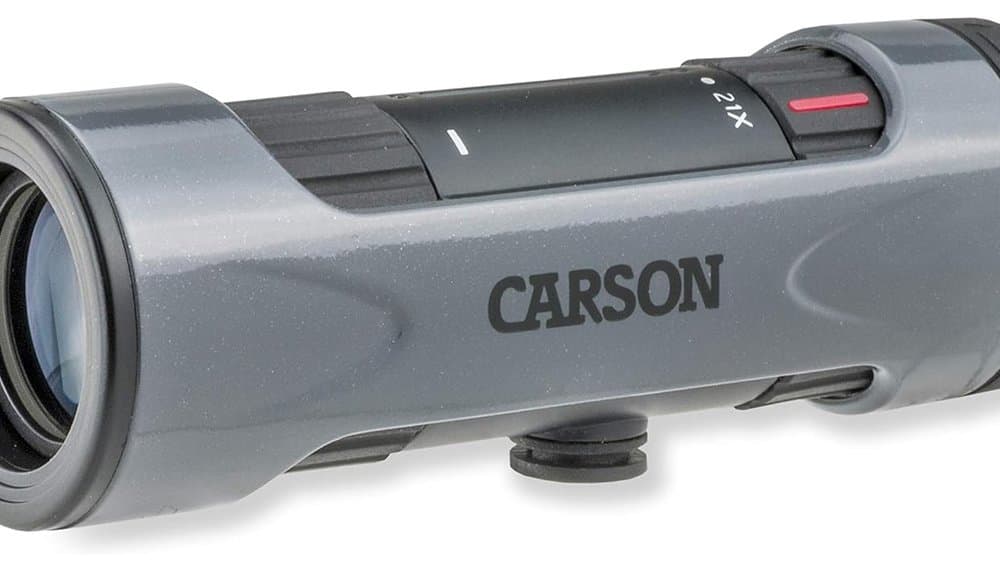
Introduction
The world of optics for nature observation offers a wide range of products, from compact binoculars to professional spotting scopes. In this landscape, the monocular finds its place as the ultimate compromise tool: a single lens for great compactness. The Carson MonoZoom ZM-721 falls into this category by offering a feature often sought: a zoom. With its claims of variable magnification from 7x to 21x on an objective lens of only 21mm in diameter, it promises versatility and ultra-portability. But is this technical promise delivered in the field? Through this analysis, we dissect the official specifications and community feedback to determine which audience this instrument truly suits.
Strong Points
- Extreme compactness and lightness: At 73 grams and with its minimalist dimensions (about 10 cm long), the ZM-721 is practically pocketable. This is a decisive advantage for hikers, travelers, or spectators at sporting events who prioritize zero bulk.
- Zoom versatility: The 7-21x magnification range offers interesting theoretical flexibility, allowing a quick switch from an overview (7x) to a distant detail (21x) without changing equipment.
- Entry-level price-to-performance ratio: According to the majority of user reviews, the product is often perceived as offering a good price-to-performance ratio for a first approach to monoculars or non-demanding occasional use.
- Presence of a tripod mounting socket: The possibility of mounting it on a tripod, even a miniature one, is a notable asset to counter shake at high magnification or for basic digiscoping.
Weak Points
- Very narrow field of view: This is the most frequently reported drawback by users. The field, already reduced at 7x, becomes excessively narrow at high magnifications, making framing and tracking a subject particularly difficult hand-held.
- Limited brightness and optical quality: The combination of a small objective lens (21mm) and high magnification mechanically results in a very small exit pupil (down to 1mm at 21x), severely penalizing brightness and viewing comfort in low-light conditions. Testers note an image that can appear "washed out" or lacking sharpness, especially at the edge of the field.
- Accessory build quality: The objective and eyepiece lens covers are consistently described as poorly fitted, too loose, and easily lost. This detail, recurring in comments, harms the overall experience and lens protection.
- Compromised stability at high magnification: Reaching 21x hand-held is described as a challenge, with the image becoming very sensitive to the slightest tremor. Using a tripod then becomes almost mandatory to exploit the advertised zoom.
Detailed Analysis by Criterion
Optical Quality and Performance
On paper, the ZM-721 advertises fully multi-coated lenses and BAK-4 prisms, two elements that, in absolute terms, are signs of good light transmission and sharpness. However, optical physics imposes its limits. With an objective diameter of 21mm, the amount of light gathered is low. The exit pupil, which is the diameter of the light beam reaching the eye, is calculated as follows: Objective Diameter / Magnification.
- At 7x: 21/7 = 3mm (acceptable in broad daylight).
- At 21x: 21/21 = 1mm (very low, the image will appear dark).
The twilight factor (√(21x21) ≈ 21.5) is theoretically correct, but the small exit pupil limits its real utility in low light. Feedback agrees: the instrument is usable during the day, but its performance drops significantly as soon as the light fades. It does not incorporate ED (Extra-low Dispersion) glass or advanced dielectric coatings, which is consistent with its market position. The community notes a visible degradation in sharpness and chromatic aberration (color fringing) when zooming in, especially on high-contrast edges.
Field of View and Ergonomics
This is likely the biggest compromise. To achieve a zoom in such a compact format, optical engineering inevitably reduces the angular field. Users describe it as a "tunnel" at high magnifications, requiring great stability just to find the observed object again. This makes it poorly suited for observing birds in flight or tracking moving animals beyond 7x-10x.
The ergonomics of the housing itself are praised for its compactness and grip. The eye relief (distance between the eyepiece lens and the eye) is not specified by Carson, but feedback from users who wear glasses is mixed; some manage to see the entire field, others do not. The focusing is done via a wheel and is generally judged to be quite precise, albeit delicate at maximum magnifications.
Build and Durability
The monocular is advertised with a weather-resistant coating. This term, often used by Carson, should be distinguished from a waterproof (waterproof) certification like IPX7 or nitrogen purging. It indicates a certain resistance to splashes or light rain, but does not guarantee immersion or protection against internal condensation (fogproof). This is an important point for users in damp conditions.
The featherweight 73g is a double-edged sword: it facilitates transport but can also give an impression of lightness which is not always synonymous with robustness. The rubber armor provides a good grip. The main construction complaint returns, once again, to the inferior quality lens caps.
Typical Use Cases
- Hiking & Lightweight Travel: This is its ideal terrain. Carried at the bottom of a bag or in a pocket, it will be useful for identifying a landmark or observing a specific detail.
- Birdwatching (occasional): Only valid for observing perched birds at short/medium distance and at low magnification. The narrow field and difficulty in tracking make it unsuitable for serious ornithology.
- Sporting or Cultural Events: Its discreet format and zoom can be practical in a stadium or theater from a distant seat, in well-lit conditions.
- Basic Digiscoping: The tripod socket allows mounting on a tripod and an approach with a smartphone, but the limited optical quality will yield mediocre results.
- Astronomy: Very limited. It can serve to crudely observe the Moon, but the small objective lens and optical aberrations make it unsuitable for planets or deep-sky objects.
Value Comparison
Clearly positioned in the budget segment, the Carson MonoZoom ZM-721 faces two types of alternatives:
- Fixed magnification monoculars (like an 8x25): At a similar price, they will often offer a wider field of view, a brighter image, and better overall optical quality, as their optical design is simpler to master.
- Compact binoculars (8x21 or 10x25): For slightly greater bulk and weight, they offer an incomparable stereoscopic comfort, a wider field, and stability facilitated by using both hands. Many users ultimately prefer a good pair of compact binoculars over this zoom monocular.
Its value therefore lies almost exclusively in the unique compromise between the zoom function and extreme compactness, despite the optical sacrifices this entails.
Technical Specifications
| Characteristic | Detail |
|---|---|
| Model | Carson MonoZoom ZM-721 |
| Type | Zoom Monocular |
| Magnification | 7x to 21x |
| Objective Diameter | 21 mm |
| Prism | BAK-4 |
| Lens Coating | Fully Multi-Coated |
| Field of View | Not specified by manufacturer (narrow according to users) |
| Exit Pupil | 3 mm (at 7x) to 1 mm (at 21x) |
| Eyepiece Lens Diameter | Not specified |
| Minimum Focus Distance | ~1 meter |
| Weather Resistance | "Weather Resistant" coating (splash resistance) |
| Tripod Mount | Yes (standard threading) |
| Weight | 73 g |
| Dimensions (L x W x H) | Approximately 104 x 36 x 41 mm |
| Included Accessories | Case, neck strap, front/rear lens caps |
What Users and Testers Say
A synthesis of nearly 800 overall reviews (average rating of 4/5) and online expert feedback paints a clear consensus.
Praise mainly focuses on:
- The size and weight being "incredibly small" for a zoom.
- The positive surprise relative to the price for a first purchase or casual use.
- The sharpness judged acceptable at minimum magnification (7x) in daylight.
- The convenience of the zoom range and the tripod socket.
Recurring criticisms are unequivocal on several points:
- Field of view "too narrow," "like a tunnel," "incredibly narrow": This is the most cited flaw, handicapping use at high magnification.
- Lens caps "that fit poorly," "fall off all the time," "poor quality": A practical problem that annoys a large majority of buyers.
- Image "too dark," "washed out," "lacking sharpness" from 15x-21x: The optical limits of the system are keenly felt by somewhat demanding users.
- Extreme instability at high zoom: Hand-held use beyond 10x-12x is described as very difficult without support.
- Unfavorable comparison with compact binoculars: Several reviews note that at an equivalent price, 8x21 binoculars offer a better overall viewing experience, except on the criterion of pure compactness.
Conclusion
The Carson MonoZoom ZM-721 is a product that clearly states its ambitions and its limits. It is not designed to compete with the specialized optics of seasoned observers. Its raison d'être is to provide, for a modest investment, an ultra-compact and versatile tool to take anywhere without a second thought.
If you are looking for a hiking or travel companion for a quick glance at a landscape, reading a distant sign, or briefly observing a perched animal, and absolute compactness is your number one criterion, this monocular can justify its place in your pocket. However, if your activities revolve around prolonged naturalistic observation, tracking moving subjects like birds, or if you are sensitive to image quality and visual comfort, you will likely be frustrated by its narrow field and limited performance at high magnifications. In that case, consider a better-quality fixed-magnification monocular or a pair of compact binoculars. The ZM-721 is a good first step into the world of optics, provided you accept its inherent compromises.
100% free and independent — All our articles are written independently, without any sponsorship. We may earn a commission on purchases made through our links, at no extra cost to you.
Articles you might like
FunKind HC600Pro 4G Trail Camera Review
FunKind HC600Pro solar-powered 4G trail camera review. Analyzes real-time wildlife monitoring specs, solar/battery power, and performance data.
Haokoo Vision Nocturne 4K Night Vision Binoculars Review
Haokoo 4K Night Vision Binoculars review: See & record in total darkness. Compact, versatile for nature observation. High-definition digital performance.
Celestron Astro-FI 102 WiFi Reflector Telescope Review
Wireless Celestron Astro-FI 102 telescope review: Does smartphone control simplify stargazing for beginners or add unnecessary complication?
Guides you might like
WiFi Trail Camera Guide
See wildlife discreetly from your couch! Learn how WiFi trail cameras let you monitor animals without disturbance and how to choose the right one.
Ultimate Travel Telescope Guide
Choose a portable, high-performance travel telescope to explore the universe from your backpack without compromising on essential astronomical views.
Ultimate Guide to Night Vision Binoculars
Choose the perfect night vision binoculars: Gen vs. digital? Unravel the tech to make your nighttime wildlife adventures a total success. Guide inside.